The Multiplexed City

July 1, 2008

The new urban world order – symbolized by malls, multiplexes and high-rise luxury apartments – reached the dense shores of Mumbai only a few years ago. But it has already transformed a major chunk of the city’s landscape, both externally and experientially. A new generation of privileged Mumbaikars – still under fifteen – have lived life exclusively in these spaces. Less lucky citizens only feast on the neighbourhood ‘mall- multiplex’ on weekends but even they have already started to organize their energies and life savings to buy that dreamy flat in a happening complex. Middle-class Mumbaikars choose to spend their weekends in malls and multiplexes since they are the only public spaces that don’t have that bombed out, war-ravaged feel the city continues to exude – with its eternally dug up roads, half-formed buildings and dilapidated structures from another era, doomed for destruction by the new order. What else is there to do on weekends? But a choice as limited as this, means so many things. In a few years, a new generation of Mumbaikars will have exclusively experienced the special quality of Mumbai life only through such experiences in a hyper-real way – through the movies – maybe only through the movies. Since most distinctive neighbourhoods would more or less have vanished. And not only because of the laws of late capitalism, as the more theoretically inclined would have us believe. After all, in most capitalist societies the heritage industry is less embattled than it is in Mumbai and does manage to carve out special enclaves that remind you of individual urban histories. Here, the builder lobby continues to behave exactly like it did all through its existence, continuing its glorious tradition of treating it – the city’s history – like dirt. Only so that it can build on it relentlessly, like compulsive bees who make outsize hives that eventually start to leak and break. As the city morphs into yet more malls and multiplexes, the next generation of Mumbaikars will experience the city only in these dark, enchanted enclaves. They will be thrilled to see its vanishing landscapes represented on the silver screen in another version of Bluffmaster. They will laugh at themselves in the sequel to the fable-like Taxi No. Nau do Gyaraah. Maybe they will also see a much delayed sequel to Jaane Bhi do Yaaron – another fabulous city story made in the early eighties. In fact one sincerely hopes that JBDY either gets a re-release or is played forever in all the multiplexes. It still remains one of the best commentaries on the way the city builds and re-builds itself in its portrayal of the glorious, eternal dance of corrupt cooperation between the bureaucracy, the builders and the media. The cinematic soul of the greedy builder Tarneja, (Raheja?) still lives on in the city. It still inspires its descendents to continue with its glorious building traditions. But of course, in a more sophisticated way. The Tarneja of today may even open up a Tarneja Ecological School of Art, Architecture and Urban Planning (KRVIA?) to equip the next generation of the city’s architects and builders with very sophisticated theories about the city. Theories that may even criticize the city’s ugly architectural and planning history and which get discussed fiercely in classroom discussions. But at the end of the day the next generation of architects, urban planners and builders will depend for their jobs and livelihoods on Tarneja Associates and their ilk and life will move on. After a hard days work, students will re-connect with their city within the cozy confines of the movie-hall and watch yet another Mumbai-based urban-legend.

Trading Places

June 9, 2008

Twin Street-Connect

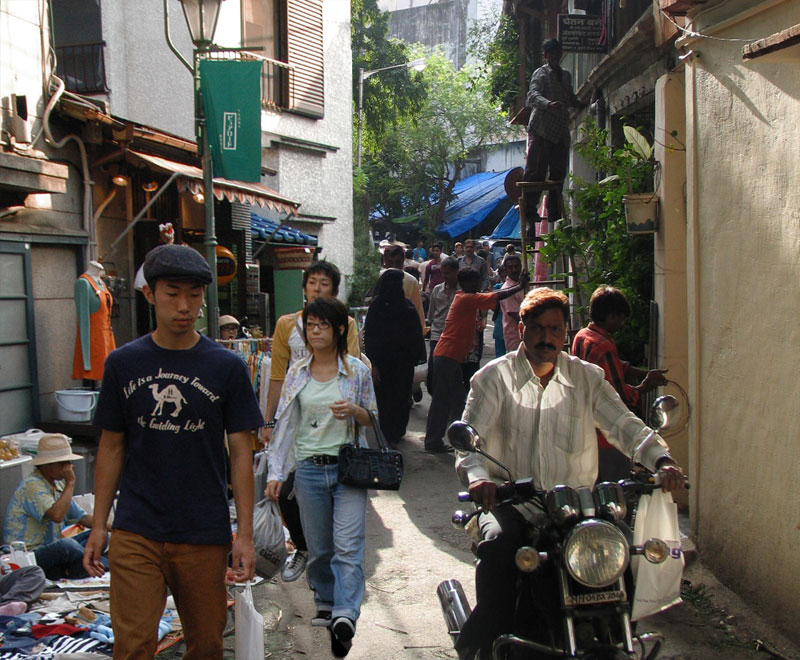
Street Connect: Where Shimokitazawa, Tokyo and Khotachiwadi, Mumbai meet.

Trading Places is a new initiative of Urbanology that re-cycles the name of an older project. The new Trading Places is a space for an exchange of narratives, images and random thoughts on lives and where we live them. At the broadest level it is an imaginary where cities from the past in one part of the world merge and collide in cities of the present and future in other parts – maybe even other worlds. This creates new contexts for drama and desire, opens up possibilities of living lives in newer ways. The idea of trade also implies movement – the exchange of goods and objects, fantasies and dreams that propel us to live lives in motion, make homes in new worlds and then move on and return to familiar places to relive past lives. It focuses as much on the journey as it does on the places themselves. It collapses the idea of the journey and destination, of nomadism and primordialism, of tribalism and sedentary habitats – and allows us to unleash our imaginations in all possible ways. After all, places, cities, journeys are as much about dreams and desires as they are about themselves. And bards, story-tellers, movie-makers, writers have inevitably conjured new worlds, places, habitats and cities, however deeply foregrounded they may have been by drama, personalities and moral commandments.

In specific terms, Trading Places invites storytellers and image makers from all kinds of backgrounds and in any language to help imagine these moments in new ways. To produce narratives and images about journeys and destinations, by delving into the past or the future, by creating drama and sculpting desire in ways that consciously mix and merge contexts, by focusing on the journeys and acts of exchange and conjuring destinations that surprise.

In May 2009 – Trading Places will come out with a publication of the best narratives and images that we find on our website – that launches in October 2008.

The theme for the first round of exchange is ‘Africa and I’. We would like these words to evoke whatever it does, keeping in mind the objectives outlined above. Do e-mail us your entries (contact <at> urbanology.org), before September 15th 2008.

Dharavi 2025

June 5, 2008

Maria is from Rio, Brazil. She is a film-maker who made a documentary on Dharavi sixteen years ago. When she first arrived her project involved a comparative study of Rocinha, the largest favela in Rio, and Dharavi. She had a clear agenda. She wanted to show Dharavi’s industriousness, how relatively non-violent it was and how fast its people were developing their environment.

Instead, she was caught in a huge upheaval – the Great Dharavi ‘Riots’ of 2009 when Mumbai came to a stand still.

The Western, Central, and Harbour railway lines had been completely cut off by peacefully dissenting residents. Her camera had captured instances of police brutality after having filmed the neighbourhood in minute detail, based on two months of conversations with researchers, activists and residents of Dharavi.

Luckily the film and camera survived the violent frenzy, though she herself was badly injured. Her last footage showed an interview with a fiery man, Bhau, who predicted apocalyptic transformations unfolding in Dharavi in the next decade. He spoke on his terrace watching the neighbourhood burn.

She never forgot his words: “They say they will redevelop Dharavi, but look at what they’re doing. These high-rise buildings mushrooming all round us. People who move in are selling and leaving their flats already. They need money because they cannot continue with their livelihoods in these buildings. People living in these high-rises don’t know their neighbours anymore. The street life you love so much will be gone. They say this is development, but it looks just the opposite to me.”

Maria is here again – nearly a decade and a half later. There is a scar on her left cheek – a legacy of the earlier visit. She stares at it in her mirror, in her hotel room near Sion station. The neighbourhood has indeed transformed beyond recognition.

She glances through the widow of her twenty-third floor room, feeling completely estranged from the cityscape around her. She cannot remember ever having felt so uncomfortable in Dharavi, even at the time it was considered to be a filthy slum. In fact, even during the riots.

Her hotel is in one of the nicer looking parts of Dharavi. The well-aligned middle-class condos must have once gleamed when they were freshly built. Unfortunately, the construction methods and materials of the European consortium, which won the bidding for redeveloping this part of town, did not fare well in the roughness of the Mumbai weather. The crisp white had longed turned yellow and green. The smell of moisture floated in the air.

She comes out of the hotel lobby looking up at the row of buildings and remembers how an advertisement on her last visit had promised to turn Dharavi into a “world class township”.

Memories of the energy that electrified the small narrow street flood her mind. She takes a cab to the 90-feet road junction where some of the “Old Dharavi” still remains. To, Kumbharvada – a village belonging to one of the earliest settlers in the neighbourhood had fought tooth and nail against the forced development. They had managed to ensure that their neighbourhood remained relatively unaffected by the plan.

As she walks through the pedestrian area, she sees souvenir boutique shops. There is one advertising tours through the streets of the old neighbourhood. The cost per trip is marked in rupees, yuan, yens, and euros. A colourful billboard gets her attention. It publicizes a theme-park: “Experience the Original Dharavi”, and below “Leather, Pottery and Suing Classes. Register Now!”

billboard2025

Maria turns away.

She spots a few unchanged huts. Nothing could make those potters move, not even the tens of thousands of rupees per head offered by the developers. They stood their ground and now are making a fortune selling “authentic” crafts to tourists. Not to mention the revenue from the camera charge, since thousands of tourists and movie crews come every year to shoot them at work. The Kumbhar youth are no longer potters but professional tourist hustlers. There are rumours that their pottery is no longer even made in Dharavi, but farmed out to industrial potters in a far out suburb.

Apart from the Kumbhars, Maria remembers another community who had been there since before Dharavi even had a name – the Kolis. She discovers they were offered massive amounts of money and most of them have moved out. Besides, the neighborhood has changed beyond recognition. Nothing remains of the village-type houses she had once filmed.

Eventually she manages to find a few old timers who stayed behind. They say they don’t recognize themselves in Dharavi anymore. The “spirit” they tell her, is gone.

She also interviews a few aging activists from a local heritage conservation NGO called SPARC (Society for the Protection of Authentic Residential Centres). They are fighting gentrification, but it has long been a lost cause – they sigh.

Maria learns more from them. Apparently, at first a few adventurers and artists had moved in, thrilled to live in the center of the city, in what remained of the “largest slum in Asia”. Gradually the place gained in respectability and some new type of nostalgia hit the middle-classes. By 2010, in the context of rising nationalism, some intellectuals claimed that slums were the “true Indian vernacular architecture”. It became hype to live in what was seen to be an exotic endangered urban species.
Bohemian youth from Mumbai bought studios in the historical part of Dharavi and set up small shops selling street fashion items and stylish 1990s second hand furniture. Soon art galleries and trendy bars were attracting the intelligentsia from all over Mumbai. Roofs were converted to terraces and gardens. Architecture magazines in India and abroad covered ‘Old Dharavi’ in special issues. There were interviews of all those who claimed to know Dharavi from when it was still a slum.

Maria had learned this through specialized websites at the time. This was now well-known urban history. Today of course, artists were deserting the place. It had become a caricature of what it was when they had first moved in.

The few remaining artists she meets recall the fight they had to put up against city authorities to obtain permission to first organize the National Arts Festival on the streets of Dharavi. Of course, now the event attracts thousands of tourists from all over the world. Initially puzzled by the popularity of the event, the civic authorities soon understood that they could make a lot of money through the tourism economy and the rental of space for vending booths, and eventually took over the control of the festival under the pretext of reestablishing order, safety and hygiene.

Wandering through the historical parts Maria soon finds herself at the edge of the rehab zone, a grimy part of town. The proximity to this vertical slum had for long kept less adventurous settlers from moving in to Old Dharavi. However, thanks to the political pressure exercised by the ‘Dharavi Homeowner Coalition’, a strong police presence had supposedly made this part relatively secure and safe.

Maria soon discovers that the police were hand in glove with ruthless local gangs that had come up all over the rehab zone.

Her walk is interrupted. A man pushes her – and tries to grab her camera. ‘What do you think your doing Miss? This is no zoo – step off and take that fucking camera with you’.

This would never have happened on her last visit! Where are those smiling children jumping in front of her? Where are those busy people carrying goods up and down the streets? Where are those old people inviting her to their home for chai? Everything seems so dull and depressed now.

So – this is the new face of Dharavi. Most of the old residents have left. Bhau too has gone away to some remote forest according to a shopkeeper, near Sion station.

Maria takes a taxi back to the hotel. They are soon stuck in traffic. From the window she watches the decrepit middle – class buildings – most of them twenty-storied tall. They are all over the place with flyovers intertwining through them, full of honking cars. The density of the neighbourhood is extraordinarily high. Even though the population is said to have halved since redevelopment – cars and congestion have only increased.

How ironic, she thought, that old “polluting” local industries of Old Dharavi, including the dantesque 13th Compound with its hundreds recycling factories, were replaced by high energy consumption buildings and crowded roads.

She decides to get off the car and take a break in an air-conditioned Barista. Glancing at the papers she stares at a particular story. There’s a new plan being floated to set up a Mini- SRZ in Dharavi. SRZ’s or Special Residential Zones are luxury apartments only sold in Euros and Yens. This plan – also called the Dharavi Redevelopment Project II intends to raze the decayed rehab zone as well as the middle-class buildings to substitute them with structures made with new construction technology. It includes a project to construct an artificial lake called ‘Mithi Lagoon’ between four new flyovers that would be constructed as part of the project. Each new building would be a minimum of 60 stories high. All the ‘old’ residents would be given new flats in this new township – though –it was clarified – they would occupy a different enclave. They could not mix with the euro and yen paying clientele.

Shocking! mumbles Maria and then stares at the man behind the counter. She recognizes Raghu at once. He used to be her assistant when working on the documentary. It takes him sometime to recognize her but when he does, he is thrilled. He is one of the few original residents still around.

They chat all through for hours and in the evening he invites her to an underground nightclub ‘Zhopdi’ located at the boundary between the middle-class area and the rehab zone. The club was well known, along with many others in Dharavi, for its bar-dancing and raucous crowds. (Bar-dancing had been reinstated ten years ago after a group called ‘Reviving Urban Folklore’ had fought a case and won’).

Tonight though, there would be no bar dancers.

It is a special night dedicated to a flea-market called ‘Navi Chor-bazaar’ that has been a regular affair for the last five years. The streets around the market get filled up with sound systems and all kinds of urban tribes come out, Raghu informs her. Nobody knows who organizes it – but the music is fabulous. A world famous DJ Indecent, an old friend of Raghu’s comes from Mankhurd to play.

Raghu takes Maria inside the club through the back door, waving at the menacing bouncers. Backstage they meet forty-five year old DJ Indecent. He used to work in a cyber-café in Dharavi as a kid. He is the man to know in the club. Maria immediately starts talking about Dharavi and the recent changes. DJ Indecent draws a bitter portrait of Dharavi.

The nightclub is the only place that brings in the old residents back sometimes…for a few hours at a time. They use to come all the way from Khopoli, Pen and Dahanu, but the new crowd is driving them away.

Tonight Dharavi resonates with old music and remixes from the early 2000s. Maria takes out her iAll and starts to film Indecent: “Before it became so popular, I used play the real shit. The crowd was small but they knew what was up. Now with all these kids coming just to be seen I have to play the commercial things they like. You know, you got to earn a living. Really, in Dharavi if you want to listen to the good stuff you’ve got to go to another old Koli enclave. Some kids there organize the wildest parties in abandoned houses.”

The nightclub is circled by flea market stalls selling stuff that once used to be made and sold in Dharavi. From leather purses to chikki to clothes. Against the throbbing music the club comes into its own to drench everyone in a powerful wave of nostalgia. Even Maria cannot escape it.

As she walks home she realizes that the film script she had prepared for the new documentary is useless. She wanted to find the same people she interviewed 16 years ago to document their evolution in the redeveloped neighbourhood. But instead she only finds missing people and broken lives. As if the development of the striving area she remembered had been aborted mid-way. All she gets is bitter interviews, shoots of urban decay on one side, and of tourists spending their hard currencies in Old Dharavi on the other. Everyone she meets is so cynical; the reality around her seems so fake. Dharavi doesn’t belong to its people anymore, she hears herself speak.

She feels an intense disconnect and then begins to doubt her ideas. Is her memory playing tricks on her? Is she idealizing the past? The summer night is hot and humid yet she shivers. Nothing makes sense.

Bhau’s words come to her mind. Just as she is thinking about where he could be, she trips on a body sleeping on the streets. It rises. She apologizes rapidly and as she is about to start walking off, the man yells “Maria!?”

Taken aback she comes closer and recognizes Bhau’s former liftman. She is thrilled and greets the old man warmly. Her hand makes for her iAll and a long interview ensues. He soon informs her that Bhau now lives with some nomads in a forest that still miraculously exists on the Konkan coast. A sense of hope rises in her. She has to find Bhau. Tomorrow she will take the train.

She gets back to her hotel room feeling low and elated at the same time. She washes her face in her tiny bathroom lit by a flashing neon.

She falls asleep the moment her head touches the pillow. Images of her old documentary mix with the images of today’s visit in her dreams. She sees smalls crowded streets, proud people, police, riots, blood and fire, high-rise buildings emerging from dust, the thug who harassed her, his sad dark eyes staring.

She is in a forest. A laughing Bhau guides her through an environment that feels strangely familiar. It is a restless jungle, everything is moving in every direction. Trees become huts; people get in and out and flood the ground like monsoon water. She smiles in her sleep.

(Published in the Mumbai Reader, UDRI, Mumbai 2007)

Mumbai Ahead

June 4, 2008

Science fiction films that project futuristic urban scenarios often get stuck in a superficial imitation of Blade Runner. They trip on their own imaginary mutations of Seoul and Tokyo neighbourhoods and fuel airborne cars to make them fly higher and higher and construct skyscrapers that literally do that — tear open the skies.

So far, Bollywood films have rarely ventured into that imaginary space. Not even in their wildest dreams could anyone have imagined Indian cities anywhere close to those urban dystopic or utopian fantasies (depending on the depth and darkness of the director’s vision).

But now — after having seen the shine and glitz of mass-manufactured malls, multiplexes and residential complexes, Bollywood finds it easier to stretch into the limitless possibilities of imagining the future. That explains Love Story 2050 taking liberties with the iconic Gateway of India and dwarfing the colonial monument with gigantic neon-lit structures in one overwhelming photoshopped swoop.

Such image-plays are not just about entertainment. They quickly become an integral part of the business of building cities. Reportedly, the producer of the film had builders and developers knocking on his door to borrow its digital images to sell their own dreams.

Parts of Shanghai and many other Chinese cities build on those imaginaries consciously all the time.

Hopefully, Bollywood will go beyond robotic group dancers and misinterpretation of high-urban technology to provide a sharper look at the city’s future. One hopes its close-ups will reveal the mildewed walls in futuristic structures, mimicking the process of rapid decay that inevitably sets into Mumbai’s present within weeks of construction.

Even in the past, Bollywood films have used the Malabar Hill and Cuffe Parade skylines to convey a sense of global urbanity. Many of them preferred long landscape shots that wilfully hid the paan stains, crumbling paint and decaying structures of the sixties and seventies RCC buildings. Then came the (relatively) realist nineties which had film-makers turning the dirty gritty reality of the city into a saleable proposition.

After all, true Mumbai lovers know that whatever the architectural exterior, Mumbai’s interiors, soul and mood will remain eternally gothic. No escaping that. One imagines there will always be film-makers even a 100 years from now to capture Mumbai’s rough-edged, dark and shabby texture. And there will always be reason for its texture to remain that way.

Even today, it does not need a huge leap of the imagination to see through the glass walls of the city’s glitzy twenty-first century constructions. Take a look at the swanky Mumbai airport terminal. It didn’t even take a year for the toilets to fold into their historical smelly condition and for the Wi-Fi and internet services to stop functioning altogether.

A few more years and we will stop being so excited about it. Just like our urban ancestors who got over the excitement of seeing the once-futuristic and sleek Sahar airport. (It may seem unbelievable today but it was like that once. That has always been the story of architecture. It’s only half about the buildings. The rest is organisation, bureaucracy, people and imagination. When will we ever learn that?)

One hopes that Love Story 2050 extrapolates on all this. That would be a sure way to strike a chord with the viewer. Scenes of a flooded Milan subway with smiling drivers who turn their cars into boats or the municipality digging through the air to open up sky channels for the latest communication technology that lead to massive traffic congestion even in space, would make viewers positively weep with empathy.

Image of the City

May 31, 2008

Having said all that about technology – it would do well to remind ourselves that the concept of technology itself has been cracked open. It is not just about the nuts and bolts of human intervention and control but is embedded in images and desires and shaped by specific arrangements of resources, knowledge and power. Often the idea of technology is used to convey something neutral- as if it is essentially part of the hardware universe – when it is in fact propelled as much by image and fantasies as it is shaped by them.

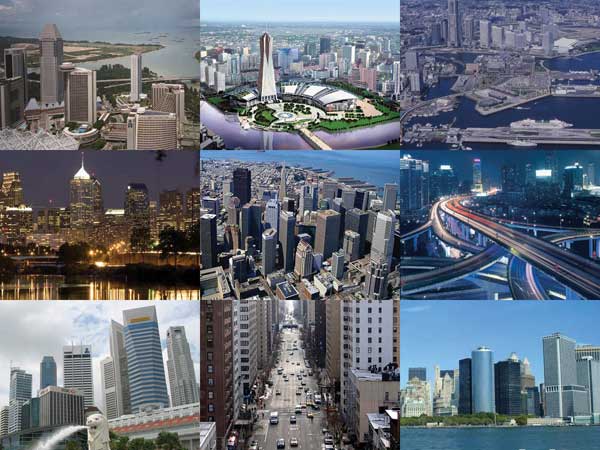
Do a google image search for “city” in English, Japanese, Chinese and you will get different versions of the same high-rise, “modern”, “world-class” city that could be New York, Singapore, Shanghai, or any new Chinese town. Even cities that are actually totally different from that generic image seem unable to imagine their urban future differently. In fact, Mumbai appears to be locked up in that generic city imaginary to the point that it is unable to recognize the unique version of modernity that it has produced. The large parts of the city that do not comply with that generic “modern city” image are seen as being “historical” at best, and at worst “backward”. No space is left in the collective imagination for a modernity that would not be high-rise and car centric, but would instead steam from the current reality of the city. The gap between the reality of a city where 60% of the population live in low-rise informal habitats characterised by dense community networks and home-based economic activity, and a Manhattanesque vision of the future produces all kinds of urban tensions and counter-productive redevelopment plans, that are typified by the McKinsey “World City” vision for Mumbai.

What makes this image so powerful is its ability to convey its connections to universal, contemporary and futuristic worlds.

The interplay of technology, aspiration, fantasies and images continues.

Notes towards Understanding Urban Technology

May 26, 2008

Technologies related to built-forms and city planning reveal as many disjunctures, inconsistencies and contradictions as any other. Some aspects of urban arrangements become increasingly sophisticated, (sometimes only to combat rising costs of labour) while others are grounded in simple formulas that have remained unchanged for centuries. These inconsistencies, as seen in the construction of drainage systems, road building, mass transport, architecture for living and working, are true across a range of urban spaces. Within the different historical layers of a two-century old contemporary city in the United States, an ancient city retro-fitted with modern comforts in Italy or Japan or a swanking new city that has been made by a combination of human energy and modern technology as in India.

The same space can reveal a variety of technological choices related to built-forms and urban planning based on the economic and commercial viability of the parties and specific projects involved. For example, in labour dense countries, in spite of ready availability of the latest technology, a good amount of projects are fuelled by human energy, only to balance costs.

Today, we see buildings being constructed globally in all kinds of ways, with technologically sophisticated material and principles complementing hand-made locally produced goods located in small workshops.

An elaborate network of goods, services and production processes go about producing modern built-forms. While the basic materials – cement and steel – are produced in large-scale furnace factories, themselves fuelled at different points by human and industrial energy, there are a whole lot of activities that arrange themselves in ways that are far from technologically sophisticated in the popular sense of the term.

Pre-industrial artisanal workshops produce a whole lot of goods and services, starting with an architect’s drawings to a whole range of secondary level material from marble, stone slabs, glass frames, tiles to even more specific goods for kitchen and bathroom fittings. At the same time the use of human energy in the construction industry remains high if measured on a global scale.

Interestingly, the nature of built-forms of the spaces in which this pre-(post?) industrial production takes place is also worth paying attention to. Urban landscapes around the world reveal astonishing diversities of built-forms. In them are embedded many kinds of economies and modes of producing, consuming and exchanging. Thus from a glass and steel city center where speculation rules the roost, one can move into middle-range six-storey brick and stone offices and residences that embody more traditional economic practices before walking inside self-made shacks, low-rise high-density structures, squatted spaces and derelict factories where an underground and ‘overground’ economy functions with regular contracts of work with the formal set-up. This disjointed urban landscape, also reveals different modes of technological expression that operate at different levels.

This kind of diversity in locating technological impulses is not new. Large monuments and fortified cities of major pre-industrial civilizations revealed a similar kind of unevenness of arrangement, even though in terms of energy they were fuelled mainly by slave labour. While the buildings themselves had a major impact in showing off levels of technological superiority of the ruling groups, their making was a markedly mixed affair. A combination of primitive and sophisticated (relative to the age) technologies, tools and organizational principles made building possible. Those worlds too reflected a range of different habitats linked to the economic arrangements of those times. Fortified cities, palaces, peasant villages, markets and tribal hamlets may have been more physically dispersed than today, but were part of an inter-connected economy. An economy that produced these built-forms and was complemented and serviced by it.

Throughout the late nineteenth and early twentieth centuries – the decades that were the most direct beneficiaries of the industrial revolution, it was possible for many modern societies to believe that the direction in which technology was moving was liner and one-way. Eventually, machines would replace human exertion (and most certainly human energy) and produce a world of technological sophistication in which humanity would be propelled to move towards higher goals – free from physical exertion.

Those were the years when artisanal works were rendered arcane and economically unviable more due to ideology than through real audits. The huge subsidies that went into producing energy and capital investment to make machine-made goods cheap, were rarely accounted for. This was most vivid in colonized countries where unfair taxation on hand-made goods complemented tax concessions for machine made goods to make the industrial revolution work. According to some anthropologists, when artisans (including tribal ironsmiths) were first exposed to the wonders of the machine age, they wanted to be part of its narrative. It was possible for them to incorporate these technological innovations in an older economy of work and production. It was possible to have a market where machine made and hand made goods could find their own specific places. But of course – those days the narratives of technological progress were more than just narratives. They were moral injunctions. They moved one way and in one direction. Entire histories of technologies, whether linked to food processing, clothes, or construction were rendered arcane. Habitats were seen to mirror this direction as well. Tribal habitats were lowest in the chain with the urban industrial ones as being the most advanced. How this idealized understanding of technology actually matched economic and lived realities was another matter altogether.

By the early twenty-first century, the reality of environmental issues, the economic and commercial limits of technological choices and the paradoxical awareness that globalization brought – of an increasingly diverse world in terms of knowledge, skills and technological expertise – managed to change a lot of these conceptions.

People and nations have now become more resigned to and have understood the intricacies of a large variety of technological expressions. It is easier to distinguish technological change from significant shifts in organizational principles. In the past, the moments of these shifts as they happened were blurred. However, today it is possible to look back and mark out the industrial revolution from a textile industrial revolution (which is what some historians say it essentially was). It is possible not to co-opt the earliest technological wonders as ‘fruit’ of that revolution but recognize them to be what they were; innovations of human-scale artisanal tools that artisans were already using. It is possible to accept the fact that the first factory revolution was an organizational one. The factory was, for one brief but extraordinary moment not a warehouse for gigantic machinery to match gigantic production but an organizational revolution in itself. A space where artisans, workers and administrators worked together to produce goods that were quickly transported to the market. It was this shift in organizational principle that ultimately harnessed the simultaneous fervent in knowledge practices to produce advances in modern technologies.

Today, given the more informed understanding we have of the way in which modern technology has to be contextualized at various levels it is easier to accept its co-existence with pre-modern technological histories and to see it as wired to knowledge practices that are complex. It easier to accept that certain kinds of technological innovations take place outside laboratories or in contexts that are constantly connected to the lived world. Many technological solutions are linked to traditional knowledge systems. It is possible to understand these complexities without belittling any of the advances and moves that science has made over the last two centuries.

The world of information, communication and imagination technology are another matter altogether – and its revolutionary and reactionary tendencies have been much documented, debated and analyzed.

Yet – if there is one space where dated thoughts and concepts linked to technology still operate in full force it is in the world of urbanism and urban planning.

Like the modernist agrarian nightmare– of producing food for all by reducing food to the unit of energy and then translating the production of units of energy as a means of doing away with hunger – urban planning and architecture are another stunted story. And just as the agrarian ideals never solved the problem of hunger – but only increased it – urbanists have a similar cross to bear with regard to housing and homelessness – those self-made problems that are more to do with our inability of recognizing the conceptual confusions in which we frame them than actual issues of ‘lessness’.

Old-fashioned urbanists believe it is possible to produce houses for all and they reduce the concept and practice of urban technology to the technology practiced by the organized construction industry.

They refuse to see that technology is embedded in economic and political equations and that organization of space, human energy and technical solutions have to work together in making technology workable in the first place. Since their thought processes are so strongly linked to modernist and dated ideas of technological emancipation they refuse to see the obvious.

That the first and foremost way in which we can solve the issue of housing is by acknowledging that humans have a history of technological practice, knowledge and skill base of producing homes that expresses an enormous diversity of styles and experiences – and more importantly are workable and relevant even today. They may need some modifications, but like cooking, are still tied down to certain essential practices that are ubiquitous, universal and practical. They may have to adapt to transport and communication issues, but that in no way means that the ability, skill and knowledge of building homes has to be questioned whatsoever. These are specific issues that can be addressed specifically – without blurring ideas of habitats, housing and urbanism as a whole.

Today it makes better sense to say that the job of the urban planner and the urban technologist is to create conditions where more and more people can build legitimate homes according to their capabilities and choices and diverse technological skills.

Since today, we are less dependent on the idea of using a single modernist technological spectrum to create urban landscapes, our task is to legitimatize the variety that is bound to emerge from the different histories and economies that characterize our lives.

Technology in the sphere of information, communication and imagination has opened up possibilities of expanding its capabilities by using the growing skills of users. This is thanks to the design of those technologies itself in the first place. Similarly it is important for us to recognize the capability of people who live in homes and cities to produce their own environments and create what we like to call user-lead urban environments.

Of course – what will many cities around the world look like when this actually happens? How will they function? We suspect they will look more like large parts of Tokyo, late nineteenth century Bombay, or something quite unlike anything we have seen before. And yet they will be more familiar to most city dwellers than the urban environments that many of us take for granted today.

But that’s another story altogether…coming soon.

Bazaarchitecture

May 20, 2008


The historical center of Mexico city is taken over by tens of thousands of vendors. Around 5 million people visit this area every day. The Bazaar extends well over a radius of 15 kilometers. You can get clothes here for as low as 1 Peso a piece.

Much has been made of the need to look beyond built form and architecture when talking of the city. The need to focus on people who use built forms and the need to focus on the ‘soul’ of a building have become well-enshrined objectives in the best of architectural practices. So much so that they generate as much cynicism or alternatively, allow reactive architectural statements to be made all the time.

From green architecture to nomadic shelters, passing through augmented reality, every dimension of the architectural realm is being explored, theorized, critiqued and remixed. It looks like as if architectural professions have reached a level of knowledge and practice never attained before, thanks in part to an advance in technological education.

In spite of this, Rem Koolhaas observes, “Junkspace is the sum total of our current achievement…” (2006). There seems to be a deep disconnect between the intelligence embedded in architectural artifacts and the dumbness of the cities we are developing for ourselves.

What if the problem does not lie in the body or soul of the architectural object? What if the uses and abuses of architecture are themselves only symptoms of a deeper conceptual malaise? Should the over-arching concept of the city itself, within which most architectural moments are located – need to be critically interrogated? Would we be able to move to an understanding of urban architecture in a less embattled way?

There is something solid and quantifiable to the idea of the city that allows architectural narratives to dominate our idea of urbanism, and through it, all contemporary life. The idea of the city starts from the fiction of evolutionary growth – from the tribal to civilized man, from the unsettled and light to the rooted and heavy, making the notions of scale, monumentalism, and density, some sort of in-built genetic conceptual pools that dictate the way human civilization evolves. It’s as if they contribute as much to the escalation of urban intensity as does the impulse of urbanization itself. Every civilizational moment that feels it has arrived has its own peculiar notion of evolutionary movement from the tribal primitive to the urban sophisticated.

According to a dialectical conception of history, the urban is superior to the natural in evolutionary terms, or at least, it represents an advanced expression of nature’s evolution. The imagined opposition between the natural environment and the city confers a heroic status to the architect whose practice seemingly consists in extricating tomorrow’s civilization from today’s material conditions.

In today’s endlessly sprawling, densifying cities, ‘savage nature’ that we once believed we had successfully contained, comes to haunt us in all kinds of ways. The new frontiers of our cities exist within. The urban wilderness of American inner-city ghettos or Asian slums for instance clashes with urban planners’ and real estate developers’ aspirations of controlling space and modernizing.

For all their grandeur and pretension, masterpieces of Modern architecture are as many doomed attempts at defying the city’s anarchic expansion. All around the globe, clones of Mies van der Rohe’s Seagram Building are proudly erected, forcing the chaotic city “to look at itself reflected… in the neutral mirror that breaks the city web” (Tafuri & Dal Co, 1979). The dramatic moment when the pure architectural form finally stands and confronts the urban mess around is on some kind of perpetual repeat mode, as if planners and architects have not been able to get over its illusory thrill. However, the mess always wins in the end.


Seagram Building by
Mies van der Rohe, 1969

New York for instance once again became the city of the future on September 11, 2001, when the Twin Towers disintegrated back into the city web releasing a billion tiny glass and steel particles that reflected, for an instant, the ultimate failure of the Modern project. The debacle was quickly draped up like a Christo piece. A “work in progress” sign was left in front of Ground Zero and our brains were plugged right back onto the sedative media stream, fed with rhetoric of civilization and dreams of progress.

In our growth-obsessed civilization, destruction is nothing more than an opportunity for construction. The new Freedom Tower was selected and designed with great speed and by fewer people than was necessary to bring down the Twin Towers in the first place. The new Freedom Tower will have an asymmetric shape, which seems to be more in vogue these days. That’s about the only change to expect. Otherwise, the repeat button has been furiously pressed as expected, as if to contain the surrounding urban chaos threatening to spill over into Ground Zero. No time was left for any possible reflection on the bankrupt proposition the Towers symbolized.

Yet, for all their bigness, aesthetic purity, and ‘land-marking’ power, monuments have never made a city. The moment of urbanity lies, in fact, in the surrounding mess they are meant to resolve. To see that, we need to put our architect, urbanist, and activist defences down and experience the city from within. As if it were a giant art installation one could get lost in.

Let’s imagine a city. Not any particular city but rather a mix of cities; a messy collage of Mumbai, Goa, Tokyo, Barcelona, Mexico City, New York, and a few others. An endlessly sprawling global village looking like Cedric Price’s “Scrambled egg city”, where everything is distributed evenly in “small granules or pavilions across the landscape in a continuous network” (Shane 2006.4).

In typical postmodern fashion, this city is composed of disparate architectural elements: an art-deco hotel, a tourist resort, an electronic billboard, a neon sign, a delirious cathedral, mass housing, sun-breaking office towers, and so on. These archetypes majestically come together to produce the skyline of our imaginary city. Spreading over and under, within and between, even spilling outside, the “continuous network” is everywhere. Formless more than informal, it is the glue tying urban elements together. This is what we could call the ‘Bazaar City’ – the city in its raw form.

It is this history of ‘ground level urbanism’ that we want to evoke here. It is a simple way of getting out of the body/soul discourse of architecture that dominates our reading of cities today. How exactly did we arrive at this observation? What is the connection between urbanism, the bazaar, and the need to see cities beyond the issue of architecture in any dominant form? How does the bazaar tell us that urbanism lies not in the architecture at all and how does the bazaar help us understand this by never really dismissing the architectural moment? How do we keep architecture in its rightful place – body, soul, and whatever – and how is it always one step below the energy that really creates a city?


Chor Bazaar: Mumbai is the ultimate bazaar city.

History reveals that tribal and peasant-driven markets were the real sites where diverse identities, goods and artisanal skills were exchanged – always as part of larger networks of trade across the globe. However, contemporary accounts of urban history only focus on the eventual manifestation of these exchanges in the form of power centres. The bustling markets and habitats within or outside forts and palaces that nourished kingdoms and were the primary generators of wealth have slowly faded from our imagination. Only the shells remain. They offer the blueprints for modern societies to imagine the highest forms of civilizational aspiration through a partial version of the past.

These blueprints are imagined to be the nodes of kingdoms and empires, dense with people and physical structures – the earliest examples of urban spaces as we know them today. In reality they constituted only the tip of the human civilizational iceberg.

Seen in totality, civilizations were composed of the flows of wealth, goods, people, and culture, across vast spaces beyond these centres, following trade routes over land and sea. These may never have produced robust structural expressions but were full of intense urban moments.

Lets transcend the idea of urbanism as a kind of physical manifestation (or even as urban density in terms of scale of population aggregates). Instead, see it in those moments of interaction, of movement, in weekly or seasonal bazaars and flea-markets, that feed the political and economic nerve centres. What emerges is a different notion of urbanism. One in which, it does not matter if twenty people set up shop at the edge of a forest or two thousand on the outskirts of a kingdom. Urban intensity lies in that moment of buying and selling. Not just that – the context of exchange showcases many other things. The thrill of meeting new people, the excitement of discovering a new object, forging friendships and simply enjoying the thrill of crowds.

It is this moment that contemporary urban life yearns for. It is this simple moment that is regenerated in billion-dollar cities with heavy and expensive architectural legacies. Contemporary cities yearn for the thrill of the bazaar, but instead of creating appropriate contexts where its natural energies can be expressed, they produce contemporary translations that loose the subtleties of the moment. The most dominant urban spaces today – the shopping malls – reduce the idea of the bazaar to its bare minimum – shopping.

Universal and ubiquitous, the bazaar, according to Dipesh Chakrabarty, is “obviously an abstraction of certain structural characteristics” – it is an organizational principle based on the most instinctual human propensity to trade and exchange. It is “a meeting point of several communities”. The bazaar is necessarily “unenclosed, exposed, and the interstitial outside.” (Dipesh 1991)

No wonder the bazaar is making a comeback in post-industrial cities: farmers’ markets, music festivals, and the like, are appealing to an increasingly cosmopolitan and bohemian generation that constructs its identity in a way similar to how we constructed our imaginary city in this essay – with bits and pieces from here and there. The remix and collage culture that drives today’s ‘creative economy’ relies on spaces of exchange where the new can be made out of the old.

The eagerness to reinvent one’s own ‘cultural self’ is nowhere as apparent as in urban Japan, where a growing segment of the youth is rejecting older generations’ lifestyles and values, which include, among others, a respect for ‘patriarchal order’. The bazaar, for such radical denizens, becomes an outer space of socialization where another world is possible.


This vernacular style building in one of the hippest neighbrohoods of Tokyo, Daikanyama is used by the Japanese designer brand Okura. On the right side is the entrance to the very trendy Bombay Bazaar restaurant, serving curry on Japanese rice.

A makeshift bazaar aesthetic is making a comeback in Tokyo’s fashionable neighbourhoods, as exemplified by the Bombay Bazaar in Daikanyama in Tokyo. This restaurant is part of a new group of venues that have adopted a slummy-looking vernacular architecture as a fashion statement. There is no signboard announcing the place, just an old table with empty Coke bottles, a few metal sheets on the walls, and a ‘handicapped’ sign. As is typical of Tokyo, one could never find this venue, unless taken there by someone in the know. Its interior is resolutely bohemian with heteroclite second-hand furniture chosen with taste. A dreadlocked woman eats curry rice in the corner and a French couple drink lassi served by a cute hippieish waitress. In the same building, a store sells casual-chic cloth. Further down an Italian brand tries hard to ‘look ghetto’. 20 metres away, Bonjour records is packed with collectors items and features a deliberately low-key front. Tokyo’s low-rise high-density urban fabric and small-scale architectural structures allow all kinds of independent shops, small-time retail outlets, food joints and bars to flourish.

The bazaar city spreads all over the world, beyond national and cultural boundaries, with its continuous network of streets and shops. There is a fascinating continuum from the streets of Tokyo’s Daikanyama or Shimokitazawa to Ingo’s Saturday Night Flea market in Goa. where a diverse set of ‘global people’ are engaged in trading trinkets, weed-smoking pipes, high-end and low-brow cuisine, wines and local intoxicants, art and fashionable clothes, and shoes, from a thousand tiny stalls made up of bamboo and cloth. This spectacle frames the moment of pure bazaar, simultaneously evoking ancient tribal traditions and futuristic global cosmopolitan fantasies.

Read the full article in the current issue of Art India magazine available in all good bookstores in India, Europe and the US.

Another Koliwada

May 18, 2008

The Koli community is scattered in a number of villages and hamlets all along Mumbai city and the western coast. Like Koliwada Dharavi, there are others too. This piece is based on an exploration of the Koliwada in Worli, in central Mumbai in 2004. A trio of 9th graders – Neha Zope, Harshil Karia and Rishit Temkar – from the Dhirbhai Ambani International School, Mumbai, parthered with the PUKAR Neighbourhood Project, and explored Worli Koliwada – ‘a community on the edge’ of the city.

Excerpts from their field notes -

‘In the race to achieve global recognition, is Mumbai leaving its Kolis behind? Living in Mumbai, we didn’t know of the rich culture that existed so close to our homes. In collaboration with the PUKAR Neighbourhood Project and as part of our IB CAS programme, we attempted to study, document and archive aspects of The Worli Fishing Village. Through this community service project we aim to challenge our awareness of the communities surrounding us and raised questions on issues crucial to their survival.’

‘Koliwada means the village of fishermen. The Worli Koliwada has been around for more than five hundred years, before the Portuguese came to India. A fort built by Shivaji’s predecessor is present in the village. Worli Koliwada has a very interesting history. The whole village, when it began, had a very small population. Its original inhabitants were the 9 Patil brothers. They were the founders of the village. Since the village did not have as many people as it could actually sustain, the Patil brothers invited other people to live in the village. These people converted and became Kolis. Today Maharashtrian Hindus and Catholics, Muslims, Biharis, Bhaiyyas (people from U.P.); all of them live there together.’

‘The contemporary issue affecting the village is the foreign trawlers who are taking up almost 75% of the fisherman’s original catch. The Kolis have a sense of deep hatred towards these “boats that can look into the sea and catch the fish” as a fisherman puts it.

Worli Koliwada is a village right in the centre of the city and the moment you enter it, you are immediately consumed by the villages’ friendly atmosphere.’

‘According to Mr. Agaskar, one of the village headmen, “Our fishermen are returning empty handed…they are not catching any fish. The Worli – Bandra sea link (a bridge project that dominates the landscape from Bandra to Worli and has affected the lives of the Koliwadas in Dharavi as well as Worli) is not the only thing causing a decline. The company trawlers that catch all the fish in the sea are an even more serious reason for a reduced catch. They even kill the baby fish and because of that, the number of fish that are in the sea is decreasing’.

He is clearly very disappointed with the way that the government is dealing with the Kolis. According to him, the Kolis never get their say in Mumbai’s choices even though they are arguably the first community that inhabited the city. New jobs for the people in the village are needed as the numbers of fish caught per fisherman are decreasing. Mr. Agaskar also seemed disappointed by the fact that the licenses of the `foreign trawlers who were “eating up” their fish have not been cancelled in spite of repeated protests and ironically, this year (2004), more licenses have been issued to these “monster boats”. The government even plans to start a hovercraft service from Marine Drive to Gorai beach, they want space 30 – 40 yards wide, and they want that the fishermen should not cross that space. This is unacceptable as the fishermen will be confined to a limited amount of space.’

‘Cando Vickey, 26 yrs old has been in the fishing business since the age of 9. He was studying in the Sacred Heart English Medium School when a family disaster forced him to give up his education in the 5th standard and start earning money. Cando had to go thorough a lot of struggle to earn money for those 5 years when his fishing skills were just in their infancy. But after that Cando progressed very fast and now he fishes in his brother in law’s boat and earns a good salary.

Though Cando earns a decent living he isn’t quite happy with his job. In the recent times mechanically operated trawlers are coming into their waters and fishing out most of
the fish. This leaves the traditional fishermen struggling. Cando believes that in 30 years time the worli fishing village will have lost all its fishermen. These boats that can “see inside the water” are taking away their livelihood. The government gives the trawlers fishing licences that have been denied to many Kolis, but in Cando’s mind these are licences to snatch away the fishing legacy that the Kolis have been following for decades.’

Excerpts from the report:

All of us have been living in Mumbai since the last few years and we never realized that a few minutes away from our homes there exists a community that has existed even before ‘Bombay’ and our affluent homes were built. The Kolis in the Worli Koliwada truly intrigued all of us. Everything about them from their dressing sense, mentality, way of life, and their homes were very fascinating. The fact that we knew hardly anything about this community that forms the culture of this city is very ironic.

We truly believe that this micro culture right in the center of the city has great potential to become a tourist destination. The place has a friendly atmosphere and no matter what time of the day it is, a visitor to the village is always cheerfully (especially Caucasians as we noticed with Mr. McInerney when he accompanied us on our expeditions into the village). The fort built by Shivaji’s predecessors takes u back almost five hundred years in time and is worth visiting. The view that one gets from the shore of the Worli fishing villages’ coast is comparable to any in the city of Mumbai. The people in the village do not want to be troubled by tourists and maybe this just shows that they are not ready to become rarefied in a city where they were the original inhabitants.
In the Worli Koliwada, people come from different religious and cultural backgrounds and live together. This village is the perfect example for the people of India at this hour because the country has been plagued by religious riots and communal disharmony.

We were disappointed with the reaction that the government gave to the Kolis when they failed to cancel the licenses of foreign trawlers and in fact issued more licenses to them. This seems to us like a very unsustainable way to develop an economy because with the entry of these foreign trawlers into Indian sea, virtually all of India’s fishing resources are being depleted.

We would like to end on an optimistic note because we believe that the village as a whole, stands a chance of fighting all its social, political and economic battles and also winning them. The key soldiers in the Koliwada are the younger generation. According to the community heads, 95% of the children in the Koliwada today go to school and are educated. In another 10 years, these children will take the place of their parents. Thus we can see a potential growth in economic activity and a change in the mindset of the Kolis. There may not be as many fishermen as there are today but the village will become more efficient and the Koli culture certainly will not die out because our impression was that the youngsters in the village are proud of it.

Posing the question whether the Kolis are living on the edge invites us to consider not only the village through time and constrained by space, but also the way in which the fishing village dovetails with the Mumbai metropolis it lies within.

Koli history traces the passage of many eras. The village retains echoes of India’s mercantilist past, contains reminders of a military age in the shape of the Shivaji Fort, remnants of colonialism and glimpses of the nationalist reaction to the latest epoch of globalisation. All this in a space that once spread out through the seven islands of Mumbai but is now squeezed between high-rises and the waters edge.

One of the key issues shaping the present and the future of the community is the Bandra-Worli Sea-link road. Although this is seen as a lesser evil than the pressing problem of overfishing, it acts as a visual boundary, limiting the once limitless space. It is evidence that the development of Bombay is at odds with the relative sustainability of the Kolis. The Koliwada is one of the few places in Mumbai that you can breathe fresh air, away from noise and traffic pollution. The road is set to change that. It will also further reduce their catch, already dwindling from the depletion of fish stocks by trawlers. Their fight to prevent this reveals both the systematic and arbitrary workings of Indian democracy. They filed petition after petition of their grievances, over several years, yet still feel that their needs have not been considered.

Having met the demands of the sea for generations, the Koli way of life is under threat from a rising tide of unsustainable development. While bringing material prosperity to some, this process seems set to submerge the vulnerable and make the insecure weaker.

This reveals only half of the story, however. The Kolis, like the rest of the metropolitian population of Bombay, embody the resilience that is borne of necessity. Living peaceably in close quarters, evolving a different relationship with the space that surrounds them; personal space; defensible space; shared space; working space; fishing space; living space; breathing space. The Kolis are more fortunate than most for they carry with them the sense of belonging that is often missing from a disparate urban population. Whether fisher-folk or not, they have the cultural esteem that gives them the confidence to forge their own relationship with the rest of Bombay (their city) and negotiate it, as far as they can, on their terms. As more and more children aspire to join the increasing numbers working on the outside they seem to retain their sense of place in a way that is denied to Mumbai’s millions of migrant workers.

The edge is an exciting, enticing place to be. The Koli’s seem to be appreciated and celebrated for their contribution to Bombay’s identity. For the more comfortable and secure sections of Mumbai society the uncompromising lives of the Koli fishermen of Worli and elsewhere can take on an exotic quality. There may be a lesson in the Taj Hotel’s recent celebration of Koli cuisine. This suggests that the rarer the Koli lifestyle, the more rarefied it becomes. Maybe it is only when there are no more fisher-people in Worli and elsewhere that they will be truly appreciated as the vibrant cultural entity they once were. It would be the whole city’s loss if they were allowed to slip over the edge…

Urban Natures: Of Fields and Forests

May 15, 2008


Mumbai, Dharavi 2007

Stan Allen & James Corner (2005) have devised a useful concept – urban natures – that comes pretty close to airoots’ understanding of cities – but not close enough. This is about the crucial conceptual gap.

They observe that “the difference between city, country, and suburb is fast disappearing”. What is left is “field urbanism” marked by “points of intensity and exchange”. The field itself is diverse and in constant flux. It forms what could be called an urban ecology, with its topography, milieus, communities and networks. In their words, “these new city forms…are composed of small units and collectives rather than singularities, and bottom up organizations rather than top-down orders.”

Eventually they seek to replace the notion of the city as yoked to the world of planning and urban design by that of the image of a cultivated field. However, there may be good reason to believe that the world of habitats as seen through both these sets of images ultimately land up producing versions of each other. After all they are shaped by very similar notions of what constitutes patterns of ownership and propriety, order and organization. The cultivated field is also a grided, audited world. Yet the urban experience for a vast majority of people in the world today falls outside these structures altogether. Millions of people live in spaces that qualify to be the very opposite of the systematic urban worlds that we have come to expect as the valid city. How do we account for ‘urban nature’ embodied in that experience?

We are not talking only about slums, favelas and shanties here. We are also thinking of some of the most developed, technologically advanced and futuristic cities in the world, such as Tokyo.


Tokyo viewed from Sunshine City, Ikebukuro 2005

We can think of the periphery of this dense metropolis as a vast urban field mildly differentiated by zones of intensity, organized around lines and arteries that are subdivided from the regional level to that of the individual housing unit. We can also think of it as a low-rise, high-density urban forest sprawling endlessly, which developed incrementally, following no master plan. The green landscape where farms once stood amidst rivers and trees was replaced by a grey cityscape, as tiny plots of lands were gradually converted into housing lots.

Tokyo, just as most other cities that developed fast and under high economic and demographic pressures, is not the outcome of any intentional design. It just sprawled and densified as people moved in. After the Great Kanto earthquake (and again after American firebombs destroyed the city during World War Two), central planners envisioned a new, rationally planned city. However, the pressing needs for shelter and economic recovery, the absence of necessary legal mechanisms, and the resistance of local communities prevented this grand vision to materialize. The government decided to focus instead on infrastructural development and left residential and commercial development to local actors. Thus, the urban history of Tokyo seems to confirm Allen & Corner’s assertion that “cities are more the product of cultivation and management than of design per se”. Indeed, to this very day the rural past of Tokyo is still very much alive in its hundreds of thousands of village-like neighborhoods.

However, while we cannot agree more that the time has come to radically reconsider the role, purpose, and potential of “urban design”, we believe that the idea of “cultivation” throws us right back to where the old school concept of design took form in the first place. Cultivation and design are concepts fatally entrenched in the agro-industrial paradigm. If we want to think beyond the city-nature dichotomy and its corollary, private-public ideology, we have to go back all the way to pre-agrarian modes of operation, which by the way are not only pre, but also post and actually simply “non-agrarian”.


Kabul hillside 2005

Urban planning and its twin of real-estate development, are often mistaken for being markers of modernization and civilizational impulses. They bring back order and intent to messy and improvised habitats. But in fact, Goliath-like master planners and developers seldom realize the intricacy and organizational principles of the environments they seek to rationalize by tracing roads intersecting at straight angles on their rasterized CAD maps.

Spontaneous and emergent habitats, whether in urban or rural worlds, have for long been described as “primitive” and inadequate by generations of “modernizers”. Maybe a reassessment of these notions may lead to an understanding that unplanned habitats are often much less primitive than urban planners’ own compulsive fear of what they symbolize – disorder, messiness, wildness. The the fear of the wild in the West and the urge to divide, map, rationalize and commodify space can probably be traced all the way back to the Biblical schism between Cain the farmer and Abel the nomadic shepherd. As Alexandre Safran (1998) reminded us, it is Cain who founded urban civilization after killing his brother in the fields.

The dramatic moment of transition from pre-agrarian to settled cultivation is not only the stuff of myth, legend or historical reconstruction. It is re-enacted time and again in contemporary societies in all kinds of ways. Slums, favelas and shanty-towns are contemporary avatars of ancient symbolic worlds of the wild. In them we see a divide between habitats that emerge from a complex negotiation of what constitutes public, personal and private ownership (non-agrarian mode) and habitats that are literally rooted to rules of ownership (agrarian/industrial/modern context) which become the basis of civic control and spatial order that we accept as the foundations of civilized existence.


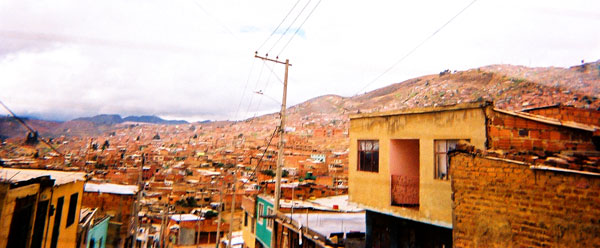
Bogota, Ciudad Bolivar 2004

Anthony Leeds (1994) considers the latter to be part of one urbanized universe. A universe that shapes the way we think about habitats. It is this universe – connecting the worlds of property ownership, habitats, land, settled livelihood and demarcated residential areas that informs contemporary notions of habitats. Ironically, this connected world presents the story of habitats through a series of problematic binaries – rural/urban, nature/culture, formal/informal, slums/formal housing so on and so forth. These binaries completely erase the non-agrarian space from our understanding of habitats and at the end of the day lump the world of rural, informality, slums and nature in one untidy heap which is then sought to be marked as dysfunctional. This paves the way for the eventual triumph of the urban visualized as formal, planned and civilized.

Allen & Corner’s concept of urban natures is liberating to the extent that it recognizes the essentially emergent nature of cities. This understanding leads them to a more responsive and context driven understanding of architectural practice. But does it really allows for all types of habitats to coexist in a messy continuum ranging from the skyscraper to the hut? A field is not a forest. We feel that their conceptualization of urbanism is still conditioned by an ultimately life-denying agrarian-industrial psychology. They cultivate and manage urban fields, while airoots is wandering and gathering in an urban jungle. The urban forest, however, is shrinking day by day as the grid penetrates ever deeper in the urbanmess in which lives an ever growing part of the world population.

We are utterly appalled by the global Babylon that the agrarian civilization has produced, with its unsustainable lot of pollution, impoverishment, segregation, repression, privatization, nationalization and other alienations. If Allen & Corner open a door towards a more sustainable urbanism, they still fall in the the conceptual trap that urbanism is quagmired in today, and therefore fail to transcend the dark prophecies of Mike Davis (Planet of Slums, 2007) or the cynical commentaries of Rem Koolhaas (Junkspace, 2003).

airoots 2007

Old Towns New Towns

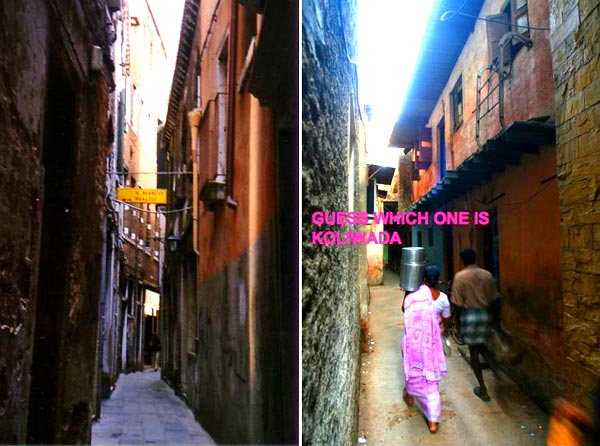
Comparing Koliwada, in Dharavi (Mumbai, India) to Italian cities. Slide from a presentation by Subhash Mukerjee’s team at the Urban Typhoon Workshop Koliwada (March 2008).

« Previous PageNext Page »