Mumbai Contra-CT

November 28, 2011

Presentation at the Municipality of Milano, on November 28th, 2011

1.    URBZ: user-generated cities


URBZ is a global network of urban practitioners interested in user-generated cities around the world. These are urban spaces produced or controlled by residents and inhabitants. The URBZ studio is in Dharavi, Mumbai and acts as a space for urban practitioners to work and learn from the context. It also provides services to the residents of Dharavi and other neighbourhoods in Mumbai and India. These services include consultation, research, design and architectural inputs.

2.    City Makers


The City-makers, or the users, inhabitants of these urban spaces are a critical presence in all that URBZ does. They are people who energize the local economies and built-environments of these neighbourhoods – as producers and providers of goods and services, retailers and vendors, innovators and designers.

3.    The Contractor


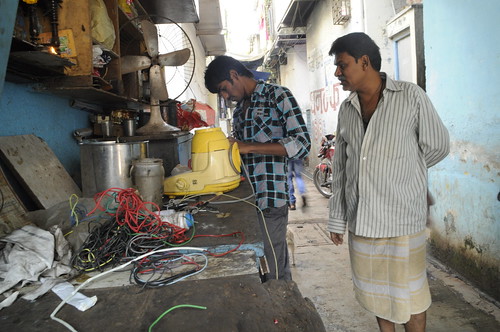
Among this vast and dense networks of city-makers, the contractor has become a very special partner to us. The contractor is a person who takes on construction assignments for local residents – usually of his own neighbourhood. He connects with material providers, labour, local financers and other actors in the production of a structure that works closely with the needs of each client. Here is a video clip of Amar, whom we met in Bhandup.

This is a video rendering of the process of building a typical structure, usually on a 10 by 10 feet foot-print.

4. Neighbourhoods…

These new, improved structures are unfolding all over the neighbourhood and play a crucial role in the incremental improvement and transformation of the neighbourhood. The neighbourhoods have evolved over a period of time and continue to evolve. Their typology and ability to absorb a range of different economic backgrounds, along with providing community and local support to people at different stages of economic status has contributed tremendously in creating a practical, financially sound affordable housing template for cities such as Mumbai.

5. … in-formation

The contractor is constantly looking for ways to introduce new material and technologies so as to make competitive structures and get more clients. In this process we came across Pankaj Gupta, a dynamic contractor from Shivaji Nagar, Govandi, who was keen on using high-quality ready mix concrete. URBZ facilitated a connection with a high-end provider from the city and helped forge a strong partnership between two very unlikely collaborators.

6. Affordable Housing


This equation is slowly becoming part of a larger conversation between high-end material providers, architects and urban planners and contractors and clients from Mumbai’s user-generated cities. Our practice focus on the exchange between architects and other professionals and city-makers in various neighbourhood. Francesco, our intern from Milan, is presently working directly on physically constructing houses with a contractor from Dharavi. Such collaborations have become the basis of our new learning programs in architecture schools as well.

This poster announces a four month long pedagogic program to be done in partnership with the JJ College of Architecture, Mumbai in partnership with Lafarge and URBZ. Students will work closely with contractors, clients from local neighbourhoods in Mumbai as well as technical consultants from around the world and evolve ways of working together.

7. Tool-House


In this initiative, the question of urban typology becomes a very crucial factor in discussions with policy makers and other actors in the city. This is one of the most difficult hurdles to overcome because it becomes a point of contention with developers and builders who work on a more high-end scale of the building market. We focus on the tool-house – the basic structure that shapes the landscape of the user-generated city and show how it is an economic, social and housing asset. In all consultations and conversations described above we look at the tool-house as the basic architectural concept that is integral to local initiatives.

The tool-house is at one and the same time integral to the production of the urban typology and the unit of production of goods and commodities. It helps in making the landscape dense and productive at the same time, by economising the spatial arrangements of the city. In Mumbai, more than half of the population of the city lives in such neighbourhoods but occupies less than 20% of the land and contributes hugely to the economy of the city. This is not a fixed statistic. As the economy improves and grows, this typology changes and absorbs newer forms and shapes. The Tool-house is at the heart of the user-generated city and brings in people, actors and resources together.

The Illustrated Street

May 2, 2011

The practice of photojournalism and image making has changed everywhere. Whether it is on websites of mainstream newspapers or on amateur blogs all around the world, images are increasingly taken by sources close to the scene of action. It is about being right here, right now, and having a sharp enough reflex to snap the image at the right time.

The story is more complicated than simply the amateur journalist taking over the job of the professional. What is happening is that the amateur becomes an expert when she talks about what’s near her, what she is familiar with.  This abundance of information from an infinite number of sources doesn’t mean the end of professional journalism at all. Instead it implies a reinvention of the journalist as a selector/editor of the texts and images that she receives. The journalist still has to be at the right time and the right place but this doesn’t necessarily mean the time and place where the action is unfolding. The place to be is at the receiving and transmitting end of deep networks of actors and readers.

Journalism was already global before the advent of decentralized media. It had become an industry that successfully mobilized people in different parts of the world, and through communication technology such as the telegram, the phone or the fax, connected them to control rooms where the information was being processed and then broadcast. The field of journalism was already broad. What new technologies have brought is a new depth. This depth is not an analytical depth (which may well have been reduced by the speed of diffusion of information), but a depth in the story, since the object of the story can also become a storyteller. We can get the insider story. The end-receiver of information is increasingly intimate with the reality reported in the news. The reader can now interact with the actors from the stories she is reading and even become part of the story, by asking a specific question or offer unique insights.

It follows that there is no simple opposition between the so-called “democratization” of the media and the role of the specialist. The amateur is a specialist of her own reality. We recently started a workshop series on the theme of ‘water’ at the Dharavi Shelter. The kids have quickly become familiar with the use of the digital camera. For this project, we are asking them to look at water in their neighbourhood. They shoot pictures and describe what they have photographed in their own words. Then they document the way water is being used at home, how it gets evacuated and where it goes afterward. This material is then shared with water system specialists who ask questions back to the kids. We are only facilitating this communication. In a way we are acting as journalists, getting information from here and transmitting it there, and then the other way around. Our role is not simply that of a mediator however – we are also actors. And a lot of this involves connecting people to each other. The art of connecting is just as creative as any other, be it writing or photography. This connection, going both ways, empowers the children  significantly.  They will be able to speak with authority about something near them and will get to know it better than anyone else.

It seems to us that good photojournalists have always looked at photojournalism as much more than a profession. It is a form of engagement with the context, with the subject. The most moving and insightful work in that field, has always been one which constructs its own story and doesn’t try to elude the presence and subjectivity of the photographer. Carrying a camera automatically changes the response of the people around you. Playing with that effect is what makes great photography. What we love the most about previous the photos taken by the kids at the Shelter is that they could never have been taken by anyone else. People on the photos would simply have responded differently if they had been snapped by unknown adults. Maybe some would have smiled or felt intimidated in front of a photographer. In front of their friends or family people are more spontaneous and natural. Some of the best shots taken by the kids are the ones that let us sense the relationship between the person behind the camera and the person being photographed.

The images that emerge have a distinctive aesthetic and politics. They emerge from the knowledge embedded in familiarity, the taken for granted, the mundane but eventually emerge to have a sacredness of their own. What facilitates this process is the collective energy that is unleashed by the use of digital technology. The plasticity of which is an individual nightmare for the professional photographer surrounded by amateur images and image-makers, but which becomes a powerful tool when it allows for users to come together and enter into an exercise that becomes a shared and collective practice. The process of making images together, of exploring familiar contexts as a collective, of sharing with an immediacy that this technology facilitates like none other, makes the entire exercise in photojournalism enter into a different realm – one that needs to be appreciated for its aesthetics as well.

Historian, philosopher, writer, Umberto Eco points out how new knowledge technologies that use the digital image are connected to a world at least as old as European medievalism in which the word and the image have always been integral to the political imagination. He looks at contemporary society and all its technological paraphernalia as one more episode in this epic story. He insists that digital technology is potentially liberating and – more importantly – irreversible. We need to find the right handles so that our relationship with knowledge continues to be genuinely challenging and satisfying.

Anthropologist Appadurai points out that the contemporary practitioner is part of a shifting, moving and fluid landscape. New technologies help us express these further and connect to the ‘scapes’ that make up our social imagination in more ways than one. This ‘social imagination’ continues to be rooted in a complex, ever-changing context, one that is inevitably local, because locality is always being produced. However, at the same time, it is acutely aware that national boundaries, like many others are being challenged by new constantly mutating technologies. For him, the globalized world is not the same as Marshall Mcluhan’s mediated global village. It is rather about the migration and movements of people from one part of the globe to another. It is about becoming aware that our lives and worlds are deeply interconnected. Most importantly, it is about the way in which media and new technologies help us come to terms with these connections, shifts and movements.

One story that encapsulates the entire experience of the photography workshops that we do at the Shelter, where images keep being produced and then tell their own stories, where the location is supreme, where time is tamed by sheer presence and immediacy, is told by Ray Bradbury in ‘The Illustrated Man’, first published in 1951. This is a collection of narratives about a dystopic future in which the media literally comes alive. The stories are embodied on a man and are alive with moving images, tattooed by some enchanted artist from a local fair. The man himself could be from any point from the past or future. The stories his body ‘reveals’ ultimately end with one that starts to reflect the life of the person presently ‘watching’ them. They are futuristic stories about a world where a giant screen absorbs human beings into its digital folds, and about human impulses emerging through the ruins of a nuclear devastated world and the intricacies of faith.

But what is striking is that that it places the storyteller at its centre, weaving images and worlds about the past, present and the future. It is ultimately about the triumph of her imagination that cuts through the varied contexts in which one finds her telling her story – always part of a collective universe of story tellers – performing around a fire, thundering in an auditorium, whispering through cyber-space, crackling through television or hitting back at the player in a video game. When the kids at the Dharavi Shelter take pictures of their own streets and homes, they also tattoo them with their imaginations, report it, narrate it and emboss it with their own lives.  The story that emerges has a life of its own.

The photos have been by children living near MG Road, New Transit Camp, Dharavi, during a workshop conducted at the Dharavi Shelter by photographer Lasse Bak Mejlvang from Denmark and Himanshu S. Jan 23, 2011. The workshop participants are: Simon, Anand, Vishal, Neha, Reshma, Karishma, Muskan, Umesh, Gautam, Punam, Amar.

More photos here.

Click here to read an article on photojournalism by Neha Thirani that inspired this post (pdf document).

Mumbai’s overgrown habitats

February 2, 2010

The Portuguese left a few long lasting legacies in Mumbai. Forts are one of them. Along Mumbai’s Eastern and Western waterfronts one can rediscover them hidden in the surrounding habitat, whether it is mangroves, fishermen’s huts or Dharaviesque microworkshops.

Airoots follows Anuradha Mathur (co-author with Dilip Da Cunha of the much acclaimed book and exhibition SOAK) down the adventurous path in Sewri, Mahim and Worli.


Down the adventurous path: Anuradha Mathur in front of Rahul Srivastava


Abyssinian Mangroves. Unlike Red Mangroves their branches go straight up in the air and don’t become roots. Both photos are taken in the vicinity of the Sewri Fort.

What if the city acknowledged the incompressible dimensions of its existence and redefined itself around its fault-lines : rivers and tides, vegetation and wildlife, migration flows and vernacular habitats… These are the living forces shaping Mumbai day after day, yet they are all, in one way or the other, misunderstood and endangered.


Supereal Mahim Beach and its hidden villages.

Following a methodology based on sectional analysis of a territorial segment, Anuradha’s students observe the integration or the disappearance of one habitat into another. For instance, a river flowing into a creek and sustaining a mangrove forest, which is slowly reclaimed by garbage and turns into a solid ground upon which a settlement grows. This grounded approach serves to produce design interventions that acknowledge and potentially influence the forces in presence.

The Worli-Bandra Sealink viewed from Worli’s Koliwada (Fisher folks village)

When Enmeshed Worlds Remain Parallel

January 25, 2010

C&C

Right from Sharada Dwivedi and Rahul Mehrotra’s evocative title (Bombay; The Cities Within) , to the trite images of slums juxtaposed against high-rise buildings – Mumbai’s many personalities have been alternatively celebrated and chastised. The diversity of built-forms, the many different urban sensibilities (small town enclaves in South Mumbai, coastal villages in  the suburbs) and the contrasting economic and cultural lifestyles are still very pronounced experiences in Mumbai – making any first time visitor feel disconcerted beyond the normal lag of time, space and culture. It does take a special level of composure to walk from a street, crowded with makeshift homes with children playing around dizzily speeding cars or being accosted by a demanding beggar for your sandwich and then walking into a mega-mall lined by the latest branded items even if you do see the shocked face of the girl behind the counter marveling at your ability to buy goods worth her entire years salary. You don’t have to be a card-carrying socialist to know that these are- at the very minimum – moments demanding some element of erasure, forgetfulness and glossing over if you want to continue living with a semblance of normalcy. Visitors still wonder at how easy it is for such worlds to co-exist without erupting into easy violence. That’s when you realise that there are many ways in which people live around and through contradictions. Its not that you need Johannesburg style gated communities with electric walls to keep people apart. There are all kinds of gates – many a times invisible and even more effective. Older feudal structures in the mind are pretty strong, easily making a rebellious soul stop short of pushing the envelope. Combined by good old brute police force – this helps in creating a perfectly gate-less secure society. At least for the moment.

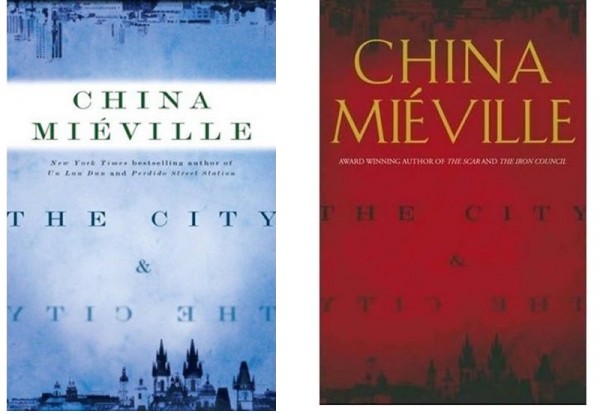
When we came across the theme of China Mievelle’s  wonderfully wierd fiction story ‘The City and The City’ (introduced to us by Carol Breckenridge) it lent itself easily to a comprehension of Mumbai’s extreme contrasts. In his novel two cities are enmeshed in each other, but citizens of one are conditioned to ignore the evidences (sometimes staring at them in their face) of the other. The office of the ‘Breach’ ensures that the urban worlds remain parallel (even though enmeshed intricately) and disconnected. When a body from one city is found in the other – the narrative starts to flow and the reader discovers the rules through which people can co-exist and remain disconnected.

For anyone in Mumbai who has rolled up a window in an air-conditioned car – in the face of a highly professionalized beggar economy, or walked over a sleeping homeless body, or appreciated the new arty graffiti on a wall once housing streams of homeless families, the novel touches a raw nerve. Reminds you, with the same moral force of your conscientious school teacher – that there is a world out there, which you see and need to respond to in a manner beyond glazed eyes. And yet that would be a ridiculously simple allegorical connection to make with the book. Thankfully our comparison is not moralistic nor intended to create victim – based hysteria. There always are deeper reasons behind the resignation to accept contrasts, particularly when they are so obvious.

But what Mievelle’s world conjures is the ability to see how deeply etched are the invisible worlds that exist around us in many scenarios. It is an ideologically divided Europe that is the inspiring context of his novel. It can work in several ways. Reminding us that there are schisms in several cities – energetically cosmopolitan New York, aggressively regenerating Moscow, ethnically complexed Paris, or migrant enriched London. Its possible for the office of the Breach to operate in all kinds of ways. Its possible for us to be oblivious of the obvious in more ways than simply not seeing the faultlines that are all too evident. Its about finding out where the faultlines actually are. And they may not at all be where you look for them.

Mumbai: A Port City?

January 15, 2010


Ferry Wharf, Or the Brother’s Push (Bhau-Cha-Dhakka), Mumbai

Some years ago, the idea of the Eastern Waterfront was thrown into the public realm by several planning and design centres to show that much more can be done to explore the city’s island status and its vast shoreline on both its sides. Right now, the Marine Drive, Priyadarshini Park, small stretches up to Bandra, Andheri and beyond legitimately demonstrate what the western waterfront has offer to the public of Mumbai.

On the east you have Colaba, Mazagaon, parts of Sewri and then the vast saltpans that are relatively open. Most of the eastern waterfront is controlled by the Mumbai Port Trust – an entity that officially handles a huge amount of cargo – most of which is consumed by the city itself. It offers employment to several thousand people with many more being dependent on it directly and indirectly.

According to the port authority representatives it is difficult to evaluate the eastern and western waterfronts’ contribution to the city only in terms of open spaces. The fact that it is an economic engine cannot be discounted. It points out that many spaces which are restricted to the public are done so by the defence authorities. In many cases it has opened up public gardens and provided access to people to visit historical structures even though large parts of the front is in poor condition in terms of infrastructural facilities.

However many of them feel that in the name of opening the waterfront to the city at large – the real estate lobby can simply take over pockets of the land and still keep the place inaccessible to the not so privileged public. Citing the case of the mill lands and the way the state government ultimately gave in to the building lobby they feel there is no guarantee the same may not happen here.

The opponents are not fully convinced. They feel a lot more can be done in terms of rationalizing the use of surplus land that the port authorities have control over, now that many lease terms are coming to an end. Many feel that there is no place for a port in a modern cities and give examples from all around the world. This is countered by the fact that the Mumbai port trust is actually in a state of expansion and a phase of economic growth. There are also newer streams of thinking in which city ports have adapted to their urban status and turn their location to an advantage.

All in all we have a situation in which the city seems to be very divided and in which debates tend to get heated and passionate. Personally we have witnessed several situations in which good intentions have been overridden by commercial interests and so one has to be doubly cautious of tall claims. At the same time to have an economically dynamic functioning port is vital for the economy of a city – especially if it can also develop a powerful relationship with the city by helping through transport issues and opening up parts of its waterfront for the public at large.

These issues are currently being explored by a joint Eastern Waterfront studio by the Urban Design Program and the Earth Institute at Columbia University, together with the JJ School of Architecture and the School of Habitat Studies at TISS. Mumbai’s historical relationship with the sea and its trading networks, the question of land availability, as well as environmental concerns about rising sea levels and mangrove preservation are likely to spark much more passionate debate and ideas in the years to come.

Prawn Nagar – Dharavi, Mumbai

December 30, 2009


Softer landing for District 9’s Prawns in Dharavi

If the aliens hadn’t found their way to District 9 in Johannesburg but turned a few latitudes east, across the Indian ocean, over a tiny sliver of land jutting out obscenely and defiantly off the v-shaped south-Asian sub-continent, their fate in cinematic history would have been something else.

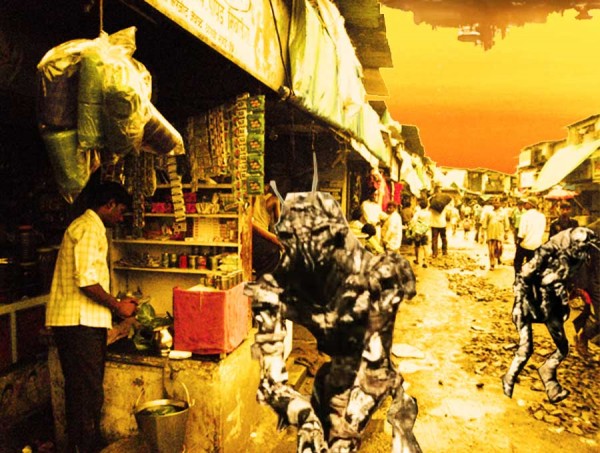
Imagine the spaceship hanging over the hot and humid city of Mumbai, specifically over its most mythified neighbourhood – Dharavi.

Its enterprising residents would have absorbed the presence of the craft and its seafood resembling occupants with relative ease. The metallic tentacles of Dharavi’s legendary recycling industry, would have eventually penetrated the most sophisticated barriers and shields to slowly and steadily dismantle the alien structure for absorption into a million-dollar industry that does not allow even the most ordinary piece of scrap to go unsold. How could tons of exotic metal be left to hang in mid-air? Notwithstanding any degree of technological superiority…Bits and pieces of the metal would have found their way into spare body-parts of second-hand cars, ships, toys and assorted machinery. The unusable celestial leftovers may be left to hang in space with no one caring much for aesthetics. Instead somebody would start a little sight-seeing tour by making an improvised crane-bridge to take curious onlookers and tourists for a closer look.

And what of the aliens themselves?

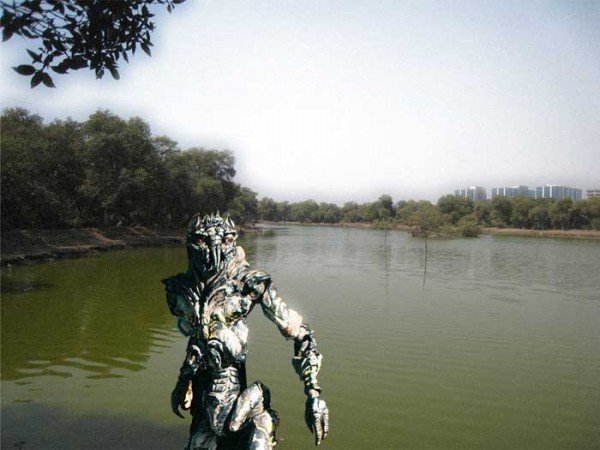
They would have managed to build a tiny little habitat between the crevices of the impossibly dense habitat. Maybe on the toxic watery edge of the mangroves. Not having access to tinned cat-food in Dharavi, could well have found the fish in the sewage water a worthy substitute, considering that a few older residents still fish there even now. And they would have found something worthwhile to do for sure. Their presence would have inevitably fired several wild allegations. One can imagine absurd rumors circulating that a gang from Pakistan is chasing the Aliens and selling them as seafood throughout the city!


Prawns are said to be hiding in the Mahim Creek near Dharavi

Economically they could make leather goods in Dharavi even more globally competitive with a dash of their own technology. Of course, this could mean a legal crackdown – since scientific tests about the safety quotient of alien substance aren’t possible. But Dharavi’s grey zone economy would take care of that and eventually the aliens would become integral to the neighbourhood’s oldest and most prosperous economic activity, getting swallowed into its several residential, community based enclaves, taking the disputed figure of eighty –eight nagars to eighty nine.

It would have been difficult for any curious journalist to actually discover Prawn-nagar as the boundaries between enclaves are not easy to discern. The only way she would know she’s arrived would be on seeing a bunch of young prawns playing cricket with local Dharavi boys. They would point her out to a set of structures around a small clearing where a few adults would be having a heated argument with neighbours over the right to build a shrine in memory of their lost home – in the form of a replica of their ship.
The shrine would be the only way to connect to their past. No chance of returning home now – given the remains of their emaciated, skeletal, once proud extra-terrestrial space vessel. The other reason nobody would want to return is because the cost of homes in Dharavi would have increased four-fold by now.

Typically, the temptation of making more money eternally overrides any possibility of return.

The journalist would most likely be reporting the possibility of a riot because a prawn-girl and a local – earthling boy had fallen in love and were nearly lynched by both communities, only to be contained by an elderly local activist trying to broker peace.

The prawns would soon be part of political demonstrations trying to save Dharavi and a politician would eventually have got them voting rights. Against the will of a local right-wing party which tried hard to fight their presence tooth and nail – equating the aliens with worse – those from the states of UP and Bihar.

Sooner or later though, a clever prawn leader would have won over the local right wing forces by declaring Marathi as their earth-tongue. He would then have proceeded to pledge support to their drive against the real aliens – the hapless migrants of U.P. and Bihar.

That would pretty much have been the story.

Look out for regular updates from Prawn-nagar, Dharavi, Mumbai on airoots…

Violence as Spectacle in 26/11 Attacks

December 5, 2009

P1040796

Any spectacularly violent event lays down the rules for both, a collective response, as well as any attempt at analysis. The meta-structure for these rules typically includes polarization, taking sides, and extreme reactions. Violent acts (glorious, perverted, desperate, passionate, defensive or aggressive), separate, crystallize, draw lines and reinforce boundaries in the most effective way, and in the shortest time.

When a worldview or ideology starts to become fuzzy, uncertain, complex and ambiguous, nothing like an aggressive attack to harden boundaries once again, reinstate the centrifugal forces around which the group, mindset, perspective or belief coagulates, block leakages and enforce strict immigration rules at the gateways.

Drawing boundaries works both ways. At one level it creates divides and reinforces antagonism, and it also encourages loyalty, faith, or firm commitment to ideology. Eventually it has to contend with the level of Puritanism – or purity of intent – through which we negotiate the extremes or ideals dictating those choices. Even Gandhi’s brand of ahimsa – non-violence – complex as it was, worked as a mirror image, with clear boundaries and little scope for fuzziness. Consequently, its logic could not escape the all-pervasive totalitarianism that characterized his age and made it work in violent ways as well – through self-inflicted fasts, denial of physical needs and other bodily experiments (with “truth” or desire).

The function of political violence seems to be to make the immediate moment omnipotent, postpone reflection, and harden any threat of ideological or intellectual ambiguity. This inevitably results in recurrent, cyclical episodes (violence typically ‘spirals’) that use the most recent memory or event to justify the immediate act of retaliatory (its always retaliatory in the mind of the perpetuator) aggression and strict adherence to the official line. As George Bush put it in his address to the Congress right after the 9/11 attacks: “You are either with us or against us”[1].

P1040811

Not surprisingly, analysis in recent times have taken unambiguous sides, becoming increasingly indistinguishable from the official line as they get closer to the source of aggression (Osama Bin Laden or George Bush) or are so sharp and critical from within that they generate simultaneous suspicions on both sides of the fence (the modernist location of radical Islam as brilliantly argued by Faisal Devji[2] for example). This is not a sign of weakness in the analyses as much as an indication about the nature of the subject in question – acts of extreme violence leave little breathing space in their aftermath. As a result, discussions revolve around simplistic assumptions. Which type and level of violence is most appropriate as a response? A conventional war or “surgical strikes”? Or the ethics of facial profiling v. the risk of being attacked from inside are all carefully weighed.

Statesmen ponder on how to respond to ambiguous political agents and potential “terrorists”, or evaluate how much security is enough or too much. It is often about channeling the thirst for revenge into as acceptable a route as possible, claiming that it is all about preventing the spread of violence. In reality it ultimately becomes about pushing the envelope, bending freedoms inwards till it reaches breaking point.

This essay analyzes our own disturbing fascination with the kind of violence displayed in the Mumbai attacks and the audacity displayed by the militants. In order to do so, we first locate the Mumbai attacks in the broader context of violence in youth culture (in television, movies, games, and music), and then explore how such concepts as audacity, magic and charisma can help us understand not only where our fascination comes from, but also open venues for radically different kinds of responses.

Our account of the event is based on our experience of the Mumbai attacks of November 2008. As many Mumbaikars we followed the events through television, while being just minutes away from the scenes of action.

The Attack – Facts and Fictions

We believe in the truism that the ability to respond to the political crisis rests as much at the level of analyses as anything else – and that the analyses itself depends on an understanding of the complex way we construct the event and the sorts of thinking it embodies. The biggest analytical challenge we faced as the event unfolded was a blurring of boundaries between fantasy and reality. It was challenging since we wanted to resist driving a wedge between these two spaces to separate them.

The 2008 Mumbai attacks, like the 9/11 attacks seemed unreal, in fact impossible. The number of conspiracy theories that emerged after 9/11 testify to the fact that the official version is hard to believe. Similarly, how could a small group of militants, as well trained as they may have been, bring to a standstill a city that always kept functioning amidst all kinds of man-made and natural disasters? In fact, it seemed and still does seem implausible. We were forced to believe a story, which would otherwise have summarily been dismissed as being as unrealistic as a movie. This moment when something seemingly impossible actually happens -when reason is bluffed- has a magical quality to it. It is this magical quality that we are trying to get at.

As the attacks unfolded we were touched and confused by the emotional waves that overwhelmed the city –

‘ranging from incredulity, rage, cynicism, disbelief, shock and nervousness, to fear, sadness, numbness, hate, and the most disturbing of all, fascination. A morbid fascination for the ability of a handful of young guys to create mayhem in the city, shake Indian politics, and hypnotise the global media.

Surely, these were no ordinary kids. They were well trained, fully equipped and driven by vengeance. Thanks to GPS technology they could navigate an ancient sea route that connected two colonial cities partitioned by history. Thanks to their urbane appearance, they could sit down at Leopold café and enter the city’s best hotels without raising any suspicion.

They checked in at the Taj next to the general manager and transformed their quarters into a five-star control room. After brutally killing scores of tourists they cool-headedly recharged their AK-47 and rampaged the city. They killed Mumbai’s top cops and hijacked police cars, twice. Till the end they defied India’s best commandos. For a moment it seemed that the country’s entire army could not stop them…[3]

P1040805

At that time we were shocked and fascinated by the audacity of the shooters. That sense of fascination, accompanied by horror, was disconcerting. The event perhaps brought to the surface a well-entrenched fascination for extreme violence, which we were not fully conscious of. As good children of television, we had been fed early on with the very same type of images that we were now seeing on our screens again. But this time it was disturbingly close and real. Periodically, the events would send shockwaves through the Girgaum lane where we were staying at the time. Some attackers were shot at in Chowpatty, barely five minutes away. There were rumors that others had escaped and were at large in the neighbourhood making concerned neighbors feverishly plead to down shutters and double lock all doors.

This back and forth between the screen and the street created some kind of feedback loop, which was relayed and magnified by phone calls and text messages. False rumors, often sparked and subsequently denounced by TV hosts at the edge of nervous breakdowns, were spreading alternative waves of panic and relief. Mumbai felt like an old steamship, which had hit an iceberg and was now sinking in an ocean of confusion.

That reality exceeds fiction is well known, but this latest attack on Mumbai, just as 9/11, was so spectacularly orchestrated and enacted, so dramatically successful that not even the most inspired scriptwriter could have conceived it. The cinematic references went beyond the literal televised image transmission that dramatized the event. The doomsday theme is classic Hollywood. The attacks on New York had been anticipated in dozens of movies, such as “Armageddon” where the Chrysler Building is flattened by meteorites, ”Deep Impact” where the Statue of Liberty is toppled, and ”Godzilla” who destroys the Brooklyn Bridge, to mention only the blockbusters. But no one came as close to reality as the Hip Hop band “The Coup” who’s album cover, released shortly before the 9/11 attacks, showed the Twin Towers being blown up. The album was of course immediately taken out of the stores after the attacks.

The sheer dramatic exaggeration of the Mumbai attacks, with episodes such as the hijacking of the commissioner’s jeep, or when the crowd gathered around the Taj to cheer up the troops hours before the fighting was over, arguably gave them a Bollywoodesque dimension. This was evident in the alternatively grinning, nervous, laughing and scared faces of the onlookers who walked a thin line between being an aggressive unruly mob and hapless victims. Their schizophrenic response stemmed from the typical uncertainty of finding oneself living a moment that has only been lived before in cinematic, mediated reality.

Extreme violence also has the unique ability to hit not just its most direct target but also bystanders, forcing them to take side. Thanks to the ubiquity of modern information technologies, virtually everyone was witness to the extreme violence of the November 2008 Mumbai attacks. Quite clearly, the real target of the attacks was the global audience.

P1040803

The attacks were aimed at an audience hundreds of kilometers away; American families whose thanksgiving dinners were interrupted by the breaking news of the attack. Mumbai was at once a worthwhile target and a cheaper, less threatening option – an outsourced terror attack site – that became a studio relaying messages to the whole world – particularly America and Israel.

However, an equally important audience for the planners of the attack were the hundreds of thousands of youth, who could well get inspired to join in their ranks to become tragic “heroes” themselves.

The looping image of Ajmal Kasab, the 22 year old militant who was captured, was reminiscent of other sets of images. We could not help but morph that ubiquitous picture of him holding an AK-47 rifle at CST Station, with similar images of countless rampage scenes from movies like Scarface. How many t-shirts and posters have glorified the image of Al Pacino playing Tony Montana in Scarface, fearlessly meeting his death? And it is always the same image of him standing with his gun, killing enemies by the dozens, just like Kasab did at CST Station. Similarly, countless hip hop songs have created a mythology around Tony Montana, a fictional Cuban immigrant coming with nothing to Miami and becoming the king of the city one coke deal at a time. Again, reality beats fiction. How much more credible is this middle-aged tough-skinned Al Pacino posing as a ruthless killer compared to young Kasab, fresh from his village and disguised as a typical middle-class Mumbai teenager with his Versa t-shirt? Doesn’t it look like Kasab is merely imitating Tony Montana, when in fact he is the real killer?

Kasab and his comrades, wearing jeans and t-shirt, looking modern and brutal are prime material for teenage hero-worship. The horror that they unleashed transformed them into pure monstrosity and brought to life the most fantastic imagery otherwise only relegated to the world of the imagination, pushing the whole narrative into another realm. Their audacity was responsible for one of the most fantastic leap from fiction (the plot to rampage the city) to reality (it’s actualization), or inversely from reality (a peaceful and cosmopolitan city) to fiction (a city polarized on its political extremes and increasingly Islamophobic).

P1040831

How confusing it was to see the villain terrorist playing the role of the sacrificial hero, who fights the system to death. Kasab’s image is a dark version of young Che Guevara, rebellious, strong and audacious beyond belief. More than anything what will have turned these boys into charismatic heroes for some, is the epic transgressions surrounding the events – national, religious and class based – which seemed to be designed to attract attention in the manner of an astounding story, wonderfully told. If only because it will be used over and again by extremist militants to penetrate the minds of global audiences and enroll new recruits, we need to understand this story from the point of view of Kasab, or any of the young men who will follow his steps. In their eyes’ Kasab symbolizes courage, fearlessness and strength. Heroic qualities that all of us have grown to value so much that they can even blur the dividing line between villains and heroes.

The fact is that fantasies of radical transgression, including bombing and killing have always been part of a certain subversive imagination, which is particularly appealing to the youth. Youth across cultures respond passionately to a certain fictionalized understanding of reality, whether it is constructed by Hollywood movies or by charismatic political or religious leaders. The possibility of breaking through and becoming the actual hero of the story becomes an once-in-a-lifetime do-or-die (do-and-die) choice that overwhelms the perpetrator of the violence.

One of the most popular video games of late is Grand Theft Auto (Vice City). The player can steal cars and drive them around Miami at full speed, bumping into other cars and running over pedestrians. He can and even get off the car, shoot at the police and steal their cars and tanks to cause total mayhem in the city. When that happens the army comes and tests you to withstand the fight as long as possible.

This is pretty much what Kasab and his gang did in real life, and also what at a lesser degree dozens of American kids have done in so many tragic school-shootings. Our concern is not whether the fictions mentioned above have influenced the killers. But rather how many people will be inspired by the perceived heroism of Kasab and his colleagues. And further how such acts of extreme violence resonate to become icons of youth culture. It is surely painful and difficult for anyone who has been directly affected by such violence to conceive it. But from a distance (geographical or historic) the events can easily be turned upon themselves and used as symbols of something else altogether.

P1040792

Urban youth in Brazil casually use Bin Laden as a counter-cultural symbol, painting him on walls and invoking him in songs and slang. Shortly after the attacks even a computer virus named Bin Laden came out of Brazil. Closer home, the Nazi swastika (not the Hindu one) is regularly seen on t-shirts, and Hitler is revered as a great leader by some Hindu youth who do not actually consider themselves fanatics. This is of course shocking to Westerners who would not otherwise be disturbed by a teenager wearing a Mao Zetong pins.

Audacity, Magic and Charisma

charisma of violence

No matter what the ideological and religious quality of his indoctrination, the actual drama unleashed by Kasab and his gang, is, at one level, similar to the senseless school shootings in the US (and recently in Europe). It is after all, a certain kind of youthful energy that marks these horrific events. In our mind however, while the Mumbai attacks and school shooting are comparable in the form of violence they exult, they differ in important ways. The perpetrators of school-shootings never achieve “cult” status. There is hardly any heroism in their attacks since they only attack defenseless victims and generally kill themselves rather than die fighting. Moreover, the Mumbai attackers achieved a level of destruction that seems unimaginable and lasted for longer than anyone would have predicted. School-shootings are horrible but not implausible.

Psychological profiles of perpetrators of school shootings portray them as being often isolated, rejected by their peers and often victims of bullying. While there may be a subconscious political dimension in school-shootings (they always happen in a seemingly alienating middle-class suburban context), it is too vague to mobilize any kind of support. The Mumbai attackers however, will undoubtedly live on in the memory of many as revolutionary martyrs who died defending their political cause and/or religious mission.

However, the self-perception and drive of attackers in both cases may actually find its source in the same youthful passion, which can become the darkest expression of Horace’s Carpe diem quam minimum credula postero – “seize the day and place no trust in tomorrow” – a complete abandonment in the moment that intoxicates, gives a high like nothing else and alters states of consciousness so much that the most unbelievable acts can emerge from there. As is becoming evident, it is our suggestion that youthful passion, actualizing the most audacious of ideas, can transform Kasabs into monsters or heroes.

The audacity of daring, coupled with the ability of achieving what seems impossible confers a charismatic aura to the author of the act. Here we mean charismatic in a Weberian sense: “…a certain quality of an individual personality, by virtue of which one is ‘set apart’ from ordinary people and treated as endowed with supernatural, superhuman, or at least specifically exceptional powers or qualities.” [4] Kasab and his comrades, most of whom were barely out of teenagehood, accomplished something that no one could have imagined.

P1040828

In the first hours of the attacks the feeling that prevailed was one of incredulity. We thought that the media were blowing up a story which was most probably a tragic fait divers of the sort that happens every week in a city of 14 million. We were even mocking our friends who went on automatic panic mode. However, as the event unfolded, the news turned more and more extraordinary and the doubt settled in. We started to simply believe what we were seeing on TV, hearing on the phone and on the street, in spite of the fact that it was inconceivable.

This moment, when one’s rationality is challenged and the mind flips into the realm of “belief”, has been described by Arjun Appadurai analyzing the reaction to Barack Obama’s election: “magic is the universal feeling that what we see and feel exceeds our knowledge, our understanding and our control.” [5] It was indeed an incredibly audacious move for a relatively unknown young senator to make his bid to the presidency to start with. This audacity carried him all the way to the breaking point at which his rise started to seriously threaten, and ultimately defeat the most formidable political organizations in the world: The Hillary Clinton campaign and the Republicans.

It is when grounded cynicism looses ground that “magic” happens. Everything shifted the moment it became clear that, contrary to the predictions of all serious political analysts, it could indeed be done. It is this magic moment that carried the Obama campaign all the way to a victory that ‘exceeded all expectations’.

The Mumbai attacks and 9/11 fit Arjun Appadurai’s definition of magic just as much as Barack Obama’s irresistible rise. The black magic of 9/11 hypnotized the world and instantaneously transformed Osama Bin Laden into a god-like figure and a horrendous monster. Even more perhaps than Barack Obama’s victorious campaign, the destruction of the Twin Towers by two hijacked planes defied understanding to the point that a large portion of the American population still refuses to believe the official version. The charisma gained by Bin Laden after allegedly master-planning the 9/11 will ensure a continuous influx of new recruits in the years to come.

P1040814

Conclusion

Audacity works at various levels. One is that of imagination. Allowing oneself to think about the unthinkable, dream about the impossible, or fantasize about the forbidden is a first kind of audacity that so many people deny themselves. We have all experienced the charisma of people who allow themselves to breach these boundaries. We call them anarchists, “free thinkers”, artists, poets, gurus or mystics. They have a special status in our societies, being placed at the same time on the margins and on a pedestal. The other level is the audacity of action, which Kasab personifies. This appeals particularly to the youth, who as we attempted to show, identify with the passion and bravery of such daring.

Audacity of imagination – that leads to transformative moments – must urgently be reclaimed with the same passion and determination, but after injecting it with a totally different set of values. Suppressing ideas because they are too audacious and falling back into a cynical form of realism will only give more leverage to polarizing forces. A middle-ground politics repressing the expression of youthful passion and imagination leads to more of the kind of destructive responses that we have become accustomed to everywhere, from America to India. The only way to respond to the audacity of unimaginable violence that divides and polarizes, is not by controlling freedoms within, nor by building firewalls between groups but by imagining and acting upon even more audacious attempts at uniting, blurring and bridging divides.

P1040791


[1] President George W. Bush, in an address to a joint session of Congress on September 20, 2001.

[2] Landscapes of the Jihad: militancy, morality, modernity; Devji Faisal

Cornell University Press, 2005

[3] Rahul Srivastava & Matias Echanove, “Reclaiming Audacity”, The Hindu, December 7, 2008

[4] * Dr David Boje, Charisma lecture notes, Leadership & Society course at New Mexico State University College of Business Administration & Economics, Retrieved 28 July 2005. Via Wikipedia.org.

[5] Arjun Appadurai, “The Magic Ballot”, in The Immanent Frame (blog), November 7th, 2008. http://www.ssrc.org/blogs/immanent_frame/2008/11/07/the-magic-ballot/

This paper was presented at the Global City seminar, organized by the Max Planck Institute for the Study of Religious and Ethnic Diversity in Göttingen, Germany, August 2009. All pictures were taken at the Peace Wall, Marine Line, Mumbai, December 2009.

Learning From Dharavi

October 25, 2009

1. Can’t Picture it: Demographic surveys and enumerations lie. They cannot possibly tell the truth about the number of people coming, going, living, working, renting, subletting and encroaching. Dharavi can only be effectively grasped on the ground and in real-time.

2. Many Dharavis: Dharavi is a collection neighbourhoods, each with their own specialities, languages, activities, festivals, rituals and aspirations. Each follow its own organizational logic.

3. Dharavi is not Poor: Dharavi is an Indian success story. It is full of opportunities. It doesn’t matter how small one starts, as long as one is allowed to fulfill one’s potential. That’s what Dharavi has meant for hundreds of thousands of people.

4. Artisanal City: Dharavi strives on artisanal energy. A house is an object like any other. To build one you need knowhow and materials. Dharavi is not an architect’s city by any means and yet architects are fascinated by it for this very energy it exudes.

5. Do it Yourself or Die: Landing up in Dharavi means having a foot in the door to India’s wealthiest city. Migrants either exploit it to the maximum (sometimes all the way to the top) or get their foot cut off.

6. A Cluster of Tool-houses: In Dharavi virtually every home doubles up as a productive space. A tool-house emerges when every wall, nook and corner becomes an extension of the tools of the trade of its inhabitant. When the furnace and the cooking hearth exchange roles and when sleeping competes with warehouse space.

7. Reading Dharavi’s Palm: Dharavi’s history can be read through its streets, they are like the lines of the hand. It reveals a history of incremental development configured through the biography of each migrant, family, or community that ever moved in.

8. Dharavi is a Mangrove Forest: Architecture, social networks, and economic activity are irremediably enmeshed, like the roots and branches of a mangrove. Destroy one and you destroy the others. Let one grow, and you develop everything.

9. Forest Economy: Like all jungles, Dharavi is full of resources for those who know how to hunt and gather. Dharavi is a knowledge and skill based economy.

10. Density is Wealth: If there are enough people passing by, (and there always are) – you’ll always be able to sell something to someone. Density means opportunities and Dharavi is Super Dense.

11. Space = K: Space is capital, human energy is capital, relatives, neighbors and community members are capital. Capitalize and maximize whatever you’ve got – that is Dharavi’s byline.

12. Las Dharavegas: Dharavi follows the same logic of hyper exploitation of space, people and opportunities as Las Vegas. Aesthetically, however, it is vastly superior to Las Vegas. Humanly even more so.

13. My Sweatshop: Dharavi is the libertarian version of totalitarian Chinese sweatshop, producing just as much with a decentralized web of producers. Just as exploitative but allows more individual mobility and initiative.

14. Live/Work or Leave Work: Work at home if you can afford it. If you can’t then live at work. Either way no space can have just one function, unless it is sacred space. Gods and spirits need some privacy.

15. Intimate with Neighbours: Intimacy means everyone knows about everyone’s life. You are intimate with your neighbors for better or worse.

16. Hell is the Other People: Hell is other people and Dharavi is loaded with other people from all over India. The relations are conflictual but without violence (usually). At the end the bazaar keeps the goodwill flowing.

17. Fractal Social Fractures: In Dharavi you find refuge in your community and family only to find out that they are a fractal image of whatever lays outside them. Social networks are not smooth. Dealing with them only means more creative and pragmatic solutions rather than the bourgeois sense of corrected consensus.

18. Mess is more: Neighbourhoods that looks messy and backward at first sight are often instead complex, dynamic and resolutely contemporary. The karmic potential of Dharavi is realized in Tokyo’s periphery. Dharavi shares its history of incremental development, its low-rise high-density typology and labyrinthine street patterns with many of Tokyo’s neighbourhoods.

19. With Love From Dharavi: Some say it has the charm of European old towns. Yes, the very same “romantic” old towns that we all love. Did they look as pretty back then when they had open sewage systems?

20. The Village Inside: Dharavi is made of the same urban fabric that can be found in many artisan villages and smalls town in India, just much more of it. Scratch the surface and you’ll see the village emerge, almost intact.

21. Invisible Ties: Dharavi’s biggest strength in tangible terms is community/caste ties. Shrines and sacred spaces abound in Dharavi indicating this connection. They evoke old cultural trajectories and support systems.

22. Dharavi Development Project: Dharavi is already developed, it doesn’t need to be redeveloped. It simply needs the same add-on civic infrastructure that is available in any other part of the city. The Dharavi “Redevelopment” Project means stopping its on-going development and kicking hundreds of thousands of people out in the streets of Mumbai and throwing them into a situation of penury. They will move to another slum or start a fresh one, making Mumbai worse off.

Photos Sytse de Maat.

Audacious Learning: The Dharavi School of Urbanology

August 17, 2009

Institutions have been much misunderstood entities. In strict anthropological terms they refer to any stabilizing of ideas, beliefs, practices, traditions, lifestyles, knowledge practices and skills that one generation wishes to pass on to the next.  By this definition, families, guilds, community associations, art schools that are based on the practices of a teacher – all qualify to be institutions. Musical traditions in South Asia codify themselves around gurus and become institutions of sorts. In Japan, martial arts, tea ceremonies and other arts and cultural practices center around the sensei and institutionalize themselves over generations. Much of knowledge, insights and learning have been generated through such inherited and evolved practices.

It’s only in the nineteenth century, with the emergence of the modern bureaucracy that a distinction came to be made between the primary and secondary nature of all organizations, with the former being part of the realm of domesticated, ethnicized or personal spaces and the latter being shaped by impersonal, universal principles that were sharpened by the development of bureaucracies. What such a distinction meant for knowledge and cultural practices was quite special. It privileged the development of modern day institutions only if they walked down the path of bureaucratic organization and relegated traditional knowledge practices to an informal realm – contained and preserved by traditional customs and private resources. As a result, the state, and subsequently large resource rich establishments, shaped the emergence of modern day educational, cultural and arts institutions, and made them more bureaucratic and impersonal. This was also the process through which the idea of tradition as a hyper-conscious space became more prominent pushing forth for a whole lot of speculation about the invention of traditions. This went hand in hand with the invention of other firmed up dialectical categories, including personal-impersonal, ethnic-modern, primary and secondary organizations, informal and formal practices, pure intellectual pursuits versus engaged and politicized practices, scientific versus religious truths so on and so forth – dialectical categories that plagued intellectual worlds for centuries but started to harden around this time.

Of course, in the real world, the informal and formal, the traditional and the modern played themselves out in complex ways. Thus modern day educational institutions could have large bureaucracies embedded in them along with age-old feudal practices and authoritarian teacher-patriarchs. Research practices could move between subjective and objective truths, between science and faith in various permutations and combination.

Eventually, these inner contradictions were contained by the idea of modern day institutions as respectable entities due to their validation as formal, organized and bureaucratic centers of learning and research. The more respectable they were the more they had to distance themselves from the other side of the wall; the informal, the personal, the engaged, religious, traditional…

What it did to the idea of institutions was particularly problematic. Any well organized bureaucracy, no matter what its ideology, beliefs, practices and track-record as a research center, could be passed off as an institution. Today, business enterprises running knowledge-for-cash programs are considered respectable institutions all over the world – going by the synonym of universities.

And small research centers, which connect knowledge to practices and are conscious of the power equations they are embedded in (they have no protection in the form of bureaucratic shields) have to prove themselves several times over before they can be understood as institutions.

The Dharavi School of Urbanology – see www.urbz.net for the latest update – is an institution in a more resilient sense of the term – when institutionalization meant a settling down of the ideas of practitioners who would like to learn more from the emerging generation.

It is located literally in the residual space of the grand journey of concepts that shaped the history of ideas and modern day institutional practices – the informal, hyperurban, dense space of a city – right at the other end of the spectrum.

What better place for a school of cities to be located in?

Its tiny. In the tradition of small centers of learning that could be found in narrow streets of old Edo, Alexandria, Baghdad, Benares centered around the beliefs and practices of people firmly committed to their dynamic beliefs.

It is a modern day myth that these were traditional spaces which preserved old forms of knowing. On the contrary, they preserved only by changing, evolving and adapting, unburdened by the categories of respectability and validation that modern day institutions are obsessed by.  They were centered on their practices and produced insights through them – with the same effectiveness as those hot on the pursuit of pure knowledge.

The Dharavi School of Urbanology challenges notions of institutions as it goes on to establish itself with literally nothing.

Do come and nourish it with your passion, experience and playfulness.

More Mumbai Politics

June 4, 2009

Last fortnight’s column evoked several angry responses. Indignant Maharshtrian friends who have never supported MNS (the right-wing Maharashtra Nav Nirman Sena, a break-away group of the Shiv Sena) in their lives complained strongly. Friends from Koliwada in Dharavi were admonishing. Colleagues from Kolkatta, once Marxist and now simply fed-up with the ruling communist party, pointed out that that the question of aggressive politics transcends parties and ideologies. Moreover, quite a few of the MNS supporters who wrote in, confirmed their support for the party, along with expressing disagreement with its aggressive tactics. That is a vital point. The fact is that in a democratic system we have to negotiate differences – however deep – without resorting to physical force. And if Mumbai’s political culture can evolve into a space where force and coercion do not shape its agendas, that would work best for everyone.

Go to any neighbourhood in which the street is still an integral part of social life and you will see it resonating with dynamism, with people helping each other in times of crisis, and daily needs, using community resources in the best possible way. These contexts throw up grassroots workers and committed activists. At one time, these neighbourhood leaders were the foundations of a strong, socialist culture. When the political fortunes of left parties declined, those spaces were taken over by newer parties who continued to depend on the excellent organizational skills and grassroots skills of this cadre. When you meet this cadre face to face, you meet several committed men and women, politically astute and very open minded. They are a far cry from the top rung of leadership who provide the face to such parties and often take decisions that put everyone at risk.

In many ways a new political outfit which enters the scene inherits both, a committed set of grassroots activists who know their neighbourhoods well and a legacy of corruption and the habit of muscling their way through issues. The point is what do you do with this legacy? You either fight it or join it. It takes a different kind of strength to willfully change something as deeply entrenched as a corrupt political system by working positively with local neighbourhood leaders.

The fact is that MNS had a choice – it could have started on a fresh note. It may have taken it longer to establish itself but it would have had greater impact in a positive way. Instead, it took the idea of force to another level, by scapegoating and violating the rights of poor sections of migrant populations.

Where does ethnicity lie in this story? It is an integral part. One cannot wish ethnic identity away. Or insist that people must transcend their ethnicity with a simplistic flourish, or that parties must give up their ethnic agendas overnight.

The fact is that Mumbai, with its location in Maharashtra and its strong foundational culture rooted in the local population will always be connected to a rich Maharashtrian ethos. It is equally true that the city is part of India and home to millions of Indians from elsewhere and it has the ability of making them all feel at home in their struggle for earning a living and validating their choice to settle down there.

That’s the whole city. All it needs is a healthy political worldview that matches this wholeness. That surely cant be asking for too much.

Published in the Mumbai Mirror, Wed June 3, 2009

Next Page »