Learning From Dharavi

October 25, 2009

1. Can’t Picture it: Demographic surveys and enumerations lie. They cannot possibly tell the truth about the number of people coming, going, living, working, renting, subletting and encroaching. Dharavi can only be effectively grasped on the ground and in real-time.

2. Many Dharavis: Dharavi is a collection neighbourhoods, each with their own specialities, languages, activities, festivals, rituals and aspirations. Each follow its own organizational logic.

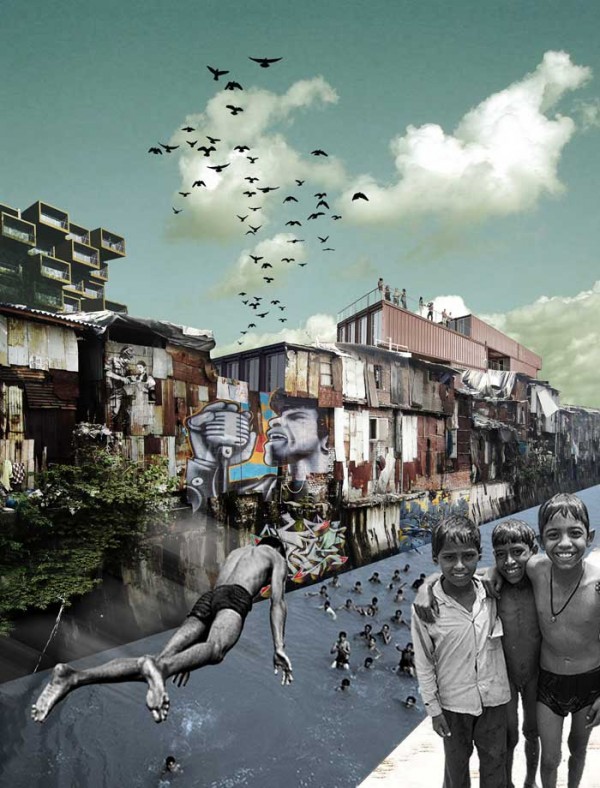
3. Dharavi is not Poor: Dharavi is an Indian success story. It is full of opportunities. It doesn’t matter how small one starts, as long as one is allowed to fulfill one’s potential. That’s what Dharavi has meant for hundreds of thousands of people.

4. Artisanal City: Dharavi strives on artisanal energy. A house is an object like any other. To build one you need knowhow and materials. Dharavi is not an architect’s city by any means and yet architects are fascinated by it for this very energy it exudes.

5. Do it Yourself or Die: Landing up in Dharavi means having a foot in the door to India’s wealthiest city. Migrants either exploit it to the maximum (sometimes all the way to the top) or get their foot cut off.

6. A Cluster of Tool-houses: In Dharavi virtually every home doubles up as a productive space. A tool-house emerges when every wall, nook and corner becomes an extension of the tools of the trade of its inhabitant. When the furnace and the cooking hearth exchange roles and when sleeping competes with warehouse space.

7. Reading Dharavi’s Palm: Dharavi’s history can be read through its streets, they are like the lines of the hand. It reveals a history of incremental development configured through the biography of each migrant, family, or community that ever moved in.

8. Dharavi is a Mangrove Forest: Architecture, social networks, and economic activity are irremediably enmeshed, like the roots and branches of a mangrove. Destroy one and you destroy the others. Let one grow, and you develop everything.

9. Forest Economy: Like all jungles, Dharavi is full of resources for those who know how to hunt and gather. Dharavi is a knowledge and skill based economy.

10. Density is Wealth: If there are enough people passing by, (and there always are) – you’ll always be able to sell something to someone. Density means opportunities and Dharavi is Super Dense.

11. Space = K: Space is capital, human energy is capital, relatives, neighbors and community members are capital. Capitalize and maximize whatever you’ve got – that is Dharavi’s byline.

12. Las Dharavegas: Dharavi follows the same logic of hyper exploitation of space, people and opportunities as Las Vegas. Aesthetically, however, it is vastly superior to Las Vegas. Humanly even more so.

13. My Sweatshop: Dharavi is the libertarian version of totalitarian Chinese sweatshop, producing just as much with a decentralized web of producers. Just as exploitative but allows more individual mobility and initiative.

14. Live/Work or Leave Work: Work at home if you can afford it. If you can’t then live at work. Either way no space can have just one function, unless it is sacred space. Gods and spirits need some privacy.

15. Intimate with Neighbours: Intimacy means everyone knows about everyone’s life. You are intimate with your neighbors for better or worse.

16. Hell is the Other People: Hell is other people and Dharavi is loaded with other people from all over India. The relations are conflictual but without violence (usually). At the end the bazaar keeps the goodwill flowing.

17. Fractal Social Fractures: In Dharavi you find refuge in your community and family only to find out that they are a fractal image of whatever lays outside them. Social networks are not smooth. Dealing with them only means more creative and pragmatic solutions rather than the bourgeois sense of corrected consensus.

18. Mess is more: Neighbourhoods that looks messy and backward at first sight are often instead complex, dynamic and resolutely contemporary. The karmic potential of Dharavi is realized in Tokyo’s periphery. Dharavi shares its history of incremental development, its low-rise high-density typology and labyrinthine street patterns with many of Tokyo’s neighbourhoods.

19. With Love From Dharavi: Some say it has the charm of European old towns. Yes, the very same “romantic” old towns that we all love. Did they look as pretty back then when they had open sewage systems?

20. The Village Inside: Dharavi is made of the same urban fabric that can be found in many artisan villages and smalls town in India, just much more of it. Scratch the surface and you’ll see the village emerge, almost intact.

21. Invisible Ties: Dharavi’s biggest strength in tangible terms is community/caste ties. Shrines and sacred spaces abound in Dharavi indicating this connection. They evoke old cultural trajectories and support systems.

22. Dharavi Development Project: Dharavi is already developed, it doesn’t need to be redeveloped. It simply needs the same add-on civic infrastructure that is available in any other part of the city. The Dharavi “Redevelopment” Project means stopping its on-going development and kicking hundreds of thousands of people out in the streets of Mumbai and throwing them into a situation of penury. They will move to another slum or start a fresh one, making Mumbai worse off.

Audacious Learning: The Dharavi School of Urbanology

August 17, 2009

Institutions have been much misunderstood entities. In strict anthropological terms they refer to any stabilizing of ideas, beliefs, practices, traditions, lifestyles, knowledge practices and skills that one generation wishes to pass on to the next.  By this definition, families, guilds, community associations, art schools that are based on the practices of a teacher – all qualify to be institutions. Musical traditions in South Asia codify themselves around gurus and become institutions of sorts. In Japan, martial arts, tea ceremonies and other arts and cultural practices center around the sensei and institutionalize themselves over generations. Much of knowledge, insights and learning have been generated through such inherited and evolved practices.

It’s only in the nineteenth century, with the emergence of the modern bureaucracy that a distinction came to be made between the primary and secondary nature of all organizations, with the former being part of the realm of domesticated, ethnicized or personal spaces and the latter being shaped by impersonal, universal principles that were sharpened by the development of bureaucracies. What such a distinction meant for knowledge and cultural practices was quite special. It privileged the development of modern day institutions only if they walked down the path of bureaucratic organization and relegated traditional knowledge practices to an informal realm – contained and preserved by traditional customs and private resources. As a result, the state, and subsequently large resource rich establishments, shaped the emergence of modern day educational, cultural and arts institutions, and made them more bureaucratic and impersonal. This was also the process through which the idea of tradition as a hyper-conscious space became more prominent pushing forth for a whole lot of speculation about the invention of traditions. This went hand in hand with the invention of other firmed up dialectical categories, including personal-impersonal, ethnic-modern, primary and secondary organizations, informal and formal practices, pure intellectual pursuits versus engaged and politicized practices, scientific versus religious truths so on and so forth – dialectical categories that plagued intellectual worlds for centuries but started to harden around this time.

Of course, in the real world, the informal and formal, the traditional and the modern played themselves out in complex ways. Thus modern day educational institutions could have large bureaucracies embedded in them along with age-old feudal practices and authoritarian teacher-patriarchs. Research practices could move between subjective and objective truths, between science and faith in various permutations and combination.

Eventually, these inner contradictions were contained by the idea of modern day institutions as respectable entities due to their validation as formal, organized and bureaucratic centers of learning and research. The more respectable they were the more they had to distance themselves from the other side of the wall; the informal, the personal, the engaged, religious, traditional…

What it did to the idea of institutions was particularly problematic. Any well organized bureaucracy, no matter what its ideology, beliefs, practices and track-record as a research center, could be passed off as an institution. Today, business enterprises running knowledge-for-cash programs are considered respectable institutions all over the world – going by the synonym of universities.

And small research centers, which connect knowledge to practices and are conscious of the power equations they are embedded in (they have no protection in the form of bureaucratic shields) have to prove themselves several times over before they can be understood as institutions.

The Dharavi School of Urbanology – see www.urbz.net for the latest update – is an institution in a more resilient sense of the term – when institutionalization meant a settling down of the ideas of practitioners who would like to learn more from the emerging generation.

It is located literally in the residual space of the grand journey of concepts that shaped the history of ideas and modern day institutional practices – the informal, hyperurban, dense space of a city – right at the other end of the spectrum.

What better place for a school of cities to be located in?

Its tiny. In the tradition of small centers of learning that could be found in narrow streets of old Edo, Alexandria, Baghdad, Benares centered around the beliefs and practices of people firmly committed to their dynamic beliefs.

It is a modern day myth that these were traditional spaces which preserved old forms of knowing. On the contrary, they preserved only by changing, evolving and adapting, unburdened by the categories of respectability and validation that modern day institutions are obsessed by.  They were centered on their practices and produced insights through them – with the same effectiveness as those hot on the pursuit of pure knowledge.

The Dharavi School of Urbanology challenges notions of institutions as it goes on to establish itself with literally nothing.

Do come and nourish it with your passion, experience and playfulness.

More Mumbai Politics

June 4, 2009

Last fortnight’s column evoked several angry responses. Indignant Maharshtrian friends who have never supported MNS (the right-wing Maharashtra Nav Nirman Sena, a break-away group of the Shiv Sena) in their lives complained strongly. Friends from Koliwada in Dharavi were admonishing. Colleagues from Kolkatta, once Marxist and now simply fed-up with the ruling communist party, pointed out that that the question of aggressive politics transcends parties and ideologies. Moreover, quite a few of the MNS supporters who wrote in, confirmed their support for the party, along with expressing disagreement with its aggressive tactics. That is a vital point. The fact is that in a democratic system we have to negotiate differences – however deep – without resorting to physical force. And if Mumbai’s political culture can evolve into a space where force and coercion do not shape its agendas, that would work best for everyone.

Go to any neighbourhood in which the street is still an integral part of social life and you will see it resonating with dynamism, with people helping each other in times of crisis, and daily needs, using community resources in the best possible way. These contexts throw up grassroots workers and committed activists. At one time, these neighbourhood leaders were the foundations of a strong, socialist culture. When the political fortunes of left parties declined, those spaces were taken over by newer parties who continued to depend on the excellent organizational skills and grassroots skills of this cadre. When you meet this cadre face to face, you meet several committed men and women, politically astute and very open minded. They are a far cry from the top rung of leadership who provide the face to such parties and often take decisions that put everyone at risk.

In many ways a new political outfit which enters the scene inherits both, a committed set of grassroots activists who know their neighbourhoods well and a legacy of corruption and the habit of muscling their way through issues. The point is what do you do with this legacy? You either fight it or join it. It takes a different kind of strength to willfully change something as deeply entrenched as a corrupt political system by working positively with local neighbourhood leaders.

The fact is that MNS had a choice – it could have started on a fresh note. It may have taken it longer to establish itself but it would have had greater impact in a positive way. Instead, it took the idea of force to another level, by scapegoating and violating the rights of poor sections of migrant populations.

Where does ethnicity lie in this story? It is an integral part. One cannot wish ethnic identity away. Or insist that people must transcend their ethnicity with a simplistic flourish, or that parties must give up their ethnic agendas overnight.

The fact is that Mumbai, with its location in Maharashtra and its strong foundational culture rooted in the local population will always be connected to a rich Maharashtrian ethos. It is equally true that the city is part of India and home to millions of Indians from elsewhere and it has the ability of making them all feel at home in their struggle for earning a living and validating their choice to settle down there.

That’s the whole city. All it needs is a healthy political worldview that matches this wholeness. That surely cant be asking for too much.

Published in the Mumbai Mirror, Wed June 3, 2009

Taking the ‘Slum’ Out of Dharavi

February 21, 2009

This is the original version of our piece that appeared in The New York Times on February 21st 2009.

It does not take much to galvanize protest against a movie in India, but few thought the word Slumdog would cause so much anger. Especially as hundreds of Bollywood titles translate into much worse. We had to pay attention though, when friends from Dharavi joined hands with the protestors. The Indian media widely reported popular outrage at the word ‘dog’. But what we heard from Manju Keny, a 19 year – old college student living in Dharavi – was something else. She was upset at the word ‘slum’.

We could not agree more.

Dharavi is the celebrated Mumbai neighborhood in which some the most spectacular scenes of Danny Boyle’s movie were shot, including the anti-Muslim riots of 1992. The opening sequence, however was actually filmed near the airport, with kids playing on the plane field, being chased by policemen and landing up – in a moment of pure Hollywood magic – a few kilometers away in Dharavi. Rather than name an actual location, the movie constructs a cinematic slum out of many pockets around Mumbai.

This imagery represents what most middle-class residents in Mumbai (and now all over the world) imagine Dharavi to be. The urban legend has taken root only because few of them have ever been there. It is the same reason why most Manhattanites still avoid stepping anywhere near Bed-Stuy, that beautiful and vibrant neighborhood in Brooklyn. Times might have changed since Barry Stein described it as the “largest ghetto in the US” but old prejudices die hard.

Likewise, the slum imagery does little justice to the reality of Dharavi. Don’t expect to see the familiar clichés about urban poverty here. Well over a million “eyes on the street”, to use Jane Jacobs’ phrase, keep Dharavi safer than most US cities. Yet, Dharavi’s extreme population density doesn’t translate into an oppressive feeling. The crowd is efficiently absorbed in the thousands of tiny streets branching into bustling commercial arteries. Also, you won’t be chased by beggars or see depressed people loitering. Dharavi is probably the most active and lively part of an already incredibly industrious city.

What you will see however are piles of garbage uncollected by municipal authorities. These are favored by a certain brand of photo-reporters and slum tourists. But then again, one has to remember images of Naples during the garbage crisis. In comparison, things are nowhere as bad in Dharavi where people have learned to respond in creative ways to the indifference of the state – including the setting up of a highly functional waste recycling industry that serves the whole city.

This resourcefulness has aroused the curiosity of people from all over the world. They cannot get their head around this phenomenon, which in sixty years emerged out of marshlands to become a multi-million dollar economic miracle that provides fresh food to Mumbai and exports crafts and manufactured goods to places as far as Sweden.

No master plan, urban design, zoning ordinance, construction law or expert knowledge can claim any stake in the success of Dharavi. It was entirely built by successive waves of immigrants who moved there in response to rural poverty, political oppression or natural disasters. They managed to produce a place that is far from perfect but has proved to be amazingly resilient and able to upgrade itself. In the words of its resident-activist Bhau Korde – “Dharavi is an economic success story that the world must pay attention to during these times of global depression.” The fact that it developed with internal resources, through the sheer resourcefulness of its inhabitants is something truly special.

Not surprisingly an increasing number of students, researchers, activists and writers are feeding off Dharavi to produce new concepts, participatory methodologies and architectural systems. They come not to help poor people but to learn from Dharavi. The Net Generation in particular recognizes itself in the story of this self-developing city, which is powered by the collective intelligence and individual aspirations of hundreds of thousands of people.

Why can’t government officials, real-estate developers and NGO workers think about Dharavi in any other way than as a slum that needs to be cleared and redeveloped? Maybe it is simply a conceptual and generational gap. Why can’t they see that development is in fact the main driving principle of Dharavi? Its apparently messy organization is not a problem in itself but rather an expression of intensive social and economic processes at work. In an age of complexity, artificial intelligence and wiki-logic, this should be self-evident.

Any attempt to segregate living and working would not make any more sense in there than in an artist’s loft in Brooklyn. In typical post-industrial fashion, in Dharavi homes double up as productive spaces. When the morning comes, mattresses are folded and tens of thousands of units emerge to sustain a decentralized production network rivaling in efficiency with the most ruthless of Chinese sweatshops.

Dharavi is the ultimate user-generated city. Its urban and economic development relies on the intensive use of social networks and communities. Each of Dharavi’s 80 plus neighborhoods has been incrementally developed by generations of residents updating their shelters and businesses according to needs and means. This organizational logic is neither new nor unique to Dharavi, but we have never been in a better time to understand it. Just as the development of open source software requires guidelines and coordination; all Dharavi needs is some support from the government – mostly in the form of giving its functioning some legitimacy by providing the same services as in any other part of the city– and then trusting its inhabitants to continue from there.

For this to happen, urban planning needs to come to terms with some of the fundamental changes that the information age has brought to all fields of knowledge and practice. The role of the expert, for one, must be reinvented. It is no longer possible for planners to work in isolation. Instead we must find ways to plug into local knowledge and respond with new ideas, tools and practices. Besides, the complexity of a neighborhood such as Dharavi should never be blanketed under a generic term such as ‘slum’. One way to deal with it, is to disaggregate and localize planning and design interventions. This should build on existing dynamics and incentives and work through the internal logic of each community.

This is no fantasy wishlist. Sometimes, historical accidents show the way for such spontaneous urban evolution. Look at large parts of Tokyo. Its low-rise high density and mixed-use cityscape, which appears messy and chaotic to western planners, has emerged through a similar Dharaviesque logic. The only difference was that it modernized, legitimized and was supported by economic growth, which its inhabitants themselves contributed towards.

Maybe all that Dharavi needs is a recognition of such spontaenous processes that have always sustained its development. As Ramesh Misra, lawyer and life-long resident puts it, echoing the aspirations of many in Dharavi: ‘We have always improved Dharavi by ourselves. All we want is permission and support to keep doing it. Is that asking for too much?’

The Itinerants of Mumbai

February 6, 2009

David and Charmayne de Souza’s book is a tale about Mumbai and the numerous roads that connect it to the rest of the world. Through the turns and twists of life, the city once seen as a refuge from nomadism, an heir of sedentary agrarian life, becomes the most vibrant stage for itinerants from everywhere. A stage vividly alive with other worldly songs, dances, colors and stories, which invites us to dream of hitting the road, leave all things behind, rely on providence, put on a colorful dress, paint one’s face, tattoo this bodily vehicle of ours, and dance our way through. Like madmen who have finally recovered themselves not by sitting back in an illusory normality but by engaging fully with their fantasies, using imagination, myth and tradition as weapons for survival.

With the rigor of a scientist, David catalogues the itinerant species of Mumbai. He abstracts them from their context and captures them in their most heightened spirits. His photo gallery of characters is reminiscent of our old biology labs, where obsessive professors kept exotic creatures in formalin. Charmayne sets the subjects of David’s photos back into movement through poetic inspiration. Her writing reminds us of the mythical dimension of itinerant life, which is present in every civilization. Sedentary societies have indeed always had an ambivalent relationship to the people of the wind, as Japanese villagers call them. Itinerants have been perceived in turns as indispensable trading partners, threatening agents of change and as objects of desire. David and Charmayne’s images and words bring to life some of the multiple avatars of that nomadic spirit that all of us carry deep inside and which refuses to leave.

This is probably why, turning these pages, even those of us who chose or inherited comfort and security cannot help but sigh at the thought of these untied lives, which seem to be fed by faith and magic more than anything else. Of course nomadic life, as intense and meaningful as it can be, is usually driven by necessity more than choice. But for an instant, it is liberating to believe that most of the people in this book would never trade itinerancy for routine and standardization.

Itinerants have by definition traveled through all kinds of roads and crossed all kinds of bridges. Poverty, subjugation, creativity, freedom and spirituality have proved to be the most difficult and slippery terrains, where one easily slides from one state to the other. And yet, evolving on these edges, itinerants have unsettled feudal political regimes more than any democratic system ever could. All through history, they produced heterodox spiritual kingdoms and challenged caste and tribal identities.

In Mumbai, itinerants are at home. This is after all, a city in which the street is king. It is here that the rules of urbanism seem to bend backwards, where the streets stop being just thoroughfares, where the evolutionary linearity of hamlet, village and town become fuzzy and where the home and the road become, quite literally, one and the same.

The itinerants of Mumbai are of many different kinds. Several of them may well have discovered the thrills and perils of the road only on arriving here. A large number could have moved from the world of subjugation to that of freedom on reaching here.  A fair amount would never consider their lives enviable and would be actually quite willing to trade it for middle-class comforts any day. Most may want to escape the streets altogether. But none would deny the fact that, if there is one place that is paradoxically reminiscent of the freedom that forests provided in the past to all those who wanted to escape, it is this city.

Every morning in Mumbai’s urban jungle, the multitude wakes up before the sun and chases the night away. Bats, rats and cockroaches go hide underground and the magnificent buzz starts. Those who have slept on the streets wake up to the blaring horns of taxis and buses. They find little niches in between buildings and by-lanes to use as washrooms. They open up boxes on pavements and transform them into stalls, enshrine trees with fresh flowers and incense, serve chai to the early crowd. Very soon they are dwarfed by the millions of commuters who march in rhythm to the city’s arcane industrial work ethic. While salaried men and women commute from home to office, from office to the supermarket and back, itinerants go nowhere. In the street only the sedentary kind must move, if possible in an AC car. The nomads are at home, right then and there, and everywhere.

The urbanite is often quite uncomfortable with this city’s most idiosyncratic citizens. That is because they seem to be so at ease in his landscape. Before he sees it coming someone knocks on the car window demanding a few rupees in exchange for a prayer, a flower or a book. Somehow it always feels wrong to refuse the trade, as if it the hawkers were actually asking for nothing but their due. The sedentary car user comes to terms with the nature of reversals, brings the window down and makes a deal. It is encounters like this one, multiplied a million times, that saves this city day after day. For all its shortcomings and in spite of a recent rise in nationalist politics, Mumbai has proved to be an urban oasis for many migrants and travelers ever since the first fishermen settled on its shores. It is the capacity of Mumbaikars to accept a high level of promiscuity with strangers that has made it so safe despite the vertiginous divides existing between castes and classes.

Itinerants become human connectors in an increasingly divided yet interdependent world. As much as the pathways and signals mediate roads and neighbourhoods, itinerants constantly connect the city’s many different dimensions to one another. They are the x-factor that allows this exuberant unpredictable city to function day after day. It is these ever-present encounters that make us realize how full of mad contrasts the city is. Where one brushes shoulders with ipod listening teenagers one moment and the very next, faces a tribal ritual masochist doing a thousand year old dance. Further down the lane, one come across the last of a dying breed of water carriers using ancient goatskin pouches walking past piles of used mineral water bottles.  One can hear a knife sharpener’s wheel screaming, next to a well-stocked shopping mall selling everything under the sun,

David and Charmayne’s ode to Mumbai’s itinerants makes the reader aware of these contrasts through their own distinct approaches. The portraits isolate them in the stark environment of the studio while the poems re-connect them to their contexts like light, near invisible strings.

They wake up the sedated jaded urbanite who turns away from their incongruity but has registered their presence and at the end of the day is actually blessed to be connected to the world wide web of the mystic, astrologer, eunuch or beggar. They provide that touch of fantasy, that glimmer of otherness that saves him from that very urban brand of autism proliferated by global media and consumerist culture. This coalescing of different moments, eras, epochs, and state of minds is what makes the streets of Mumbai so special. David and Charmayne remind us that their exhilarating unpredictability is predicated as much on run-of-the-mill disorder, civic mismanagement and individual idiosyncrasies as it is on the genuine love of unpredictability of the city’s inhabitants.

Itinerants wind up embodying the roads they inhabit. Not just its smell and hues but also its edginess, roughness and straightforwardness. This can been seen most sharply when the context is erased. In a photographer’s studio, which invisiblizes the city, the subjects in sharp focus become just as disconcerting as an empty, silent city on a day of curfew. Paradoxically, this evacuation of context only makes us understand the affectionate relationship of the street and its myriad squatters even better. The street is to Mumbaikars what the sea is to fishermen.

The book builds on several such reversals. It successfully generates the impression that it is not the reader watching these personas but the other way around. The itinerants look back amused at our child-like fascination as we gaze at them. They come with their pride and smiles and snap at our faces, waking us up for an instant from our sedentary somnolence.

They unsettle us for many reasons.

They convince our resistant minds that that the man with a painted face, outrageous dress and clinking necklaces is in fact truer to himself than the suited man driving by on his way to office. Is there anything more discomfiting than a head on confrontation with the self-conscious celebration of nomadic life and its exquisite liberty? Is there anything more transformative than the realization that the beggar and the hooker are actually richer than their patrons? Is there anything more radical than accepting the fact that the greatest perceived victim is actually a fearless master of his life?

David & Charmayne de Souza’s book “Itinerants, the Nomads of Mumbai” is available in all good bookstores.  In case you cannot find it and would like to purchase it contact us and we will put you in touch with them.

Media Media on the Wall

February 5, 2009

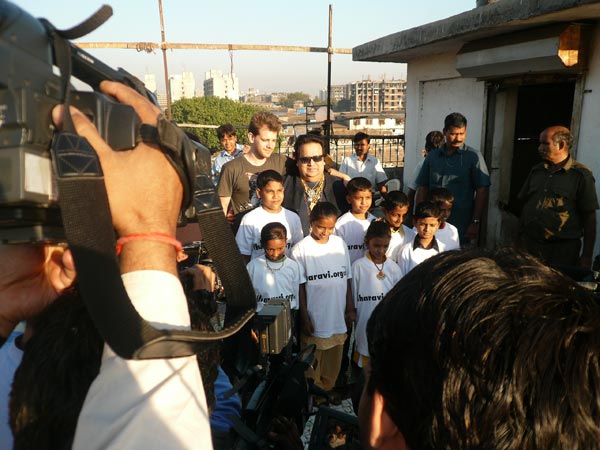
The Jevon Hall on Dharavi Main road usually resounds with Bollywood music playing during marriages and festivals. But last week Bollywood arrived on Dharavi’s door steps. Music composer Bappi Lahiri, the disco king of the eighties walked up the flight of stairs to sing with a bunch of children from Ganesh Vidya Mandir and Ambedkar schools located in Dharavi.

Bappi Lahiri aka Bappi Da came for a press conference about the new album he is producing with children of Dharavi and DJ Paul Devro of the label Mad Decent (Philadelphia). We had invited Paul Devro, a veteran of the Urban Typhoon Workshop, for a week to map the music and sounds of Dharavi. When Paul expressed his unconditional love for the music of Bappi Da, we immediately tried to connect them. It worked and they got along so well that they decided to produce an album together with children from Dharavi, which Bappi Da  called “Slum Stars” as a response to the title of the movie “Slumdog Millionaire.”


Bollywood star producer Bappi Lahiri with DJ Paul Devro and young Dharavi singers at a press conference in Dharavi.

Bappi Da recorded some songs with the children in his studio. The media had come that day to check out what his public relations officer had sent out to them. Many admitted they had stepped into Dharavi for the very first time. While Bappi Da, Paul Devro and the children got good attention – there were a host of community leaders and residents who had also come for the event but were given the royal ignore. Except for a couple of press reporters  – who did interview a few – for the most part Dharavi remained in the media’s shadow this evening.

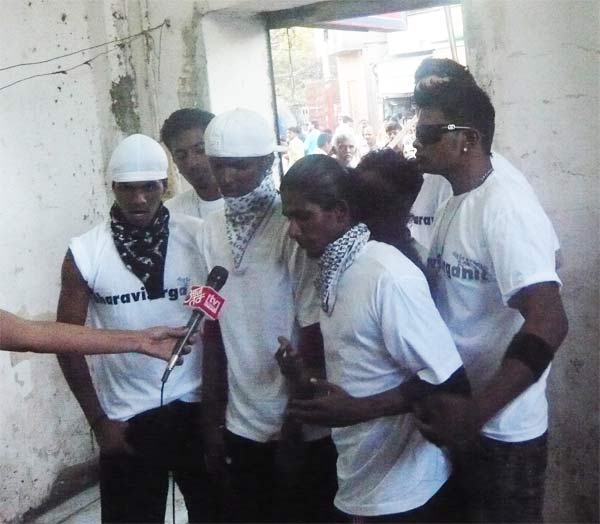
Fortunately, a local hip hop crew, the South Dandy Squad who Paul Devro had recorded and who had helped us find a space for the party in Dharavi managed to get some attention from the media.


South Dandy Squad performing a capella for a local TV network.

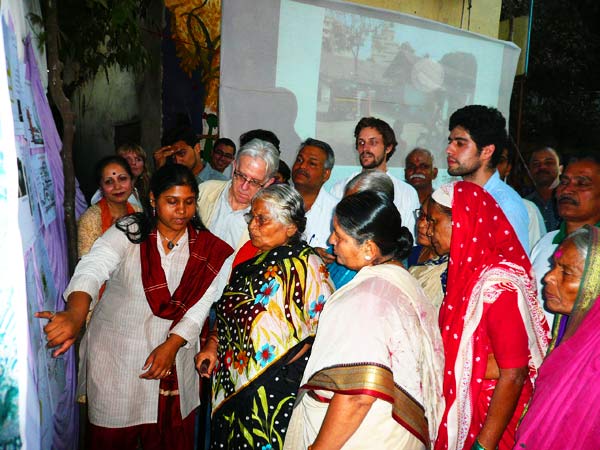
Yet – the media bias was clear. Just a couple of weeks earlier we, along with architect Wahid Seraj and students of Srishti School, Bangalore, helped organize an architectural studio. This was to help the faculty and graduate students of the Urban Design Program at Columbia University and the JJ School of Architecture do a project in Dharavi. The studio responded to the need of three Municipal Chawls in Dharavi to evolve plans for their self development.


Omkar Municipal Housing Society (proposed) in Kokiwada, Dharavi.

The issues were complex, but the students and the community did a terrific job in responding to the nuances. They provided alternative scenarios, using different rules and regulations. They connected with the community, who in turn gave them all the cooperation that was needed. It is rare that architects, planners and community members get a chance to collaborate like this. However, when an event was organized to present the work to the community and the public at large, we invited the media. Unfortunately, since there was no celebrity, no big speeches and consequently, very little reportage. The sole journalist who came did not publish the report as promised. It was published later – truncated within another story.

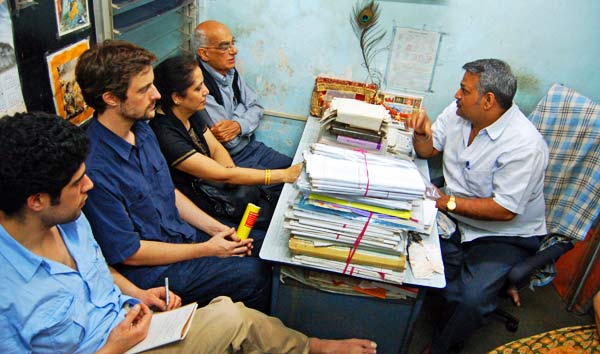
One of the persons who was disappointed, but not surprised was Mr. Ramesh Mishra, a lawyer born and brought up in one of the several Bombay Municipal Corporation (BMC) chawls in Dharavi, Koliwada. It was he who had invited us to help evolve plans for his chawls that subsequently lead to the studio. He was working on a case in the Human Right Commisson. It involved the right to self-development for the residents of his and a neighbouring chawl.


Ramesh Mishra (right) with members of the Urban Typhoon team, including architects Geeta Mehta and Kamu Iyer in the back.

The built-form of the ‘chawl’ evolved in colonial Bombay as a working class tenement modified on army barracks with one room per family, a common toilet and usually a long common corridor. They can be single or multi-storied structures and reportedly a good part of Dharavi comprises of chawls. Their existence testifies to some official involvement in their construction. In fact most of the tenants in the chawls in Dharavi built by the BMC (The Brihan Mumbai Municipal Corporation) pay controlled rent to the administration.


Municipal Chawl in Dharavi

The case by Ramesh Mishra demands that chawls such as his be exempt from the Dharavi redevelopment Plan which would reduce the size of individual homes considerably. His insistence that the BMC chawls be recognized as a distinct historical component of the neighbourhood is important at several levels. It questions the deliberate homogenization of the neighbourhood as one slum. It aligns with similar resistances by residents of Koliwada (in fact Mr. Mishra is on fairly strong ground when he says that his chawl actually comes within the purview of the Gaothan law – a special protection for urban villages).

All these concerns went into the studio but almost nothing was reported. Many residents of Dharavi have been cynical about the way the media reports or does not report stories about their neighbourhood, this is why we created www.dharavi.org which lets anyone publish their research, ideas and opinion in any language.

This is our tip to the mass media: If you want a good story speak to Mr Mishra, the South Dandy Crew and the thousand other people who have unique stories and knowledge about Dharavi. If that happens it will be a paradigm shift in the way the media understands cities and neighborhoods.


JJ School of the Arts and Columbia University students presenting their work to chawls residents. Bellow is one out of three Powerpoint presentations shown by the students to the residents. This was done after only a week of work on site. The students are now working on a more professional plan that Municipal Chawls hope to present to the authorities in June.

View more presentations from the Columbia-JJ studio in Dharavi .

In addition to the airoots team, Melissa Nahory and Sytse de Maat contributed photos to this post.

Dharavi: User-Generated City

January 24, 2009


Dharavi Bazaar by Wahid Seraj. What would happen if Dharavi could develop on its own terms?

Why is it that Dharavi exercises so much fascination for architects, urbanists, researchers, students and journalists from all over the world? Is it because it is the “largest slum in Asia”? Is it because it is under imminent threat of being redeveloped? Is it because it is worth billions? Is it because the global media loves to recycle stereotypes of victimhood and third world poverty? These tired clichés and false alarms have filled the news for some time. But it is time to reload our browsers.

Let’s start by dissipating some of the most prevalent myths about Dharavi. It is not the largest slum in Mumbai, let alone Asia. There are more huts and structures around the airport. There are massive, sprawling informal settlements in the industrial suburbs of Kandivili and Vikhroli.

The infamous Dharavi Redevelopment Project (DRP) has been decried as a land grab of the highest order by many residents, professionals and advocates in India and abroad. For better or worse it seems to have hit a wall after the financial meltdown. All that hot speculative money, which investment bankers were eager to cool off by injecting into real estate, has evaporated. Who can the government sell the land to now? Who wants to colonize that urban jungle full of political parties, slum dweller federations, NGOs, religious factions and angry residents?

The global media loves to work with the simplistic and highly problematic label of “slum”. City reporters, activists and non-governmental organizations also find the short-cut concept useful. Dharavi has often been pictured by the city’s media as a wasteland with barely standing temporary structures; an immense junkyard crowded with undernourished people hopelessly disconnected from the rest of the world, surviving on charity and pulling the whole city’s economy backward.

It is only recently, and in conjunction with informed local and global opinions that an alternative picture of Dharavi has begun to circulate. Where it appears as a developed urban area composed of distinct neighbourhoods, as a space where artisanship thrives, where commerce and business are the main defining moments of its landscape. Far from being depressed and isolated, the economy of Dharavi appears to be deep-rooted in the city and networked globally, with local goods being exported as far as Italy and Sweden.

If we deduct pity and voyeurism as the only reasons for the wide interest in Dharavi, what is left? Maybe there is something truly energizing and inspiring to be found there. Something so big that Mumbaikars don’t perceive it until they realize that the whole world is looking at it over their shoulders. Indeed, a certain detachment is necessary to get out of the general myopia. What fascinates so many people is no longer the misery of Dharavi, but its incredible capacity to develop and evolve in spite of all odds. Dharavi has emerged through the collective intelligence, skills and efforts of its residents. To use the language of the net generation, it is the ultimate user-generated city.


Dharavi Beach by Jose “Cole” Abasolo. Today the Mithi river is terribly polluted. Maybe that instead of throwing its untreated waste water into it, the five stars offices of the Bandra Kurla Complex could help cleaning it.

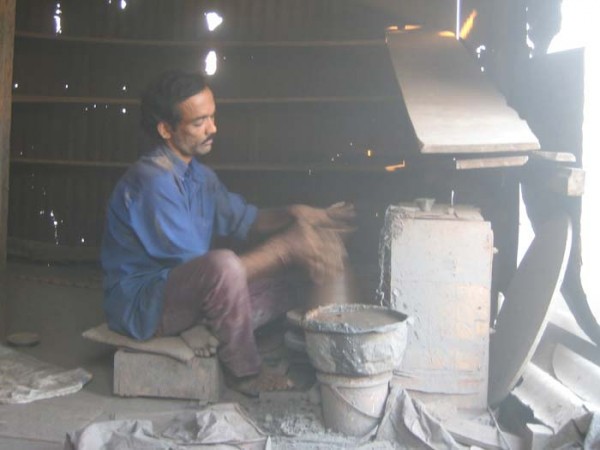
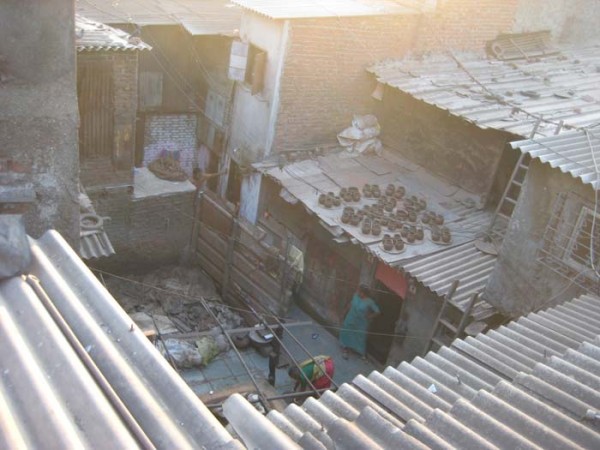
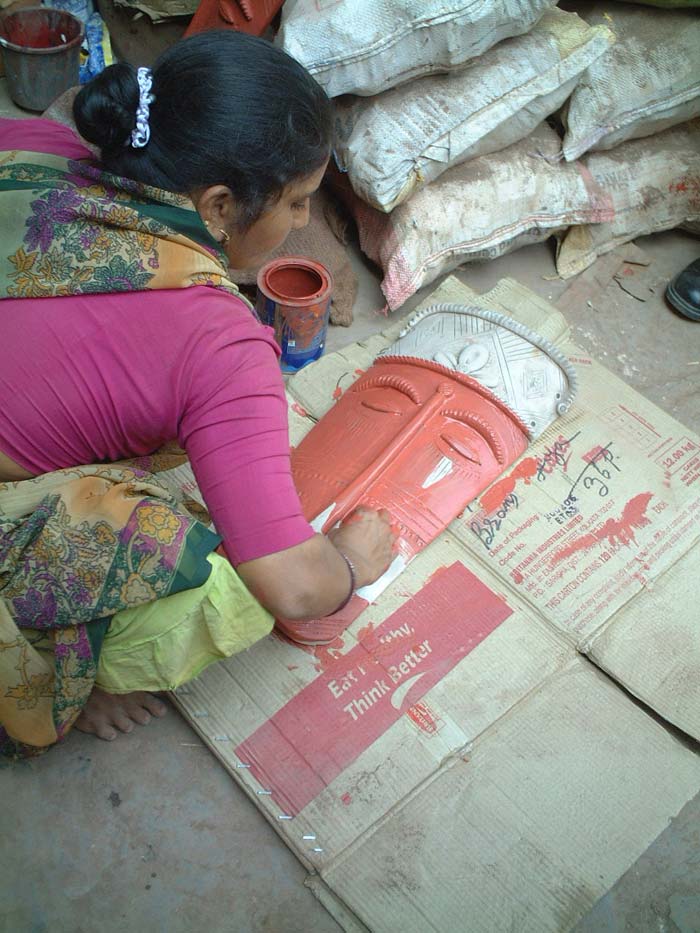
The fishing village in the neighbourhood, the potter’s community that settled there and the waves of rural artisanal migrants from different parts of the country came with their multiple skills and shaped this enclave in the most creative way one can imagine. In fact artisanal skills are primarily what has made Dharavi what it is. No wonder it is often talked about as the ultimate workshop-factory-residential space. The post-industrial, decentralized production processes through which most goods are produced in Dharavi stands in sharp contrast to the Chinese sweatshop model. Every wall, nook and corner is an extension of the tools of the trade of its inhabitants. Over here, the furnace and the cooking hearth regularly exchange roles and sleeping competes with warehouse space all the time. Space is the most precious resource in Dharavi, this is why it is used around the clock in the most efficient way possible.

The inhabitants of Dharavi have a fantastic capacity to solve their own problems. For many, Dharavi has been a platform for social mobility to middle-classdoom. However, one problem the inhabitants cannot get their head around is the threat of a top down redevelopment plan backed by the state. This burdens the residents of Dharavi more than anything else. Not only does the state not help, it even comes in the way of self-development. Why would anyone invest in their homes or business if it risks being bulldozed in a few months or years?

What seems to separate Dharavi from the DRP more than anything else is a generational gap. In the age of user-generated content, open-source and P2P, the net generation connects intuitively with the archetype of the squatter, who, just like the hacker in another realm, delves in and strives to overcome loopholes leftover by the system, and uses community and social networking as its modus operandi. In fact, it makes total sense to understand Dharavi as a self-generating post-industrial city.

While many are still chewing the blue pill, the world has experienced a paradigm shift, which most spectacularly manifests itself through the rise of information and communication technologies to affect all fields of knowledge. One of the principal characteristics of this shift is the collapse of distance between the expert and the layperson. The success story of Wikipedia, which lets anyone be a contributor to the most comprehensive encyclopaedia ever produced, is nothing but a reflection of the power of the Web, which was designed, in the words of Web pioneer Tim Berners Lee, “to be used for anything, constraining its users as little as possible … [and] built to enable, not to control.”

The user-generated approach to knowledge production is also injecting new concepts and viewpoints in the practice of urban planning. Top down plans such as the Dharavi Redevelopment Project have become objects of much criticism on the grounds that they completely ignore the knowledge and concerns of the residents themselves. Surely, they should be included in discussions and projects that will radically impact their sheltering and livelihood. How can one pretend to do any plan for Dharavi without drawing on the experience and skills of its inhabitants? After all, they are the ones who developed Dharavi generation after generation.

Slow, generational growth and incremental development is what created several European towns and villages that today are considered to be fine specimens of urban heritage. Close set streets, low-rise and high-density structures create vibrant neighbourhoods that have become major tourist attractions.


Tokyo Dharavi Remix by Matias Echanove. A chunk of Dharavi is inserted in a Tokyo landscape. The suburbs of Tokyo have the same urban typology as the informal settlements of Mumbai. This is because both share a history of incremental development.

In Japan, villages got absorbed seamlessly into new urban precincts and crop-fields converted effortlessly to residential or industrial spaces. A futuristic city like Tokyo emerged through such a process and reveals vast swathes of urban space that are dense with small, compact structures and labyrinthine streets, looking, from a distance, astonishingly like Dharavi.

More than a master plan, Dharavi needs a liberation of the imagination. Lets drop the heavy CAD maps and GIS surveys and zoom in to the street level. All Dharavi needs is some creative photoshoping and less of a patronising colonial gaze. If allowed to develop through their own internal skills, if provided for with basic infrastructural and amenities, the hundreds of enclaves, will keep improving their conditions, as they have always done. While no one can imagine what the neighbourhood may look in a couple of decades, it is certain to represent the city’s spirit like nothing else.

Published in Time Out Mumbai, Jan 20, 2009

Potter’s Tale

December 30, 2008

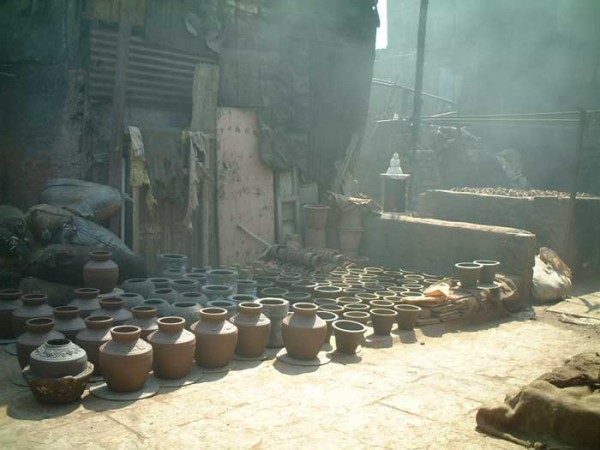
Ranchhod Savdas Tank from Kumbharwada, the potters neighbourhood in Dharavi, has very clear dreams and ambitions. He wants Kumbharwada to be known as the best pottery production center in the world. He wants the new generation of youngsters in Kumbharwada to find this traditional occupation so lucrative that they would take to it spontaneously. He wants to modernize production techniques, respond to the latest demands in terms of designs and choices and generally build on the hundred year old dynamic history of this neighbourhood that was founded by his ancestors and their families.

He is also very annoyed at the inability of the city, its media and civic authorities to see the value of his dreams and the fact that they are inextricably linked to those of the city at large. After all the city has been built on similar ambitions; it has seen enterprises emerge from nothingness, it has been nourished by the sweat of its hard-working resident-workers and it continues to evolve and modernize in many sectors.


Smoke coming out of the ovens where the Kumbhars bake their pottery.

He finds it difficult to believe that the authorities cannot see a simple thing. That his neighbourhood is primarily an artisanal space around which the resident artisans have woven an intricate and interdependent structure of residential and work spaces that are so enmeshed, that it is impossible for one to be conceived off without the other even for a minute.

Tank, like other members of Kumbharwada in Dharavi, believes that for the city to do justice to its history of enterprise, it must rise to the occasion and recognize this simple fact. The best way of recognizing this is by letting this neighboruhood continue to evolve through its own inner logic. Not impose a development plan on it and learn to give importance to the voices of its residents and their choices.

Coming across someone like him is indeed an important reminder to all of us so invested in transforming the city. It is an important lesson for all urbanists, urban planners and urban historians. What the story of Kumbharwada represents is a vital moment in the history of cities that has the potential of making Mumbai a trendsetter.

A history, which acknowledges that homes and workspaces were decisively cut-off from each other only as recently as the industrial revolution and the impact of this incision was most strongly felt in the house of the artisan. Historically, if there was any space that used itself most creatively and productively it was the artisan’s workshop-cum-home that produced goods that circulated in the pre-industrial economy.

The gigantic scale of the modern city was unleashed through many forces – mainly energy-based revolutions – but its architectural character owes most to the atomic split that happened when the workshop-home of the artisan was splintered. Since then, the logic of separating residences from places of manufacture has shaped much of the way we think of cities.

However, cities like Mumbai are living examples of built-forms that do not reflect this neat divide. The artisanal home continues to exist in many different forms. Consider the fact that this form exists functionally, in some way or the other (as studio-homes, artists lofts and so many other examples) in the contemporary global economy.

All it needs is a little bit of imagination to transform neighbourhoods like Kumbharwada and use it to showcase Mumbai’s amazing spirit of enterprise. The pottery industry represents one of the few lucrative artisanal occupations that has survived mechanical competition thanks to the tastes of its consumers.

It would be nothing short of foolishness to over look this precious history.


Photo credits: All but last by airoots team. The last taken by KRVIA

Published in the Mumbai Mirror, December 31st 2008

Opium City

December 26, 2008

Amar Farooqui’s slim but potent, ‘Opium City: The making of Early Victorian Bombay’ (Three Essays Collective, 2006) takes you on a journey of Mumbai darker than the city’s industrial waste.

Farooqui, makes absolutely no compromises. He leads us out of the sepia-tinted memories we fancy so much and forces us into the squalid eighteenth and nineteenth century streets of Bombay in a manner that would make most heritage conservationists squirm.

You get to see the city in pretty much the way we know it today – a city of crowds and pathetic facilities for those unlucky to live outside its privileged, inner circle. A city dominated by administrative uncertainty, yoked to the larger imperial project headquartered in Calcutta much in the manner that it is today to Delhi. A city energized by small business communities from across the region, but who are always kept subservient to its suspicious rulers. A city economically addicted to forbidden trade – opium – an addiction that shaped the rules of the trading game and one, which remains a shadowy presence in the city’s underbelly, where the lines between business and crime are still seen as blurred.

Such an account of the city’s past means that those who lived through the city’s effervescent post-independence optimism – the celebrated decades of the fifties and sixties – have to re-cast their nostalgia and see them as freak moments. As soon as the dust settled, the city reverted to its wicked old ways.

But then, Farooqui’s story is still half-told. Historians often get so carried away by the austere fact that lies in the archive that they forget there’s more.

And one is not talking about the spirit of the city at all. That has been done to death, by novelists and writers – and with good reason. One is talking about the fuel that keeps the city going – the act of exchanging goods and services.

We detect in Farooqui’s rendering a lot of prejudice about conducting business itself. And the familiar disdain that many misguided historians in India have towards this act. A disdain that is a mirror image of the equally pathetic attitude that the city’s economic elites show towards the traders that rule its streets – the feriwalas or the hawkers – treating them like criminals.

Such extreme attitudes yield two contrary but complementary stories; of the city’s heroic working class past that focuses exclusively on its industrial, trade union-lead history and the false hagiographies of its corporate heroes.

In reality, the complete story of Mumbai lies in its very humble origins as a trading city, which incidentally, Farooqui draws quite accurately. The problem is the way he tells his story.

He does not do adequate justice to these real characters – the petty traders, small shopkeepers and street-hawkers – who were crushed in the past by a colonial regime that treated them suspiciously. But they were all over the place, building the foundations of the city and making it what it remains – an economically successful and cosmopolitan city.

The tragedy is that even such well-researched historical accounts condemn these characters into insignificance because they do not fit into a larger story of working class history.

And that’s the reason the city keeps stumbling.

Instead of making the symbol of the feriwala or the street trader, its mascot, the city criminalizes them while the prejudiced scribe ignores them altogether.

No wonder the city’s thwarted identity spews out weird mythologies where the underworld refers to itself as a business company!

Audacity

December 7, 2008

Published in The Hindu on Sunday December 7, 2008

In the last week of November, all of us living in Mumbai went through a succession of mental states. Ranging from incredulity, rage, cynicism, disbelief, shock and nervousness, to fear, sadness, numbness, hate, and and the most disturbing of all, fascination. A morbid fascination for the ability of a handful of young guys to create mayhem in the city, shake Indian politics, and hypnotise the global media.

Surely these were no ordinary kids. They were well trained, fully equipped and possibly driven by faith. Thanks to GPS technology they could navigate an ancient sea route that connects two colonial cities partitioned by history. Thanks to their urbane appearance they could sit down at Leopold café and enter the city’s best hotels without raising any suspicion.

They checked in at the Taj next to the general manager and transformed their quarters into a five-star control room. After brutally killing scores of tourists they cool-headedly recharged their AK-47 and rampaged the city. They killed Mumbai’s top cops and hijacked police cars, twice. Till the end they defied India’s best commandos. For a moment it seemed that the country’s entire army could not stop them.

Before last week, a movie script based on this sequence of events would surely have been deemed far-fetched. The audacity of this attack is indeed incredible.

The accomplishment of extraordinarily audacious objectives has precedents throughout history. Not too long ago, the word audacity was being brandied in a completely different context and with a completely different meaning. In fact, at the other end of the spectrum altogether. A group of determined men and women succeeded in carrying their candidate all the way to the highest office, beating the most powerful political apparatuses in the US: The Hillary campaign and the Republicans. The Obama campaign provided magical inspiration to people all over the world and revived some hope for the world’s most powerful (and dangerous) democracy. Such a comparison is itself audacious, but there is a reason for making it.

If anything could be learnt from last week’s event, it is the lesson about the power of audacity. Audacity is precisely what Mumbai has been lacking, especially since the 1991 communal riots. Instead of defending its multicultural identity, forged by a history of trading and migration, it allowed goons turned politicians to rule and tear apart its unique brand of cosmopolitanism. Innocent scapegoats were killed and cowardly mobs were rewarded, setting in motion a cycle of violence that just took a new spin last week.

A response to last week’s events driven by fear and paranoia against our immediate or distant neighbours –which seems more than likely– will only feed into a further destructive spiral. If we don’t want to stand mute witnesses in the face of history, we will have to reclaim audacity for ourselves, and prove against all odds that yes-indeed all things are possible; including transforming our city’s mindset and reclaiming diversity and openness as Mumbai’s main strengths.

To do that we will have to rise above our prejudices against certain communities, neighbourhoods, slums, even ordinary people. These prejudices put us at threat more than anything else. Here is a concrete example: Of all the failures that paved the way for last week’s disaster, the biggest was that the police didn’t follow up on an alert given by members of Mumbai’s oldest communities, its fishermen. They were the first to report abnormal activity on their shore. Unfortunately they were not heard.

Read another airoots article on this topic published in the Mumbai Mirror, December 3, 2008

« Previous PageNext Page »