DOT project, Dharavi-Mumbai

December 2, 2008

We are looking for funding for a project in Dharavi. We need your help! Please contact us if you can contribute or if you have any suggestions!!!

The Context:

Dharavi is usually described as the “largest slum” in Asia. Home to at least half a million people, it is one of the most diverse and culturally vibrant parts of Mumbai. About 95% of the residents of Dharavi belong to what are officially called dalits and ‘other backward castes’. This partly explains why the authorities have largely ignored their needs. Political parties and NGOs have been present in Dharavi for many years, providing support to many residents and speaking on their behalf. However, to this day, it is nearly impossible for individuals and grassroots groups of Dharavi to get heard. Mass media is generally sympathetic to the hardships endured by the residents, but again usually misrepresents Dharavi as an homogeneous community, when in fact it is composed of about 88 communities, each with their languages, practices and cultures.

One of the highest stresses faced by the residents of Dharavi today is uncertainty regarding their housing and workspaces. The Slum Rehabilitation Authority (SRA), which is the government agency in overseeing slum redevelopment efforts in Mumbai, has divided Dharavi into 5 sectors and requested proposals from real estate investors from all over the world for each of these sectors. This project, known as the Dharavi Redevelopment Project (DRP), requires developers to provide a 300 sqf flat to each family that can prove that it settled in Dharavi before the year 2000. In exchange for rehousing residents in new buildings, the builders get construction rights in Dharavi.

The DRP has been highly criticized by NGOs and independent experts, notably for leaving out of the plan hundreds of thousands of residents who cannot prove that they settled in Dharavi previous to 2000. Some experts have also pointed out that any plan that might increase the current population density of Dharavi was irresponsible, since the density levels are already unsustainable. In any case, the DRP is severly compromised by the current financial crisis, which has caused many of the bidders to withdraw or simply disappear.

Dharavi residents may be temporarily off the hook but that also means that Dharavi will also certainly fade away from the media and government’s limelight and go back to being what it always was, a shadow city. One of the reasons for the media frenzy that surrounded Dharavi is that it epitomizes the urban crisis that Mumbai, India and the world are facing as more and more people move to cities. Global economic recession will not stop rural immigrants from coming in mass to urban areas. In fact, as the crisis hits rural areas, it might well accelerate the influx and therefore the informal development of shelters on the city’s pavements, along the railways, and in the periphery.

The recent attacks in Mumbai will almost certainly translate into a renewed attention on security and a greater insularity of middle-class and upper class enclaves in a city where about 60% of the population is said to be living in slums. This deepening of the class divide will only isolate the poor majority further and exclude them from a process of development and globalization that has benefited many middle-class Indians.

The residents of Dharavi are not only aspiring to better living standards, they have also demonstrated extraordinary resilience and creativity in the face of social exclusion and economic hardship. Many commentators, including The Economist, have been impressed with the dynamism and entrepreneurialism displayed by Dharavites. Local industries, such as leather and embroidery, are even attracting the attention of shoppers and investors. Moreover, researchers, including Nokia’s R&D team and Microsoft Research India, who have performed market studies in Dharavi have noted the extremely high absorption of new technologies by the population. Every lane in Dharavi has a cell phone retailer, and cybercafes are flourishing.

The Urban Typhoon workshop, which took place in Dharavi in March 2008, and was supported by Asia Initiatives in Japan and PUKAR in Mumbai, clearly confirmed that residents are willing to be involved in the development process and have more than physical manpower to contribute. Foreign participants were utterly impressed with the positive attitude and great motivation displayed by local residents, as well as by  their genuine willingness to be part of the solution.

The Concept:

DOT stands for Dharavi.organic Technology Centre. It combines several initiatives taking place in Dharavi, including the PUKAR Youth Fellowship, the Urban Typhoon Workshop, and the dharavi.org platform. These initiatives are described in the last section of the proposal.

DOT is a space of self-expression for all residents of Dharavi. It aims at helping those who are willing to voice their opinions, ideas, visions, and plans out to the rest of the city and the rest of the world.

Objectives:

The DOT center will provide a space, tools and training in English, Marathi and Hindi for all those who want to use dharavi.org and access other websites.

Dharavi.org already serves as a link between people interested in researching Dharavi and local residents. DOT will now allow residents to reach out to people, community groups and organizations from around the world who are dealing with the same set of issues.

The Urban Typhoon workshop sparked the interest of Dharavi residents from various parts of the neighbourhoods. DOT will provide an infrastructure that will allow the multiplication of such initiatives. DOT will help connect Dharavi with students and schools of architecture, engineering, planning, and economics as well as social workers and generally with people from all walks of life who want to spend some time to help local projects in Dharavi. It will constitute a physical connection point for the outside world into Dharavi.

DOT will not only allow Dharavi residents to access the Web free of charge, it will also help them to use it to fulfil their needs and aspirations. It will for instance support local business initiatives and the pursuit of educational goals.

In addition, DOT will provide vocational training in hardware repair and software development to young people in Dharavi. It will then connect trainees to potential employers.

The space itself will have versatile usage and will be usable for different functions, such as parties, youth, women’s groups and various workshops and classes.

Partners:

PUKAR (Partners for Urban Knowledge Action and Research) is a NPO (Not-for-profit-organization) in Mumbai. It is a Research Collective that has an ongoing three-year-old research project with 40 groups all over the Mumbai Metropolitan Region involving 300 youth from diverse socio-economic backgrounds, as barefoot researchers.

Dharavi.organic is a multimedia open source Wiki website dedicated to Dharavi, one of the largest informal settlements in the world located in the heart of Mumbai. This is an URBZ project.

Urban Typhoon is a participatory design and planning workshop organized by a global network of urban researchers and practitioners. The first Urban Typhoon workshop was held in Tokyo, 2006, the second in Mumbai, 2008 and the next one will take place in Istanbul, 2009.

Why Mumbai’s Slums are Villages

November 26, 2008

Mumbai’s history reflects two distinct phases. One is the south-oriented story that starts with the development of the docks by the British in the early eighteenth century. The other is an older, northern-bound story that starts with the Portuguese conquest and domination of the regions around Vasai village in the sixteenth century. The essay argues that the point of intersection of these histories is one that can potentially explain the overwhelming presence of poor, infrastructure deprived habitats – often referred to as slums – that dominate the landscape of the city.


Worli-Koliwada, one of seven century old fishermen settlement in Mumbai

Mumbai’s slums occupy an unusually large scale – even when compared to other Indian metropolises, with similar economic and political constraints. The essay proposes that the scale and depth of the phenomenon requires a special inquiry into its history. The essay does this by focusing on the story of a small habitat – called Khotachiwadi – that encapsulates many of the issues being debated. Khotachiwadi eventually however, becomes a springboard to discuss other issues to do with the political economy of built-forms in the city – especially with regard to the dialectic of the slum and the village.


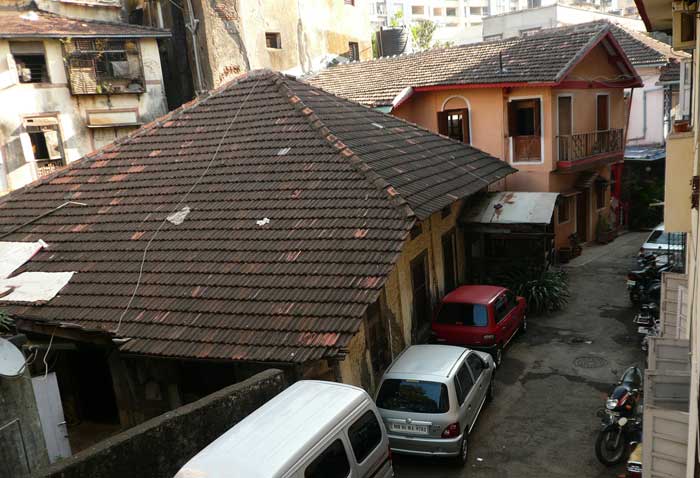
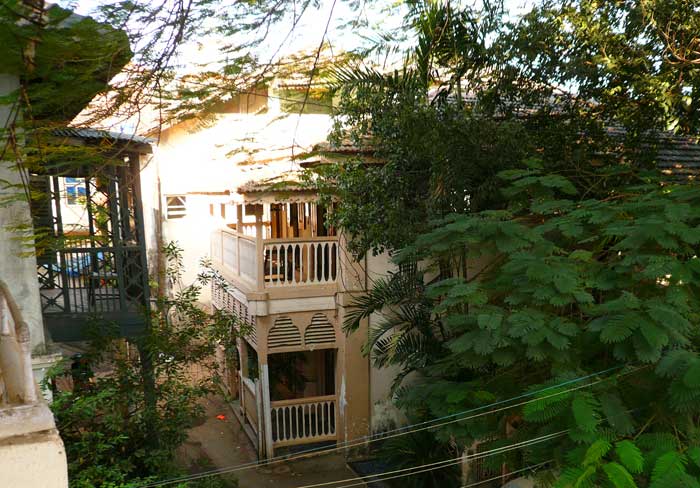
Khotachiwadi, Girgaum, South Mumbai

It also asserts that a critical examination of the category ‘slum’ – and its relationship with the ‘village’ – can challenge take-for-granted notions of urbanism and urban futures for labour-surplus countries like India that have old agrarian histories.

These notions usually render village-like habitats as being inappropriate for modern urban spaces. These spaces are viewed as having a certain kind of density that can only be absorbed by the high-rise form, which, in turn, is presented as antithetical to the village. While critiques of these notions have the potential of moving into radical ideas of the urban – especially in the realm beyond built-forms – this paper restricts its discussions to the physical dimension of urbanism.

When the Portuguese empire handed over islands in the southern end of the region to the East India Company they did not see this cluster of islands as valuable. They were more interested in the rich fertile lands of the north that supported their trading activities connecting Daman, Vasai, Goa and Calicut. These lands were dotted with villages that went all the way to Mahim and Bandra, perceived to be the southern borders of the Portuguese sphere of influence. The social structure of this space was dominated by a combination of feudal and mercantile practices subsidized by low-caste labour. Large parts of the population were converted to Christianity, a process that preserved the caste divisions by allowing for the emergence of upper caste land-lords and low-caste labour and artisanal groups.

When the East India Company took charge of the southern islands, they forcefully integrated Bandra and Mahim, which they saw as the northern borders of their territory. As the influence of the company increased through the development of the docks, many groups migrated from the Gujarat and Maharashtra regions all through the seventeenth and eighteenth centuries. The Parsee, Hindu and Muslim Gujarathi merchants, shop-keepers and businessmen moved in and around the Fort areas and brought in their urban traditions of built-forms from their city of origin – Surat – an architectural legacy that is still evident in some neighbourhoods of south Mumbai – especially Kalbadevi. On the other hand, the low-caste predominantly labour communities found themselves being absorbed by the villages that existed, in what was then perceived to be, the peripheral regions of the north. The lands were mostly owned by Christian landlords or occasionally by a member of the Pathare Prabhu community – an old courtly caste that linked its existence to a thirteenth century kingdom nearby.

All through the nineteenth century, poorer migrant groups would pay rents to landlords to set up hamlets that became their homes. Interestingly, richer rural communities, mostly upper caste Catholics, who happened to be educated and got skilled jobs in the docks also reproduced similar hamlets – referred to as wadis. These expressed themselves in newer villages like Khotachiwadi – a hamlet of cottages in Girgaum or a similar one in Matharpakadi at Mazagaon. They looked like the older upper-caste landed villages of Bandra, Mahim, Gorai and Vasai but had actually been built afresh in the nineteenth century.

On the other hand, swampy land around Mahim, particularly in a village called Dharavi (that was occupied primarily by Koli fisherfolk) became the site for the settling down of untouchable communities from different parts of the country. Those regions were seen to be unlivable and peripheral, from the vantage points of both – the fisher community that lived by the sea, as well as the city civic-authorities in the south.


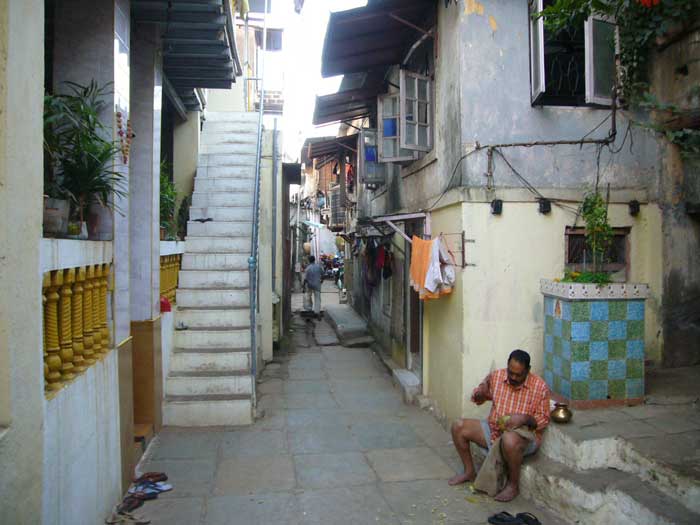
Dharavi-Koliwada, a fishermen village that has for long been called a slum

As it turned out, as more low-caste groups arrived from the countryside, attracted by the mills and the docks, the southern city could provide only limited accommodation. Most of the surplus labour lived in the villages, outside the perceived city limits.

As the southern city kept expanding and as dependence on agriculture declined in importance, it became easier for landlords to make more money by renting or selling out land than through agriculture. However, when their lands got integrated into the city they had to give up their control either to the civic authorities or to slumlords. This process got even more complicated in the post-independence period with the development of a local electoral process and the growth of new neighbourhood leaders.

The landscape that thus formed by the middle of the twentieth century in the northern parts of Mumbai was really a cluster of villages that had become outsize settlements. Even today, the largest slums of Mumbai in that region -  Dharavi and Jari-Mari – reflect this village like legacy with their land ownership patterns revealing this quite clearly.

However – villages do not simply become slums because of an awkward growth in population. It helps a certain political economy to view them as slums and this is the main argument being made in the essay. The attempt is to understand the deeper historical basis of slum formation in Mumbai and see it as much as a story of habitats and perceptions about habitats, as about the political economy of scarcity of infrastructure.

To explicate this point – we focus on a small village – called Khotachiwadi in Girgaum.

Khotachiwadi is a cluster of about twenty-eight small cottages and bungalows built in the late 19th and early 20th centuries in the heart of the city. Today it is referred to as an urban heritage precinct mainly because of its distinct architectural flourishes linked to an Indo-Portuguese past.

Right from the start, the homes represented a diverse set of architectural influences – Portuguese villas, Maharastrian coastal cottages, Goan homes and regular cottages and bungalows found in the region. In its hey-day – the early twentieth century – the village boasted of about eighty-eight such individually owned or leased homes.


Engendered architectural heritage in Khotachiwadi

During the course of interactions with the villagers, we came across frequent statements by elderly residents mentioning that the wadi used to be referred to as a slum in the early twentieth century. It was called as such by British surveyors who were developing a larger urban plan for the city. Intrigued by the fact that a village now celebrated for its architectural legacy was once referred to as a slum, we continued to explore this observation.  In spite of frequent attempts though, we were unable to actually verify this through archival material. The records only mentioned the real name of the village, never the underlying assumed category. However, on inquiring with contemporary architects, urban planners and government officials, we found most of them agreeing with the residents. Their certainty was based on the awareness that many habitats even today tend to be loosely referred to as slums, though they are historically distinct villages. Some historical accounts of the city even referred to its native towns (immediately outside the Fort precinct), as slums. Referring to Khotachiwadi as such was, thus, quite understandable.

After all, even today, there exist village lands – called ‘gaothans’ – that are specifically recognized as distinct non-urban habitats, with separate development laws. They are treated by developers – and commonly perceived by neighbouring settlements – as slums.

According to urban historian Rahul Mehrotra, it was in the fifties that one saw the emergence of the simplistic binary – the slum and the multi-storied building dominating rhetoric of built-form in the city. It came to represent a discourse that over-wrote the diversity that existed in the earlier experience of Mumbai’s built-forms and transformed the perceptions of the future of the city through the aspiration of being a high-rise oriented city. This aspiration eventually started a process that aimed at erasing all ambiguous habitats, especially those that embodied the ethnic elements of built-forms found in the erstwhile “native city” – but more so those structures that seemed rural and therefore inappropriate . Thus till the heritage movement in the city really firmed itself up as some kind of a force to reckon with in the 1980’s – much of the old city (that was not protected by the old Rent Act) was destroyed on the grounds that it was part of a back-ward looking colonial experience .


House of famous fashion designer and Khotachiwadi life-long resident, James Ferreira

Places like Khotachiwadi were seen to be anachronistic, since they were villages. While most “native” spaces were distinctly urban buildings, this particular habitat’s resonances of being “rural” created further trouble for it. The colonial “native” city had quite comfortably absorbed the rural memories that its migrants had brought in. These memories had provided the quaint architectural flourishes of habitats like Khotachiwadi. However, in the long run these very flourishes and characteristics made these hamlets seem inconsistent with the ideals of a modern “urban” present – one, that wanted to distance it self as much as possible from any rural memory.

Click here to read the full version

Magical Planning

October 5, 2008


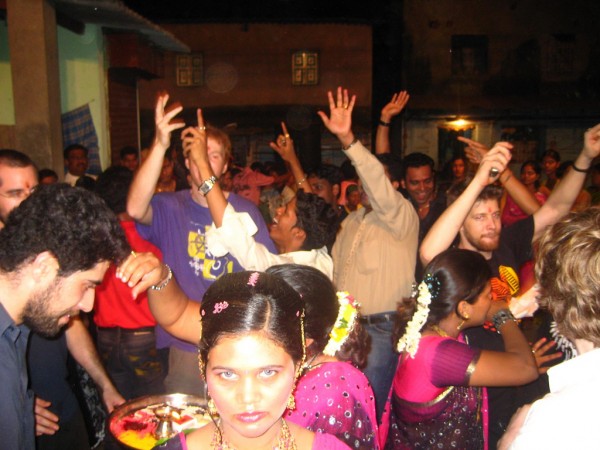
Celebration of the Holy Festival, last day of the Urban Typhoon Workshop in Koliwada-Dharavi

Sorry Manuel Castells and David Harvey and all those great theorists who have taught us how capital and technology produce the city and constrain also its future development. Apologies to Paulo Freire too who’s tried his best to wake us up from our delirious “magical consciousness” to teach us that we are “subjects in and with an objective world”.

You really are great and we are trying, but we just cannot (and don’t really want to) get liberated from our imagination. We love the world of possibilities more than the world “as it is”. We know that “in theory” the two are not incompatible, but in practice, they don’t fare that well together. So while you go ahead to keep describing it, we’ll imagine it the best we can.

Language and imagination are the best tools we have. And now the mighty Web allows us to drop ideas right in the reader’s heads, enhanced with special graphics, sound and moving images. After having tried both, we are convinced that unrestrained imagination has much more transformative potential than analysis. Don’t get us wrong. We love theories, they are beautiful narratives.

But as Yehuday Safran said, the world is shaped “above all through language, and its sublime, monstruous imagination.”  We support all the truth seekers. Seeking truth is a beautiful project to undertake, so beautiful in fact that it really doesn’t matter if it ever gets realized. But sometimes another path is equally fruitful. What we like is trying out our imagination on reality to see what works. And imagination is at its best when it is naive, magical and wild.

Look at cities. They are first and foremost the products of collective imaginations. Dreams of grandeur and power produce avenues, churches and skyscrapers. Immigrants create heavens for themselves in far away lands, which they dreamt about on their way. When they cannot actually create heavens, they dream of going back with some money to recreate them there.

These heavens are simple really – homes that are the realization of life-long dreams. At the very least, people use imagination and decoration to make their shacks feel special. As Hiroshi Hara said, “There are as many worlds as there are rooms.”

It is also clearer today that communities are imaginary. More than ever before, we live in a deterritorialized world, where the outside and inside have supposedly lost their meaning. Resorting to the imagination is therefore a matter of survival. It is especially when localities get produced by an exterior context that inhabitants dont control, that they need to use their imagination to generate a context from within. A context that can be based on historical narratives, cultural affinities or fantasies – whatever one chooses.

It is worth fighting for an imagined space, especially if it is a stage for human relations and interactions. But it is not worth fighting for a space that restrains or limits imagination in any way. There is no point defending a place that cannot be transformed; unless it is a place worth preserving for the story it embodies, such as a ruin (especially if it is haunted with good spirits). Places must inspire or they must be rethought completely!

The Web is the greatest creation since the letters of the alphabet. In fact the Web is a product of the wild imagination of Tim Berner Lee who dreamed of hypertextuality to communicate the ideas of his time – just like Gutenberg shaped the printing press to communicate the ideas of his. The power of the Web is that it provides the most advanced space possible for the textual/visual expression of imaginaries. Moreover it connects ideas to each other on an infinite plane. What’s more, it acts as a mirror between the virtual world of imagination and the physical world. And it works both ways!

Much more than simple text alone, it allows others to contribute and evolve one’s own imaginary. Just like you could add a comment under that post or copy-paste it onto your blog. These simple moves enhance the potential for materialization of ideas into the physical world.

Here is a concrete example.

There was always a point in time during the organization of the Urban Typhoon workshop when the whole event was nothing more than a Web page. It was no more than wishful thinking by a small group of people. At that point we didn’t have any money to get the guests over, commitment from the local community was at best uncertain, and we had almost no registered participants.

Nonetheless this vision, expressed in the form of a decent Website, made people believe that it was real – and they registered. Contacts were done via email, but it was only on the day of the workshop that people actually materialized. Participants never doubted that the event was really happening, but we only knew that it was real when we saw them actually apparating, one by one – notwithstanding the fact that we were the ones to have invited them in the first place!

It was always harder to convince local people that the workshop was really going to happen. It was even harder to convince them to participate, even though that was the whole idea to start with. We had been invited but community members in the first place but most local people had no interest in participating until the the outsiders popped out of the World Wide Web with their eyes full of great expectations and a pre-emptive love for the neighborhood.

The outsiders had no problem imagining that a fantastic event was going to happen in a fantastic place. They connected the place to the event, while the locals could not connect the fantastic event to their everyday, banal place. At first they simply could not imagine and refused to believe, but that was only until they became overwhelmed by the enthusiasm and faith of the numerous believers.

The materialization of this event comforted us. We felt kicked and gleeful, in our back-of-the-classroom-dreaming pupil approach; our favourite kind!

Next thing in line is the Koliwada Design Cell, which will be the fantastic vehicle that will take us on a journey towards the realization of a participatory development project for Koliwada. All the walls on our way will disintegrate! Lets try out some magical planning.

Dharavikitazawa

October 1, 2008


Structures from Dharavi (Mumbai) are inserted in this Tokyo landscape.

Here are a few collages showing how strikingly similar are the urban typologies of Dharavi (Mumbai) and many neighborhoods of Tokyo, in this case Shimokitazawa.

Shimokitazawa was preserved from destruction and redevelopment throughout the war, up to the present. As a result, the town developed incrementally along its narrow streets, retaining a village-like feel that contributes to its popularity. Characterized by low rise buildings, pedestrian space, bustling ground-level market activity, and tight community networks, Shimokitazawa represents an alternative model of urban development: the informal, unplanned city that consolidated through time.

These two neighborhoods shave many similarities despite evolving radically different contexts. Their common characteristics are indicative of some important global urban dynamics usually ignored by planning authorities.


Dharavi, left and Shimokitazawa, right.

Both neighborhoods are seen as “messy”, non-functional, irrationally laid out, hard to navigate, even harder to map out, nearly impossible to access by car, not zoned, mixed-use, full of narrow pedestrian streets with crowded storefronts, mobile vendors and groups of people hanging out. Moreover, they are havens for marginal groups and informal (or illegal) activities, and breeding grounds for all types of anti-conformist attitudes, subversive activities and movements of resistance.

In fact, there is nothing rational about denouncing them as messy. It says more about the ideology or phobia of whom is pointing the finger than anything. Indeed, this “mess” hides a different order. In the case of Shimokitazawa and Dharavi, we witness the emergence of new cultural, social, and economic patterns, which might well be some type of a global edge; an early adaptation to deep transformations in our ways of working, socializing, interacting and thinking.


Shimokitazawa streetscape with Dharavi house on the right.

Both neighborhoods are populated by creative, highly mobile, and entrepreneurial people who generate economic opportunities for themselves. They have developed sophisticated social networks, relying on the most intensive used of available technologies. Mobile phone stands can be found at every corner of Dharavi. Shimokitazawa’s youth working on wirelessly networked laptops convert small living spaces into creative offices. The distinction between living space and working space is also blurred in Dharavi with residents using their apartments, for instance, as daytime workshops, storage place and by the hour rental rooms. In both neighborhoods, commercial activity at the street level is dominated by a web of flea-market type specialty shops, representing a de facto alternative to the mainstream department store-office-factory model of commercial development.


The old Black Market in Shimokitwazawa (right) and Dharavi (left).

There is nothing surprising about the fact that real-estate developers ignore the richness of what they are willing to destroy in the pursuit of profit. What is chocking however is to see governments buying (or should I say selling?) into that tabula raza urban development approach. Especially since they claim, loud and clear, to be committed to the involvement of communities into the planning of their habitats.

Both Shimokitazawa and Dharavi are threatened by redevelopment plans from the government, acting on behalf of powerful real estate interests.

Dharavi University

Playful conversations during Urban Typhoon 2008 produced the idea of institutionalizing the pedagogic moments inherent in Dharavi. Before the banter could be dismissed as one more effort in idealizing the neighbourhood – already trapped in cliché’s of all kinds – we said why not? Everybody acknowledges that no other place in the world can, at the very least, teach us about condensing space, time and motion the way Dharavi does and at the most, teach us about the possibilities of extreme urbanism even as it is pushed to the verge of destroying itself thanks to myopic policies.

So – the establishment of Dharavi University is imminent – part museum, part tribute, part laboratory, part battlefield, part celebration; the virtual version is already functioning at www.dharavi.org. And since universities do need expression in real time and space the Koliwada Design Cell (KDC), one hub of this concept is set to start activities by end October this year as well. To become a place where everybody who lives and works in Dharavi can voice their viewpoints and create a living digital archive of opinions, images, ideals and values to shape the future of their lives and context. Where all those voices and personalities which speak with that particular edge, whose connections are deep and whose commitment to Dharavi’s history, present and future is total – become the main fountainheads of knowledge, instigators of debate and catalysts of more learning. Interviews and conversations with some of them will appear here very soon.

The KDC, just one among many such nodes imagined in Dharavi University, plans to layer the neighbourhood with an inexpensive and accessible information and communication technology infrastructure to come closer to its ideal of a user-generated city – one that is produced through the knowledge and life practices of its inhabitants.

We look for support, ideas and collaborations!

Airoots Interviews Arjun Appadurai

September 21, 2008

Arjun Appadurai is a cultural-anthropologist born in Mumbai and living in New York. He specializes in issues of globalization and urbanism. He is the founder and president of PUKAR, a research collective based in Mumbai. He is the author of many classics on urbanism and globalization including the groundbreaking Modernity at Large: Cultural Dimensions of Globalization. A detailed biography is available on his website.

This is a short version, the full interview is available here.


Arjun Appadurai and his wife Carol Breckenridge

Airoots: With regard to your essay ‘the production of locality’, how would you present the notions of ‘agency’ and ‘participation’ in the context of urban activism?

Arjun Appadurai: When I wrote that essay (which became part of the book ‘Modernity at Large’ published in 1996) I had in mind the sense that societies, their values and structures – so far portrayed as if they were habitual and unthinking responses – were in fact the result of intention, design and conscious effort against various political and contextual environments and pressures.

The original argument was that large areas of ethnographies of the local were actually descriptions of the labour of the production of locality. In this sense agency, design and effort were important for traditional societies and this effort had relevance to globalization as well.

At that time, I did not articulate the idea of agency as part of the argument. (There did exist a sizable body of work that used agency as a basis of understanding social change). However, if I had to do that now – and it certainly begins with the idea of labour in the context of social survival – the mediating idea would be that of ‘collective agency’ (in the way that theorists like Roy Bhaskar have articulated). In this sense agency should not always be seen as an aggregate of individual choices but as something essentially social or collective.

Thus the production of locality is a symptom of collective agency. However, the qualification to that understanding is that it is not equally distributed and embodies the differences and hierarchies that emerge in collective interaction. But what is important to note is that the product – as a social force – is more than the sum of the intention, wishes and energies of any individual in the group.

Agency implies activity; action rather than mere behaviour. This also suggests that a social dimension is inevitably tied to the project – in the sense that a project is a design, a projection or a vision. In this light, the production of locality can be seen as agency that involves design and vision.


Dharavi, Mumbai 2006

Airoots: What are the problems with the concept of participation?

AA: Words like empowerment and participation can descend into clichés very easily. It is more or less meaningful in alliance with other concepts – like informed citizenship. Thus a participant is significant if he is a more informed participant. However there is something more that has to be factored in. Along with being informed, we have to ask the question if the participant is given a voice. A woman in a movement may be highly informed – but does she have a space to articulate her views and ideas. Does she have a voice? The importance of movements like that of Aruna Roy fighting for the right to information is vital since it affects grassroots movements in a big way. However it is vital because this right to information immediately expresses the idea that the informed citizen has to have a space to be heard as well. Otherwise a highly informed and aware citizen can be silenced even through custom, traditional structures and other mechanisms of control. […]

Airoots: With regard to individual and collective control – when does collective control start to violate individual freedom?

AA: […] At the grassroots level alienation sets in at two levels: One when your voice is not heard and second when you are forced to go along even when you don’t want to. My own experience comes from my observation of the National Slum Dwellers Federation, SPARC and other groups.

My discovery (or rediscovery) is that individuals do count – and that individual freedom and dissidence is an integral part of the way in which these organizations function. However there is something more than just looking at these spaces as places of control and dissent. These are also spaces which function on long-term friendships. And friendships is between individuals. You cannot take that out of the equation. There are long term friendships in which other friendships are connected – a network of friendships in which trust forms as the basic foundation of these networks. […]


Kids in Dharavi, 2006

Airoots: Don’t most grassroots/ community groups rely on the charisma of individual leaders rather than on any type of a democratic process?

AA: Many people are uncomfortable with the idea of charisma. But to refer to the success of a movement through short-hand representations of leadership as being charismatic does not do adequate justice to what happens in many movements. It distracts from the fact that overtime the relationship between leaders and participants evolves into an interactive space. Overtime networks emerge and these are not built through the charisma of a single individual but an interactive charisma – a shared aura or what Weber called collective charisma (in the context of caste). Even Weber used the concept of charisma in different ways – not just in terms of leadership. […]

Airoots: What is a model of local information production and decision-making that we seem to be moving towards?

AA: Information is different from knowledge – knowledge is processed and placed in an ethical framework. Information is neutral. For knowledge to be of any consequence it needs a space for articulation and traction on public outcomes and debate. There is a tendency to imagine that information by default will change things – but this is not so. Information can exist and still be a harsh picture of exclusion. What we need to do is to put it in the context of knowledge and the space for its articulation. SPARC is constantly trying to bring people on the stage – as many people as possible – so that they can articulate their concerns. The PUKAR Youth Fellowship project, the Neighbourhood project all of them get people to tell their own story in different ways. Telling your story, narrating lives is a very important space within which you have to frame the question of information. The idea of the story, the right to tell your story is an old civilizational resource. Unfortunately when classified as folklore it becomes a top-down phenomenon. But it can and should be expressed in bottom- up ways and most groups and organizations which recognize this allow for such articulation. […]


Mapping the neighborhoods of Dharavi on a large google satellite image with residents at SPARC’s office.

Airoots: what is the potential of new communication technologies to radically transform the way cities get planned and developed?

AA: In a recent talk I made allusions to this. My proposal was that we have tended to think of disempowered and the disfranchised (in the context of cities or otherwise) mostly in terms of the information paradigm. I suggest that we use the imagination paradigm.

Thus for people who have access to the space of this technology, it is important to use this within the spheres you are alluding to – as much through the space of imagination and creativity as through information and knowledge. […]

It is important for all grassroots movements – whether to do with urban spaces or otherwise – to have a robust discussion on issues of information and creativity.
In fact it is vital to tell your story with proper exposure to the new technologies. […]

There is indeed a rich space for information and creativity in the world of urban planning and design by coalescing the worlds of information and imagination, but only when the people – the inhabitants themselves – become creators and a resource.

New York, October 12, 2007.
Full interview available here.

Mumbai’s Eastern Waterfront and The Necessity of Evoking Social Histories

August 9, 2008

The future of Mumbai’s Eastern Water Front is currently being envisaged in diverse ways. The discussions and debates being provoked by the port authorities, the media and the city’s urban planners reveal a lot about the political and economic choices that the docklands – as well as the city at large – have to make.

Recently, the region has generated a particularly intense argument about its development as part of an integrated vision for Mumbai’s future. The argument pushes for the use of allegedly surplus land in custody of the port authorities. This has, in turn been countered by the controlling authorities, who believe they are a functioning space, in need of every inch of their land and in no mood to relinquish control.

Both these positions avoid a negotiation with the region’s social histories. The Eastern Water Front – or the Docklands – of Mumbai are also a cluster of localities, with distinct historical experiences. The conflicting positions mentioned above do not take into account the abilities of the people living in the region – as well as of Mumbai’s citizens as a whole– to contribute to the future use of that space in creative ways.

It is important to see the docklands as more than the question of formal proprietorship that the Port Trust has over it. Even, for that matter, as something beyond the untidy network of tenancy relationships that the trust is tied with other large organizations, including industrial houses that operate from its premises.

It becomes perhaps, important to locate a space where the inhabitants and the workers of the docklands find a legitimate space for contributing to these discussions. Most of them belong to communities that have traditionally been marginalized and can easily be recognized to be the dominant faces of Mumbai’s poor populations.

In this context, maybe we have to locate the drama unfolding over the Eastern waterfront within the larger politics of urban transformation occurring in the city – a transformation that should not be allowed to ignore its impact on the inhabitants that occupy the space as workers and residents. More importantly, it cannot be allowed to ignore the social location of these inhabitants within the larger fabric of citizenry of the city.

In addition, an examination of the debates on the use of the waterfront reveals that the biggest obstacles to any intended rearrangement comes from heavy institutions that control the area. Most of these are government agencies like the Urban Development Ministry, Defense Ministry, Surface Transport Ministry, The Port Trust itself, The Customs, The Mumbai Metropolitan Region Development Authority, the Environment Ministry, and other players that push and pull the political tides of the waterfront.

In this light, it can suggested that if there is any force that has the potential to bond with those interested in the re-development of the region, and get these agencies to respond positively, it is the inhabitants themselves. As a political force, they are the only ones that can prod inert institutional agencies into productive action.

However, this can only happen if serious attention is paid to mobilizing the people and integrating their needs into the plans being envisaged. So far, though, there seems to be little indication of a move in this direction.

It becomes crucial to foreground the fact that the majority of inhabitants of the docklands include scheduled castes and scheduled tribes, upper and backward caste Hindus and Muslims from the impoverished districts of Uttar Pradesh, Bihar, and Maharashtra. Other communities include the Kamatis (traditional labourers from Andhra Pradesh) South Indians, Bangladeshis, and Muslim communities from the South.

They work as unskilled construction labourers, drivers, domestic servants, scrap collectors, loaders and unloaders, factory workers, service industry labourers, domestic servants, stone breakers, vegetable and other commodity sellers, drivers, gutter cleaners, shop owners, bus conductors, restaurant owners, mechanics and clerks (ibid.).
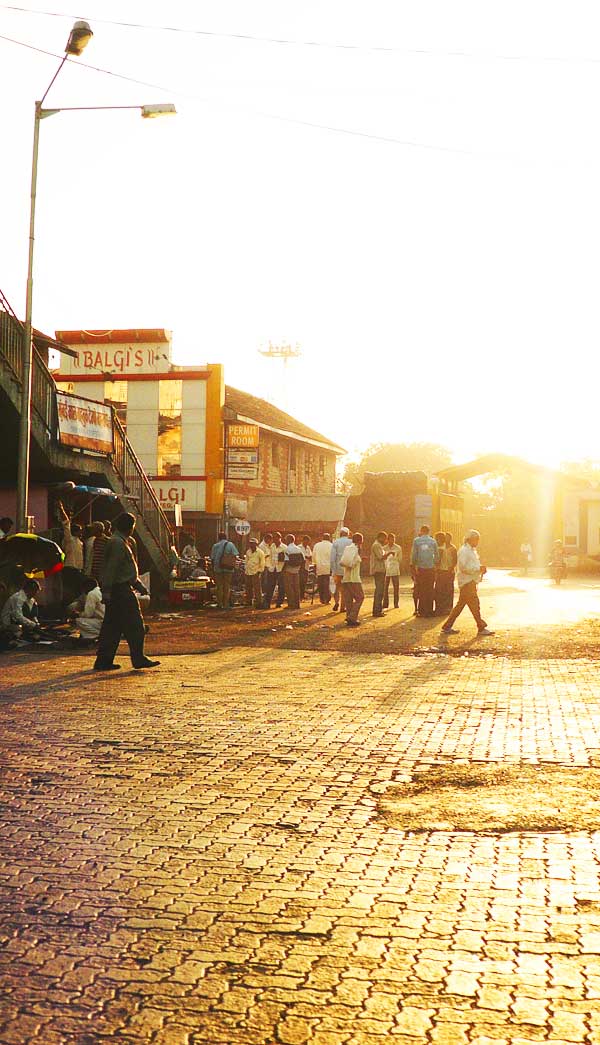
EasternWaterfrontURBZ

Most of them belong to the informal working class populations working on daily wages. Their homes may have access to shared water supplies and metered electricity but a majority of them do not have access to schools for their children and appropriate medical facilities. Many of them were once part of dock-unions that existed (and in some cases still do) in the region. However, the larger political changes in the city – from the 1980’s onwards completely transformed the trade union movement in every work sphere – staring from the mills and the universities and moving all the way to the docklands. Since then it has been even more difficult to mobilize the disparate workers of the space into any organized political formation.

Discussions with some of them indicated that the intended transformations of the docklands could become a rallying point for the workers to come together – and these could well be stimulated by the planning agencies – provided of course the interests of the workers and inhabitants were duly safeguarded.

One observes that the socio-political forces that influence the rest of the city also shape the docklands. Conversely, the footprint of the docklands also spills way beyond the official boundary that is usually used to mark it off. The influence of the docklands has always seeped into many aspects of the city’s history and structures – especially of the development of its mills and industries. Moreover, it is also evident in its middle-class imagination – especially amongst the older neighbourhoods as well as the habitats that exist along the periphery of the docklands. Interestingly, all these neighbourhoods are connected in intimate ways.

If one examines the bus routes that were started over the years, between ‘Ferry Wharf’ – the most public of sites in the heart of the docklands – and different localities in the city, one can see these interconnections very clearly. There are routes that line the entire eastern waterfront, besides some unexpected connections into the oldest middle-class trader dominated neighbourhoods. Expectedly, there are routes that connect the diverse neighbourhoods of the docklands with those of the mill lands in central Mumbai. The connecting neighbourhoods include: Chor Bazaar (that treasure trove of fake and real antiques that embody many hidden stories of the docklands), the Dalit neighbourhoods of Wadala, the fishing communities along the coast, the working class residential enclaves of the mill lands, the nineteenth century middle-class neighbourhoods of Kalbadevi, Mohammadali Road, Mazagaon and Girgaum, the working class neighbourhoods of Antop Hill and Sewri, the tourist lanes of Colaba and the footpath slums of P.D’Mello Road.

cleanup

Mumbai, like most cities, has always embodied many layers of social histories, histories that express themselves through different ways of imagining the city and realigning its geographical orientation. In this context, the docklands of Bombay have always been part of the city’s public imagination – even if physical access to all parts of the eastern waterfront has been a restricted affair. Visits to the Ferry Wharf (for recreational trips to Elephanta caves or Uran islands), the iconic Gateway of India, touristy Colaba Causeway and the elevated dock parks of Mazagaon hill are as integral to the city’s recreational past-times as the better-known Juhu Beach and Chowpatty situated on the west coast. For the millions of residents who actually live on the eastern side – including the ‘government servants’ living in the official buildings and colonies and the commuters of the Harbour Line Railways- the docklands are an integral way of experiencing the city.

A well known Marathi humorist Pu La Deshpande, has an evocative essay in his travelogue, ‘Apoorvai’ written in the seventies, in which he describes the bustle at Ferry Wharf on Saturdays when migrants from Alibaug – a coastal district of mainland Maharshtra – would arrive in boats and stay on for a few days to work in the docks. Even Hindi movies like ‘Deewar’ (1970s) and ‘Hum’ (1980s) have built narratives around tales of dockland underworld dons.

Unfortunately, recent narratives around the docklands – including those by urban planners – tend to represent the docklands as an isolated, decrepit space, a relic of a bygone era, a pre-industrial past, and ultimately, a space at once anachronistic to the city’s present day status as a global financial centre and one ready for new urban interventions.

Such narratives use the examples of other port cities from around the globe and idealize the ways in which those cities have reinvented similar spaces to create new resources for urban plans, designs and stimulation of real-estate prices.

It is vital to question such narratives since they ignore the peculiar manifestation of the docklands in cities like Mumbai. With its special history of surplus informal labour, the social composition of its poor communities and the unpredictable influences of electoral politics, Mumbai’s political impulses push for a different paradigm for urban planning. One in which there is a greater participation from the ground and more agency for the current inhabitants, besides of course, making provisions for the concerned authoritative official bodies. These impulses can be frequently found in the rhetoric of citizen-activists and political actors who are part of the city’s public sphere. Unfortunately, they have more often than not been quashed. The most recent example – and one that continues to haunt those interested in working in the docklands – is the failed attempt of the activists to protect the mill lands of the city.

If one ignores these impulses altogether, one can land in a situation in which the firing lines of opposing parties (in this case the port authorities and the civic planners) become hardened and rigid. Already the MpBT (the port authority in the city) is taking a position that restricts a productive conversation for an imaginative re-use of the docklands. It uses its colonial heritage of controlling the land to assert its first right of use and behave like a feudal proprietor. The civic planners, on their part, continue to evoke apocalyptic visions and use media pressure to push their own agendas.

Both, however, ignore the rich resource that exists right in front of their eyes – the people who live and work in the docklands.

They also ignore the potential of harnessing the social imagination of the docklands – that has been integral to the way the city evokes its history – as a force of negotiation and bargaining. After all, informed citizens are aware that the history of the city and the port overlap considerably. Unfortunately, whatever few narratives that are produced about the architectural and official histories of the port areas (mostly in the form of coffee-table books) and the docklands, tend to ignore the social histories embedded in the region. Instead, they encourage a nostalgic, colonial imagery that does not get much empathy from the political actors looking for populist issues nor does it excite the establishment.

What is needed is an approach that incorporates people’s histories of the region, the political energies that flow through it and need to use the social imagination of the docklands as a tool to negotiate with the port authorities. However, this is not just about strategy. This is also about pushing for creative ways of imagining the re-use of docklands in cities like Mumbai – cities, which have a strong presence of informal economic and habitat systems. There is a strong case being made by planners and activists in many parts of the world to integrate these systems into plans for urban futures.

In the case of Mumbai this may express itself in ways in which the portly duties of the docklands can continue to function to optimum levels. At the same time the space can still become part of the larger planning process of the city, and can also be claimed by the citizens of the city as a whole but in a manner in which the current inhabitants and workers are allowed to be important stakeholders – as important as the port authorities themselves.

In the few instances when the port authorities and planners do use the spirit of political participation, it is usually through NGOs who aid them in clearing the space of infrastructure-deprived habitats – disparagingly referred to as slums. To facilitate this they represent the space as being overcrowded and derelict – as if this is unique to the docklands and does not affect the city as a whole. The point is that the docklands and the city at large are connected in deep ways and the processes at work in one affect those in another. If one isolates the eastern waterfront as a distinct geographical region and proceeds to highlight a certain kind of visual imagery and narrative for it in distinct terms – one does not get a complete picture.

To reiterate; it is necessary to bring to light the social histories of the neighbourhoods that are part of the docklands footprint (and, as mentioned above, the footprint is much larger than the physical boundaries that have been officially designated as the Eastern Waterfront). This is one important way through which the actors who live in the region may be able to play an important role in the future development of the region. They would also be able to pressurize the port authorities to be more yielding to this process, without imposing an apocalyptic vision of a total economic failure – a vision, if it is allowed to go out of hand, can actually contribute to the evacuation of the people who live there. Of course, this process would need to be accompanied by the city envisioning itself as a more accommodating entity – where it would look at the history of its informal labour as productive and dynamic. More importantly, it would have to be less suspicious of the electoral political process and the noise create by citizen-activists that are unfairly represented as painful hurdles to wholesale, momentous architectural transformations of the region.

An examination of the ongoing debates around the future of the Eastern Water Front reveals that the language being used is one of governance, administration, and political control. There is a certain kind of political rhetoric that is being evoked to justify the choices being made. In this light, to understand the processes of the political imagination of the city, its peculiar relationship with the region and the historical background of its social composition, it would be useful to make a brief detour into the region’s history. This detour may also provide insights into the reasons why the port authorities of the city tend to be so imperial in their attitude towards the city – especially when it stakes a claim on the precious estate.

The presidency cities of colonial India – Calcutta, Madras and Bombay – were shaped by a combination of political forces, economic compulsions and social constraints that were peculiar to their status as administrative arms of an imperial government. They were centers of power within their own sub – empires. They created circles of influence that connected with their hinterlands and other international centers within easy reach. For Bombay, this included inland Maharashtra, the Konkan coast, Gujarat, all the way to Karachi in Pakistan and – via sea routes – West Asia. The connection of the city to these regions, could be traced through the history of migration into the city during the colonial period: Parsee and Bohri businessmen, Jain merchants, Surati and Kutchi traders from Gujarat, labour from the Konkan coast, service providers – including cooks and educated domestic help – from Goa, migrants from Iran and Afghanistan or Sindhi dealers from Pakistan. There were also connections between the presidency cities themselves. These facilitated leapfrogging over the dozens of kingdoms in the hinterland to allow the entry of skilled communities directly from Madras and Calcutta – especially during the time of the cotton boom in the early nineteenth century. Like these two cities, Bombay’s growth was directly connected to its port-activities, mostly to do with trade of cotton, but in the case of Bombay also, opium.

The city in the early nineteenth century centered entirely on the port. However, it also supported the development of an administrative and social infrastructure that helped in connecting to the region as a whole. The city rarely imagined itself as a distinct territorial space. It was always part of an expansive spread into the region.

The East India Company was disbanded in the middle of the nineteenth century. The colonies in South Asia began to be governed directly by the crown. Very soon, judicial systems, systems of administrations, governance, economic, educational, cultural, and financial institutions were set-up. They too however, did not necessarily locate their center of gravity within the municipal limits of the city in question. The city of Bombay became the capital of the Bombay Presidency that connected Karachi in modern-day Pakistan to Sawantwadi, a town that bordered Portuguese Goa and moved all the way into the hinterland up to the state of Hyderabad.

By the turn of the twentieth century, Bombay had become a larger than life space within the region. It’s influence spilled over imperial firewalls into Portuguese Goa to attract thousands of skilled migrants. They moved to the city for jobs involved in shipping and clerical work in the ports. Dock labourers moved in from the Konkan coast and State of Hyderabad. Most of these migrants occupied that special enclave within – and often indistinguishable from the city at that time – the docklands.

In the early twentieth century, the port grew civic and social tentacles from the dockyards all over the island – especially through its contribution to the development of industrialization in the city. However, most of the older neighbourhoods that had emerged with the development of the docks a century earlier, continued to thrive. The traders of Kalbadevi, Girgaum and Mohammadali Road, the clerks and secretaries from Mazagaon and Byculla and the prosperous trading families from Malabar hill emerged as the city’s new middle classes. The more prosperous amongst them were the ones to invest in mills and industries.

Even during these years of industrialization, the city’s economic and cultural identity continued to be shaped by trading activities centered on the port. While industries had their own social base – predominantly an organized working class and its industrial elite, a large chunk of the city continued to reflect the social profile linked to the port.

This was mainly reflected in the middle-class world of traders and shopkeepers, the huge working-class presence of dockworkers and the equally numerous presence of hawkers and small traders that roamed the streets of the city to provide services and sell goods of all kinds – especially those brought through the port.

This world is often not represented in the official working class history of the city that concentrates rather single-mindedly, on industrial labour. However, by the middle of the twentieth century, the middle-classes that had grown around the port-related trading activities began to be dominated by the educated, service-classes – especially the administrative staff linked to banking and financial institutions and the new industrial elite. Even so, the trading middle-classes, with their fuzzy working-class origins that had grown around the port areas – were still visible in the older neighbourhoods of South Mumbai.

Today, you can still see the vestiges of this social history in present day habitats – even as they rapidly give way to newer structures, mostly multi-storied luxury apartments. You can still see a handful of Goan villages, Maharashtrian coastal towns, dense Gujarathi urban enclaves, Benares style Ghats in the heart of the city – most vividly still seen in the neighbourhoods of Banganga, Kalbadevi, Girgaum and Mohammadli Road

This continuity from the past to the present is still possible to trace – even though the neighbourhoods are rapidly changing through rapid real estate development.

The contemporary scenario of the Eastern waterfront neighbourhoods however, tells a slightly different story. It facilitates an entry into a discussion on informal economic systems that dominate the world of work and livelihood in the docklands.

The Eastern Waterfront proper includes the residential neighbourhoods of Antop Hill, Mazagaon, Colaba, and Wadala. These comprise a complex mix of communities, including Parsees, Goan Catholics, East Indians and Hindus and Muslims from Gujarat that make-up its middle and upper – middle classes. The habitats in these areas comprise mainly of four to eight story apartment blocks.
The working classes in these areas are of the same social composition as described earlier in the essay – though they are present in smaller numbers. Their proportion increases near the docks where many of them live in infrastructure-deprived habitats – mostly in and around the Prince’s docks, Bhau Cha Dhakka, Darukhana and Sewree Fort. There is a large Dalit neighbourhood in Wadala that comprises of mainly scheduled caste communities. There are sharp inequalities in terms of civic infrastructure between the middle-classes and poorer neighbourhoods within the entire region. To develop an accurate profile of the working classes of the docklands, most of whom are part of an unorganized workforce functioning in an informal economic set-up, it would be useful to perspectivize them against the larger story of informal labour in the city. The informal sector accounts for 68% of total employment in Mumbai and workers engaged in the urban informal sector form the bulk of the urban poor.

According to sociologist Jan Breman the informal sector can be defined as work on one’s own account, which generates income but is not regulated by an explicit employment contract and enjoys no protection. This includes people who work in the street, in homes, small-scale enterprises, power loom workshops etc. The informal sector workers work for as long as their employers require them to. Sometimes, these workers may be working in the context of a secure, organised workplace but their relationship is contractual and therefore classified as informal. According to him, the move from formality to informality in the work context almost immediately means a fall in the standard of living. The lower-income classes are mainly visible in these new neighbourhoods as domestic servants, street vendors, repair and odd-job men, cleaners, day or night guards. The realities of the informal sector are vividly expressed in the existence of slums.
In the context of Mumbai, the informal economy also refers to the survival economy of the poor who occupy a grey zone of commercial exchange, by providing skilled or semi-skilled labour. The privileged within poorer economies and polities find informal economic transactions very profitable, mainly since it keeps labour costs low. It also allows corrupt municipalities to exploit physical space for commercial gain rather than for the welfare of the poor and extort bribes from the poor entrepreneurs who are never given full status as valid citizens earning their livelihood. The only reason why the informal economy continues to grow is because it subsidizes the economy by keeping labour costs low.

This scenario is clearly evident in the ship breaking, construction, scrap collection, stone breaking, loading-unloading, iron and steel workshops and restaurant-related activities that exist in the docklands. These activities make significant profits for the employers mainly due to this existence of an unregulated labour market that facilitates subsidies.

The workers have low wages and the self-employed have tiny incomes. The working conditions are unregulated and most of the workers are exposed to high level of toxic substances given the nature of the activities in the area – especially in the ship breaking yards.

Most of the workers have been around for more than twenty years. They had migrated from rural areas and small towns where their social and economic location was already marginal. Their move to Mumbai represented a freedom from social restrictions and bondage and a marginal improvement in economic relations. On the whole, though, their migration to the city is not accompanied by significant social mobility. Their children still do not have access to good quality education and basic medical facilities.

At this point it becomes mandatory to underline how traditional social stratification that is the foundation of India’s social histories, epitomized by the caste system, gets reflected in the city’s socio-economic arrangements. The fact of the matter is that most of the urban poor belong to traditionally marginal communities like the Dalits and what are termed, other backward communities. The city absorbs the poor migrant into its economic system, which is dominated by informal arrangements. These do little to weaken the traditional modes of social stratification in which the migrants are embedded. The absence of basic educational infrastructure only ensures the entry of a new generation of informal, unskilled, or semi-skilled workers that continues to perpetuate the system. Illiteracy levels in cities such as Mumbai remain extraordinarily high in its slums– even when compared to rural contexts. The only mode of livelihood available for the urban poor is in informal economic spaces, which have their own limits to facilitating social mobility. In addition, since the context in which the informal economy operates is really the slum, this completes a vicious circle of social, historical, and economic equations that trap the urban poor. The poverty that is visible in the docklands is very much an illustration of this story. However, it must be noted that it only builds on what is happening in other parts of the city as well. This story is in no way peculiar to the docklands lands.

Today, globalization in Mumbai is very clearly being identified with physical transformations of neighbourhoods, transformations that accommodate post-industrial, service based economic activities and attempt to push out manufacturing and informal trading and service-based activities towards the periphery of the city. Infrastructure deprived habitats – or slums and shantytowns are seen to be an expression of these dated urban activities and much energy is invested in erasing these spaces.

The docklands are seen to be a huge potential space for such a pot-industrial transformation. The NGOs that operate there are already playing a major role in the resettlement and rehabilitation of slum-dwellers. There is hardly any discussion with regard to an improvement of the civic infrastructure of the poorer neighbourhoods. There is even little discussion on investing in education to upgrade the skills of the next generation of the city’s poor citizens. Except for an NGO like Akaansha that concentrates on education for street children, there is negligible investment in this sphere.

Such a restricted approach to social space is not only a reflection of the impatience of global capital that is eternally on the quest for new, comfortable places to nest its aspirations, but also of the insidious way in which the system of caste continues to hold social formations in its clutches within such urban supposedly globalized spaces.

One can see the disinterest to tackle these issues writ large on the faces of all the social actors involved in the docklands story.

The port authorities rely extensively on subsidies provided by informal economic arrangements and are more interested in maintaining their stranglehold on the property. They prefer dealing with the presence of informality – symbolized by the presence of infrastructure-deprived habitats. After all, more directed transformations on the social front will mean taking greater risks about their control over the territory. The planners and architects view the space as being part of a larger story of the metropolitan region’s revival (with their elaborate plans of bridging the island to the mainland, opening up the eastern waterfront for the public at large etc.). They find it difficult to incorporate social concerns with regard to mobility, education, and transformation of economic relationships into these plans.

The most drastic expression of this disinterest is the silence maintained with regard to the erasure of the habitats that house the region’s informal arrangements. That the infrastructure habitats have to be erased is a fact accepted by all – that is why there is little resistance even from activists and NGOs. At present, the moves of erasure are restricted to habitats that create obstacles for public transport projects – mainly the railways – but there is little reason to believe that the process will not be employed for other, less pressing and more profit – oriented projects in the future – especially if the urban planners have their way in the docklands.

The reason why homes of the urban poor are seen to be the most obvious signs of dereliction – when in fact their ability of subsidizing through informal arrangements should signal economic dynamism – is easy to understand. Urban transformation is as much about aesthetics as it is about efficient and profitable use of space. Moreover, the erasure of spaces of the poor, allows for both these ideals to be expressed at once. Of course, the additional price that the poor have to pay is traveling great distances, (after they have been rehabilitated and relocated) at extra cost, to continue to subsidize the profit-oriented economic transactions, which still prefer to use their cheap services.

No wonder there is little interest in understanding the social histories that are part of the docklands space – even amongst the more progressive votaries of its transformation. They are simply not considered to be important voices or stakeholders in the planning process. They can be empathized with or dealt in the plans as objects worthy of assistance and help, but they can never ever dream of becoming the agents of the ongoing transformation.

Nevertheless, it would be facetious to blame the specific actors in the docklands as being the sole proponents of such thought. The city as a whole treats its poor this way. The modus operandi being employed by the actors in the docklands only reflects the larger choices that the city regularly makes. Take for example – the attitudes reflected in Dharavi. The following is a quote from a paper written by an urban studies scholar and activist Matias Echnaove;

Some people, by ignorance or political calculation, picture Dharavi as a wasteland full of tent-like temporary structures; an immense inhabited junkyard crowded with undernourished people hopelessly disconnected from the rest of the world, surviving on charity and pulling the whole city’s economy backward. The reality could hardly be more different: Dharavi is a highly developed urban area composed of very distinct neighborhoods with a bustling economic activity integrated socially, economically, and culturally at the metropolitan, regional and global level.

This is as true of the docklands as it is of Dharavi.

It may seem like a far-fetched dream to visualize a forum in which activists and NGOs come together to mobilize the inhabitants and workers of the docklands. But it is one worth imagining.

Such a mobilization can express itself as a political force. One that negotiates with the port trust authorities about flexible usage about the space by keeping in mind the needs of the port, the inhabitants and workers and the city at large – necessarily in that order. However, to do this, it would also be important to examine the many social histories that are embedded in this rich historical space and use these to evoke an interest in the city as a whole about this space.

In a small initiative in a village in Girgaum, a neighbourhood in South Mumbai, PUKAR – Partners for Urban Knowledge Action and Research, Mumbai engaged in opening up the discourse on habitats and heritage activism by focusing on a small hamlet – dear to the city’s heritage activists – called Khotachiwadi. The initiative attempted to get the whole city engaged with the neighbourhood so that it could and see how its story was linked to that of the whole city. The overwhelming participation of the city’s residents at the festival organized by the residents of the village, was a testimony to the success of the strategy. It was not difficult to understand how the village won so many enthusiasts who lived scattered all over the city. The idea was simple; convince them that Khotachiwadi was about the city as well.

With regard to the docklands – one does not even have to try so hard. The social histories and the narratives are relatively well known. Activists and concerned citizens simply need to get engaged with these stories and with the lives of the inhabitants and then circulate them in the city through the media and other channels of communication.

It is only when such mainstream enthusiasm gets generated – combined with grassroots support from the poor inhabitants themselves – can one unleash enough energy to bring about transformations in a desirable direction – in the direction of a truly global, modernized metropolis. One in which issues of equity are addressed honestly and in which the process of planning is genuinely participatory.

It would be significant if the docklands of Mumbai became the space for evolving a new form of activism, and envisaging new forms of planning processes. Considering how much the city has traditionally depended on the docklands space for its survival – it would only be befitting that the docklands once more rise to the occasion to show the city a new way of dealing with issues of urban poverty and urban futures in a global world.

Bibliography:
1. Anjaria J.S: Street Hawkers and Public Space in Mumbai, EPW May 27 2006

2. Appadurai, Arjun. “Deep Democracy: Urban Governmentality and the Horizon of Politics.” Environment and Urbanization, 13.2 2001: 23-43.

3. – “Spectral Housing and Urban Cleansing: Notes on Millennial Mumbai” Public Culture Vol. 12 No. 3 Fall 2000.

4. Afzulpurkar, D. K. Programme for the Rehabilitation of Slum and Hutment Dwellers in Brihan Mumbai. Mumbai: Government of Maharashtra, 1995

5. Banerjee-Guha Swapna: Shifting Cities – Urban Restructuring in Mumbai, EPW: January 12, 2002

6. Bombay Port Trust: New Cotton Depot at Mazgaon – 1923

7. Bombay First, McKinsey Report: Vision Mumbai: Transforming Mumbai into a World Class City.

8. Bhowmik Sharit and More Nitin, ‘Coping with Urban Poverty – Ex-Textile Mill Workers in Central Mumbai ’ (?)
9. Breman Jan ‘An Informalised Labour System, End of Labour Market Dualism’ ( ? 2002)

10. Burra Sundar: Towards a pro-poor framework for slum upgrading in Mumbai, India (22 pages) Environment and Urbanization Vol. 17, no. 1, April 2005

11. Desai, V. Community Participation and Slum Housing. New Delhi: Sage Publication, 1995.

12. Desai, P. The Bombay Urban Development Programme, Mumbai, India. Third World Planning Review 23 (2) (2001): 137-154.

13. Echanove Matias : Towards an Architecture of Participation:
Activating Collective Intelligence in Urban Systems (Prepared for the NATIW OpenWeb 2.0 Seminar, Geneva, April 20, 2007)

14. Edwardes S.M: Gazatteer of Bombay City and Island, 3 vols. 1909, Bombay

15. Katakam, Anupama: Builder’s Envy, 2006 (http://www.hinduonnet.com/fline/fl2402/stories/20070209002104000.htm)

16. Kosambi, Meera: Bombay in Transition: Growth and Social Ecology of a Colonial City 1880-1980 Stockholm: Almquist Witsell International, 1986

17. Mumbai Metropolitan Region Development Authority (MMRDA). Draft Regional Plan for Bombay Metropolitan Region 1991-2011. Mumbai: MMRDA, 1995.

18. Mukhija, Vinit. Enabling Slum Redevelopment in Mumbai: Policy Paradox in Practice. Housing Studies 16(2) (2001): 791-806.

19. Patkar Medha, Singh S.: Urban Renewal at Whose cost? (3 pages), EPW March 17, 2007

20. Patel, S., et al. Beyond Evictions in a Global City: People-Managed Resettlement in Mumbai. Environment and Urbanization, 14.1 (2002): 159-172.

21. The Port of Bombay: A Brief History: Issued by the Trustees of the Port of Bombay – 1974
22. UDRI, KRVIA: A Study of the Eastern Waterfront of Mumbai, 2004

The Global Gaze

July 2, 2008

Conferences and meets on Mumbai are dime a dozen. What seems to be somewhat new is to see the city’s regulars smelling out shoddy research and giving it to the scholars good and proper.

A small meeting was convened recently to discuss a global study (work in progress) on urbanization done by representatives of the World Bank. The reputed international agency had set upon itself to understand how urban concentration is crucial to economic growth and to explore the impact of such concentration in real contexts. These two dimensions were presented as distinct studies.

Frankly, it was shocking to see the shallow assumptions behind one report, which made the loudest proclamations of urban concentration and economic growth. Considering the amount of resources that the scholars must have had at their disposal, if all that they could produce were broad strokes of explanation based on a hundred year timeframe and use that to extrapolate on much shorter urban planning life spans then that is plain shoddy research. If they could neutralize a major historical epoch like colonialism by not naming it as such, in the garb of economic explanation, then that is stepping ten steps behind even in terms of the discipline’s own intellectual history.

It was entirely to the credit of some invited participants and the chair, that the discussion and responses reflected better sense. The representatives of various city based government agencies, university departments and civic groups pointed out several theoretical lapses and methodological lacunae in the study. Without necessarily agreeing with each other. One bureaucrat did make the puzzling allegation that the city’s intellectuals often bully the political elite (who know the city’s pulse better), and some activists found it difficult to believe that most people in Mumbai actually walk to work (as per the reliable findings of a local study based on the city’s large slum population). By and large though, they made strong and sensible points. Including the observation that a political economic framework in Mumbai is always better than a purely economic explanaition given the way power and commerce work here. Also – some pointed out – planned urban concentration can never be the cause of economic growth – which is what the preliminary report seemed to tautologically suggest.

However, if average Mumbaikars were to hear these arguments there would only be confusion in their minds. Why is it that with such amazing ideas, intellectual expertise, political willingness and wisdom that get expressed at such forums do we still find ourselves in a city that struggles to provide basic civic standards for most of its people?

Maybe the answer lies in the architecture of this particular meeting itself. At the end of the day, international financial agencies see themselves at the peak of the world order and push forth agendas that, in spite of better informed local critiques, do not really help the city as per its own needs.

And if you look at the history of the city’s planning processes it has always been at the mercy of a global narrative of urbanization that sits at odds with its peculiar connections to its hinterland, local migration and needs of average citizens. Yet – we do not have the resources or the appropriate framework to collect and organize local knowledge into a formidable critique of urban choices that get bestowed on us by those who benefit from such narratives. If we look closely, these beneficiaries cannot be simplified into categories such as business or political interests. Eventually business and politics are what makes cities. What will help is a more specific villain; financial companies who are behind the grand urban construction juggernaut that rules the urban roost and defines the global order. Whether people need their projects or not.

Eventually we all left with the feeling that we still did not have enough basic data and information to actually substantiate even the most reasonable critiques made on the basis of actual lived experience.

While global laws of urbanization continued to be blithely formulated by those who lived elsewhere.

The Multiplexed City

July 1, 2008

The new urban world order – symbolized by malls, multiplexes and high-rise luxury apartments – reached the dense shores of Mumbai only a few years ago. But it has already transformed a major chunk of the city’s landscape, both externally and experientially. A new generation of privileged Mumbaikars – still under fifteen – have lived life exclusively in these spaces. Less lucky citizens only feast on the neighbourhood ‘mall- multiplex’ on weekends but even they have already started to organize their energies and life savings to buy that dreamy flat in a happening complex. Middle-class Mumbaikars choose to spend their weekends in malls and multiplexes since they are the only public spaces that don’t have that bombed out, war-ravaged feel the city continues to exude – with its eternally dug up roads, half-formed buildings and dilapidated structures from another era, doomed for destruction by the new order. What else is there to do on weekends? But a choice as limited as this, means so many things. In a few years, a new generation of Mumbaikars will have exclusively experienced the special quality of Mumbai life only through such experiences in a hyper-real way – through the movies – maybe only through the movies. Since most distinctive neighbourhoods would more or less have vanished. And not only because of the laws of late capitalism, as the more theoretically inclined would have us believe. After all, in most capitalist societies the heritage industry is less embattled than it is in Mumbai and does manage to carve out special enclaves that remind you of individual urban histories. Here, the builder lobby continues to behave exactly like it did all through its existence, continuing its glorious tradition of treating it – the city’s history – like dirt. Only so that it can build on it relentlessly, like compulsive bees who make outsize hives that eventually start to leak and break. As the city morphs into yet more malls and multiplexes, the next generation of Mumbaikars will experience the city only in these dark, enchanted enclaves. They will be thrilled to see its vanishing landscapes represented on the silver screen in another version of Bluffmaster. They will laugh at themselves in the sequel to the fable-like Taxi No. Nau do Gyaraah. Maybe they will also see a much delayed sequel to Jaane Bhi do Yaaron – another fabulous city story made in the early eighties. In fact one sincerely hopes that JBDY either gets a re-release or is played forever in all the multiplexes. It still remains one of the best commentaries on the way the city builds and re-builds itself in its portrayal of the glorious, eternal dance of corrupt cooperation between the bureaucracy, the builders and the media. The cinematic soul of the greedy builder Tarneja, (Raheja?) still lives on in the city. It still inspires its descendents to continue with its glorious building traditions. But of course, in a more sophisticated way. The Tarneja of today may even open up a Tarneja Ecological School of Art, Architecture and Urban Planning (KRVIA?) to equip the next generation of the city’s architects and builders with very sophisticated theories about the city. Theories that may even criticize the city’s ugly architectural and planning history and which get discussed fiercely in classroom discussions. But at the end of the day the next generation of architects, urban planners and builders will depend for their jobs and livelihoods on Tarneja Associates and their ilk and life will move on. After a hard days work, students will re-connect with their city within the cozy confines of the movie-hall and watch yet another Mumbai-based urban-legend.

Mumbai Ahead

June 4, 2008

Science fiction films that project futuristic urban scenarios often get stuck in a superficial imitation of Blade Runner. They trip on their own imaginary mutations of Seoul and Tokyo neighbourhoods and fuel airborne cars to make them fly higher and higher and construct skyscrapers that literally do that — tear open the skies.

So far, Bollywood films have rarely ventured into that imaginary space. Not even in their wildest dreams could anyone have imagined Indian cities anywhere close to those urban dystopic or utopian fantasies (depending on the depth and darkness of the director’s vision).

But now — after having seen the shine and glitz of mass-manufactured malls, multiplexes and residential complexes, Bollywood finds it easier to stretch into the limitless possibilities of imagining the future. That explains Love Story 2050 taking liberties with the iconic Gateway of India and dwarfing the colonial monument with gigantic neon-lit structures in one overwhelming photoshopped swoop.

Such image-plays are not just about entertainment. They quickly become an integral part of the business of building cities. Reportedly, the producer of the film had builders and developers knocking on his door to borrow its digital images to sell their own dreams.

Parts of Shanghai and many other Chinese cities build on those imaginaries consciously all the time.

Hopefully, Bollywood will go beyond robotic group dancers and misinterpretation of high-urban technology to provide a sharper look at the city’s future. One hopes its close-ups will reveal the mildewed walls in futuristic structures, mimicking the process of rapid decay that inevitably sets into Mumbai’s present within weeks of construction.

Even in the past, Bollywood films have used the Malabar Hill and Cuffe Parade skylines to convey a sense of global urbanity. Many of them preferred long landscape shots that wilfully hid the paan stains, crumbling paint and decaying structures of the sixties and seventies RCC buildings. Then came the (relatively) realist nineties which had film-makers turning the dirty gritty reality of the city into a saleable proposition.

After all, true Mumbai lovers know that whatever the architectural exterior, Mumbai’s interiors, soul and mood will remain eternally gothic. No escaping that. One imagines there will always be film-makers even a 100 years from now to capture Mumbai’s rough-edged, dark and shabby texture. And there will always be reason for its texture to remain that way.

Even today, it does not need a huge leap of the imagination to see through the glass walls of the city’s glitzy twenty-first century constructions. Take a look at the swanky Mumbai airport terminal. It didn’t even take a year for the toilets to fold into their historical smelly condition and for the Wi-Fi and internet services to stop functioning altogether.

A few more years and we will stop being so excited about it. Just like our urban ancestors who got over the excitement of seeing the once-futuristic and sleek Sahar airport. (It may seem unbelievable today but it was like that once. That has always been the story of architecture. It’s only half about the buildings. The rest is organisation, bureaucracy, people and imagination. When will we ever learn that?)

One hopes that Love Story 2050 extrapolates on all this. That would be a sure way to strike a chord with the viewer. Scenes of a flooded Milan subway with smiling drivers who turn their cars into boats or the municipality digging through the air to open up sky channels for the latest communication technology that lead to massive traffic congestion even in space, would make viewers positively weep with empathy.

« Previous PageNext Page »