Neighbourhoods in Bubbledom

June 30, 2011

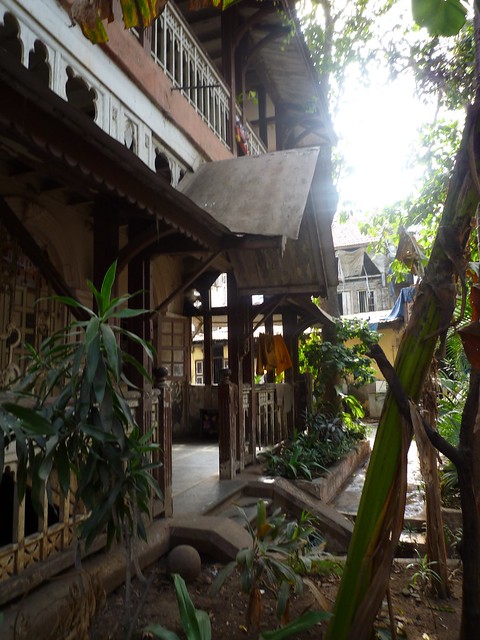
Chez Nous bungalow in Bandra West (Mumbai): A freshly repainted 1950 art-deco building. Three of the builder’s children live in the building with their children.

The biggest casualty of the new wave of urbanization in India is not architecture or design, even though these have suffered a lot from the rapid and mindless pace of construction in and around cities. The biggest casualty is quality. So many new residential and corporate high-rises in Mumbai have been built so poorly that they would not qualify as high-end in any other context but the hyper speculative bubble in which we find ourselves today. In Mumbai, we can’t speak of real estate anymore. What we are witnessing is “surreal estate.”

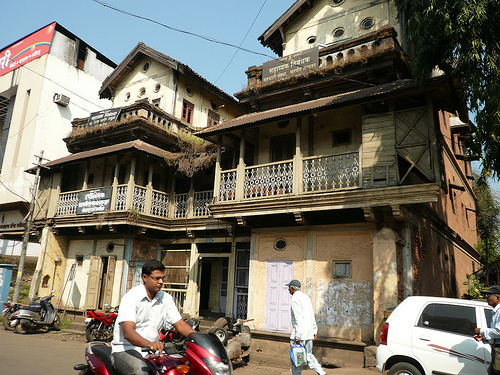
Mumbai has a good stock 100 to 60 years old art deco buildings. It is known as the second art-deco city in the world after Miami. Marine Drive is famous for its elegant raw of mid-rise buildings facing the sea. Bandra has many 2 to 4 story-high building from that period as well. Many of which where built by East Indian owners for their children. The art-deco period in Mumbai was part of a new wave of urban development in the first part of the nineteen century.

Many observers then lamented the fact that these new constructions had a terrible aesthetic compared to the buildings they came to replace. Today find these art-deco buildings attractive. But this is not only nostalgia for an older golden age. These buildings were well built and this is why they are still standing today. They have endured Mumbai extremely hot and humid weather and its salty air. Many of these buildings have thick walls and high ceilings. They can last another 200 years without any problem if they are well maintained. It is quality construction.

In parts of the city one can still see the original Portuguese-style bungalows, which art decos buildings often came to replace. They can be found in Bandra, Khotachiwadi and other East Indian enclaves. Those that have not been destroyed by their owners or predatory developers still look beautiful 150, sometimes 200 years, after being built. Quality and care.


A street in Khotachiwadi (Mumbai) with a Portuguese-style bungalow

Roseville Bungalow, St Sebastian Rd, Bandra West, Mumbai: Original style East-Indian bungalow. Probably up to 150 years old.

In contrast, some of the new upper-class high-rises you see in Lower Parel and the Northern suburbs will look like nothing in 10-20 years time. This is because their first function is not actually to provide a long lasting quality experience to their residents. Architecture, design and durability seem to be the last concerns of this generation of developers. These new buildings are first and foremost financial products. They need to be sold quickly to fellow speculators who will not live in them, but instead resell them in a couple of months or a couple of years to another speculator. All this speculation is done with borrowed money, which must quickly return to the lender. This lasts until the bubble bursts.

One sign of surreal-estate bubbledom is the tens of thousands of flats lying vacant in Mumbai, waiting to be bought and sold. Their most important quality is to be easy to sell and for this they must remain empty. What developers want to maximize is the exchange value of their properties. This is done by standardizing construction as much as possible. Everyone wants easy products. That’s why most new buildings in the city and suburbs are monofunctional and offer more or less same layout on every floor. Any variation makes their market value harder to assess. Standardization means that the value of the building can easily be calculated on the basis of square foot price in any given part of the city. Each flat can also be sold individually to smaller investors who often bet with their savings. This speculative pattern trickles down all the way to affordable housing, with blessings of the government, which even incentivizes it through the SRA scheme and other similar market happy initiatives. This has disastrous consequences for the city of an order of magnitude that is still hard to grasp. Heritage is getting lost, a great potential for the city is wasted and people who end up staying in these buildings see them degrading very quickly.

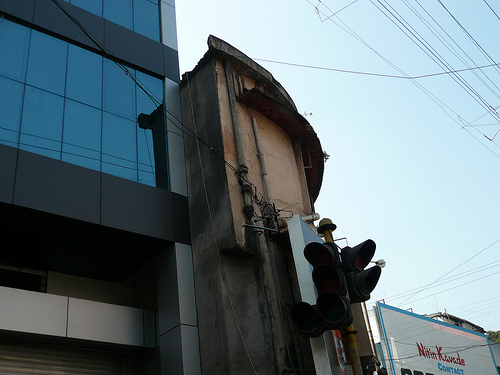
New constructions in Lower Parel, Mumbai

India is home to some of the oldest, deepest and most sophisticated forms of urbanity anywhere in the world. Old cities such as those of Kochin, Ahmedabad, Surat, Delhi, Haridwar, Varanasi and a hundred more encapsulate a sense of urbanity and cosmopolitanism that we have everything to learn from. They are still the liveliest parts of towns after hundreds of years of existence. These are not valorized at all. They are either being redeveloped or decaying. While a few old families actually want to stay in their historical neighbourhoods, most middle-class people left the city for the suburb. And the suburb sprawls into nothingness. One could argue for instance that in Delhi, the Old Town is actually the city and that “New” Delhi is everything else -for the most part being an endlessly suburban sprawl, with enclaves of urbanity here and there.

New India seems to be about urbanization without a city. Did we loose the city somewhere in Old India? The beauty of places like Khotachiwadi in Mumbai and Khirkee Village in Delhi is that they know how to be urbane. They have deep roots, they are connected to the larger context, yet also appear to be slightly detached; not fully buying into the development craze they see around them, as if they had seen it all before.

A 200 years old house in Ahmedabad that has been restored with the help of the Alliance Française. The current owner, who is the third generation in his family to live in the house, welcomes overnight guests.

These neighbourhoods are their own universes. Like the Pols in Ahmedabad, they are self-contained and preserve a very strong sense of identity, without being exclusive or closed to the rest of the city. They stand in sharp contrast to the gated colonies that are the norm in middle-class suburbs. A closed gate marks the end of the city. It is the beginning of another logic, which is not that of the urbane trader or artisan. The gate belongs to the culture of the settler who wants to work the land exploiting it to the maximum. The settler seeks to profit directly from the land rather than from the social and commercial networks that crisscross it.

New Delhi is full of gates, which it seems to have inherited from its farming past. It is not as much a city of villages as a city of fields. As soon as people can put a gate somewhere they do it. In Mumbai the most gated spaces are five star hotels, which by the way all try to look like airline lounges. When you enter their compounds you are really made to feel that you are leaving the city (if not the country).

View of Khirkee (Delhi) from the Masjid
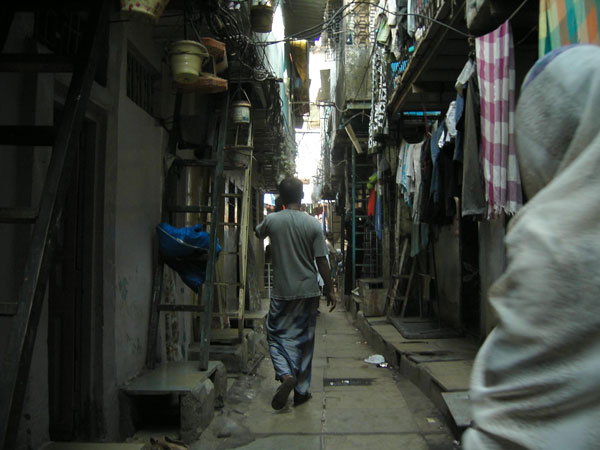
There are no closed gates in Old Delhi, no gates in Khotachiwadi, no gates in Dharavi. The city is a place that anyone can enter freely. Khirkee Village has gates. But it must be by mimetism. Or maybe that these gates are better understood the other way around. They are encircling this enclave of urbanity, leaving it outside New Delhi’s totalizing suburban spread.

When you enter Khotachiwadi you feel safe even though there are no gates. In fact you feel safer because there are no gates. People are walking in the street. Neighbours are talking to each other, sometimes shouting at each other. But when something goes wrong they know how to come together. Our friend James who is a life-long resident of Khotachiwadi leaves the doors of his 150+ years old bungalow open all day. People come in and out all the time. He has sparrow nests in each corners of his house.

Waking up in Dharavi somewhere in a house on a small street –and almost every street is narrow and pedestrian- it is not unusual to hear a birdsong or a rooster cocking. It is only when one looks outside the window that one realizes this is not the countryside, but the heart of the city.

dharaviA back street in Dharavi
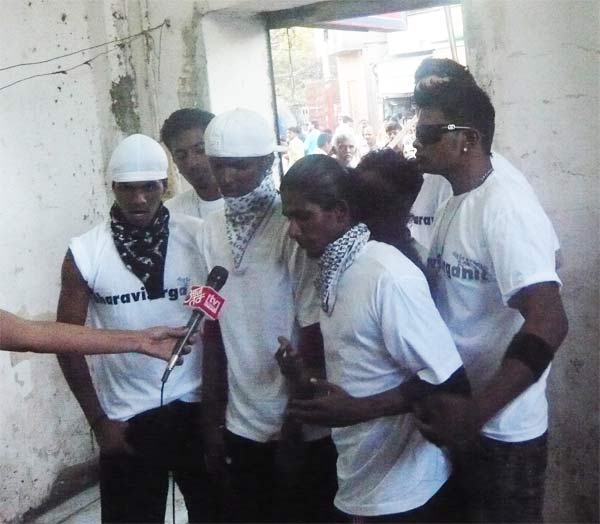
The best neighbourhoods we can think of have all in one way or the other preserved village-like qualities. A beautiful neighbourhood is a neighbourhood that has roots and people to keep them alive. Khotachiwadi was once a plantation and the shore used to come to its doorsteps. Somehow this past is still alive there. Sometimes the link with the origins is not as old, direct or as spatial. In Dharavi people have often brought the village along with them, preserving old community ties, along with an ability to use spaces to fulfill many different functions, and a high degree of local autonomy. Most people in Dharavi go back to their village at least once a year. Khirkee Village proudly preserves its identity and a sense of its origins. The beauty of these neighbourhoods is not architectural –although some places like Khotachiwadi have outstanding self-standing houses– it is rather the way people are invested and involved in their habitats. The way they have shaped them over time, and the way the neighbourhood is experienced as a moment, which continues the historical journey of the people who inhabit it.

This is why Guy Debord says that when we destroy such neighbourhoods, we don’t only destroy people’s social networks and livelihood, but also their collective history and sense of identity. The point is not at all that places like Khotachiwadi, Dharavi or Khirkee village should be turned into Archeological Survey of India sites and barricaded, with a ticket booth at the entrance. It is in fact, exactly the contrary. In order to exist and survive, neighbouhoods must continue their journey through time and keep on evolving continuously. It is the dynamic interaction between people and the space they inhabit that must be preserved at all cost.

Architecture and Fiction

January 5, 2010

The First Issue. There are 3 out already.
The First Issue of Pedro Gadanho

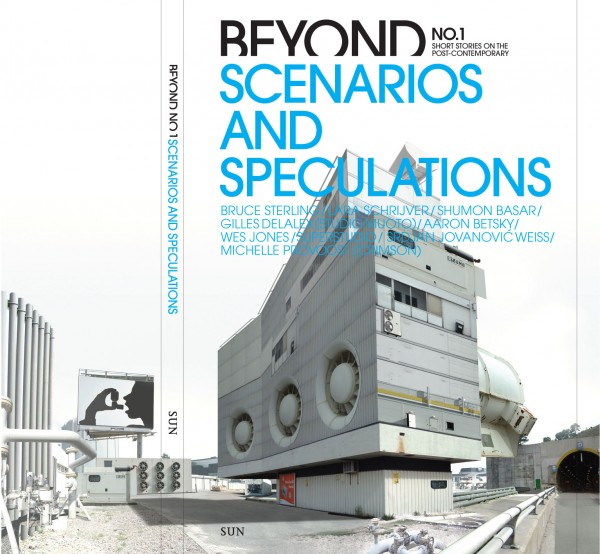
We ended 2009 with an imaginative blurring of District 9 and Dharavi with the help of some extra-terrestrial help and found ourselves stimulated by the power of fiction to visualize context, space and location in the most unexpected ways. The relationship of aesthetics to design related practices is obvious, the fact that imagination is the fountainhead for architectural practices is even more so – but the capacity of fiction to infuse that relationship with a full-blooded, wholesome stream of subjective connections is something that tends to get overlooked. We pay light-hearted tributes all the time to the power of speculative fiction to influence the architectural imagination but dont always acknowledge how deeply cross-influential those forces really are in the way we think of urban futures. That is why we were so happy to come across the work of Lisbon based writer, curator and architect, Pedro Gadanho who has started a bookazine called Beyond – Short Stories on the Post-Contemporary (through Sun Architecture) which is dedicated to the relationship of fiction and architecture, where architectural projects are conjured through writing, where builtforms can be seen as fiction and much more.

Look for more Airoots writing celebrating this relationship in 2010… A Happy New Year!

Kolhapur Photo Diary

December 28, 2009

Kolhapur is a small town in the south-west region of the state of Maharashtra, not more than four hours drive from Goa. It is part of a district with the same name, on the prosperous sugar-cane growing belt which makes the rural areas relatively more prosperous than the town itself. Kolhapur is known for several artisanal goods such as leather slippers, pots (there is a local Kumbharwada, potters colony right in its inner city area) and once even had a bustling movie industry (around the early and mid-twentieth century), besides being a well known patron for classical music. It fascinates us not as a town alone, but as an urban system that includes a well-off country side and some distinctive architecture thanks to its princely lineage, ruled as it was by a king until the Indian independence. But most significantly of all, a group of enthusiasts who love their little part of the world. We found an architect who conducts studios with international students along with doing his practice, a high level of civic pride with the presence of several action groups including ‘Kolhapur Calling’ and several young people trained in Kolhapur’s well known educational center – Shivaji University – and its college of architecture D.Y. Patil.

Local Architectural Flourishes

Local Architectural Flourishes

The ubiquitous black stone frequently used in coastal Maharashtra

The ubiquitous black stone frequently used in coastal Maharashtra

4166885609_20a36ff776

Lost Lady

Lost Lady

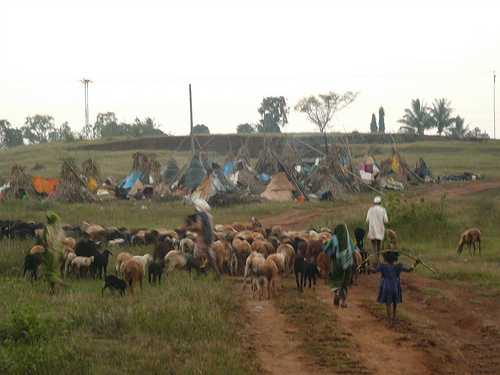
On the fringes, but in the urban system? Dhangar Nomadic Shephards

On the fringes, but in the urban system? Dhangar Nomadic Shepards

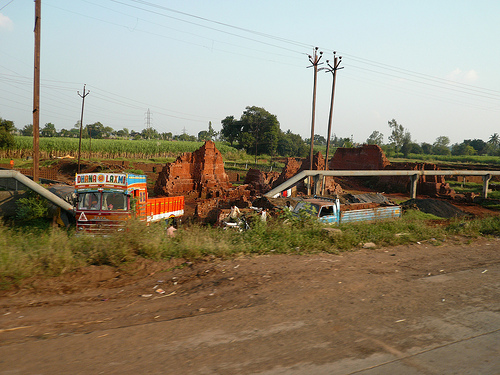
Brick Kilns - made right outside the city

Brick Kilns - made right outside the city

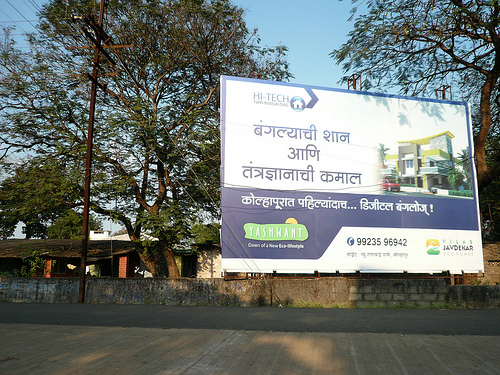
Digital Bungalows: Thats what the poster says!

Digital Bungalows: Thats what the poster says!

The Tool-House (Expanded)

September 9, 2009

This article was published in the Mumbai Reader 2009 (Urban Design Research Institute)

DharaviTool-House

One of the most enduring artifacts of pre-industrial society in contemporary times is the tool-house; the habitat of the artisan where work and residence co-exist amicably. Conceptually located between Le Corbusier’s machine for living and Ivan Illich’s convivial tool, the tool-house is an apparatus fulfilling economic and sheltering purposes.

In the past, production practices took place mostly in the artisanal homes of rural areas, while cities were political and trading centers. Today, in a post-industrial hyper-urbanized era, versions of the tool house can be found in an artists loft, a web-designers den, a hidden restaurant in an immigrant enclave or in an up-market artisanal shopfront behind which an old family continues to perform a traditional occupation.

Tool-houses can be found across cultures and socio-economic backgrounds. Middle-class homes in housing colonies often double up as clothes stores over the weekend while their kitchens service huge clienteles. Parisian hôtels particuliers are conceived to provide a range of professional services for their owners and guests, acting as semi-private salons and gentleman’s clubs.

Yet, as a structure epitomizing such dual use, the tool-house, does not have the legitimacy it deserves. In fact in many places it is considered outdated, or worse, an invalid urban form, thanks to strict zoning laws and rigid conceptions of urban order. With the universalizing principles of the industrial revolution becoming mainstream, homes and workspaces have been decisively cut off from each other.

The modern city emerged through an atomic division of functions which had for long cohabitated in space and time. As working and living became spatially segregated, they also started being regimented along temporal lines. When the self-employed artisan became a factory worker he splintered his workshop-home and his days. He would have to commute to a separate place and compartmentalize his time in strict schedules demarcating work and leisure time. Ever since, the practice of separating residences from places of manufacture has shaped much of the way we think of cities, work, and time. In particular, the organizing of space according to these principles became the main purpose of urban planning.

In practice however, several parts of the urban world are littered by sprawling collections of built-forms that do not reflect this neat divide. In fact informal settlements around the world are the best expressions of the enduring presence of the tool-house. The reason for its resilience is basic economics. In a context where more than 40% of people are self-employed, and urban development keeps pushing up the price of space, the home needs to double up as a productive site. In low income neighbourhoods, it is not uncommon to find a small tool-house partially rented as storage space, used as a shop in the front and as a workshop space in the back in addition to serving as a shelter for an extended family. Interestingly, several economic commentaries these days talk of the return of the home-based workspace (in the US this is supposed to be a good anti-dote to outsourcing) and the re-emergence of the post-industrial artisan. The contemporary world is proving to be a live exhibition space for different eras and epochs to be displayed, with regard to the world of industry and commerce.

With a little bit of imagination, a walk through any Mumbai slum also becomes a trip through a moment in the dawn of the industrial revolution. When the economic regime had still not drawn the rules of how we should live, work and sleep. Several of Mumbai’s informal settlements are shaped by the contours of the tool-house. You can see every wall, nook and corner becoming an extension of the tools of the trade of its inhabitants, where the furnace and the cooking hearth exchange roles and sleeping competes with warehouse space, with eventually a cluster of tool-houses making for a thriving workshop-neighbourhood.

Unfortunately, in spite of the way things actually unfolded, perceptions about industrial society were often limited. The movement from the home to the factory was mostly described as representing progress for humanity, and measured in terms of output increase. The discourse looked at the village as a counterpoint to the city, and as being culturally and economically backward. Not surprisingly, over the last century, it is agriculture more than any other economic activity that has been scaled up to fit the requirements of the industrial age.

Voices such as Gandhi’s were a few of the critical ones that questioned such narratives. His vision of rural India was essentially an artisanal one – with the tool of the charkha becoming a potent symbol, linked to narratives of economic self-sufficiency in a colonial age dominated by the frenzy of industrial production. However, rather than isolating the space of the artisan, Gandhi’s vision encapsulated a totalizing notion of rural self-sufficiency and located the village exclusively within this landscape.

A look at the living conditions of contemporary rural India reveals that Gandhi’s vision is desperately lost. Yet, if we turn our eye to our much decried dirty and messy cities, we actually see post-industrial versions of the village form flourishing in all kinds of ways. It would not be too much of a stretch to say that if the Gandhian village was the soul of his India, the tool-house was actually its heart. If we detach the village from its exclusive rural setting and accept it as a valid urban form, we soon realize that one of its most persistence features, the artisanal home, deserves much greater attention.

Through the twentieth century, the modernist urban imagination was firmly tied to the industrial age, even though in actual experience, processes of living, production of goods and the evolution of structures were discontinuous and fragmentary. Formal and informal economic practices have co-existed in several ways. Manual energy has supported mechanical energy and vice versa. Yet, the idealized vision of this age was always one that saw human scale economic operations as redundant, or on the verge of disappearance. The reality is absolutely to the contrary. A lot more production takes place in informal settlements with a combination of manual and mechanical energy than we would like to acknowledge. Cheap human labour is what energizes and subsidizes such a gigantic economy as India. A substantial amount of that energy is located in informal settlements, slums and urban villages, and a million tool-houses where massive and decentralized production processes take place.

The reason why urban landscapes formed by tool-houses are so crucial for urbanists is that it makes explicit the relationship between production, livelihood and spaces that expresses the lives of more than half of humanity. Not to be able to see this dimension in slums reveals a terrible lack of imagination and aborts the complex and organic evolution of urban forms.

In reality – tool-house landscapes indicate a need for a sharp restructuring of the way in which labour, work, and capital are understood in the post-industrial city. They can help us to concretely visualize a future in which the dated dichotomy of the formal and the informal organization of production and services is transcended. Where the new spatial-temporal order that internet-based and mobile communication technologies have introduced in our lives are acknowledged, and the complex dialectic between the artisanal/organic, decentralized and industrial mass-based product in the contemporary economy is recognized.

Cities of the future can keep being formed by the empty development and one-dimensional growth of real-estate development or they can rearrange themselves in less predicable ways following our aspirations and localized needs. Where urban development is left to local actors we observe the (re)emergence of live-work spaces that are in fact less dehumanizing than the housing block and its twin office tower that are being systematically promoted by urban developers all across the ideological spectrum – from real estate investors to NGOs, passing by the government, as the only acceptable way towards modernity.

It might be time to acknowledge that for all its lack of infrastructure and overcrowding, several informal settlements reveal a trend that can be well integrated into a post-industrial landscape. They will then emerge not as much slums in dire need for redevelopment but as a highly successful model of bottom-up development, with the tool house being at the core of its system.

The Dharavi Redevelopment Project’s latest design produced by Mukesh Mehta – that accommodates the recommendations of a panel of experts – pretends to respect the living and working conditions as epitomized in the tool-house dominated landscape of the neighbourhood. Actually it only reinforces a segregation by superimposing economic and residential functions onto each other, in distinct layers.

The fact of the matter is that the logic of the tool-house is intimately linked to the larger economic context of informality, decentralized production and the subsidizing of costs by using space in complex and layered ways. It is organically connected to the unit of the family, the community and the persistence of the village form in the modern metropolis. By ignoring these complexities, the attempts at making over Mumbai’s informal settlements will simply not hold water.

More airoots writing on urban villages, tool-houses and user-generated cities in the upcoming book What We See: Advancing the Investigations of Jane Jacobs

The Conflict Inside

February 22, 2009

Text published on a special issue of the Indian Architect & Builder on ‘conflict’, February 2009.

An issue dedicated to conflict and architecture is a perfect opportunity to think about the conflicts inherent to the profession, for they are symptomatic of a deeper social stress and have a profound impact on our cities. Architecture seems to be in constant conflict mode. Against the elements, against clients, against developers, against planners, against previous conventions, techniques and theories. Even against itself. That’s why architects make good mercenaries, working in the service of rich clients, and also being intense critical theorists. However, they rarely become fighters in their own names. Or even in the names of other causes.

Architects have generally ignored the political dimension of their work, even though this has been the main topic of much urban theory throughout the later part of the Twentieth Century. They have instead preferred to pose as designers concerned first and foremost with form and aesthetic. However, we know since Freud that whatever is repressed and interiorized will come out in some other way. This is why we would like to take a hard look at conflict within, and suggest a way to deal with it.

It is our contention that the conflicts within the profession should be addressed by the architects in their daily practice. The photos accompanying this essay illustrate how a new generation of architects is coming to terms with these issues, by engaging directly in the urban realm and using their skills to improve the living conditions of the people who are most deeply affected by social injustice. It is only recently that architects have started looking at the environmental, economic, and political impact and potential of architecture.

Architects usually think of themselves as mighty creators, producing context rather than responding to it. However, as Arjun Appadurai reminds us, there is no architectural construction without destruction. Architects typically have to destroy whatever is on the ground before their own venture can start. It is virtually impossible to build without uprooting trees and disturbing the local ecosystem. And that’s just for a house. Imagine the destruction involved in the production of a neighbourhood or a city.

The ritual of destruction and construction is actualized in different ways in different cultures and civilizations. Sacrifices, prayers, games, collective performances are all brought into play when transformations are in progress. The rituals that modern creators perform are similar in spirit. Architects, governments and urban planners make searing critiques of earlier designs, templates and forms, thus rendering entire schools of thoughts and practices redundant. They declare whole neighbourhoods as dysfunctional and arcane in acts of symbolic destruction before setting up their own plans and designs into motion – which eventually will face a similar fate.

At heart, most architects know that 99% of buildings are built without architects. Just as most cities are not master planned. Yet, this cannot be acknowledged after a point, lest it mean hacking at the very branch they sit on. As a result architects split themselves up. Their roles as commentator and critic become distinct from that of a practitioner. It is virtually impossible to have a dialogue between the two stances. For example, you have a Rem Koolhas who theoretically advocates an anti-architectural stance and then goes on to produce artifacts in the same breath. What bridges these two positions is a shrug and a sigh – usually of resignation. A resignation embodying both self-awareness and cynicism.


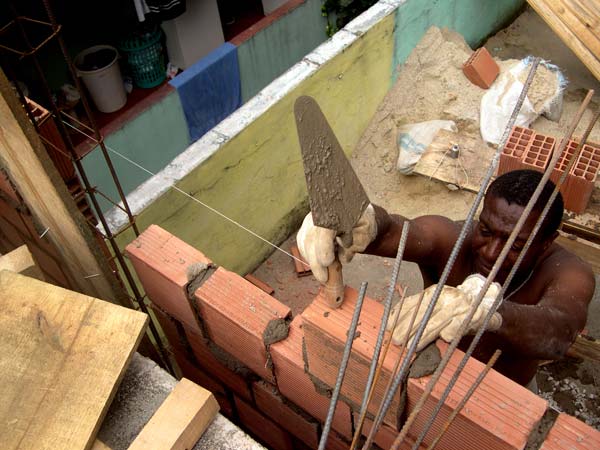
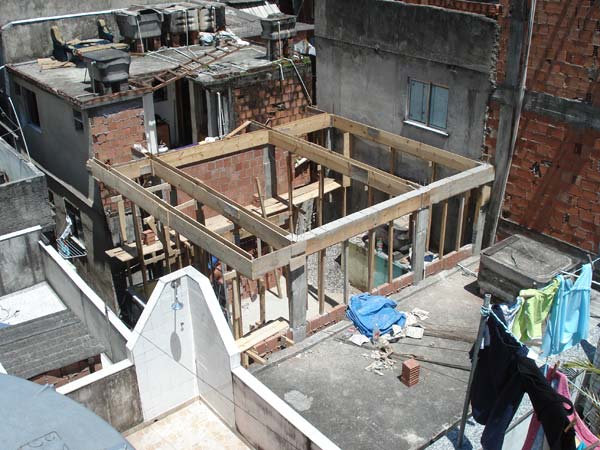
Construction of a school and cultural centre a favela in Rio. See below for more explanations.

Architects find themselves in the eye of this cyclical industry of building and re-building and soon discover that their talents are frequently abused and perverted. The more architects become aware of the history of the discipline and the forces that shape it, the greater is their disenchantment. They become highly conscious of the contradictions the profession embodies. They are aware that, as an artist or a socially concerned individual, they have one set of impulses, and as a professional another.

The conflict between the world of ideas and the world of money, and its collusion in the form of luxury homes and corporate architecture is every bit as dramatic as the suffering endured by a bipolar patient, passing from a state of ecstatic joy to one of utter depression. In the same way, architects can experience the sublime joy of pouring forth the human thrust for eternal recognition. And minutes later be confronted with the dire realization that not only will their contributions not be fully acknowledged, even by the people whom they were intended to serve, but also that their visions will be revised and adapted to the will of the all mighty client. Instead of being gods themselves, they are merely pawns in the service of a higher being: the client.

Responses to this sorry state of affairs have been as imaginative as one could expect. One is a special version of the Stockholm syndrome that causes architects to fall in love with their client. At this point, they can become “bottom-up” advocates submitting themselves to the will of the noble savage for whom they have all types of contradictory feelings. Sometimes they decide to indulge in the love of money, cynically selling their creativity to whomever pays more.

Another kind of response transforms them into Peter Pans. They refuse to grow out of the mighty age of architectural adolescence, when all dreams were lived with full intensity and faith. This sometimes produces geniuses such as constructivist Iakov Chernikhov, who entered the pantheon of famous architects after building only one structure, but sketching hundreds of fantasies into architectural glory; and Hermann Finsterlin who privileged inspiration over rationalism and refused to undergo formal architectural training because he thought it would hurt his creativity. But usually it produces teachers of architecture, who take their revenge by making their pupils dream harder and higher than they ever could, thereby producing the next generation of frustrated architects.

Architects are nearly never able to resolve their internal conflicts between artistic creation, building actualization, economic success and social recognition. Even those architects that become superstars have often been so used to selling their soul on Main Street that they have become intellectually frigid and unable to experience the simplest joys of creation. The practice of architecture evokes the greatest agony amongst its most creative and rebellious souls. They are acutely aware of the inconsistencies they embody, at once full of importance as producers of the physical world and profoundly aware of their own futility.

Sometimes these internal conflicts produce a friction that stimulates creativity even as it destroys the creator in his core. Sleepless nights, heavy consumption of coffee and cigarettes, hours in front of the computer screen, loneliness and seclusion from the family, and miserable paychecks are the common lot of architects around the world.

Architects are usually unwilling to face the true object of their quest. They are therefore unable to realize how this quest could be fulfilled. Lets face it, architects are narcissistic egomaniacs dreaming of reshaping the world in their own individual and idealized self-image. Architecture as we know it today may be a language but it is hardly a spiritual path. Ego has been driving architecture for as far as we can remember. And that’s true of almost all acts of creation.

This drive is fundamentally human and its fulfillment possible, if only one approaches it with a healthy dose of pragmatism and a bit of perversion. It can be done by hitting at the aesthetic and economic arrangements on which the profession is based -from below. For example, let’s not immediately aim at designing the highest skyscrapers or masterplanning an entire city. Instead channelize these impulses into the total production of a structure that means the world to someone who would normally not have the means to afford an architect. See this not as do-good charity, but as the way to a balanced resolution. A sacred union of the enemies within the architect’s psyche will certainly happen once you swim against the tide and project the self not merely on a CAD design, but more radically engage in the physical production of an architectural object. If the whole mind and body focus on the enormously challenging task of realizing a project with limited means, you will shock the system and transform it. All you must do is fully project your ingenuity, skills, and know-how into every minute of the construction process. Even the most conventional colleagues will have to applaud this move. The architect will then really feel like god, since, as the saying goes: “God is in the details.”

In this respect, Indian architects have a head start. They are surrounded by informally developing settlements filled with people with some resources and a great need for some architectural legitimacy and support. They can help them fulfill their own dreams of a well-built house or neighbourhood, short circuit the system and find a place in the hall of fame. Unfortunately, they are ignoring this opportunity. Instead, their colleagues from around the world are coming in large numbers – in search of the real raw material of architecture – people in need of shelter, with the basic skills of making their own.

Young architects are coming from far away to work in Indian cities because they want to learn by doing. Unplanned settlements, where many residents still remember how to build a shelter for themselves, provide the most amazing learning environment. At the same time, these deprived contexts give adventurous architects a chance to actually put their learning to good use and build. The practical knowledge of materials and methods of construction should make a comeback in architectural education, if only because they can help the contemporary architect to cure his conflicted mind.

Resolve the conflict inside the architects’ minds and we will have moved centuries ahead, into a culture of sustainability.

Photos of a 2006 project by 24 year old architect Filipe Balestra (photo) with the NGO Instituto Dois Irmãos (i2i) in Rocinha, Rio. With 200,000 to 300,000 residents and a total footprint of 0.8 sqKm, Rocinha is the largest favela of Brazil. With the help of local residents, i2i converted an old rotting house into a school and community centre. The whole project cost $30,000 out of which $16,000 went to buying the plot. It took about a year to be completed. This structure now serves nearly 70 children during the day and adults during the night. The structure hosts a large number of activities including a community centre, recycling of materials art school, Portuguese, English, French, Italian and Spanish classes, literacy, maths, capoeira, storytelling, cinema, Internet room and other temporary activities. Filipe now lives and work in Pune, India where he works with SPARC on incrementally developable structures. For more info on i2i, visit their website: www.2bros.org.

Media Media on the Wall

February 5, 2009

The Jevon Hall on Dharavi Main road usually resounds with Bollywood music playing during marriages and festivals. But last week Bollywood arrived on Dharavi’s door steps. Music composer Bappi Lahiri, the disco king of the eighties walked up the flight of stairs to sing with a bunch of children from Ganesh Vidya Mandir and Ambedkar schools located in Dharavi.

Bappi Lahiri aka Bappi Da came for a press conference about the new album he is producing with children of Dharavi and DJ Paul Devro of the label Mad Decent (Philadelphia). We had invited Paul Devro, a veteran of the Urban Typhoon Workshop, for a week to map the music and sounds of Dharavi. When Paul expressed his unconditional love for the music of Bappi Da, we immediately tried to connect them. It worked and they got along so well that they decided to produce an album together with children from Dharavi, which Bappi Da  called “Slum Stars” as a response to the title of the movie “Slumdog Millionaire.”


Bollywood star producer Bappi Lahiri with DJ Paul Devro and young Dharavi singers at a press conference in Dharavi.

Bappi Da recorded some songs with the children in his studio. The media had come that day to check out what his public relations officer had sent out to them. Many admitted they had stepped into Dharavi for the very first time. While Bappi Da, Paul Devro and the children got good attention – there were a host of community leaders and residents who had also come for the event but were given the royal ignore. Except for a couple of press reporters  – who did interview a few – for the most part Dharavi remained in the media’s shadow this evening.

Fortunately, a local hip hop crew, the South Dandy Squad who Paul Devro had recorded and who had helped us find a space for the party in Dharavi managed to get some attention from the media.


South Dandy Squad performing a capella for a local TV network.

Yet – the media bias was clear. Just a couple of weeks earlier we, along with architect Wahid Seraj and students of Srishti School, Bangalore, helped organize an architectural studio. This was to help the faculty and graduate students of the Urban Design Program at Columbia University and the JJ School of Architecture do a project in Dharavi. The studio responded to the need of three Municipal Chawls in Dharavi to evolve plans for their self development.


Omkar Municipal Housing Society (proposed) in Kokiwada, Dharavi.

The issues were complex, but the students and the community did a terrific job in responding to the nuances. They provided alternative scenarios, using different rules and regulations. They connected with the community, who in turn gave them all the cooperation that was needed. It is rare that architects, planners and community members get a chance to collaborate like this. However, when an event was organized to present the work to the community and the public at large, we invited the media. Unfortunately, since there was no celebrity, no big speeches and consequently, very little reportage. The sole journalist who came did not publish the report as promised. It was published later – truncated within another story.

One of the persons who was disappointed, but not surprised was Mr. Ramesh Mishra, a lawyer born and brought up in one of the several Bombay Municipal Corporation (BMC) chawls in Dharavi, Koliwada. It was he who had invited us to help evolve plans for his chawls that subsequently lead to the studio. He was working on a case in the Human Right Commisson. It involved the right to self-development for the residents of his and a neighbouring chawl.


Ramesh Mishra (right) with members of the Urban Typhoon team, including architects Geeta Mehta and Kamu Iyer in the back.

The built-form of the ‘chawl’ evolved in colonial Bombay as a working class tenement modified on army barracks with one room per family, a common toilet and usually a long common corridor. They can be single or multi-storied structures and reportedly a good part of Dharavi comprises of chawls. Their existence testifies to some official involvement in their construction. In fact most of the tenants in the chawls in Dharavi built by the BMC (The Brihan Mumbai Municipal Corporation) pay controlled rent to the administration.


Municipal Chawl in Dharavi

The case by Ramesh Mishra demands that chawls such as his be exempt from the Dharavi redevelopment Plan which would reduce the size of individual homes considerably. His insistence that the BMC chawls be recognized as a distinct historical component of the neighbourhood is important at several levels. It questions the deliberate homogenization of the neighbourhood as one slum. It aligns with similar resistances by residents of Koliwada (in fact Mr. Mishra is on fairly strong ground when he says that his chawl actually comes within the purview of the Gaothan law – a special protection for urban villages).

All these concerns went into the studio but almost nothing was reported. Many residents of Dharavi have been cynical about the way the media reports or does not report stories about their neighbourhood, this is why we created www.dharavi.org which lets anyone publish their research, ideas and opinion in any language.

This is our tip to the mass media: If you want a good story speak to Mr Mishra, the South Dandy Crew and the thousand other people who have unique stories and knowledge about Dharavi. If that happens it will be a paradigm shift in the way the media understands cities and neighborhoods.


JJ School of the Arts and Columbia University students presenting their work to chawls residents. Bellow is one out of three Powerpoint presentations shown by the students to the residents. This was done after only a week of work on site. The students are now working on a more professional plan that Municipal Chawls hope to present to the authorities in June.

View more presentations from the Columbia-JJ studio in Dharavi .

In addition to the airoots team, Melissa Nahory and Sytse de Maat contributed photos to this post.

Siteless Architecture

November 16, 2008

François Blanciak’s recently published book ‘Siteless’ (MIT Press 2008) features 1001 architectural designs unconstrained by scale or context. Each of his hand drawn sketches represents a possible design for a building anywhere –or maybe nowhere– in the world. Each drawing is complemented with a title, which is just as imaginative and humorous.

This book belongs to a long tradition of experimentation in architecture, which privileged inspiration over rationalism. Its subtitle ‘1001 Building Forms’ is an homage to Iakov Chernikhov’s 101 architectural fantasies. Among François Blanciak’s other inspirations, he cites John Hejduk, Jean-Nicolas-Louis Durand, and Hermann Finsterlin. Finsterlin notoriously refused to undergo formal architectural training because he thought it would reduce his creativity. This rebellious attitude towards institutions and conventions is certainly present in Blanciak’s work.

Blanciak’s book seems to originate from a profound contempt for the kind of architecture he experienced, even as he worked in some of the most prestigious offices in the world, including Frank Gehry, OMA, and Peter Eisenman. It also comes as a reaction to the moral imperative for architects of fitting new buildings into an existing fabric. What if buildings could land in the city as if they came from another planet?

Architects, already frustrated by the expectations of their clients (when they are lucky enough to have any), are also told that their designs must respect the context in which they will stand. Blanciak unapologetically rejects this constraint and abstracts design from space, which allows him to design fantastic forms with an almost aerial kind of freedom. Some of the architectural designs presented in ‘Siteless’ seem to defy gravity itself.

This makes for a good sci-fi architecture, one could say, but if any of these building forms were actualized in the urban realm, they would look alien and threatening. One could also argue that, however much one believes in respecting the local context, sometimes it just needs to be woken up from its dullness. On the other hand, a context is often full of its own eccentricities, like in many Tokyo suburbs, and may only need an extra push to come into its own more confidently.

At the same time, when it comes to picking up from his 1001 forms and insert into a Tokyo landscape, Blanciak chooses one which fits rather well in the context. This reminds us that over and above sitelessness, Blanciak’s book is really making a statement about the need for  imagination in architecture. In conversation with the author, he explains how the landscape of Tokyo with its seemingly random juxtaposition of forms and functions provides for the most inspiring visual experience. This street-level experience is one that no architectural masterpiece can match.

Blanciak produces a manic stream of designs, each of which are as different and similar as snow flakes. This mass –or rather massive– creation of difference serves to make a strong point about our general inability to activate individual creativity in the urban landscape. Of course in the big bag of diversity not every form is beautiful, just as most of Blanciak’s designs taken individually would not necessarily translate into great architecture. Nonetheless, more trial and error in the urban realm would not hurt, especially if it implies a broader participation in urban development by young architects and non-professionals.

This book should not be understood as a catalog of possible architectural forms but rather as a device to trigger one’s architectural fantasies and imagination. ‘Siteless’ would make a great cookbook for self-help builders. It is indeed in contexts like Tokyo, Bombay or Rio, where large chucks of the city have been developed by local actors, one small structure at the time, that one encounters the most innovative architectural contributions, and it is precisely in these less regulated urban contexts that experimental forms could be actualized.

In a paradoxical way, contexts, when defining themselves, are so interdependent on other contexts, that they often auto-dissolve their boundaries altogether. No wonder, each individual design in ‘Siteless’, with its gravity-defying lightness, seems to generate its own imaginary context altogether.

An interview with SANAA

October 5, 2008


New Museum, New York City which opened in December 2007

SANAA (Kazuyo Sejima + Ryue Nishizawa) is one of the most en vogue architecture office in Tokyo. They recently designed the New Museum in Manhattan. They also designed the Learning Center at the Ecole Polytechnique Fédérale de Lausanne (EPFL). Here is an excerpt from an interview we made for the Taiwanese magazine EGG, which published a special issue on SANAA in Summer 2007. For the full interview click here.


Gallery space in the New Museum

How does the New Museum project in New York relate to the city?

N: New Museum was a difficult project. It is difficult for a museum to be so open to the outside. It needs walls to hang up the paintings. An enclosed space is necessary. One of the striking features of the New Museum is that it is right in the middle of the city. It is not in the outskirts like many museums. Also it doesn’t exhibit classical art, it is very contemporary. This is why they wanted to be in the middle of the city. So the question for us was how to open up the museum in this context.

So how did you manage?

N: We opened up the ground floor, people can get in and out for free, go to the cafe or the bookstore.

S: The design of the New Museum is based on the concept of shifting box, which allows us to create an open skyline. The building literally opens up to the sky. The shifting boxes create terraces allowing people to go in and out in the middle of the building.

N: As people go up the atmosphere changes. Each floor has a different relationship to the city and offers a different experience. The ground level is very messy, in direct contact with street life. From the top we can see the skyline of New York and the Chrysler building. Of course the clients wanted walls to exhibit art, but we wanted windows because the view is so interesting!

In Japan buildings are typically not built to last more than 20 or 30 years, whereas in Europe architects don’t usually think about their work as temporary. How do you view your work in time?

N: Most of the Roman buildings are gone, except for a few bridges and the Pantheon which are still standing. In Japan some ancient temples remain thanks to maintenance. We expect our buildings to stand for a really long time, but I cannot say forever. Maybe a hundred years at the maximum. But the city has a longer life span. The city lives through many generations.

S: With many changes.

N: Yes, I feel nothing changes in European cities. The notion is that the city must preserve the same form forever. I go to Asian cities and I see everything changed since the last time. The population is growing. The life of the people is changing and the city is changing with it. In China and Tokyo I see many things happening, many changes. This is like moving with the life. This is a very different viewpoint. In Europe the idea is that cities must stay the same, in Asia cities must change. I cannot say which one is the good view.

Tokyo is the biggest city in the world and yet it is often described as a collection of small villages. What is your idea of Tokyo, thinking specifically about the notion of scale from very small to extremely big?

S: I use a very limited part of Tokyo, so in this sense Tokyo feels like a village. I cannot say I have an overall image of Tokyo. Physically I cannot tell what are the boundaries of Tokyo.

N: Tokyo appears to be very much disorganized but actually it is a city which works really well. There is no train delay. Every morning huge crowds are moved in a very orderly way from one point to the other. Very few crimes are committed in Tokyo. It is actually very orderly, even if the landscape looks disorderly. Some Westerners come to Tokyo and say this is chaos! Maybe it is true but people manage it very well.

S: It is a chaotic but also extremely dynamic place. Somehow it looks generic and not well organized but so many things happen in Tokyo. One bad aspect of Tokyo is that people cannot spend time without money, which is also related to the physical reality of the city. But since the economy was bad for so long, we gradually learned how to enjoy the city without much money!

Airoots Interviews Arjun Appadurai

September 21, 2008

Arjun Appadurai is a cultural-anthropologist born in Mumbai and living in New York. He specializes in issues of globalization and urbanism. He is the founder and president of PUKAR, a research collective based in Mumbai. He is the author of many classics on urbanism and globalization including the groundbreaking Modernity at Large: Cultural Dimensions of Globalization. A detailed biography is available on his website.

This is a short version, the full interview is available here.


Arjun Appadurai and his wife Carol Breckenridge

Airoots: With regard to your essay ‘the production of locality’, how would you present the notions of ‘agency’ and ‘participation’ in the context of urban activism?

Arjun Appadurai: When I wrote that essay (which became part of the book ‘Modernity at Large’ published in 1996) I had in mind the sense that societies, their values and structures – so far portrayed as if they were habitual and unthinking responses – were in fact the result of intention, design and conscious effort against various political and contextual environments and pressures.

The original argument was that large areas of ethnographies of the local were actually descriptions of the labour of the production of locality. In this sense agency, design and effort were important for traditional societies and this effort had relevance to globalization as well.

At that time, I did not articulate the idea of agency as part of the argument. (There did exist a sizable body of work that used agency as a basis of understanding social change). However, if I had to do that now – and it certainly begins with the idea of labour in the context of social survival – the mediating idea would be that of ‘collective agency’ (in the way that theorists like Roy Bhaskar have articulated). In this sense agency should not always be seen as an aggregate of individual choices but as something essentially social or collective.

Thus the production of locality is a symptom of collective agency. However, the qualification to that understanding is that it is not equally distributed and embodies the differences and hierarchies that emerge in collective interaction. But what is important to note is that the product – as a social force – is more than the sum of the intention, wishes and energies of any individual in the group.

Agency implies activity; action rather than mere behaviour. This also suggests that a social dimension is inevitably tied to the project – in the sense that a project is a design, a projection or a vision. In this light, the production of locality can be seen as agency that involves design and vision.


Dharavi, Mumbai 2006

Airoots: What are the problems with the concept of participation?

AA: Words like empowerment and participation can descend into clichés very easily. It is more or less meaningful in alliance with other concepts – like informed citizenship. Thus a participant is significant if he is a more informed participant. However there is something more that has to be factored in. Along with being informed, we have to ask the question if the participant is given a voice. A woman in a movement may be highly informed – but does she have a space to articulate her views and ideas. Does she have a voice? The importance of movements like that of Aruna Roy fighting for the right to information is vital since it affects grassroots movements in a big way. However it is vital because this right to information immediately expresses the idea that the informed citizen has to have a space to be heard as well. Otherwise a highly informed and aware citizen can be silenced even through custom, traditional structures and other mechanisms of control. […]

Airoots: With regard to individual and collective control – when does collective control start to violate individual freedom?

AA: […] At the grassroots level alienation sets in at two levels: One when your voice is not heard and second when you are forced to go along even when you don’t want to. My own experience comes from my observation of the National Slum Dwellers Federation, SPARC and other groups.

My discovery (or rediscovery) is that individuals do count – and that individual freedom and dissidence is an integral part of the way in which these organizations function. However there is something more than just looking at these spaces as places of control and dissent. These are also spaces which function on long-term friendships. And friendships is between individuals. You cannot take that out of the equation. There are long term friendships in which other friendships are connected – a network of friendships in which trust forms as the basic foundation of these networks. […]


Kids in Dharavi, 2006

Airoots: Don’t most grassroots/ community groups rely on the charisma of individual leaders rather than on any type of a democratic process?

AA: Many people are uncomfortable with the idea of charisma. But to refer to the success of a movement through short-hand representations of leadership as being charismatic does not do adequate justice to what happens in many movements. It distracts from the fact that overtime the relationship between leaders and participants evolves into an interactive space. Overtime networks emerge and these are not built through the charisma of a single individual but an interactive charisma – a shared aura or what Weber called collective charisma (in the context of caste). Even Weber used the concept of charisma in different ways – not just in terms of leadership. […]

Airoots: What is a model of local information production and decision-making that we seem to be moving towards?

AA: Information is different from knowledge – knowledge is processed and placed in an ethical framework. Information is neutral. For knowledge to be of any consequence it needs a space for articulation and traction on public outcomes and debate. There is a tendency to imagine that information by default will change things – but this is not so. Information can exist and still be a harsh picture of exclusion. What we need to do is to put it in the context of knowledge and the space for its articulation. SPARC is constantly trying to bring people on the stage – as many people as possible – so that they can articulate their concerns. The PUKAR Youth Fellowship project, the Neighbourhood project all of them get people to tell their own story in different ways. Telling your story, narrating lives is a very important space within which you have to frame the question of information. The idea of the story, the right to tell your story is an old civilizational resource. Unfortunately when classified as folklore it becomes a top-down phenomenon. But it can and should be expressed in bottom- up ways and most groups and organizations which recognize this allow for such articulation. […]


Mapping the neighborhoods of Dharavi on a large google satellite image with residents at SPARC’s office.

Airoots: what is the potential of new communication technologies to radically transform the way cities get planned and developed?

AA: In a recent talk I made allusions to this. My proposal was that we have tended to think of disempowered and the disfranchised (in the context of cities or otherwise) mostly in terms of the information paradigm. I suggest that we use the imagination paradigm.

Thus for people who have access to the space of this technology, it is important to use this within the spheres you are alluding to – as much through the space of imagination and creativity as through information and knowledge. […]

It is important for all grassroots movements – whether to do with urban spaces or otherwise – to have a robust discussion on issues of information and creativity.
In fact it is vital to tell your story with proper exposure to the new technologies. […]

There is indeed a rich space for information and creativity in the world of urban planning and design by coalescing the worlds of information and imagination, but only when the people – the inhabitants themselves – become creators and a resource.

New York, October 12, 2007.
Full interview available here.

An Artist Village stands in Mumbabylon

September 4, 2008

Charles Correa is one of the most interesting of Indian architects. He has been building extensively in India and abroad, but more than his design it is his thought process that is impressive.

map.gifHe was a strong advocate for the development of New Bombay (Navi Mumbai) as a twin city to Mumbai, that would decongest the city (or at least absorb some of the inflow of immigrants pouring in from rural areas to the financial capital of India). He actually acted as Chief Architect for the planning of the new city. Of course we want to ask: “What happened Charles? We know you didn’t want New Bombay to become the brutal urban environment that is today.” We’ll really need to look into why, even with such a sensible Chief Architect, the city got so ugly. An educated guess is: big money and unscrupulous/corrupted public officials messed up what was originally a good plan.

We know Charles Correa cannot be held responsible because in one part of the new city, he showed what he was really up to. This is the ‘Artist Village’, a 55 hectare mixed-income housing project in Belapur, New Bombay. The Artist Village transported us to a Goan atmosphere.

The village has a high concentration of artists. The first residents had to be artists of some sort to move in. Naturally things have changed a lot since it was built, about 20 years ago.

It is really worth a visit. Don’t go to see Charles Correa’s architectural skills or you will be disappointed. Go instead to see what a genius urban designer can do when he thinks beyond design. It is very fashionable amongst architects to despise each others’ works. Charles Correa’s ‘Artist Village’ in New Bombay has not been spared by criticism and mocking by fellow architects.

True, not much remains of the houses he designed. Most of the houses have been remodeled or destroyed and rebuilt. Some inhabitants said they were impractical (”What was the architect thinking when he put toilets outside the house?”). Some clusters of houses became “model” mini-gated-communities while others became mini-slums.

But this is precisely the genius of the project. It was produced with the idea that the residents were going to alter it in many ways, making it truly their own.

One resident we talked to complained that no provisions were made for the common spaces in the center of each cluster of houses. No one was in charge of maintaining them. These spaces do not fall under any jurisdiction; not private nor public.

He was blaming the architect for this omission. This resident had to take it in his own hands and talked to his neighbors and they worked out a solution. They each contribute to a common fund that is used for maintenance. There is even extra money left to pay a retired army officer to spend his days sitting on a chair in front of the gate they built to prevent strangers from entering the cluster (we got through though!)

In other clusters we saw residents wiping out the ground in front of their house. This was part of the plan. The architect even foresaw the dispute between neighbors which is part of the pluralistic and messy process of creating a community.

What really struck us as we walked through the Artist Village, was how organic it really looked. It was designed, yes – but it managed to be a natural city. Before we saw the project we had almost lost faith in urban design altogether, thinking that it was irremediably oppressive, determining in advance how people are to go about their lives, enclosing them into a limiting format.

The first reason why the Artist Village looks organic is that it allowed people to modify their houses freely, whether with a paintbrush or a mortar. Something that is NEVER allowed in the type of mass housing devastating the urban and psychological landscape of cities around the world.

The second reason, we have to say, is Correa’s deep understanding of the nature of cities. His cluster modules are very simple, yet they are related to each other in a complex way.

This housing project offers the quality of life of a village with the sophistication of a city. Each cluster permits the emergence of a hyperlocal community feeling, while integrating each house to the whole settlement at different levels. The hierarchy itself is very organic, as the diagrams below show (from Charles Correa 1989, The New Landscape).

Cluster of 7 houses

Cluster of 3 x 7 houses

Clusters of 3 x 3 x 7 houses

Mapping of the village

It is great to see that the best is possible. There is a middle-way between Dharavi and Brasilia and Charles Correa is pointing to it. Thank you Uncle Charlie. A deep bow from the airoots team.

Next Page »