An interview with SANAA

October 5, 2008


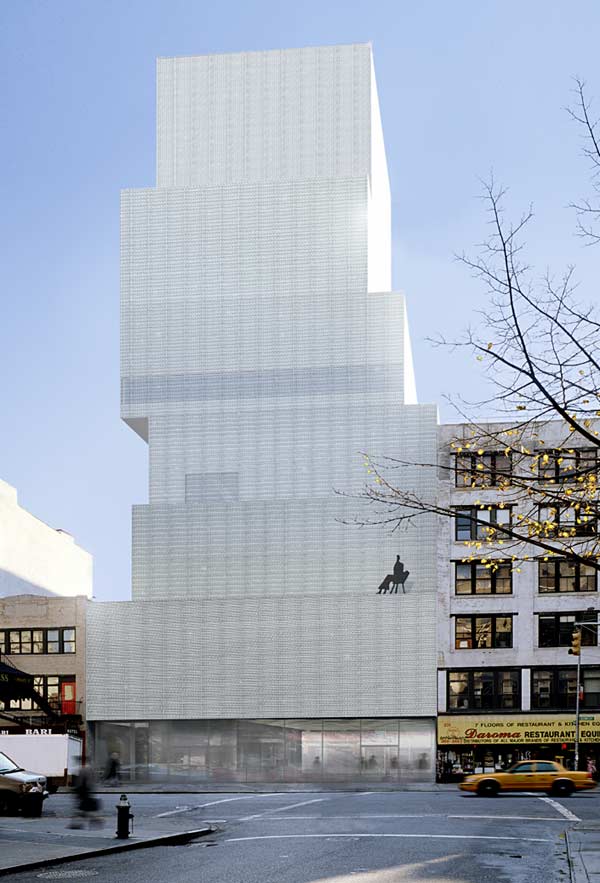
New Museum, New York City which opened in December 2007

SANAA (Kazuyo Sejima + Ryue Nishizawa) is one of the most en vogue architecture office in Tokyo. They recently designed the New Museum in Manhattan. They also designed the Learning Center at the Ecole Polytechnique Fédérale de Lausanne (EPFL). Here is an excerpt from an interview we made for the Taiwanese magazine EGG, which published a special issue on SANAA in Summer 2007. For the full interview click here.


Gallery space in the New Museum

How does the New Museum project in New York relate to the city?

N: New Museum was a difficult project. It is difficult for a museum to be so open to the outside. It needs walls to hang up the paintings. An enclosed space is necessary. One of the striking features of the New Museum is that it is right in the middle of the city. It is not in the outskirts like many museums. Also it doesn’t exhibit classical art, it is very contemporary. This is why they wanted to be in the middle of the city. So the question for us was how to open up the museum in this context.

So how did you manage?

N: We opened up the ground floor, people can get in and out for free, go to the cafe or the bookstore.

S: The design of the New Museum is based on the concept of shifting box, which allows us to create an open skyline. The building literally opens up to the sky. The shifting boxes create terraces allowing people to go in and out in the middle of the building.

N: As people go up the atmosphere changes. Each floor has a different relationship to the city and offers a different experience. The ground level is very messy, in direct contact with street life. From the top we can see the skyline of New York and the Chrysler building. Of course the clients wanted walls to exhibit art, but we wanted windows because the view is so interesting!

In Japan buildings are typically not built to last more than 20 or 30 years, whereas in Europe architects don’t usually think about their work as temporary. How do you view your work in time?

N: Most of the Roman buildings are gone, except for a few bridges and the Pantheon which are still standing. In Japan some ancient temples remain thanks to maintenance. We expect our buildings to stand for a really long time, but I cannot say forever. Maybe a hundred years at the maximum. But the city has a longer life span. The city lives through many generations.

S: With many changes.

N: Yes, I feel nothing changes in European cities. The notion is that the city must preserve the same form forever. I go to Asian cities and I see everything changed since the last time. The population is growing. The life of the people is changing and the city is changing with it. In China and Tokyo I see many things happening, many changes. This is like moving with the life. This is a very different viewpoint. In Europe the idea is that cities must stay the same, in Asia cities must change. I cannot say which one is the good view.

Tokyo is the biggest city in the world and yet it is often described as a collection of small villages. What is your idea of Tokyo, thinking specifically about the notion of scale from very small to extremely big?

S: I use a very limited part of Tokyo, so in this sense Tokyo feels like a village. I cannot say I have an overall image of Tokyo. Physically I cannot tell what are the boundaries of Tokyo.

N: Tokyo appears to be very much disorganized but actually it is a city which works really well. There is no train delay. Every morning huge crowds are moved in a very orderly way from one point to the other. Very few crimes are committed in Tokyo. It is actually very orderly, even if the landscape looks disorderly. Some Westerners come to Tokyo and say this is chaos! Maybe it is true but people manage it very well.

S: It is a chaotic but also extremely dynamic place. Somehow it looks generic and not well organized but so many things happen in Tokyo. One bad aspect of Tokyo is that people cannot spend time without money, which is also related to the physical reality of the city. But since the economy was bad for so long, we gradually learned how to enjoy the city without much money!

Airoots Interviews Arjun Appadurai

September 21, 2008

Arjun Appadurai is a cultural-anthropologist born in Mumbai and living in New York. He specializes in issues of globalization and urbanism. He is the founder and president of PUKAR, a research collective based in Mumbai. He is the author of many classics on urbanism and globalization including the groundbreaking Modernity at Large: Cultural Dimensions of Globalization. A detailed biography is available on his website.

This is a short version, the full interview is available here.


Arjun Appadurai and his wife Carol Breckenridge

Airoots: With regard to your essay ‘the production of locality’, how would you present the notions of ‘agency’ and ‘participation’ in the context of urban activism?

Arjun Appadurai: When I wrote that essay (which became part of the book ‘Modernity at Large’ published in 1996) I had in mind the sense that societies, their values and structures – so far portrayed as if they were habitual and unthinking responses – were in fact the result of intention, design and conscious effort against various political and contextual environments and pressures.

The original argument was that large areas of ethnographies of the local were actually descriptions of the labour of the production of locality. In this sense agency, design and effort were important for traditional societies and this effort had relevance to globalization as well.

At that time, I did not articulate the idea of agency as part of the argument. (There did exist a sizable body of work that used agency as a basis of understanding social change). However, if I had to do that now – and it certainly begins with the idea of labour in the context of social survival – the mediating idea would be that of ‘collective agency’ (in the way that theorists like Roy Bhaskar have articulated). In this sense agency should not always be seen as an aggregate of individual choices but as something essentially social or collective.

Thus the production of locality is a symptom of collective agency. However, the qualification to that understanding is that it is not equally distributed and embodies the differences and hierarchies that emerge in collective interaction. But what is important to note is that the product – as a social force – is more than the sum of the intention, wishes and energies of any individual in the group.

Agency implies activity; action rather than mere behaviour. This also suggests that a social dimension is inevitably tied to the project – in the sense that a project is a design, a projection or a vision. In this light, the production of locality can be seen as agency that involves design and vision.


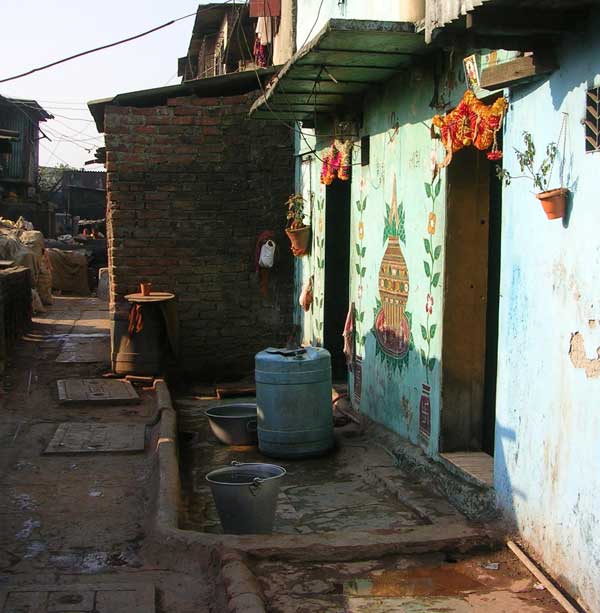
Dharavi, Mumbai 2006

Airoots: What are the problems with the concept of participation?

AA: Words like empowerment and participation can descend into clichés very easily. It is more or less meaningful in alliance with other concepts – like informed citizenship. Thus a participant is significant if he is a more informed participant. However there is something more that has to be factored in. Along with being informed, we have to ask the question if the participant is given a voice. A woman in a movement may be highly informed – but does she have a space to articulate her views and ideas. Does she have a voice? The importance of movements like that of Aruna Roy fighting for the right to information is vital since it affects grassroots movements in a big way. However it is vital because this right to information immediately expresses the idea that the informed citizen has to have a space to be heard as well. Otherwise a highly informed and aware citizen can be silenced even through custom, traditional structures and other mechanisms of control. […]

Airoots: With regard to individual and collective control – when does collective control start to violate individual freedom?

AA: […] At the grassroots level alienation sets in at two levels: One when your voice is not heard and second when you are forced to go along even when you don’t want to. My own experience comes from my observation of the National Slum Dwellers Federation, SPARC and other groups.

My discovery (or rediscovery) is that individuals do count – and that individual freedom and dissidence is an integral part of the way in which these organizations function. However there is something more than just looking at these spaces as places of control and dissent. These are also spaces which function on long-term friendships. And friendships is between individuals. You cannot take that out of the equation. There are long term friendships in which other friendships are connected – a network of friendships in which trust forms as the basic foundation of these networks. […]


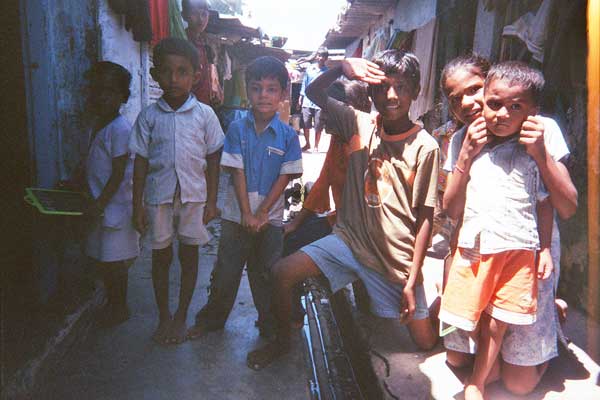
Kids in Dharavi, 2006

Airoots: Don’t most grassroots/ community groups rely on the charisma of individual leaders rather than on any type of a democratic process?

AA: Many people are uncomfortable with the idea of charisma. But to refer to the success of a movement through short-hand representations of leadership as being charismatic does not do adequate justice to what happens in many movements. It distracts from the fact that overtime the relationship between leaders and participants evolves into an interactive space. Overtime networks emerge and these are not built through the charisma of a single individual but an interactive charisma – a shared aura or what Weber called collective charisma (in the context of caste). Even Weber used the concept of charisma in different ways – not just in terms of leadership. […]

Airoots: What is a model of local information production and decision-making that we seem to be moving towards?

AA: Information is different from knowledge – knowledge is processed and placed in an ethical framework. Information is neutral. For knowledge to be of any consequence it needs a space for articulation and traction on public outcomes and debate. There is a tendency to imagine that information by default will change things – but this is not so. Information can exist and still be a harsh picture of exclusion. What we need to do is to put it in the context of knowledge and the space for its articulation. SPARC is constantly trying to bring people on the stage – as many people as possible – so that they can articulate their concerns. The PUKAR Youth Fellowship project, the Neighbourhood project all of them get people to tell their own story in different ways. Telling your story, narrating lives is a very important space within which you have to frame the question of information. The idea of the story, the right to tell your story is an old civilizational resource. Unfortunately when classified as folklore it becomes a top-down phenomenon. But it can and should be expressed in bottom- up ways and most groups and organizations which recognize this allow for such articulation. […]


Mapping the neighborhoods of Dharavi on a large google satellite image with residents at SPARC’s office.

Airoots: what is the potential of new communication technologies to radically transform the way cities get planned and developed?

AA: In a recent talk I made allusions to this. My proposal was that we have tended to think of disempowered and the disfranchised (in the context of cities or otherwise) mostly in terms of the information paradigm. I suggest that we use the imagination paradigm.

Thus for people who have access to the space of this technology, it is important to use this within the spheres you are alluding to – as much through the space of imagination and creativity as through information and knowledge. […]

It is important for all grassroots movements – whether to do with urban spaces or otherwise – to have a robust discussion on issues of information and creativity.
In fact it is vital to tell your story with proper exposure to the new technologies. […]

There is indeed a rich space for information and creativity in the world of urban planning and design by coalescing the worlds of information and imagination, but only when the people – the inhabitants themselves – become creators and a resource.

New York, October 12, 2007.
Full interview available here.

Artist Village in Mumbabylon

September 4, 2008

Charles Correa is one of the most influential Indian architects around. He has been building extensively in India and abroad, but along with his designs it is his thought process that made an impact. He was a strong advocate for the development of New Bombay (Navi Mumbai) as a twin city to Mumbai, that would decongest the city (or at least absorb some of the inflow of immigrants pouring in from rural areas to the financial capital of India). He actually acted as Chief Architect for the planning of the new city.  However, he himself would agree that, eventually, the city’s growth didn’t quite go as planned. An educated guess is: big money and unscrupulous/corrupted public officials messed up what was originally a good plan.

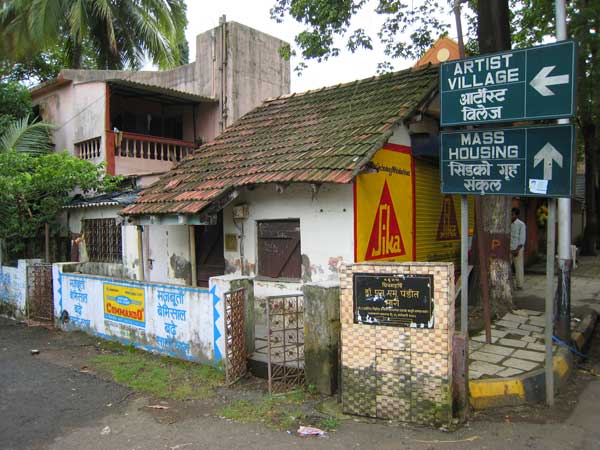
We know Charles Correa cannot be held responsible because in one part of the new city, he showed what he was really up to. This is the ‘Artist Village’, a 55 hectare mixed-income housing project in Belapur, New Bombay. The neighbourhood immediately transported us to a Goan atmosphere, indicating his roots on the Konkan. It was almost as if he saw the twin city as a gateway to the coast, all the way down to his native state.

The village has a high concentration of artists. The first residents had to be artists of some sort to move in. Naturally things have changed a lot since it was built, about 20 years ago.

It is really worth a visit. Go to see what a genius urban designer can do when he thinks beyond design. It is very fashionable amongst architects to despise each others’ works. Charles Correa’s ‘Artist Village’ in New Bombay has not been spared by criticism from fellow architects.

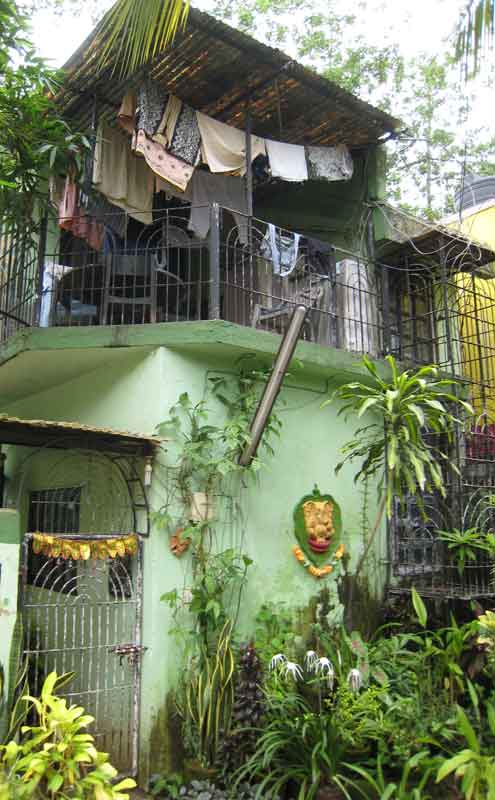
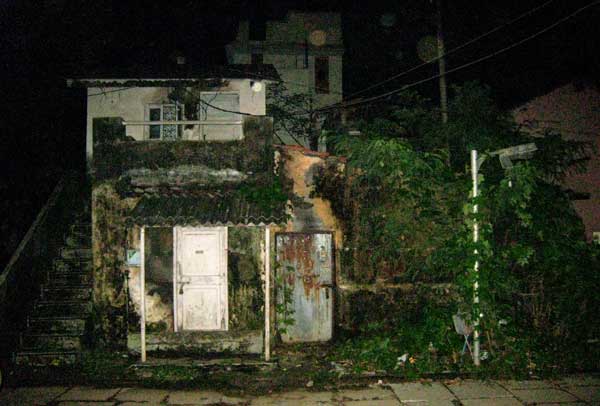
True, not much remains of the houses he designed. Most have been remodeled or destroyed and rebuilt. Some inhabitants said they were impractical (”What was the architect thinking when he put toilets outside the house?”). Some clusters of houses became “model” mini-gated-communities while others became mini-slums.

But this is precisely the genius of the project. It was produced with the idea that the residents were going to alter it in many ways, making it truly their own.

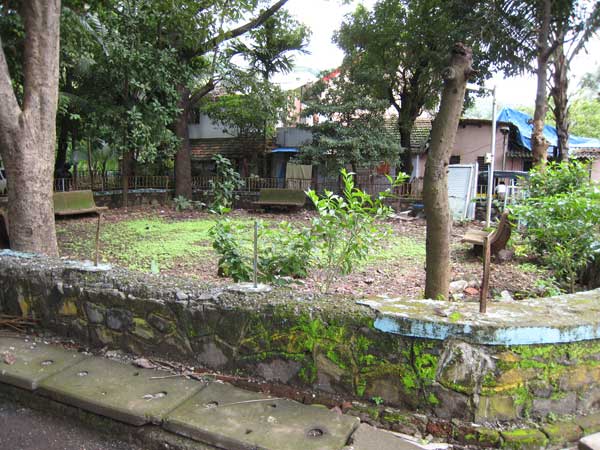
One resident we talked to complained that no provisions were made for the common spaces in the center of each cluster of houses. No one was in charge of maintaining them. These spaces do not fall under any jurisdiction; not private nor public.

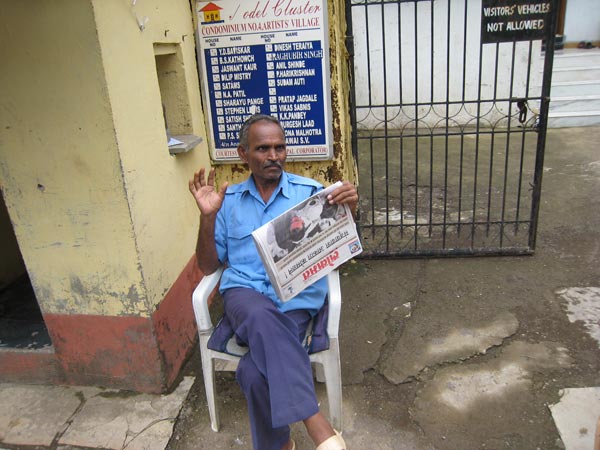
This resident had to take it in his own hands and talked to his neighbors and they worked out a solution. They each contributed to a common fund that started being used for maintenance. There is even extra money left to pay a retired army man to spend his days sitting on a chair in front of the gate they built, to prevent strangers from entering the cluster (we got through though!)

In other clusters we saw residents wiping out the ground in front of their house. This was part of the plan. The architect even foresaw the dispute between neighbors which is part of the pluralistic and messy process of creating a community.

What really struck us as we walked through the Artist Village, was how organic it really looked. It was designed, yes – but it managed to be a natural city. Before we saw the project we had almost lost faith in urban design altogether, thinking that it was irremediably oppressive, determining in advance how people are to go about their lives, enclosing them into a limiting format.

The first reason why the Artist Village looks organic is that it allowed people to modify their houses freely, whether with a paintbrush or a mortar. Something that is NEVER allowed in the type of mass housing devastating the urban and psychological landscape of cities around the world.

The second reason, we have to say, is Correa’s deep understanding of the nature of cities. His cluster modules are very simple, yet they are related to each other in a complex way.

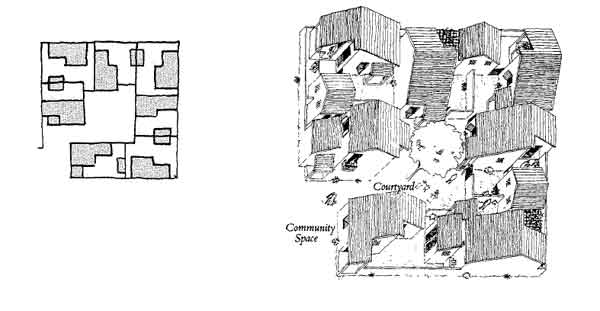
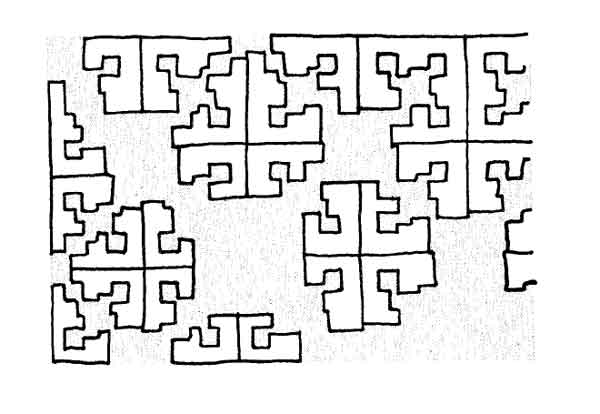
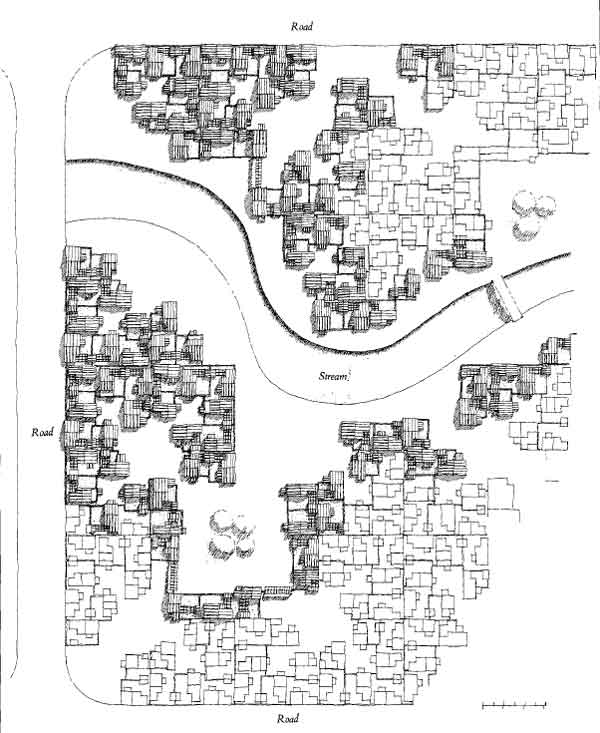
This housing project offers the quality of life of a village with the sophistication of a city. Each cluster permits the emergence of a hyperlocal community feeling, while integrating each house to the whole settlement at different levels. The hierarchy itself is very organic, as the diagrams below show (from Charles Correa 1989, The New Landscape).

Cluster of 7 houses

Cluster of 3 x 7 houses

Clusters of 3 x 3 x 7 houses

Mapping of the village

It is great to see that the best is possible. There is a middle-way between Dharavi and Brasilia and Charles Correa points clearly to it. Thank you Charles!  A deep bow from the airoots team.

Pondicherry Black City Revisited

August 18, 2008


Digital mashup.

Pondicherry Black City  Pondicherry is well known throughout the world for its historical French Quarters and more recently for the amazingly successful community of Auroville, which is gaining global attention for the new greening, farming and redistribution models it is experimenting with. Somewhere between these grandiose realizations lies the Black city, which was named in opposition to the pristine French Quarters. The street manages to hold its own against the elegant white-washed art deco structures and the quaint and cosy streets that a colonial legacy has bestowed on this slice of what was once Francophone India.

The Black city responds at once to the frozen elegance of the White city and the elitist utopianism of Auroville.  It absorbs these models along with a many others and regurgitates everything cheerfully in a unique mix of styles. This article explores Pondicherry’s Black City brand of mashup architecture.


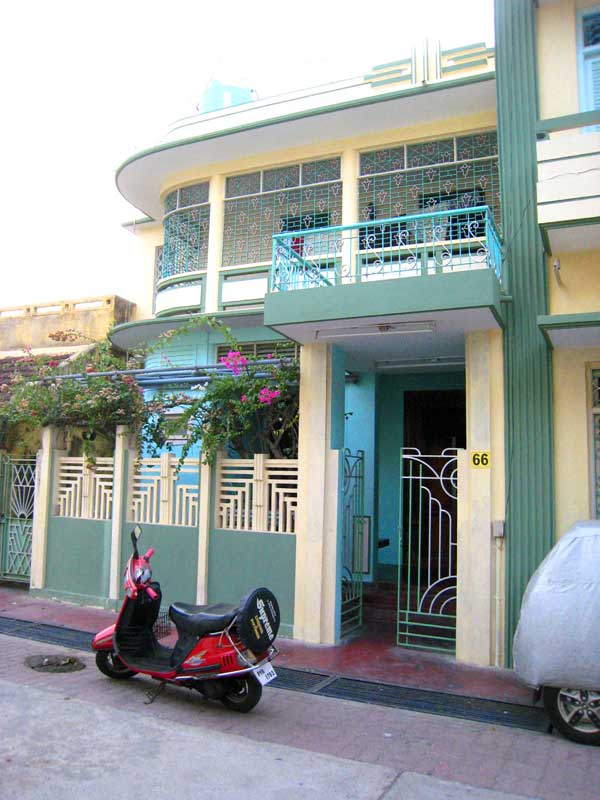
Futura mashup.

The streets of the Black city are in turn creative, imitative, beautiful, kitschy or ugly but at all given points of time they are highly personal and expressive. Yet – just as each individual is as much a holistic entity as a confluence of varied histories and backgrounds, influences and experiences – their individual self-expressions inevitably produce complex archetypes.

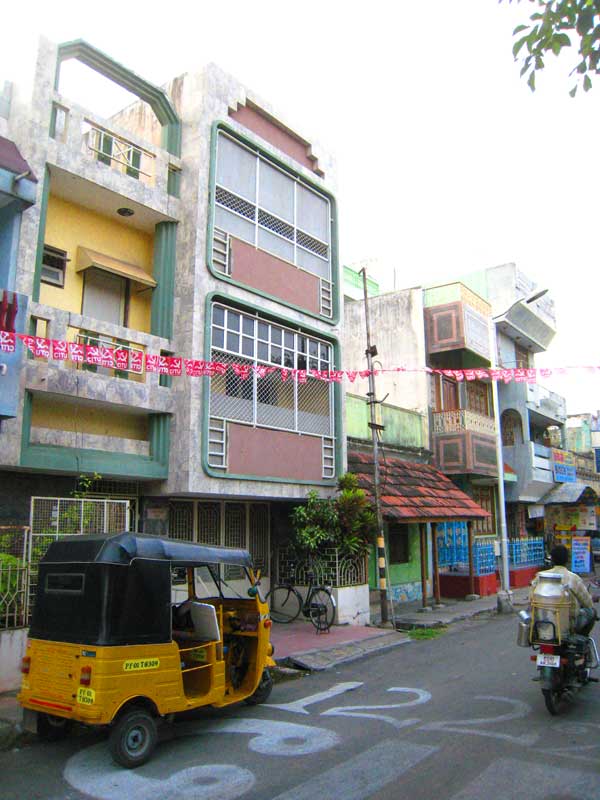
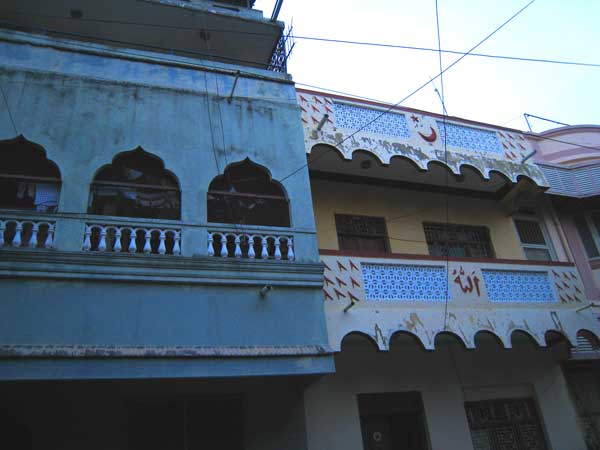
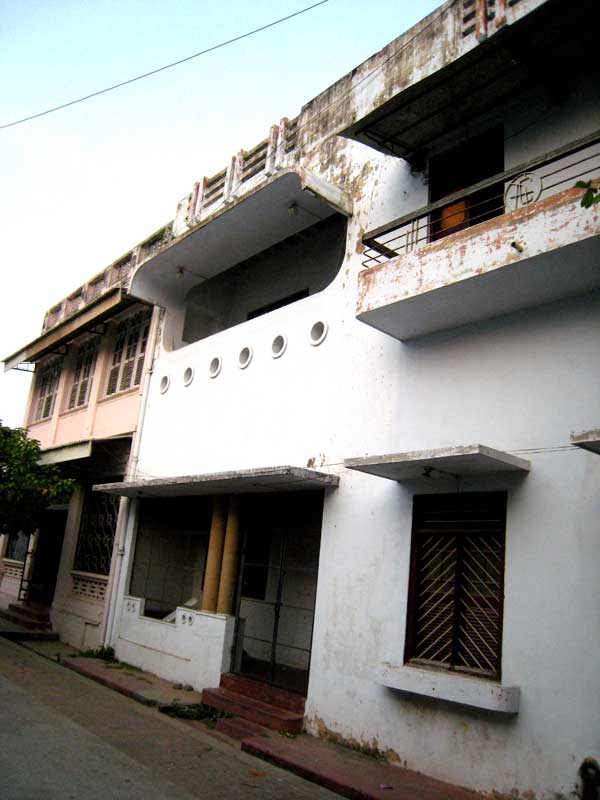
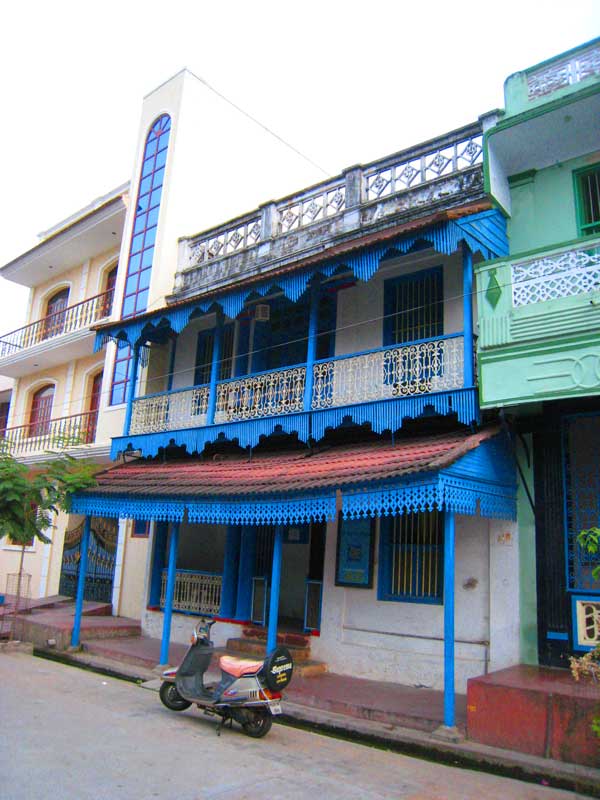
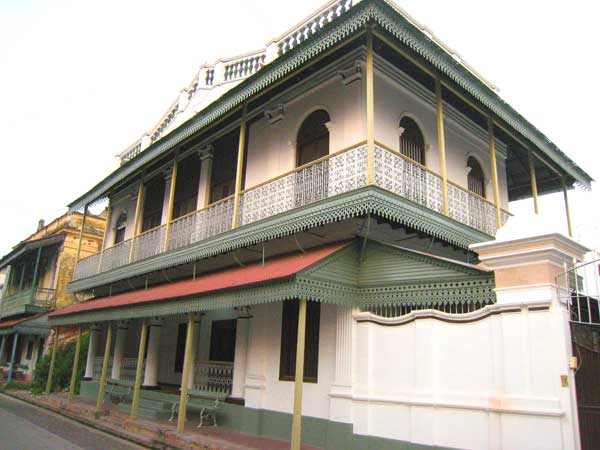
What makes the Black city stand out is the diversity of idiosyncratic architectural styles that it features. Individually and collectively, the homes are a riot of colour and shapes, making unexpected references to decontextualized histories and sentimental nods to nostalgic memories. They take the flourishes of the white city and mold them into something quite extraordinary – at once building on the principles of art-deco’s plasticity and running away with it. Like many aspects of popular culture they do not claim to be original and in fact deliberately use a copy-pasting strategy, building up the new out of the old.


Art Deco mashups.

These structures use and abuse every possible existing architectural style to the point that one can even wonder if it is not a new architectural gender of its own, one that could be called “mashup” in reference to the rapidly spreading Web practice of integrating various systems and languages to create new features and modes of operation.

This remix culture is eminently contemporary. Celebrated today as postmodern it has always been the driving principle behind most collective creative productions. For example, Indian popular cinema is nothing but a collusion of styles and an open-ended pursuit of originality constrained only by the ever-changing tastes of the public. Our street is popular culture at its best. An explosive expression of the Indian vernacular that provides a fantastically graphic illustration of the way traditions, colonial architecture and global influences have been digested and processed by a segment of the population.


Neo-classic mashups.

In many parts of India colonial enclaves have similarly inspired desi architectural versions. So-called Portuguese villas in Goa have spawned a thick-set, local variant that litters the lush country-side. The British Bungalow from the cantonment has inspired a variety of architectural responses all over small town India.

Each house in the Black city seems to have a unique history, which as difficult to map as it is to recollect a dream – the very same dream that may have allowed the house to be constructed in the first place. A piece of a fragmented fantasy, seen on travels to Asia or the Middle East, could have got grafted onto a memory of a childhood home, which in turn must have been spiked by the fire of social aspiration to produce a genuine South Indian streetscape.


Disneyland mashups.

While one debates whether desi variants of dominant trends can be referred to as styles of their own – one cannot deny that there is a process in place which guarantees constant creative output. A process that is expressed by the main initiator, conceiver or the inhabitant of the house. The ordinariness of constructing each home is balanced by the ability of each builder-inhabitant to play out his fantasy. Global influences, local histories, familial obligations, available technology and skills come together in the singularity of the moment. The subsequent crystallization produces a dynamic architectural flow that connects this street to millions of others on the sub-continent while at the same time being absolutely unique. The quality of its uniqueness is a testimony to the coming together of all these forces in a special way. What connects it to its other country cousins is the fact that similar forces operate everywhere to produce these unique expressions.


Islamic mashups.

The aesthetic component of the production process is very similar to those of other popular cultural artifacts. Take Indian movies for example. Whether Bollywood can be called a “style” or not in view of what it produces, is open to debate. However, one cannot deny that there is a certain process in the Indian movie industry that at the very least allows the production of Bollywood movies to happen in a special way, especially through the willingness to surprise the spectator or through a profound disregard for stylistic categories. If we had to say what thing is common to all Bollywood productions, we would have to say that none of them tries to consciously fit in the genre except through broad nods to inherited conventions. With the ever present possibility of finding a movie that denies those conventions as well – or at least attempts to do so. The same is true for Black City. Seen by itself, each home may not have much to project outside of loud melodramatic statements, but as a street, each home consolidates with the other to garner all the power and force of an energetic popular text.


New Pakistan mashup.

These homes are interesting only thanks to the fact that they exist next to each other, encouraging each other’s wilderness. They explode in your face with a loud bang that seems to come straight out of a comic strip completely exaggerated, but never embarrassed by their shrillness. Just as in the comic book each frame competes with the previous one to call the attention of the reader, in the Black city each home seems to rejoice in its palatial projections. At the same time it only seems to take itself half-seriously, as if a hint of irony had been tastefully added to the mix.


Romantic mashup.

At one level one could simply call these homes kitsch and join in their celebration of diversity of form. It would reflect the democratic mood of the times. But they do not allow such simple projections either. For tomorrow – they may just auto-destruct with the next inhabitant, a new dream and flow down another stream in some other direction.


Smurf mashup.


Boat mashup.


Louisiana mashups.

After all their collective diversity simply emerged as a result of creative freedom from architectural conservatism. Black city is to us a celebration of self-expression and collective identity – a true resolution of  global influences into localaesthetic.

Article published in The Indian Architect & Builder, Summer 2008.

Bazaarchitecture

May 20, 2008


The historical center of Mexico city is taken over by tens of thousands of vendors. Around 5 million people visit this area every day. The Bazaar extends well over a radius of 15 kilometers. You can get clothes here for as low as 1 Peso a piece.

Much has been made of the need to look beyond built form and architecture when talking of the city. The need to focus on people who use built forms and the need to focus on the ‘soul’ of a building have become well-enshrined objectives in the best of architectural practices. So much so that they generate as much cynicism or alternatively, allow reactive architectural statements to be made all the time.

From green architecture to nomadic shelters, passing through augmented reality, every dimension of the architectural realm is being explored, theorized, critiqued and remixed. It looks like as if architectural professions have reached a level of knowledge and practice never attained before, thanks in part to an advance in technological education.

In spite of this, Rem Koolhaas observes, “Junkspace is the sum total of our current achievement…” (2006). There seems to be a deep disconnect between the intelligence embedded in architectural artifacts and the dumbness of the cities we are developing for ourselves.

What if the problem does not lie in the body or soul of the architectural object? What if the uses and abuses of architecture are themselves only symptoms of a deeper conceptual malaise? Should the over-arching concept of the city itself, within which most architectural moments are located – need to be critically interrogated? Would we be able to move to an understanding of urban architecture in a less embattled way?

There is something solid and quantifiable to the idea of the city that allows architectural narratives to dominate our idea of urbanism, and through it, all contemporary life. The idea of the city starts from the fiction of evolutionary growth – from the tribal to civilized man, from the unsettled and light to the rooted and heavy, making the notions of scale, monumentalism, and density, some sort of in-built genetic conceptual pools that dictate the way human civilization evolves. It’s as if they contribute as much to the escalation of urban intensity as does the impulse of urbanization itself. Every civilizational moment that feels it has arrived has its own peculiar notion of evolutionary movement from the tribal primitive to the urban sophisticated.

According to a dialectical conception of history, the urban is superior to the natural in evolutionary terms, or at least, it represents an advanced expression of nature’s evolution. The imagined opposition between the natural environment and the city confers a heroic status to the architect whose practice seemingly consists in extricating tomorrow’s civilization from today’s material conditions.

In today’s endlessly sprawling, densifying cities, ‘savage nature’ that we once believed we had successfully contained, comes to haunt us in all kinds of ways. The new frontiers of our cities exist within. The urban wilderness of American inner-city ghettos or Asian slums for instance clashes with urban planners’ and real estate developers’ aspirations of controlling space and modernizing.

For all their grandeur and pretension, masterpieces of Modern architecture are as many doomed attempts at defying the city’s anarchic expansion. All around the globe, clones of Mies van der Rohe’s Seagram Building are proudly erected, forcing the chaotic city “to look at itself reflected… in the neutral mirror that breaks the city web” (Tafuri & Dal Co, 1979). The dramatic moment when the pure architectural form finally stands and confronts the urban mess around is on some kind of perpetual repeat mode, as if planners and architects have not been able to get over its illusory thrill. However, the mess always wins in the end.


Seagram Building by
Mies van der Rohe, 1969

New York for instance once again became the city of the future on September 11, 2001, when the Twin Towers disintegrated back into the city web releasing a billion tiny glass and steel particles that reflected, for an instant, the ultimate failure of the Modern project. The debacle was quickly draped up like a Christo piece. A “work in progress” sign was left in front of Ground Zero and our brains were plugged right back onto the sedative media stream, fed with rhetoric of civilization and dreams of progress.

In our growth-obsessed civilization, destruction is nothing more than an opportunity for construction. The new Freedom Tower was selected and designed with great speed and by fewer people than was necessary to bring down the Twin Towers in the first place. The new Freedom Tower will have an asymmetric shape, which seems to be more in vogue these days. That’s about the only change to expect. Otherwise, the repeat button has been furiously pressed as expected, as if to contain the surrounding urban chaos threatening to spill over into Ground Zero. No time was left for any possible reflection on the bankrupt proposition the Towers symbolized.

Yet, for all their bigness, aesthetic purity, and ‘land-marking’ power, monuments have never made a city. The moment of urbanity lies, in fact, in the surrounding mess they are meant to resolve. To see that, we need to put our architect, urbanist, and activist defences down and experience the city from within. As if it were a giant art installation one could get lost in.

Let’s imagine a city. Not any particular city but rather a mix of cities; a messy collage of Mumbai, Goa, Tokyo, Barcelona, Mexico City, New York, and a few others. An endlessly sprawling global village looking like Cedric Price’s “Scrambled egg city”, where everything is distributed evenly in “small granules or pavilions across the landscape in a continuous network” (Shane 2006.4).

In typical postmodern fashion, this city is composed of disparate architectural elements: an art-deco hotel, a tourist resort, an electronic billboard, a neon sign, a delirious cathedral, mass housing, sun-breaking office towers, and so on. These archetypes majestically come together to produce the skyline of our imaginary city. Spreading over and under, within and between, even spilling outside, the “continuous network” is everywhere. Formless more than informal, it is the glue tying urban elements together. This is what we could call the ‘Bazaar City’ – the city in its raw form.

It is this history of ‘ground level urbanism’ that we want to evoke here. It is a simple way of getting out of the body/soul discourse of architecture that dominates our reading of cities today. How exactly did we arrive at this observation? What is the connection between urbanism, the bazaar, and the need to see cities beyond the issue of architecture in any dominant form? How does the bazaar tell us that urbanism lies not in the architecture at all and how does the bazaar help us understand this by never really dismissing the architectural moment? How do we keep architecture in its rightful place – body, soul, and whatever – and how is it always one step below the energy that really creates a city?


Chor Bazaar: Mumbai is the ultimate bazaar city.

History reveals that tribal and peasant-driven markets were the real sites where diverse identities, goods and artisanal skills were exchanged – always as part of larger networks of trade across the globe. However, contemporary accounts of urban history only focus on the eventual manifestation of these exchanges in the form of power centres. The bustling markets and habitats within or outside forts and palaces that nourished kingdoms and were the primary generators of wealth have slowly faded from our imagination. Only the shells remain. They offer the blueprints for modern societies to imagine the highest forms of civilizational aspiration through a partial version of the past.

These blueprints are imagined to be the nodes of kingdoms and empires, dense with people and physical structures – the earliest examples of urban spaces as we know them today. In reality they constituted only the tip of the human civilizational iceberg.

Seen in totality, civilizations were composed of the flows of wealth, goods, people, and culture, across vast spaces beyond these centres, following trade routes over land and sea. These may never have produced robust structural expressions but were full of intense urban moments.

Lets transcend the idea of urbanism as a kind of physical manifestation (or even as urban density in terms of scale of population aggregates). Instead, see it in those moments of interaction, of movement, in weekly or seasonal bazaars and flea-markets, that feed the political and economic nerve centres. What emerges is a different notion of urbanism. One in which, it does not matter if twenty people set up shop at the edge of a forest or two thousand on the outskirts of a kingdom. Urban intensity lies in that moment of buying and selling. Not just that – the context of exchange showcases many other things. The thrill of meeting new people, the excitement of discovering a new object, forging friendships and simply enjoying the thrill of crowds.

It is this moment that contemporary urban life yearns for. It is this simple moment that is regenerated in billion-dollar cities with heavy and expensive architectural legacies. Contemporary cities yearn for the thrill of the bazaar, but instead of creating appropriate contexts where its natural energies can be expressed, they produce contemporary translations that loose the subtleties of the moment. The most dominant urban spaces today – the shopping malls – reduce the idea of the bazaar to its bare minimum – shopping.

Universal and ubiquitous, the bazaar, according to Dipesh Chakrabarty, is “obviously an abstraction of certain structural characteristics” – it is an organizational principle based on the most instinctual human propensity to trade and exchange. It is “a meeting point of several communities”. The bazaar is necessarily “unenclosed, exposed, and the interstitial outside.” (Dipesh 1991)

No wonder the bazaar is making a comeback in post-industrial cities: farmers’ markets, music festivals, and the like, are appealing to an increasingly cosmopolitan and bohemian generation that constructs its identity in a way similar to how we constructed our imaginary city in this essay – with bits and pieces from here and there. The remix and collage culture that drives today’s ‘creative economy’ relies on spaces of exchange where the new can be made out of the old.

The eagerness to reinvent one’s own ‘cultural self’ is nowhere as apparent as in urban Japan, where a growing segment of the youth is rejecting older generations’ lifestyles and values, which include, among others, a respect for ‘patriarchal order’. The bazaar, for such radical denizens, becomes an outer space of socialization where another world is possible.


This vernacular style building in one of the hippest neighbrohoods of Tokyo, Daikanyama is used by the Japanese designer brand Okura. On the right side is the entrance to the very trendy Bombay Bazaar restaurant, serving curry on Japanese rice.

A makeshift bazaar aesthetic is making a comeback in Tokyo’s fashionable neighbourhoods, as exemplified by the Bombay Bazaar in Daikanyama in Tokyo. This restaurant is part of a new group of venues that have adopted a slummy-looking vernacular architecture as a fashion statement. There is no signboard announcing the place, just an old table with empty Coke bottles, a few metal sheets on the walls, and a ‘handicapped’ sign. As is typical of Tokyo, one could never find this venue, unless taken there by someone in the know. Its interior is resolutely bohemian with heteroclite second-hand furniture chosen with taste. A dreadlocked woman eats curry rice in the corner and a French couple drink lassi served by a cute hippieish waitress. In the same building, a store sells casual-chic cloth. Further down an Italian brand tries hard to ‘look ghetto’. 20 metres away, Bonjour records is packed with collectors items and features a deliberately low-key front. Tokyo’s low-rise high-density urban fabric and small-scale architectural structures allow all kinds of independent shops, small-time retail outlets, food joints and bars to flourish.

The bazaar city spreads all over the world, beyond national and cultural boundaries, with its continuous network of streets and shops. There is a fascinating continuum from the streets of Tokyo’s Daikanyama or Shimokitazawa to Ingo’s Saturday Night Flea market in Goa. where a diverse set of ‘global people’ are engaged in trading trinkets, weed-smoking pipes, high-end and low-brow cuisine, wines and local intoxicants, art and fashionable clothes, and shoes, from a thousand tiny stalls made up of bamboo and cloth. This spectacle frames the moment of pure bazaar, simultaneously evoking ancient tribal traditions and futuristic global cosmopolitan fantasies.

Read the full article in the current issue of Art India magazine available in all good bookstores in India, Europe and the US.

« Previous Page