The Moment of Activism
October 9, 2008

Local identity is a notion worth exploring since it is often in its name that activists and community groups come together and oppose “redevelopment plansâ€, such as the ones taking place in Shimokitazawa-Tokyo, Dharavi-Mumbai, Goa, Barcelonetta-Barcelone and so many other places around the world.
In Shimokitazawa for instance, local residents created various groups including Save the Shimokitazawa and Shimokitazawa Forum in response to a typical old-school top-down master plan of the government for a 26 meter-wide road cutting through the culturally vibrant pedestrian streets of that unique Tokyo neighborhood. These groups have been incredibly active and creative in their response to the government’s plans.
They organized symposiums with academics and experts, invited students from Japan, Israel, and the US to propose alternatives, organized an international design workshop, conducted population surveys, petitioned residents, raised funds, created other groups, wrote to the government and the media, designed posters, t-shirts, hats and pins, organized marches, concerts, and festivals… They have done everything imaginable.
These groups are composed of some of the most informed, organized and passionate people in Tokyo. They are also the most diverse yet united bunch ever: planners, architects, musicians, students, unemployed, professors, bar owners, retirees, editors, journalists, professional gamblers, translators, dancers, librarians, corner shop owners, enthusiastic foreigners, you name it. Spend an evening with them at their favorite meeting place, the Never Never Land bar, and they just look like childhood friends or better, like old comrades who’ve been fighting many wars together.
They are united against a common threat; fighting a common enemy. Yet sometimes one wonders if that enemy is not also their best friend. A best enemy of sorts. Think about it: if the government was to withdraw its redevelopment plan altogether, what would happen to the sacred unity connecting these people? What would then happen to that “local identity†they are defending? Would it still exist once everyone goes back home and meets only randomly in the street or occasionally in a bar?
In fact community groups such as Save the Shimokitazawa and Shimokitazawa Forum do not defend “local identity†as much as they create it. In other words, the moment of activism is more meaningful than the cause being defended. Not only that, there is nothing static about the local identity that they create in the process. It gets redefined each time a new member joins the group or each time the government alters its plans. Community groups are actually rarely in favor of the status quo. They are fighting for self-determination and control in the local development process.
Community groups are sometimes accused of being composed of nostalgic, romantic souls trying vainly to preserve a local identity that has no meaning in the context of cities like Tokyo, Mumbai or Barcelona, which are in constant evolution. But really, these groups are fighting to preserve the ever changing nature of their neighborhoods, not to keep them stuck in one point of time. They are defending a culture in movement and the movement of culture.
The redevelopment plan in Shimokitazawa, with its wide road and lanes of 10-12 storey high buildings, will clearly make any future development costly and difficult, and necessarily top-down. Metabolic evolution requires a multiplicity of actors acting at the local level. The possibility of change is what needs to be preserved. It is only when a culture or “local identity†doesn’t have the possibility to change that it dies. Change is a necessary condition of identity.
The most important function of “participatory planning†is to create venues for the “production of locality†in our cities today. And without a doubt, community activist groups are the best sources of inspiration for any policymaker or urban planner interested in participatory planning.
For all its shortcomings, participatory planning is worth a genuine try. The crowd is not always wise in the end, but it definitively gets wiser in the process.
12 Principles for an Architecture of Participation
September 28, 2008
These are non-constraining, open-ended, and adaptable principles for an architecture of participation that can be used by any group of people, NGOs or urban planners interested in activating the collective intelligence of a community. Here, we use the example of city planning, but the principles are adaptable to the development, coordination, or management of various types of open systems, including corporations or software development.
1. NEED IT: Necessity is the mother of invention. What do you need, as an individual and as a community? It is not for master planners to guess what people need. Stakeholders should speak up.
2. GET IT: No need to reinvent the wheel again. Lets find what works elsewhere and adapt to the local/present needs and then expand it.
3. DO IT: You don’t really understand the problem until after you start implementing the solutions. It doesn’t have to be an all out “redevelopmentâ€, we can start small and gradually build knowledge and best practices. This will develop the social and cultural capital of the community.
4. BE OPEN: With the right attitude, interesting (and unexpected) issues will come up and make the plan & development better.
5. SHARE: Do not feel proprietary about the plan. Or rather, let other people feel proprietary about it as well. The common goal is to have the best/optimal solution for all.
6. CONTRIBUTE: Residents should be co-planners and co-developers. The concerned population is the biggest asset for and of planners.
7. COMMUNICATE: The plan should be publicly accessible to all concerned parties at all times. Updates should be frequent so everyone has access to the latest information and can react immediately. Say what you have to say and listen to what other people have to say and immediately incorporate it. It can always be modified/adjusted along the way.
8. CONVENE: If we have enough people looking at different aspects of the plan, any issue can be recognized and addressed quickly. Finding the issues is the biggest challenge. Once identified, someone will have an idea about how to solve the problem.
9. INCLUDE: Finding an efficient way to get everyone’s input is more important than the inputs themselves. A lot of time and attention should be spent to cultivate the community’s active participation.
10. ACKNOWLEDGE: If participants are treated as the most valuable resource of the plan, they will become the most valuable resource of the plan. Contributions should be acknowledged and valued.
11. PROCESS: We should strive to activate the collective intelligence of a community, which also means processing, selecting and incorporating good inputs into the plan. This may or may not be the task of a sub-group of people acting on behalf of, and accountable to, all stakeholders.
12. BE CRITICAL: Realizing that our concepts are wrong might lead to the most striking and innovative solutions.
These value-based principles will lead the plan in a certain way. They are self-consistent and mutually reinforcing. These principles have been proven to work very well for the development of complex systems over time. They are actually based on an analysis of the success of the legendary open-source operating system Linux.
We “hacked†these 12 principles from Eric S. Raymond’s groundbreaking essay of the organizational principles behind the development of Linux by a global community of programmers (The Cathedral and the Bazaar, 2001). We simplified them and tentatively adapted them to the field of urban planning. Eric S. Raymond himself formalized the principles that Linus Torvald followed with the success that is now legendary. Eric S. Raymond also successfully tested these principles for the development of “fetchmailâ€, an email application.
These principles are still at a nascent stage and we hope that with time and practice they will get defined better. After all, we are still pretty much walking in the dark as far as participatory planning is concerned, so it might be wiser to abstain from organizing these principles too tightly. People should adapt them according to their own objectives, context and experience. We encourage everyone to propose new versions of these principles on this blog or elsewhere.
These principles echo a mutation in knowledge and information systems, characterized by a new consciousness emerging amidst a confusing mix of ideas, which question established hierarchies and blur the boundaries between fields of knowledge. When some wires cross, especially between information/communication theory and urban planning, new systems come to life, new energies are unleashed.
Airoots Interviews Arjun Appadurai
September 21, 2008
Arjun Appadurai is a cultural-anthropologist born in Mumbai and living in New York. He specializes in issues of globalization and urbanism. He is the founder and president of PUKAR, a research collective based in Mumbai. He is the author of many classics on urbanism and globalization including the groundbreaking Modernity at Large: Cultural Dimensions of Globalization. A detailed biography is available on his website.
This is a short version, the full interview is available here.

Arjun Appadurai and his wife Carol Breckenridge
Airoots: With regard to your essay ‘the production of locality’, how would you present the notions of ‘agency’ and ‘participation’ in the context of urban activism?
Arjun Appadurai: When I wrote that essay (which became part of the book ‘Modernity at Large’ published in 1996) I had in mind the sense that societies, their values and structures – so far portrayed as if they were habitual and unthinking responses – were in fact the result of intention, design and conscious effort against various political and contextual environments and pressures.
The original argument was that large areas of ethnographies of the local were actually descriptions of the labour of the production of locality. In this sense agency, design and effort were important for traditional societies and this effort had relevance to globalization as well.
At that time, I did not articulate the idea of agency as part of the argument. (There did exist a sizable body of work that used agency as a basis of understanding social change). However, if I had to do that now – and it certainly begins with the idea of labour in the context of social survival – the mediating idea would be that of ‘collective agency’ (in the way that theorists like Roy Bhaskar have articulated). In this sense agency should not always be seen as an aggregate of individual choices but as something essentially social or collective.
Thus the production of locality is a symptom of collective agency. However, the qualification to that understanding is that it is not equally distributed and embodies the differences and hierarchies that emerge in collective interaction. But what is important to note is that the product – as a social force – is more than the sum of the intention, wishes and energies of any individual in the group.
Agency implies activity; action rather than mere behaviour. This also suggests that a social dimension is inevitably tied to the project – in the sense that a project is a design, a projection or a vision. In this light, the production of locality can be seen as agency that involves design and vision.
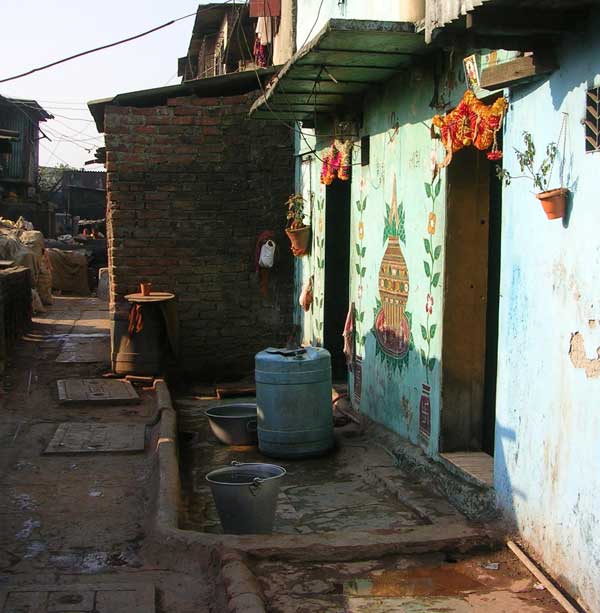
Dharavi, Mumbai 2006
Airoots: What are the problems with the concept of participation?
AA: Words like empowerment and participation can descend into clichés very easily. It is more or less meaningful in alliance with other concepts – like informed citizenship. Thus a participant is significant if he is a more informed participant. However there is something more that has to be factored in. Along with being informed, we have to ask the question if the participant is given a voice. A woman in a movement may be highly informed – but does she have a space to articulate her views and ideas. Does she have a voice? The importance of movements like that of Aruna Roy fighting for the right to information is vital since it affects grassroots movements in a big way. However it is vital because this right to information immediately expresses the idea that the informed citizen has to have a space to be heard as well. Otherwise a highly informed and aware citizen can be silenced even through custom, traditional structures and other mechanisms of control. […]
Airoots: With regard to individual and collective control – when does collective control start to violate individual freedom?
AA: […] At the grassroots level alienation sets in at two levels: One when your voice is not heard and second when you are forced to go along even when you don’t want to. My own experience comes from my observation of the National Slum Dwellers Federation, SPARC and other groups.
My discovery (or rediscovery) is that individuals do count – and that individual freedom and dissidence is an integral part of the way in which these organizations function. However there is something more than just looking at these spaces as places of control and dissent. These are also spaces which function on long-term friendships. And friendships is between individuals. You cannot take that out of the equation. There are long term friendships in which other friendships are connected – a network of friendships in which trust forms as the basic foundation of these networks. […]
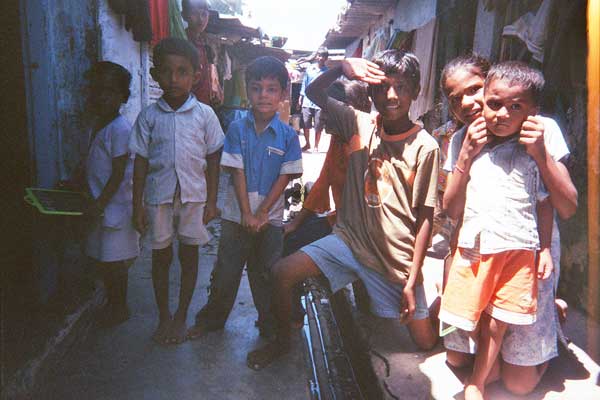
Kids in Dharavi, 2006
Airoots: Don’t most grassroots/ community groups rely on the charisma of individual leaders rather than on any type of a democratic process?
AA: Many people are uncomfortable with the idea of charisma. But to refer to the success of a movement through short-hand representations of leadership as being charismatic does not do adequate justice to what happens in many movements. It distracts from the fact that overtime the relationship between leaders and participants evolves into an interactive space. Overtime networks emerge and these are not built through the charisma of a single individual but an interactive charisma – a shared aura or what Weber called collective charisma (in the context of caste). Even Weber used the concept of charisma in different ways – not just in terms of leadership. […]
Airoots: What is a model of local information production and decision-making that we seem to be moving towards?
AA: Information is different from knowledge – knowledge is processed and placed in an ethical framework. Information is neutral. For knowledge to be of any consequence it needs a space for articulation and traction on public outcomes and debate. There is a tendency to imagine that information by default will change things – but this is not so. Information can exist and still be a harsh picture of exclusion. What we need to do is to put it in the context of knowledge and the space for its articulation. SPARC is constantly trying to bring people on the stage – as many people as possible – so that they can articulate their concerns. The PUKAR Youth Fellowship project, the Neighbourhood project all of them get people to tell their own story in different ways. Telling your story, narrating lives is a very important space within which you have to frame the question of information. The idea of the story, the right to tell your story is an old civilizational resource. Unfortunately when classified as folklore it becomes a top-down phenomenon. But it can and should be expressed in bottom- up ways and most groups and organizations which recognize this allow for such articulation. […]

Mapping the neighborhoods of Dharavi on a large google satellite image with residents at SPARC’s office.
Airoots: what is the potential of new communication technologies to radically transform the way cities get planned and developed?
AA: In a recent talk I made allusions to this. My proposal was that we have tended to think of disempowered and the disfranchised (in the context of cities or otherwise) mostly in terms of the information paradigm. I suggest that we use the imagination paradigm.
Thus for people who have access to the space of this technology, it is important to use this within the spheres you are alluding to – as much through the space of imagination and creativity as through information and knowledge. […]
It is important for all grassroots movements – whether to do with urban spaces or otherwise – to have a robust discussion on issues of information and creativity.
In fact it is vital to tell your story with proper exposure to the new technologies. […]
There is indeed a rich space for information and creativity in the world of urban planning and design by coalescing the worlds of information and imagination, but only when the people – the inhabitants themselves – become creators and a resource.
New York, October 12, 2007.
Full interview available here.
A Route to Abyssinia
August 28, 2008

The spectacular Janjira fort, a chip of India’s African history, stands in the Arabian Sea, a few kilometers below Mumbai. It is literally referred to as the Island Fort. Covered with trees and roots, it is tall and majestic – proud of the fact that it remained the only unconquered fort in the region.

Unconquered, by the several rival rulers who cast covetous eyes on its strategic position.
It is a beautiful urban ruin. Overgrown with trees that have roots going all the way to Africa. A place that is physically surprisingly close, but has been made distant through forgetfulness and a lack of perspective.
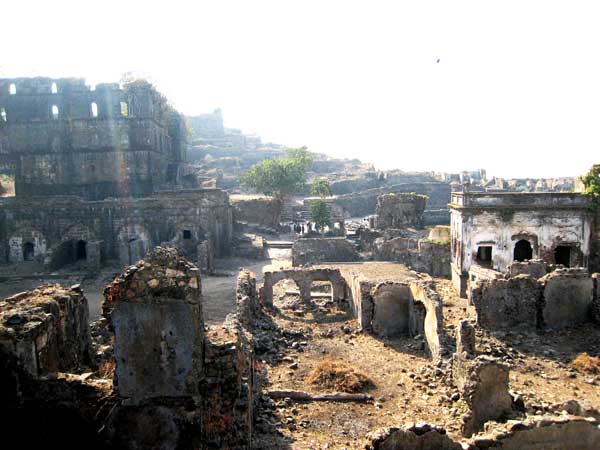
Its airoots thrive in open air, sniffing for a whiff of the past.


They remember the days when it was a compact city full of the several industries that armies generate, industries that brought in families and made communities. The 22 acres of black stonewalls are littered with cave-like rooms and shelters, water bodies and the remains of a mosque. They are lined with heavy iron cannons and elegantly designed archways that look like framed pictures of the sea and the coast. The island fort was once full of urban intensity. It belonged to a liminal world in between continents and was multi racial and cosmopolitan.

The sea links between Africa and India have been alive and kicking for a thousand years. There was trade, trafficking, wars, and this African kingdom that ruled parts of western India for a few hundred years. A kingdom that ruled through the seas, from coast to coast, harnessing the energy of a thousand exchanges, of goods, services, ideas, cultural artifacts, music, flora, fauna, and people. The Siddhis, descendents of this African legacy on the Konkan, still live along the coast from Gujarat to Karnataka speaking local languages, living as an indigenous people with a vague memory of an African origin. Like the Bene Israel – an ancient Jewish community who lived on the same coast, riding the same historical wave and getting absorbed as a local caste – the Siddhis too bring to surface their African past only when history makes it come willfully alive.

The small coastal towns of this old globally cosmopolitan belt have homes that reflect its hybrid architectural legacy. Structures that could have existed on the eastern African coast, for all practical purposes.
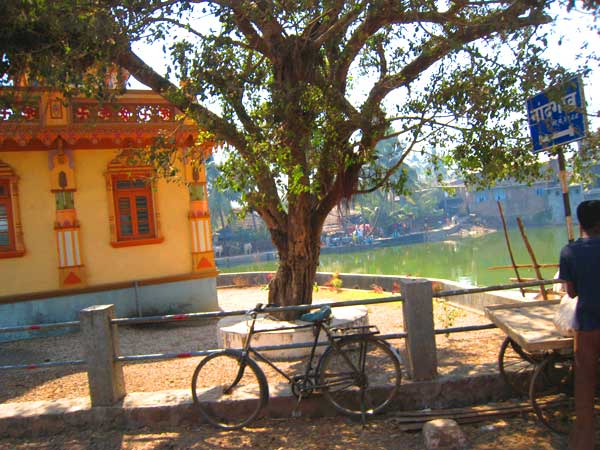


An old customs house, a colonial leftover of the millennial old trade practices still stands in Murud. It was responsible for transforming the ancient sea-exchanges from traditional trading activities into an underground smuggling network. Like many colonial judgments – this too became a self-fulfilling prophecy of sorts – or at least kept alive prejudices and suspicions.
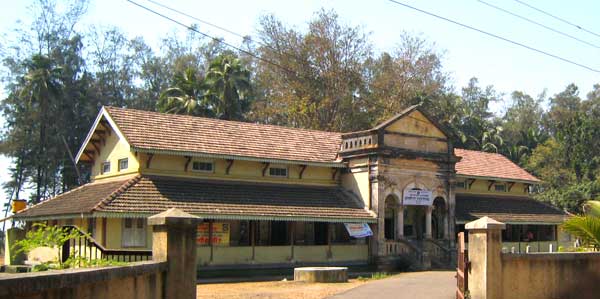
At the northern edge of Murud is an ornamental palace – private property of the descendent of the Abyssinian King. Referred to as Nawab Khan, the royal man, often comes here, when he is not with his family in Bombay or visiting another palace of his in Indore – Madhya Pradesh. He graciously meets visitors on prior appointment.

Africa for Nawab Khan is a hazy memory. Today, home is where history and destiny have bought him.

Urban Puzzles
July 29, 2008
Travel to Europe is always a revelation in terms of scale and space. And it is not about being reminded of its obvious comparison with the Indian sub-continent as much as how it operates so differently at various levels. The population of the entire state of Switzerland is about half of that of Mumbai. As many people live in Geneva city as do in maybe one neighbourhood of Mumbai. Geneva comes across as having an ideal density in terms of size, walkability, civic and cultural infrastructure making it in fact a favourite of foreigners from other parts of Europe and the world, which accounts for nearly 40 % of its total population.
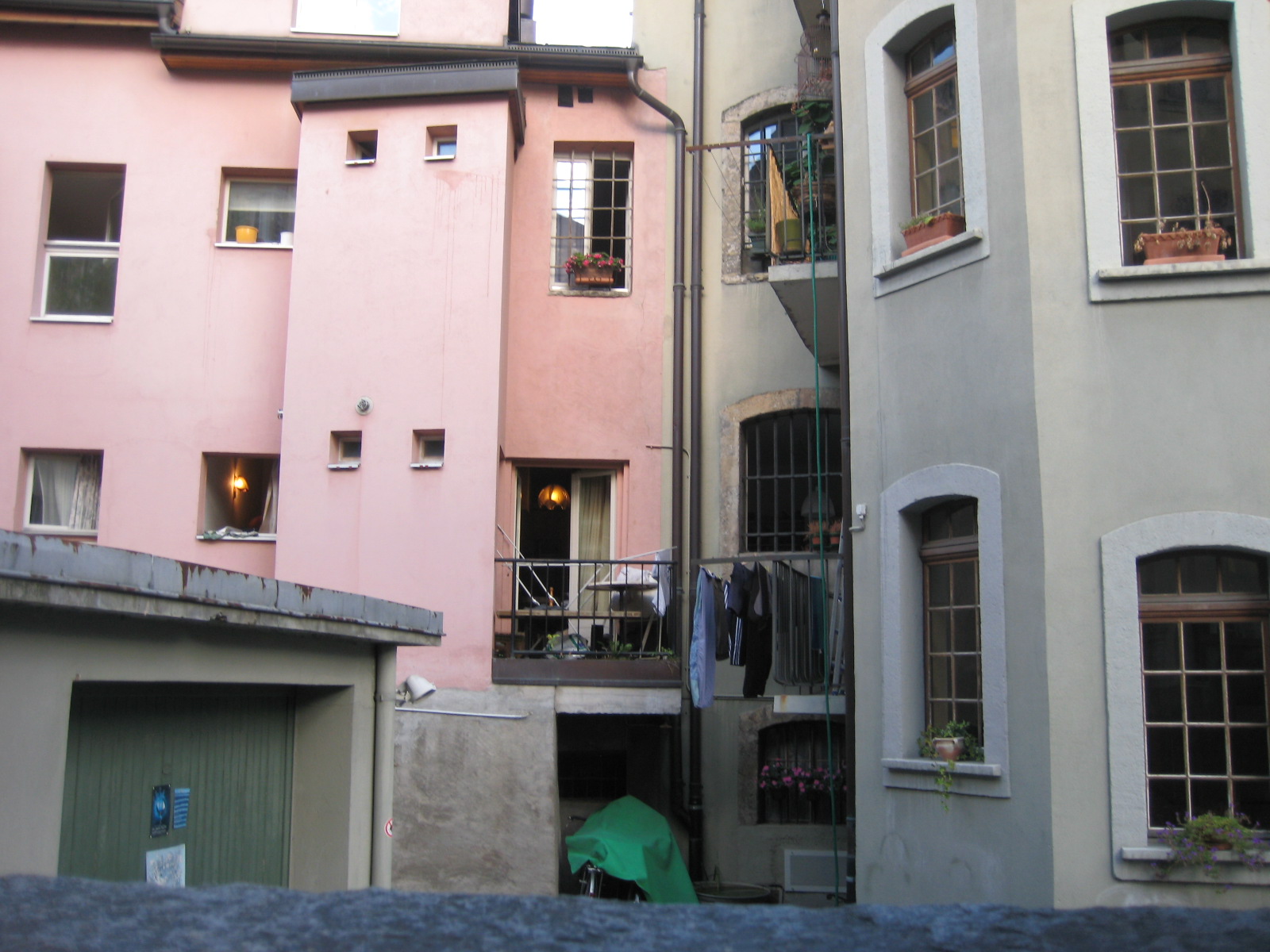
At the same time if you consider the fact the city has commuters from neigbhouring France who come to work there everyday thanks, to an excellent transport network then once again you know you can’t play around too much with population figures. Vast tracts of the country are actually urban systems in place where the formal city is only a nodal hub.  If you compare the density levels of Geneva (11,780 per square kilometers) with Mumbai’s (30,000) at face value it would mean one thing, but if you compare the fact that there are regular moments – especially during festivals and special events – when density levels even in this Swiss city increase to maybe more than 100,000, and such density levels are often considered attractive in specific contexts, you have a different story. At two separate weekend events in July, one could experience crowds that reminded you of Churchgate station at peak hour. Demographic explanation has its limits. Tokyo, at 20 million still operates with precise Swiss efficiency and doesn’t complain too much. Some parts of south Mumbai are actually showing a decline in total population figures thanks to out migration to the northern suburbs.
Urbanists have often wondered what is the optimum size of a city – but in reality its so difficult to develop any kind of standard norm. Proximity and density work at different levels altogether. I saw tiny European villages surrounded by vast tracts of mountainous land in which homes nestled next to each other on the same scale as a crowded Mumbai slum.
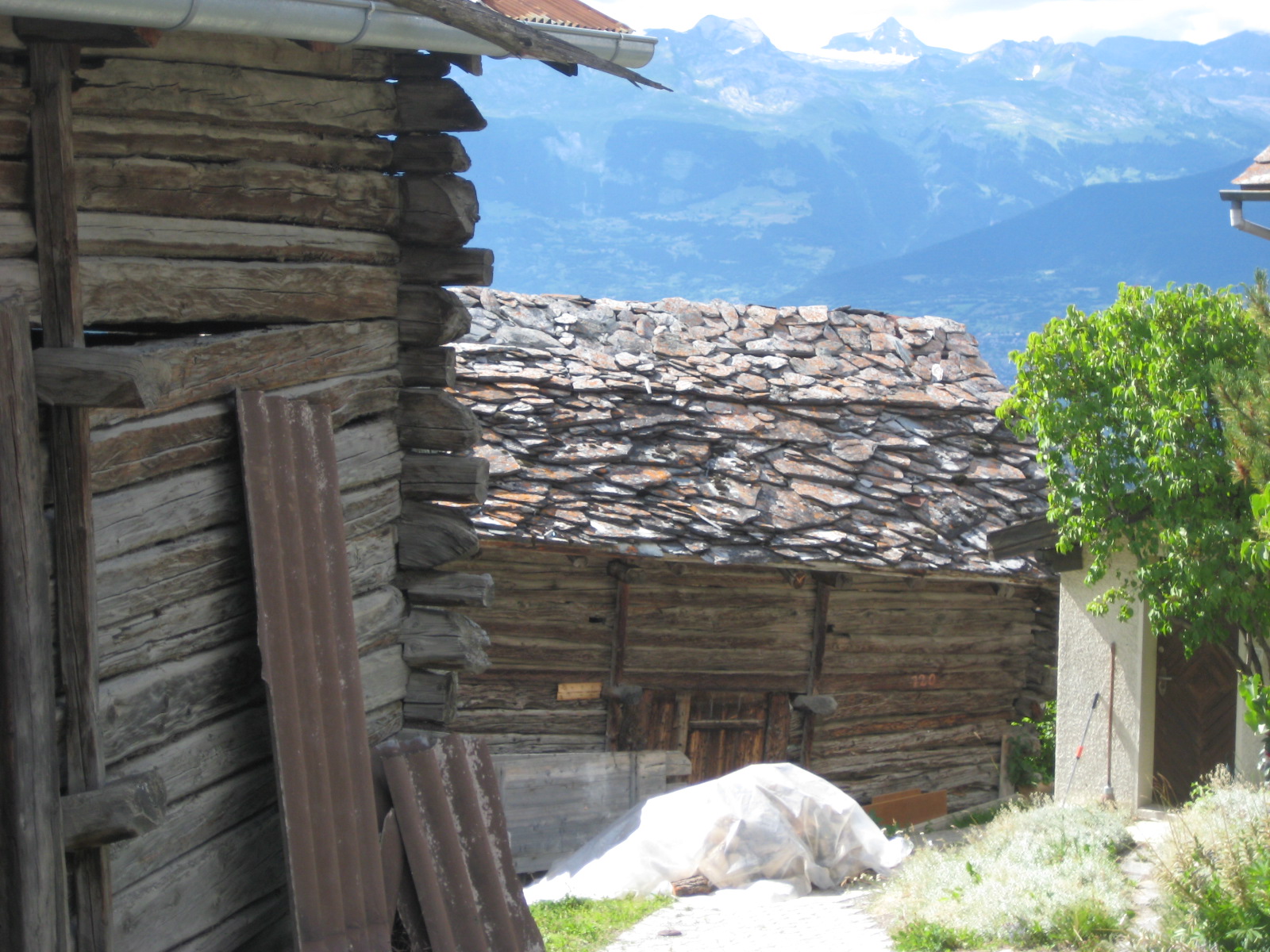
You get a similar contrary feeling when moving through the open countryside of coastal Maharashtra after having experienced the city’s over-populated intensity. At the end of the day total figures are less important than putting systems in place to respond to different kinds of needs of density, proximity and connectivity. Of course, there will be differences in textures. Regions with a history of thick organized agrarian demography will always have more people than regions. which are mountainous, coastal or forested. This holds as true for Europe as it does for India and China. Agrarian histories of Ireland, France, England, Germany, Spain revealed as much density levels as that of India and China at one point in their history and they were the ones who moved out the most. Of course – those days global laws of immigration worked differently, but that’s another story. Then maybe not. After all Mumbai too wants to contain population movements from regions of high agrarian density in the country…the urban cycle moves on.
Image of the City
May 31, 2008
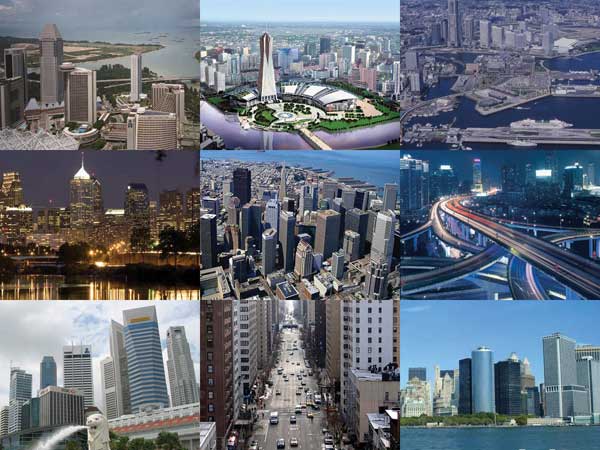
Having said all that about technology – it would do well to remind ourselves that the concept of technology itself has been cracked open. It is not just about the nuts and bolts of human intervention and control but is embedded in images and desires and shaped by specific arrangements of resources, knowledge and power. Often the idea of technology is used to convey something neutral- as if it is essentially part of the hardware universe – when it is in fact propelled as much by image and fantasies as it is shaped by them.
Do a google image search for “city” in English, Japanese, Chinese and you will get different versions of the same high-rise, “modern”, “world-class” city that could be New York, Singapore, Shanghai, or any new Chinese town. Even cities that are actually totally different from that generic image seem unable to imagine their urban future differently. In fact, Mumbai appears to be locked up in that generic city imaginary to the point that it is unable to recognize the unique version of modernity that it has produced. The large parts of the city that do not comply with that generic “modern city” image are seen as being “historical” at best, and at worst “backward”. No space is left in the collective imagination for a modernity that would not be high-rise and car centric, but would instead steam from the current reality of the city. The gap between the reality of a city where 60% of the population live in low-rise informal habitats characterised by dense community networks and home-based economic activity, and a Manhattanesque vision of the future produces all kinds of urban tensions and counter-productive redevelopment plans, that are typified by the McKinsey “World City” vision for Mumbai.
What makes this image so powerful is its ability to convey its connections to universal, contemporary and futuristic worlds.
The interplay of technology, aspiration, fantasies and images continues.
Notes towards Understanding Urban Technology
May 26, 2008
Technologies related to built-forms and city planning reveal as many disjunctures, inconsistencies and contradictions as any other. Some aspects of urban arrangements become increasingly sophisticated, (sometimes only to combat rising costs of labour) while others are grounded in simple formulas that have remained unchanged for centuries. These inconsistencies, as seen in the construction of drainage systems, road building, mass transport, architecture for living and working, are true across a range of urban spaces. Within the different historical layers of a two-century old contemporary city in the United States, an ancient city retro-fitted with modern comforts in Italy or Japan or a swanking new city that has been made by a combination of human energy and modern technology as in India.
The same space can reveal a variety of technological choices related to built-forms and urban planning based on the economic and commercial viability of the parties and specific projects involved. For example, in labour dense countries, in spite of ready availability of the latest technology, a good amount of projects are fuelled by human energy, only to balance costs.
Today, we see buildings being constructed globally in all kinds of ways, with technologically sophisticated material and principles complementing hand-made locally produced goods located in small workshops.
An elaborate network of goods, services and production processes go about producing modern built-forms. While the basic materials – cement and steel – are produced in large-scale furnace factories, themselves fuelled at different points by human and industrial energy, there are a whole lot of activities that arrange themselves in ways that are far from technologically sophisticated in the popular sense of the term.
Pre-industrial artisanal workshops produce a whole lot of goods and services, starting with an architect’s drawings to a whole range of secondary level material from marble, stone slabs, glass frames, tiles to even more specific goods for kitchen and bathroom fittings. At the same time the use of human energy in the construction industry remains high if measured on a global scale.
Interestingly, the nature of built-forms of the spaces in which this pre-(post?) industrial production takes place is also worth paying attention to. Urban landscapes around the world reveal astonishing diversities of built-forms. In them are embedded many kinds of economies and modes of producing, consuming and exchanging. Thus from a glass and steel city center where speculation rules the roost, one can move into middle-range six-storey brick and stone offices and residences that embody more traditional economic practices before walking inside self-made shacks, low-rise high-density structures, squatted spaces and derelict factories where an underground and ‘overground’ economy functions with regular contracts of work with the formal set-up. This disjointed urban landscape, also reveals different modes of technological expression that operate at different levels.
This kind of diversity in locating technological impulses is not new. Large monuments and fortified cities of major pre-industrial civilizations revealed a similar kind of unevenness of arrangement, even though in terms of energy they were fuelled mainly by slave labour. While the buildings themselves had a major impact in showing off levels of technological superiority of the ruling groups, their making was a markedly mixed affair. A combination of primitive and sophisticated (relative to the age) technologies, tools and organizational principles made building possible. Those worlds too reflected a range of different habitats linked to the economic arrangements of those times. Fortified cities, palaces, peasant villages, markets and tribal hamlets may have been more physically dispersed than today, but were part of an inter-connected economy. An economy that produced these built-forms and was complemented and serviced by it.
Throughout the late nineteenth and early twentieth centuries – the decades that were the most direct beneficiaries of the industrial revolution, it was possible for many modern societies to believe that the direction in which technology was moving was liner and one-way. Eventually, machines would replace human exertion (and most certainly human energy) and produce a world of technological sophistication in which humanity would be propelled to move towards higher goals – free from physical exertion.
Those were the years when artisanal works were rendered arcane and economically unviable more due to ideology than through real audits. The huge subsidies that went into producing energy and capital investment to make machine-made goods cheap, were rarely accounted for. This was most vivid in colonized countries where unfair taxation on hand-made goods complemented tax concessions for machine made goods to make the industrial revolution work. According to some anthropologists, when artisans (including tribal ironsmiths) were first exposed to the wonders of the machine age, they wanted to be part of its narrative. It was possible for them to incorporate these technological innovations in an older economy of work and production. It was possible to have a market where machine made and hand made goods could find their own specific places. But of course – those days the narratives of technological progress were more than just narratives. They were moral injunctions. They moved one way and in one direction. Entire histories of technologies, whether linked to food processing, clothes, or construction were rendered arcane. Habitats were seen to mirror this direction as well. Tribal habitats were lowest in the chain with the urban industrial ones as being the most advanced. How this idealized understanding of technology actually matched economic and lived realities was another matter altogether.
By the early twenty-first century, the reality of environmental issues, the economic and commercial limits of technological choices and the paradoxical awareness that globalization brought – of an increasingly diverse world in terms of knowledge, skills and technological expertise – managed to change a lot of these conceptions.
People and nations have now become more resigned to and have understood the intricacies of a large variety of technological expressions. It is easier to distinguish technological change from significant shifts in organizational principles. In the past, the moments of these shifts as they happened were blurred. However, today it is possible to look back and mark out the industrial revolution from a textile industrial revolution (which is what some historians say it essentially was). It is possible not to co-opt the earliest technological wonders as ‘fruit’ of that revolution but recognize them to be what they were; innovations of human-scale artisanal tools that artisans were already using. It is possible to accept the fact that the first factory revolution was an organizational one. The factory was, for one brief but extraordinary moment not a warehouse for gigantic machinery to match gigantic production but an organizational revolution in itself. A space where artisans, workers and administrators worked together to produce goods that were quickly transported to the market. It was this shift in organizational principle that ultimately harnessed the simultaneous fervent in knowledge practices to produce advances in modern technologies.
Today, given the more informed understanding we have of the way in which modern technology has to be contextualized at various levels it is easier to accept its co-existence with pre-modern technological histories and to see it as wired to knowledge practices that are complex. It easier to accept that certain kinds of technological innovations take place outside laboratories or in contexts that are constantly connected to the lived world. Many technological solutions are linked to traditional knowledge systems. It is possible to understand these complexities without belittling any of the advances and moves that science has made over the last two centuries.
The world of information, communication and imagination technology are another matter altogether – and its revolutionary and reactionary tendencies have been much documented, debated and analyzed.
Yet – if there is one space where dated thoughts and concepts linked to technology still operate in full force it is in the world of urbanism and urban planning.
Like the modernist agrarian nightmare– of producing food for all by reducing food to the unit of energy and then translating the production of units of energy as a means of doing away with hunger – urban planning and architecture are another stunted story. And just as the agrarian ideals never solved the problem of hunger – but only increased it – urbanists have a similar cross to bear with regard to housing and homelessness – those self-made problems that are more to do with our inability of recognizing the conceptual confusions in which we frame them than actual issues of ‘lessness’.
Old-fashioned urbanists believe it is possible to produce houses for all and they reduce the concept and practice of urban technology to the technology practiced by the organized construction industry.
They refuse to see that technology is embedded in economic and political equations and that organization of space, human energy and technical solutions have to work together in making technology workable in the first place. Since their thought processes are so strongly linked to modernist and dated ideas of technological emancipation they refuse to see the obvious.
That the first and foremost way in which we can solve the issue of housing is by acknowledging that humans have a history of technological practice, knowledge and skill base of producing homes that expresses an enormous diversity of styles and experiences – and more importantly are workable and relevant even today. They may need some modifications, but like cooking, are still tied down to certain essential practices that are ubiquitous, universal and practical. They may have to adapt to transport and communication issues, but that in no way means that the ability, skill and knowledge of building homes has to be questioned whatsoever. These are specific issues that can be addressed specifically – without blurring ideas of habitats, housing and urbanism as a whole.
Today it makes better sense to say that the job of the urban planner and the urban technologist is to create conditions where more and more people can build legitimate homes according to their capabilities and choices and diverse technological skills.
Since today, we are less dependent on the idea of using a single modernist technological spectrum to create urban landscapes, our task is to legitimatize the variety that is bound to emerge from the different histories and economies that characterize our lives.
Technology in the sphere of information, communication and imagination has opened up possibilities of expanding its capabilities by using the growing skills of users. This is thanks to the design of those technologies itself in the first place. Similarly it is important for us to recognize the capability of people who live in homes and cities to produce their own environments and create what we like to call user-lead urban environments.
Of course – what will many cities around the world look like when this actually happens? How will they function? We suspect they will look more like large parts of Tokyo, late nineteenth century Bombay, or something quite unlike anything we have seen before. And yet they will be more familiar to most city dwellers than the urban environments that many of us take for granted today.
But that’s another story altogether…coming soon.
Urban Natures: Of Fields and Forests
May 15, 2008

Mumbai, Dharavi 2007
Stan Allen & James Corner (2005) have devised a useful concept – urban natures – that comes pretty close to airoots’ understanding of cities – but not close enough. This is about the crucial conceptual gap.
They observe that “the difference between city, country, and suburb is fast disappearingâ€. What is left is “field urbanism†marked by “points of intensity and exchangeâ€. The field itself is diverse and in constant flux. It forms what could be called an urban ecology, with its topography, milieus, communities and networks. In their words, “these new city forms…are composed of small units and collectives rather than singularities, and bottom up organizations rather than top-down orders.â€
Eventually they seek to replace the notion of the city as yoked to the world of planning and urban design by that of the image of a cultivated field. However, there may be good reason to believe that the world of habitats as seen through both these sets of images ultimately land up producing versions of each other. After all they are shaped by very similar notions of what constitutes patterns of ownership and propriety, order and organization. The cultivated field is also a grided, audited world. Yet the urban experience for a vast majority of people in the world today falls outside these structures altogether. Millions of people live in spaces that qualify to be the very opposite of the systematic urban worlds that we have come to expect as the valid city. How do we account for ‘urban nature’ embodied in that experience?
We are not talking only about slums, favelas and shanties here. We are also thinking of some of the most developed, technologically advanced and futuristic cities in the world, such as Tokyo.

Tokyo viewed from Sunshine City, Ikebukuro 2005
We can think of the periphery of this dense metropolis as a vast urban field mildly differentiated by zones of intensity, organized around lines and arteries that are subdivided from the regional level to that of the individual housing unit. We can also think of it as a low-rise, high-density urban forest sprawling endlessly, which developed incrementally, following no master plan. The green landscape where farms once stood amidst rivers and trees was replaced by a grey cityscape, as tiny plots of lands were gradually converted into housing lots.
Tokyo, just as most other cities that developed fast and under high economic and demographic pressures, is not the outcome of any intentional design. It just sprawled and densified as people moved in. After the Great Kanto earthquake (and again after American firebombs destroyed the city during World War Two), central planners envisioned a new, rationally planned city. However, the pressing needs for shelter and economic recovery, the absence of necessary legal mechanisms, and the resistance of local communities prevented this grand vision to materialize. The government decided to focus instead on infrastructural development and left residential and commercial development to local actors. Thus, the urban history of Tokyo seems to confirm Allen & Corner’s assertion that “cities are more the product of cultivation and management than of design per seâ€. Indeed, to this very day the rural past of Tokyo is still very much alive in its hundreds of thousands of village-like neighborhoods.
However, while we cannot agree more that the time has come to radically reconsider the role, purpose, and potential of “urban designâ€, we believe that the idea of “cultivation†throws us right back to where the old school concept of design took form in the first place. Cultivation and design are concepts fatally entrenched in the agro-industrial paradigm. If we want to think beyond the city-nature dichotomy and its corollary, private-public ideology, we have to go back all the way to pre-agrarian modes of operation, which by the way are not only pre, but also post and actually simply “non-agrarianâ€.

Kabul hillside 2005
Urban planning and its twin of real-estate development, are often mistaken for being markers of modernization and civilizational impulses. They bring back order and intent to messy and improvised habitats. But in fact, Goliath-like master planners and developers seldom realize the intricacy and organizational principles of the environments they seek to rationalize by tracing roads intersecting at straight angles on their rasterized CAD maps.
Spontaneous and emergent habitats, whether in urban or rural worlds, have for long been described as “primitive†and inadequate by generations of “modernizersâ€. Maybe a reassessment of these notions may lead to an understanding that unplanned habitats are often much less primitive than urban planners’ own compulsive fear of what they symbolize – disorder, messiness, wildness. The the fear of the wild in the West and the urge to divide, map, rationalize and commodify space can probably be traced all the way back to the Biblical schism between Cain the farmer and Abel the nomadic shepherd. As Alexandre Safran (1998) reminded us, it is Cain who founded urban civilization after killing his brother in the fields.
The dramatic moment of transition from pre-agrarian to settled cultivation is not only the stuff of myth, legend or historical reconstruction. It is re-enacted time and again in contemporary societies in all kinds of ways. Slums, favelas and shanty-towns are contemporary avatars of ancient symbolic worlds of the wild. In them we see a divide between habitats that emerge from a complex negotiation of what constitutes public, personal and private ownership (non-agrarian mode) and habitats that are literally rooted to rules of ownership (agrarian/industrial/modern context) which become the basis of civic control and spatial order that we accept as the foundations of civilized existence.
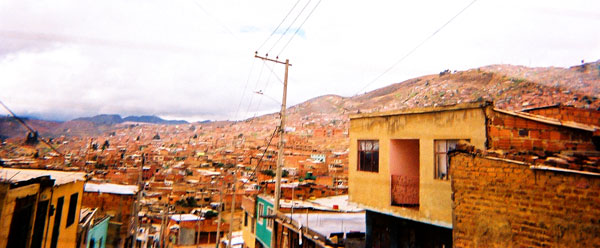
Bogota, Ciudad Bolivar 2004
Anthony Leeds (1994) considers the latter to be part of one urbanized universe. A universe that shapes the way we think about habitats. It is this universe – connecting the worlds of property ownership, habitats, land, settled livelihood and demarcated residential areas that informs contemporary notions of habitats. Ironically, this connected world presents the story of habitats through a series of problematic binaries – rural/urban, nature/culture, formal/informal, slums/formal housing so on and so forth. These binaries completely erase the non-agrarian space from our understanding of habitats and at the end of the day lump the world of rural, informality, slums and nature in one untidy heap which is then sought to be marked as dysfunctional. This paves the way for the eventual triumph of the urban visualized as formal, planned and civilized.
Allen & Corner’s concept of urban natures is liberating to the extent that it recognizes the essentially emergent nature of cities. This understanding leads them to a more responsive and context driven understanding of architectural practice. But does it really allows for all types of habitats to coexist in a messy continuum ranging from the skyscraper to the hut? A field is not a forest. We feel that their conceptualization of urbanism is still conditioned by an ultimately life-denying agrarian-industrial psychology. They cultivate and manage urban fields, while airoots is wandering and gathering in an urban jungle. The urban forest, however, is shrinking day by day as the grid penetrates ever deeper in the urbanmess in which lives an ever growing part of the world population.
We are utterly appalled by the global Babylon that the agrarian civilization has produced, with its unsustainable lot of pollution, impoverishment, segregation, repression, privatization, nationalization and other alienations. If Allen & Corner open a door towards a more sustainable urbanism, they still fall in the the conceptual trap that urbanism is quagmired in today, and therefore fail to transcend the dark prophecies of Mike Davis (Planet of Slums, 2007) or the cynical commentaries of Rem Koolhaas (Junkspace, 2003).
airoots 2007
Junglist City
May 14, 2008

View of Mira Road, in the outskirts of Mumbai
[audio:http://www.airoots.org/music/Junglist.mp3]
Track by Natty Congo
The moisture spreading all over Mumbai’s buildings gives us hope for the future. It won’t be long before the weed that’s cracking through the pavement becomes trees extending their aerial roots through our asphalted streets and concrete walls. One could say that nature will takeover if the city was not already a jungle of its own kind. The city has grown and developed for decades outside planning and control. Urban ecosystems have been regulating the flux of migrants forever. Informal settlements are human beings’ natural response to the city, and its most sustainable form in the face of uncontrollability. No more informal than a forest, the unplanned city is our urban future – for the best if we are willing to engage with it.
Mass housing, even “affordable”, will never accommodate the flux of rural-urban migrants. Just as mass food production won’t solve the world food crisis. In fact, these engineered “solutions” are the root cause of the problem. On the other hand, the junglist city has an unlimited capacity to absorb and regulate transient populations. Incomers have an unlimited capacity to respond to their own needs and their collective imagination that cannot be matched by that of any architect or planner. The variety of solutions and habitats emerging from the junglist city can only be compared to the diversity of species and plants one can find in the forest.
Planners and architects’ irrational faith in formal solutions to a problem that they have invented for themselves seems to come straight out of the dark age. It perpetuates a cycle of institutional breakdown and injustice that can only be ended by acknowledging that Reason lies not in their theories, aesthetic values and moral imperatives, but in the decentralized action of hundreds of thousands of people producing the junglist city day after day. Here is the leadership that the architectural professions should follow. Imagination is required not to invent new top-down solutions, but rather to understand and support the intrinsic logic of spontaneous urban development.

This social housing built in Dharavi under the Slum Rehabilitation Authority scheme less than 8 years ago exemplifies the unsustainability of industrial-age building constructions in the social and ecological conditions of Mumbai.
The so called order that we desperately try to impose on our cities is ultimately unsustainable. The European and North American models of urban development have no future. This is maybe why an increasing number of students come and visit Indian slums. They teach us not only about the history of Western cities but also their possible future. Just as they are being aggressively promoted and developed throughout the world, more and more suburban shopping malls are closing in the US because they are too expensive to sustain and commute to. US inner-cities, which were for long left to the poor and excluded are gentrifying and densifying rapidly. European medieval city centers are being celebrated by tourists from all over the world for their charming pedestrian streets and human scale. Could the pre-industrial city be our urban future?
It is time wannabe planners and architects get off their school bench and office desks and start learning from people who actually develop livable cities. Let illegal migrants, slum dwellers, encroachers and squatters be the teachers. It is time our shadow cities get reclaimed and retrofitted with new intentions and imagination. There is no reason modern amenities should only be available in the unsustainable industrial age model. Technologies have become more flexible than ever before and can easily adapt to the malleable logic and evergrowing structures of the junglist city.

Social Nagar in Dharavi. Ever changing, ever developing Dharavi epitomizes the resilience and the endurance of the Junglist City.