The industrial revolution decisively cut-off homes and workspaces from each other. The impact of this incision was most strongly felt in the house of the artisan. If there was any space that used itself most creatively and productively it was the artisan’s workshop-cum-home that produced most of the goods that circulated in the pre-industrial economy.
The gigantic scale of the modern city was unleashed through many forces – mainly energy-based revolutions – but its architectural character owes a lot to the atomic split that happened when the workshop-home of the artisan was splintered. Since then, the logic of separating residences from places of manufacture has shaped much of the way we think of cities.
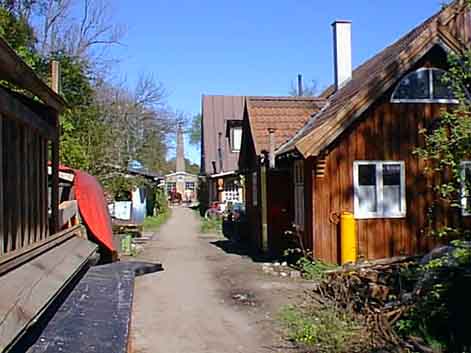
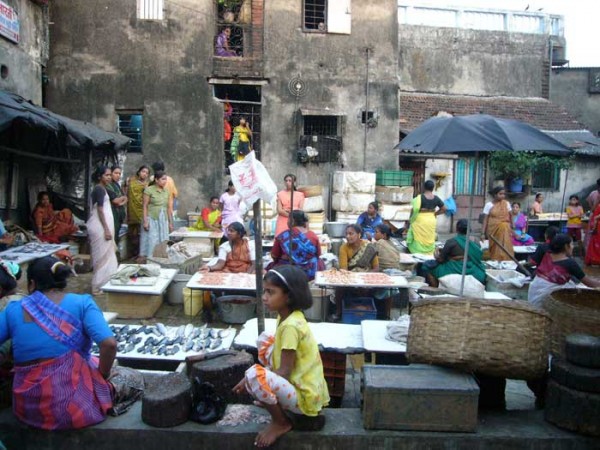
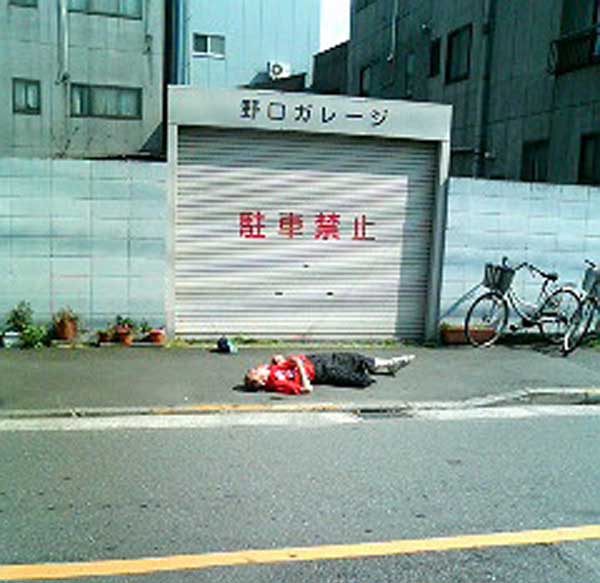
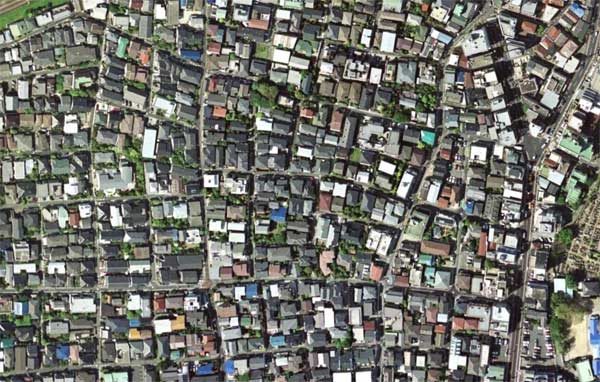
Yet – many cities in India are littered by sprawling collections of built-forms that do not reflect this neat divide. In its new-avataar – in what we term the tool-house – the artisanal home continues to exist in many different lives. This could be mistaken for an expression of backwardness, if we didn’t see the same arrangement was not happening at accelerating rates in our classic first wold global cities: London, New York and Tokyo. What is the artist’s loft if not a tool-house? Our creative cities are indeed reorganizing their industrial structures into polyvalent spaces.
A tool-house emerges when every wall, nook and corner becomes an extension of the tools of the trade of its inhabitant. When the furnace and the cooking hearth exchange roles and when sleeping competes with warehouse space. A cluster of tool-houses makes for a thriving workshop-neighbourhood and its public spaces emerge as a dynamic by-product of such an auto-organized habitat.
This explains why a walk through any so-called Indian slum – is also an imaginative walk through a moment in the dawn of the industrial revolution. When it had still not drawn the rules of how we should live, work and sleep. When it had still not marked itself off as the moment of taking humanity into the great urban age and when it still produced fantastic and flexible narratives about the future of humanity. The industrial revolution and urban transformation have always been discontinuous and fragmentary. The echoes of the moments of its transition repeatedly re-appear everywhere. Just look out for the presence of the tool-house – more real and ubiquitous than the much-hyped robot.
The reason why urban landscapes formed by tool-houses are so crucial for urbanists is that it makes explicit the relationship between production, livelihood and spaces that expresses the lives of more than half of humanity. Not to be able to see this dimension in slums reveals a terrible lack of imagination and aborts the complex and organic evolution of urban forms. To see them for what they are – maybe through the lens of a sci-fi possibility – is to do real justice to the multiplicty of urban forms.
In reality – tool-house landscapes indicate a need for a sharp re-structuring of the way in which labour, work, and capital unfold in the post-industrial city. It can help us to concretely visualize a future in which the dated dichotomy of the formal and the informal organization of production and services, the new spatial order that internet-based and mobile communication technologies have introduced in our lives, and complex dialectic between the artisanal/organic and industrial mass-based product in the contemporary economy.
Cities of the future can keep being formed by the empty development and one-dimensional growth (literally) of real-estate development or they can rearrange themselves in less predicable ways following our aspirations localized needs. Where urban development is left to local actors we observe the (re)emergence of live-work spaces that are in fact less dehumanizing than the housing block and its twin office tower that are being systematically promoted by urban developers from all across the ideological spectrum from real estate investors to NGOs passing by the government as the only way on to modernity.
It might be time to acknowledge that for all its lack of infrastructure and overcrowding, Dharavi is not as much a pre-industrial settlement as it is a post-industrial one. Not as much as slum in dire need for redevelopment as a highly successful model of bottom-up development, with at the core of its system the tool-house.
Just when Dharavi vanishes from Mumbai…architects will want to re-examine its complex structure for referencing the future…mad prophecy… but just you wait… talk to the international researchers flocking into the labyrinthine streets of Dharavi, you will soon find out that they come less to propose their own models than to learn from Dharavi. Get over it, Dharavi is not backwards, but forward.
One of the most insidious changes taking place in our world these days is to do with auditing. Everything and every body gets quantified, measured and valued in as numerically accurate terms as possible. Anthropologist Marilyn Strathern elaborates this in her edited book ‘Audit Culture’, which should be read by every philanthropist, bureaucrat, and policy maker. She refers to social and cultural auditing as reductive and destructive. It forces educational institutions to devalue learning and to privilege acquisition of degrees and certificates. It makes donor agencies transform the idea of social change into a snake and ladder game. It makes governments and bureaucrats even more powerful than they are. They decide what is good for everyone – especially those who are deemed incapable of making decisions on their own.
Even activists and social leaders fall into the auditing trap all the time. Though they work through its reverse logic. They flatten every aspiration into the denominator that they think is appropriate for everyone. To them, the poor or the unprivileged must be treated as one – or they are being unjust to their comrades. They must calculate their strength in strict numerical terms and present themselves as a united front.
No wonder when the city authorities tried to deal with housing shortage for the poor they viewed the whole exercise as a massive auditing task. The need to do surveys was considered the most logical consequence of this process.
However, the surveys soon became tools of control – so that families could be relocated into a pre-fabricated notion of an ideal housing size. A size that was audited into existence in the meanest way possible. The basic idea being; how can you squeeze all the poor in the city in the smallest possible area so that the cost of building their homes gets subsidized by the rich who then choose their own homes as per their means.
The Kolis of Mumbai complained that the slum rehabilitation process would leave them high and dry – since they had inherited larger homes but lived in village like habitats that got labeled as slums by a myopic government And would now have to be re-located in the standard norm of a 300 whatever square feet flat. Their complaint was seen to be unfair by everyone – the state, as well as the housing activists..
This is blatantly unfair. The poor of the city seem to have lost their right to even assert their own needs as per their distinct histories.
Recently, members of several BMC chawls, among them the Omkar, Rang Tarang and Ram Gunta Co-operative Housing Societies have started an agitation requesting that they be exempt from the slum rehabilitation scheme since their housing histories could not be collapsed into the category ‘slums’. They feel they have the resources to develop their own tenements in a manner that fits into their middle-class aspirations and can be created through the existing land size that they have.
It is only in our beloved city that everyone, the state as well as housing activists would consider such a positive, straightforward request as being unfair. It is after all, a city where the rich are exclusively allowed the sinful luxury of inequality, while the poor have to celebrate their chaste egalitarian ideals through willful restraint. They must never challenge the precarious balance of equality among the united nation of the poor. Which of course, is the surest way of ensuring they always remain so.
1. Need It: Define the project’s vision, based on what’s collectively needed in the neighborhood but not provided, via a collaboratively-written declaration, manifesto or constitution. Secondly, develop a program for how this will be executed. You can see some of this on the Elements restaurant home page.
2. Get It: Use precedents as models to explain what doesn’t exist yet. For example, a beta community looking to develop truly attainably-priced green condo efficiencies, like at the Bearden Arts Building in Washington DC, should look at San Francisco’s Cubix Yerba Buena, or downtown apartments in Tokyo and Paris.
3. Do It: Have the beta community start meeting to define the vision and program, with professional designers and the development team transforming those into tangible floor plans, renderings and product offering suggestions. The Gear Factory in Syracuse produced floor plans based on beta community input, and so will the Bearden Arts Building.
4. Be Open: Don’t write off ideas you don’t like because you don’t think other people will like them either… only to find out you’re in the minority. This happens a lot with pedestrian-only streets and smaller home sizes. Openness is also one of the tenets of a creative community.
5. Share: This is a big one for self-righteousness – don’t talk louder because you think your idea is the best, even if it’s ‘going to save the world’, like demanding that a restaurant serve more ‘raw food’. It’s not a pure democracy either – decision-making by committee leaves you with the status quo. However, if you share your values with others, a clear vision and program will emerge that will then be a lot easier to interpret into real design.
6. Contribute: Time to give back to your community. Nothing will happen without people attending meetings, offering their feedback and referring others. This is where being social network bilingual is highly productive – make sure your beta community champions can speak both languages. Also, the goal is a whole that is larger than the sum of its parts, so think ‘community-first’. Ironically, it’ll often be more individually rewarding as well.
7. Communicate: This is what open source is all about – the ‘sponsor’ providing the business plan and updates as if it were a co-op, and listening to their members just as well. Here’s an example from a beta community agreement in New Orleans: “The purpose of the Broadmoor Beta Community is to provide NCD (the developer sponsor) with an identifiable group of future tenants and customers for a third place that is eventually established in the neighborhood. NCD understands that the Broadmoor Beta Community’s commitment to the social and financial success of this third place is directly proportional to how much NCD listens to and incorporates the ideas and input of the Beta Community.“
8. Convene: Crowdsourcing works best when people meet face-face to make decisions, or at least have a solid deadline (resulting in virtual convening), rather than contributing individually on their own time. As they say, the more things change, the more they stay the same.
9. Include: Two things here: 1) Ensure you’re getting proper representation of the neighborhood that you’re working in, even if it means taking a little more effort and time to find them; and 2) Provide some training or ongoing assistance if they lack social network skills, much less be social network bilingual. While technology has helped bring people together, it shouldn’t be an excuse to exclude anyone either.
10. Acknowledge: Recognition is a powerful motivator. Are you still recognized for contributing to nonprofits years ago, or forgotten among the masses? People are recognized in every beta community project for their efforts on a monthly basis – sometimes being rewarded with free dinners to favorite restaurants like with CreativesDC, or even with profit sharing as with the Elements restaurant.
11. Process: This is where the rubber meets the road. How do you take the collective values of hundreds of participants and interpret that into design and programming that inspires them? This is a matter of working with a new generation of architects and developers with not only the skills, but the mindset to be able to professionally synthesize ideas into a tangible form.
12. Be Critical: Innovation can’t happen when there’s groupthink – “a type of thought exhibited by group members who try to minimize conflict and reach consensus without critically testing, analyzing, and evaluating ideas.Design by committee doesn’t work. But, if people were courageous and stated what they really wanted, “That side alley should be outdoor dining for cafes!“, perhaps we’d have more inspiring destinations.
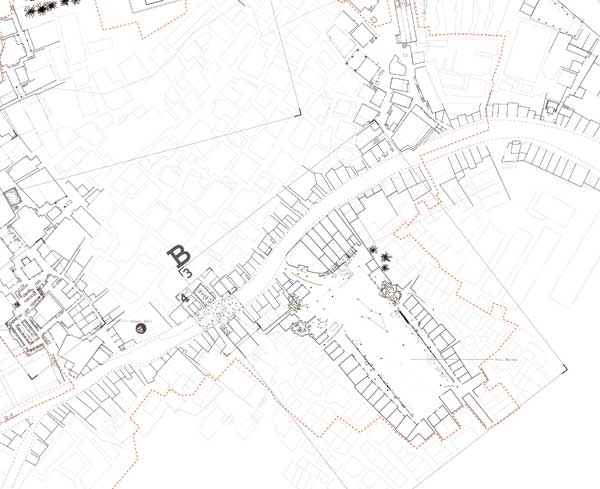
Koliwada Map: This map of Koliwada was based on collection and synthesis of historical documents and maps, studies and surveys from SPARC, KRVIA and SRA, satellite views, and on-site photographic surveys. All maps and sketches in this text produced by Wahid Seraj for the Urban Typhoon Workshop in Dharavi-Koliwada, March 2008.
The first mistake of virtually all slum redevelopment schemes, no matter how well intentioned, is to start from scratch instead of using existing structures and patterns as a starting point. Planners often use structural and demographic surveys as raw data, but these only provide snapshots of the state of things at a given point in time. They do not capture the dynamic interactions between people, structures and streets, which are vital for sustainable planning and development.
The end result of most redevelopment projects is a series of grids in every direction, up, down and sideways, that erases all the existing formations imprinted on the territory. The constant movement of people within urban spaces and across neighbourhoods, as well as fresh migrations – factors that every city has to reckon with – find no legitimate expression. Nor does the versatile use of space, a trademark of slum life.
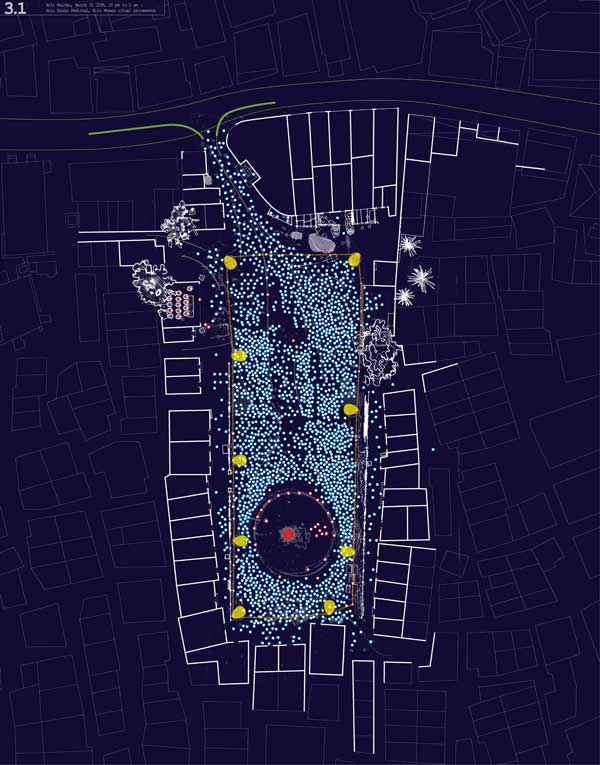
The Holi Maidan is Koliwada’s main open public space. At the time of the annual Holi Festival, a Hindu celebration, more than 10,000 people gather in and around the central space, including Dharavi Main Road. The drawing records the movement of crowds and ritual processions around the central fire during Holi.
A tabula rasa approach to slum redevelopment only results in the formation of new slums in the periphery. Those who cannot be absorbed in the new housing or afford maintenance move out and new slums emerge.
Most redevelopment projects, until very recently, translated the issue of slums redevelopment only in terms of housing needs. Such an approach buries over organic connections between local livelihood systems and residential requirements.The livelihood issue becomes secondary and at most, reduced to questions of employment. As research on the informal economy began to throw new light on the way cities function, especially in the context of slums, the understanding of these spaces became more informed. It became clearer that the new global economy relied a lot more on locally produced goods and services that are dependent on cheap labour, and that these activities are organically connected to the forms of habitats in which they exist.
The Tool-House: Live-Work Typology of a Kumbarwada Potter Family House:This drawing reflects the necessity to understand the particular urban life-styles of traditional communities. Many of Dharavi’s residents live and work at the same site, a reality completely dismissed by the ongoing Dharavi Redevelopment Plan. One must understand that shelter issues are inextricably tied to residents’ means of livelihood.
However, it is one thing to understand the organization of slums in terms of its economic role and another to incorporate this understanding into urban planning. At best, what emerges are token gestures to livelihood issues, – either in the form of building a local market or providing space for economic activities within new homes.
What happens if we work from the other side of this spectrum. If we take as the starting point the existing resources at hand? What we get is a rich legacy of user-generated space patterns that are organically connected to the way people live and earn livelihoods. These patterns are based on the principles of incremental development. In other words, they have evolved over time, over generations and through the absorption of new migration inflows, constant movement within and between neighbourhoods and through continuous class mobility.
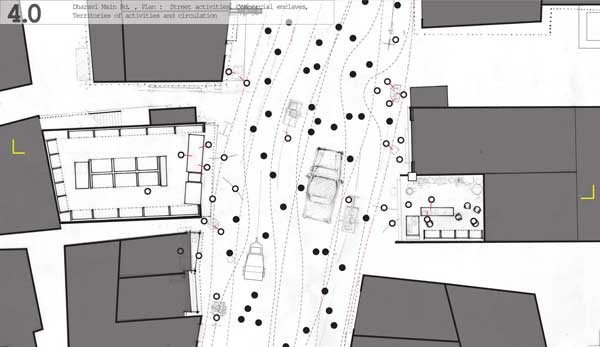
Fragment of Dharavi Main Road: Mapping of Street Activities and Territories, Public and Commercial: Dharavi Main Road is 25 ft.-wide road running through Koliwada and across Dharavi. In the section that crosses Koliwada alone, one finds almost one hundred non-residential sites, such as churches, temples, shops, restaurants and small-scale industrial workshops. Reflecting Dharavi’s high-density street-scape, the road also accommodates heavy and continuous pedestrian traffic, cars, motorcycles and mobile street vendors.
It is our contention that these patterns of incremental development are embodied within the streetscapes of such localities. It is in the street that the genetic code of a habitat gets imprinted. They emerge as walking paths connecting markets, homes and nodes of transport hubs. As they evolve, accommodating cars and other forms of local transport, street bazaars, spaces for youngsters to hang-out, for children to play, for neighbours to exchange news and gossip, for people to shop and set-up shop, they follow the needs of the residents very directly. The signature of a neighbourhood is often a streetscape.
Ideally, slum redevelopment schemes should build upon the incremental logic that most slum histories embody. And a pragmatic way to do so would be by recognizing the street layout that has evolved within such habitats.
In the case of Mumbai, we clearly see two dominant patterns of slum formations with their distinctive streetscapes. (Actually there are three patterns, the third, post-modern version is linked to the redevelopment projects outlined above and is the most nasty and dangerous one!).
The first one is best exemplified by the presence of fishermen’s villages in the city. They were villages that at some point got absorbed in the sprawling megacity to be eventually assimilated as slums. Self-standing houses, some of them more than 100 years old, within these habitats, are a clear marker of that history. The second type is the slum that emerged gradually as immigrant workers settled into temporary camps wherever they could and consolidated them over time.
As A. Jockin, founder of the National Slum Dwellers Federation poetically puts in an interview; first the man comes to work from the countryside, then his wife joins him. Because she needs privacy she puts her sari on strings and that becomes their home. This gets multiplied a million times.
In incrementally developed neighborhoud the connection to the village is very direct, since migrant workers and their families bring with them skills and crafts from their hometowns. They are soon joined by fellow villagers who reinforce the reproduction of traditional patterns.
Villages, whether they are in Asia or in Europe have strikingly similar features. The most important one, and the most easily overlooked, is high-density levels of populations and structures. We generally assume that because they are typically surrounded with open fields, villages have a low density and that high density is usually found only in cities. In fact, in most French, Italian, or Indian villages houses are so narrowly built to each other, that cars cannot get through, making rural settlements mostly pedestrian.
Getting a little deeper in the study of the structure of villages, one can observe an interesting hierarchy of streets, with broader roads serving smaller roads all the way down to the entrance of the hut. Anyone who has ever walked in a slum has observed the same type of network, leading the visitor from a large road with rickshaws and cars to smaller roads shared by pedestrians and vehicles bringing goods in and out, to smaller roads penetrating inside specific nagars. Even within the nagars some streets are busy with people going from one point to the other, which themselves open to smaller lanes taking the visitor to clusters of houses.
These communal lanes are often used by the residents of the huts alongside it as space for social interaction and production, and are clearly not public in the sense of the larger roads. They will make the visitor walking along these lanes almost feel uninvited, nearly as uncomfortable as if he was walking into someone’s private property.
The street layout is initially shaped by social and economic relationships, and then influences them in return. The interconnectedness between spatial and social structures should be fully acknowledged by any architect and planner engaged in slum redevelopment. While it is true that these structures are often communal and unequal, changing the spatial structure alone will never suffice to change social structure. It must be understood once and for all that relocating every family in 225 sqft or 300 sqft flat in high rise structures will not make everybody equal or suddenly propel them into middle-classdom! Unless one pretends to tackle social and economic issues alongside spatial issues, architects and planners should not pretend that they will be able to address issues of equality in a given settlement. When we think about these issues we have to remember one of Thomas Jefferson’s most enlightened quotes: “There is nothing more unequal than the equal treatment of unequal people.†The same goes for the serpentine, complex and uneven streets that can be found in villages and slums!
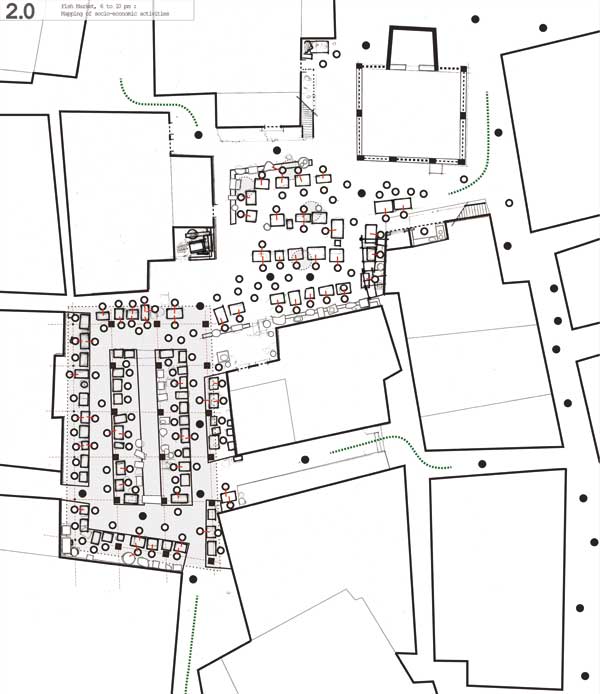
Koliwada’s Fish Market: Mapping of Socio-Economic Activities of the Market in Relationship to the Morphology of Space: The Fish Market is the witness of Koliwada’s roots as a traditional fishing village. The fish market has existed at its current location for the last 70 to 100 years.
The fact is that habitats constantly change and evolve, as families start to grow with new members being added, as new businesses come into the neighbourhood and as new families migrate. Add to this, the need for infrastructural expansion, including sewage, water supply and road networks means that the ongoing transformation of habitats is an everyday reality. Most habitats, harness the resources for making these changes from within. The necessary skills are brought to surface and used to the best of their abilities.
As change unfolds, the street patterns remains a point of continuity from the past and the anchor for the future. Once they are seen as the starting points, then the transformations become more productive. Many cities around the world have evolved in this way. And most are bookmarked in public memory by their streetscapes. Indeed, it is precisely these organic patterns that give so much charm to European old towns. There is a reason why despite being invaded by hordes of tourists the ancient quarters of cities such as Barcelona, Basel, Lyon, and Florence keep their local character and charisma intact. What is important to note is that this happened despite the fact that many buildings have been torn down and rebuilt or floors have been added up to 7 or 10 stories high. All the transformations happened over a period of time by responding to specific user needs and without altering the streetscapes too much.
The same holds true for Tokyo, which more than any other city has kept its village-like fabric and street patterns while completely transforming itself. In fact, the success story of Tokyo –which transformed itself from being a gigantic pile of debris produced by US fire bombs during the Pacific war to being the largest, most advanced and urbane city on earth – is the story of incremental urban and economic development.
We deliberately focused here on the importance of preserving the organic street layout of slums to preserve identity and continuity in social and economic arrangements. There are many others reasons that we will elaborate in future essays. These include: visual coherence, functional efficiency, respect of local autonomy, sustainability and quality of life.
It should finally also be clearly stated that the preservation of existing street layouts should be a means to maintain and improve existing quality of life. It is not an ideology that should blindly followed. It should always be considered on a case-to-case basis and in consultation with residents, since in some instance the benefits of modifying the layout of some streets can in fact be greater than the advantage linked to its preservation.
Published in The Indian Architect & Builder, December 2008
The immense ferment that Dharavi has seen in the last few years has settled a bit. A tiny bit maybe, but there has certainly been some calming. It is to do with the global financial crisis that translates into the expected cold-shouldering of the promised private investment in the Dharavi redevelopment plan.
According to many involved sources, there is hesitation on the part of several parties to say anything definite about where exactly the plans are headed now. Especially if they were linked to private investment and real-estate development rather than the masked rhetoric about slum redevelopment and rehabilitation.
However, those activist groups working in the field of housing who did not directly connect with the feverish rhetoric find themselves having some more breathing space. What they do eventually with this breather only time will tell.
According to a few unconventional urban planners, this is the best time to bring to notice the fact that a really effective transformation of a space like Dharavi is only possible from within. In other words, to rely on the resources that exist inside the community in terms of skills, willingness to mobilize resources and raising funds. However this has to be framed within the logic of incrementalism – the idea that slow, step-by-step growth and changes over time and stimulated by the needs of natural growth of families and communities is the best way ahead.
If we look carefully at those spaces within Dharavi where some level of incrementalism has occurred spontaneously, due to relative economic, we see the way economic mobility has spurred a natural improvement. Homes have been improved upon and built over. In some cases the communities have gotten together to build sewage and improve drainage systems on their own.
The residents of Dharavi have always aspired to better living standards, and demonstrated extraordinary resilience and creativity in the face of social exclusion and economic hardship. Many commentators, including The Economist, have been impressed with the dynamism and entrepreneurialism displayed by its residents. Studies show a very high degree of absorption of new technologies by the population. Every lane in Dharavi has a cell phone retailer, and cybercafes are flourishing.
If these internal energies are allowed to spill over into the space of self-development – or what are also called auto-built urban environments, then the government does not have to play a role beyond providing a support system.
From within the logic of incrementalism, Dharavi does not appear to be a complex, overcrowded, chaotic space but one that is teeming with resources. Of course the several decades of political and social indoctrination – in which patronage has been the norm has had its toll. Often it is difficult for the residents themselves to have faith in their own capabilities simply because the local leaders and political representatives brow-beat them into a passive role. Activists should have cut through the space of centralized leadership to create structures for organic participation. Processes that have worked, often by default or accident. Unfortunately, the language of activism that Mumbai and the country at large has become used to is an extension of state patronage. If the non-governmental organization also speaks a version of statism, then there is slim chance of a genuine break from old thought processes. In this scenario, it will be impossible to make ‘incrementalism’ part of a policy statement. That would involve the same level of synthetic intervention as wholesale manufacturing of consent.
Instead, the best way ahead would be to take advantage of a situation where the overheated markets are correcting themselves and also correct a bit of the overheated political rhetoric that we have also become attached to!
Urbspotting: Recognizing urban processes and formations. Archetypes are as much about the gaze of the observer as they are about real patterns and formations. Discerning them is often useful to crack open the calcified, hardened conceptual crust that has formed on the idea of the city. A crust so tough that it pretends to act as a foundational principle for all urban possibilities, when in fact it is one among many. We welcome additions to the ones suggested here!
The Bazaar: Temporary P2P exchange zones. The bazaar could well be the genesis of all urban forms. Stable cities have mostly been sparked off by simple acts of trading and many cities today are sustained by markets that sprout in all kinds of places. The bustle of a bazaar often suggests that its not just trading that goes on there. They indicate that exchanges of all kinds – even when not linked to livelihoods or profit – are life-sustaining and desperately needed. Thats why they can also be referred to as P2P zones.
Ex: Ingo’s Flea Market, Goa; Everywhere in Mumbai
The Bazaar, Tepito Market, Mexico City
Bobo Town: When artists, gay communities and students discover fringe areas of the city and transform them into trendy comfort zones. Exuberance, creativity and rebellion go hand in hand and neighbourhoods get transformed by acts of defiance that such groups spontaneously exude. These moments of lifestyle critiques make great exorcists of dullness and boredom that often lie over streets like heavy fog.
Ex: Williamsburg, Brooklyn; East Village, Manhattan
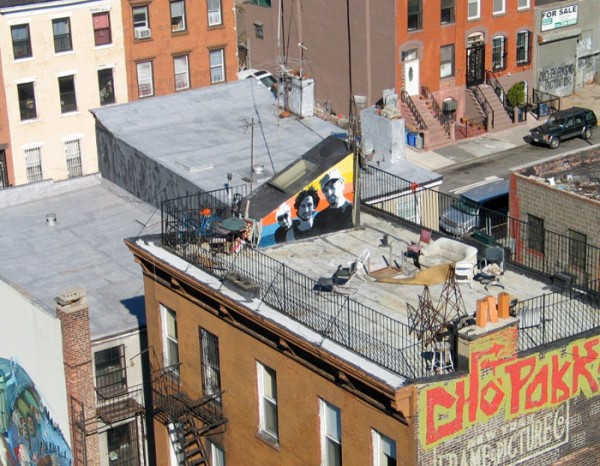
Bobo Town in Williamsburg, Brooklyn, New York
The Hamlet: Anachronistic urban villages that have a distinct identity and manage to survive in a large megalopolis. They keep reminding vertically obsessed cities that habitats come in all kinds of shapes and sizes. Low rise high density clusters can be as urbane as any contemporary piece of architecture and can have their own legitimate place in urban lives.
Ex: Khotachiwadi and Koliwada, Mumbai
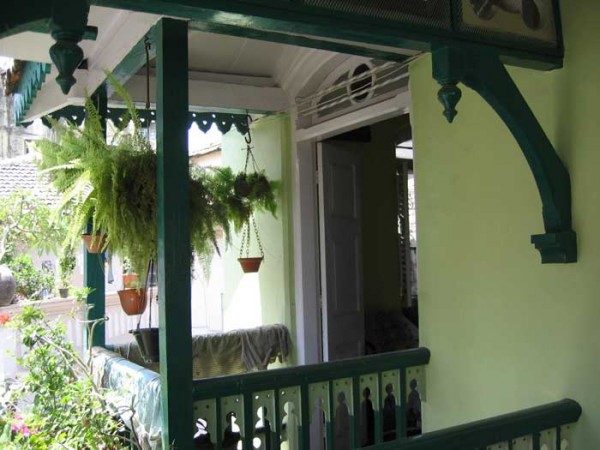
The Hamlet in Khotachiwadi, Girgaum, Mumbai
Post-Industrial Site: That reflects a different economic era, typically industrial, which today is a ruin, but still full of potential. The post-industrial site reminds you of the cyclical nature of economic activities and of the rise and fall of neighbourhoods. However, even in its ruin it is inevitably pregnant with possibilities, since the urban imagination has the ability of absorbing even the most decayed of landscapes and converting them into vibrant zones, with a sleight of hand and a touch of trickery.
Ex: Tada Site, Taichung (Taiwan); Cockatoo Island, Sydney; La Escocesa, Poble Nou, Barcelona
La Escocesa, Post-industrial site in Barcelona
Creeper Street: Informal arrangements supporting the formal economy, which can be found in the back alleys of every central business district and generally all over the city. The Wall street is as much about invisible financial transactions as it is about the thriving food and hands-on service industries that surround it. Creeper streets abound in a city like Mumbai which pretends they are ‘informal’ when in fact they comprise the main activities of the urban economy.
Ex: Print shops and services in Wall Street, New York; Recycling shops in Dharavi, Mumbai
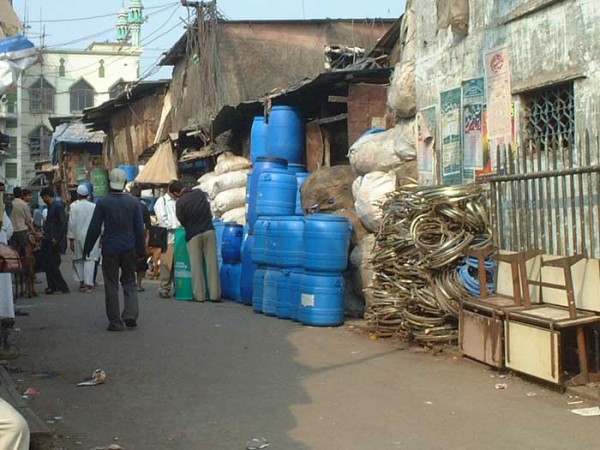
Creeper Street in Dharavi’s 13 Compound, Mumbai
Disney Street: A selfconscious historical quarter that builds on its own mythology almost to caricatural extremes, usually living off the tourist economy. They are different from Bobo streets since they depend on one narrative, set of myths or the life of a celebrity. They are quaint side shows to the urban story but have the potential of sustaining quite a few generations of small scale services and businesses.
Ex: Barri Gòtic, Barcelona; Pigalle, Paris; Abbey Road, London
Disney Street in the Gothic neighborhoud in Barcelona
Takeover Street: Enclaves where squatters save neighbourhoods by a creative reuse of space. Today, many of them are an endangered species. Yet the history of squatting in Europe has been nothing but a chronicle of the best possible examples of the re-use of urban space. It has been a testimony to the creativity of ordinary people and an expose of the fact that there is a whole universe between the surplus of space and its commercially induced scarcity.
Ex: Artamis Site, Geneva (RIP); Christiania, Copenhagen (RIP)
Takeover Street, Christiana, Copenhagen
Transglobal Localities: Havens for passerbys, travellers and tourists. The weather is often one of the most over looked causes of new urban formations, yet people travel all across the world in quest of the perfect temperature. Organized tourism and travel may have stripped a bit off the romance of exploration and geographical discovery but it has spawned unexpected moments of urbanism in the most unlikeliest of corners.
Ex: Calangute-Baga, Goa
Transglobal locality, Near Titos, Calangute-Baga Beachfront, Goa (Photo image ination)
Ethnie City: Community based enclaves. They are legacies of insecure social histories on one hand and positive statements about the comforts of familiarity on the other. In most cases they are simply what they are. And are as willing to become something else. Yet – the symbols they have generated mark the diversity of urban life in a manner that is so important for celebrating cosmopolitanism. Typically paradoxical of modern life.
Ex: Lee Street, Williamsburg, Brooklyn (Hasidic Jews); Koliwada, Dharavi, Mumbai, (Fisherfolk); The Castro, San Francisco, California, (Gay)
Ethnie City: Fish market in Koliwada, Dharavi, Mumbai
Ura Machi (Shadow City): Blindspots in the psycho-geographies of contemporary cities. Every city has them. To those outside their boundaries they are embarrassments, but to those who dwell within them they are repositories of valid urban histories, however awkward or distinctive. Yet – blindspots can suddenly find themselves in the harsh spotlights of commercial attention if they come in the way.
Ex: East New York, Brooklyn; Dharavi, Mumbai; San’ya, Taito Ward, Tokyo
Ura Machi, San’ya Buraku, Taito Ward, Tokyo(photo crowndedworld.com)
Lost Street: That which is part of a historical moment forgotten altogether.
Ex: ? You just have to visit the least travelled to spot in a city, take a train or subway that runs empty or get off that deserted stop and you will re-discover it.
Lost street somewhere around Mira Road, Mumbai
Edge Street: That which lies at the boundary in more than one sense of the term. There are edges and fringes and peripheries and then there are spaces that are outlawed, self-governed or simply no-mans-land squeezed in between administrative boundaries. They can spawn some amazing counter-cultural moments or are best left in a hurry.
Ex: Ghodbundar Road, Thane; Coney Island and East New York, Brooklyn, New York
Edge Street, in East New York, Brooklyn, New York
The Carnaval: Occasional, popular, celeberatory takeovers of neighbourhoods and streets. Noise, music, lights and colour are the hallmarks of moments when communities and people decide to leave their mark on the collective consciousness of the city. Its showbiz of another kind and equally seductive. Its a way of leaving your collective scent on the street before the authorities forget you altogether. The ritual or festival is just an excuse.
Ex: Notting Hill Carnival, London; Ganesh Chaturthi Celebrations, Mumbai; Salvadore de Bahia Carnaval, Brazil
We are all children of Mike Davis. The publication of his City of Quartz was an inspiring moment when we realized that we can and should talk about cities not just as architects and urbanists but also as engaged citizens, critics and activists, allowing ourselves to be confused by an urban experience of infinite depth. He introduced us to a perverted aesthetic where urban dreadfulness became attractive and fascinating. A camera on a street corner, a homeless-proof bench, defensive walls were all turned into iconic expressions of the paranoid urbanity of a city living in fear of itself.
The simple act of taking a picture of a surveillance camera and walking these supposedly dangerous streets came across as gesture of defiance, a direct engagement with the urban realm, and a kind of cure to the city’s neurosis. The idea that anyone can be an urbanist stayed on our minds . All we really need is to explore our environment, critically assess it and let our imagination drift. We don’t need to be urbanists to have ideas about space, what we need is a direct engagement.
Mike Davis’ intimate relationship with Los Angeles is what made City of Quartz a great read, and it is what is terribly lacking in his Planet of Slums, which at times reads more like a UN report than anything else. The intention was noble and the topic is obviously of critical relevance, but a direct form of engagement with the topic was missing. Not that Mike Davis never stepped in a slum before. No doubt he has many friends in many parts of the world. The problem was rather that he tried to say too much about slums, putting an enormously varied bunch of habitats in one very problematic and ill defined category. In fact slums around the world share little in common, apart from a vague definition born from the uncreative minds of bureaucrats and academics. According to the United Nation Task Force in Improving the Lives of Slum Dwellers, a slum is “a group of individuals living under the same roof lacking one or more of the following necessities: access to improved water, access to improved sanitation, sufficient living area, structural quality and durability of dwellings, and security of tenure.â€
Oh my God, my Tokyo apartment is a slum!
This type of broad amalgamation and labeling opens the way to all kinds of man-made urban disasters. The well-intentioned UN Millennium project targets to “Have achieved by 2020 a significant improvement in the lives of at least 100 million slum dwellers.†How do you realistically make a difference on such a scale? Just to get an idea of the extent of the project, 100 million is anything between 100 and 200 Dharavi, which as a settlement definitively fits in the UN definition of a slum -although many of the residents do not conceive of it as such. 100 million is a third of the US population. How can you invent a program that can impact the living conditions of so many people at once?
Lets imagine a best case scenario; an UN officer’s dream: An enlightened new US president gets elected and says: “No more war, we will give instead all these billions to the UN so it can accomplish its target of improving the life of 100 million slum dwellers.†The UN officer smiles in his sleep and his dream flies to the near-by bedroom of a real-estate developer: Mass housing construction for 100 million people throughout the world. His smile is twice as large as that of the UN bureaucrat. What a project!
“I will make world-class townships and improve the lives of 100 million slum dwellers!…â€
That would translate in the redevelopment of hundreds of thousands settlements throughout the world. And everyone would ride on a great feeling of social justice. Except that Redevelopment is not development. Development is what is happening all the time in so-called slums throughout the world and it is not just urban, but also economic, political, social and cultural. Redevelopment plans do much less for the concerned population and much more for private developers and financial institutions than is often believed. They actually often do more harm than good, especially large scale ones.
The main problem with large scale development projects, such as the Dharavi Redevelopment Project is that they usually have no consideration for the neighborhoods they are set to redevelop. After all, these are slums and slums can only be seen in negative terms. Most middle-class people sincerely conceive of slum as urban junk. And anyone pointing out to that the settlements in questions cannot be reduced to their depressed appearance, but are also complex economies with intricate social webs and vibrant cultural life, will immediately be called “romanticâ€. By the way, this generic “romantic†label put on anyone questioning the dominant logic of urban development ought to be the theme of a future post on this blog.
Moving people from their makeshift homes to a mass-produced concrete building won’t turn them into middle-class citizens by magic. If anything is truly “romantic†it is this crazy idea and conviction. Just as the idea that middle-class pity and paternalism will help the poor in any way. As our good friend Bhau, who was born in Dharavi and lived there his whole life, often reminds us:
“They say they will redevelop Dharavi, but look at what they’re doing! These high-rise buildings mushrooming all round us. Families who are given a flat are soon selling and leaving. They need money because they cannot continue with their livelihoods in these buildings. People living in these high-rises don’t know their neighbours anymore. This street activity will be gone. Where will my people go now? They say it is development but it’s just the opposite.â€
So Mike, if by any chance you come across this blog and are reading these lines: We love you as a street-wise urban prophet, but not so much as a proxy UN reporter. The real-life vision and direct engagement that we liked so much in City of Quartz was missing from your Planet of Slums. Please stop reading statistics and come join us in Koliwada-Dharavi!
According to Kisho Kurokawa – a proponent of the metabolist architectural movement – “Western Culture…based on modernism, cannot be discussed without reference to its… [reliance on] dualism and binominal opposition … Dualism is the fundamental base of rationalism of the modern West. Spirit and form, freedom and necessity, good and evil, reaction and reform, art and science, intellect and emotion, humanity and nature, tradition and technology, capitalism and socialism, the individual and the whole…†(1998).
To this list of oppositions we can add city and village, modern and primitive, formal and informal, order and mess or “noiseâ€, as Kurokawa calls it in reference to Edgar Morin’s theory of noise. According to Kurokawa, in Japan, order includes noise. This is why Japanese cities are so tolerant to those forms of urbanism that Western notions of planning and urban order would call “irrationalâ€, “messy†or even “slummyâ€.
A city, says Kurokawa, “is also composed of complex and multilayered relations between an organized structure and the multivalent, heterogeneous elements that can be called noise. The city is always changing dynamically as it continually incorporates new elements. The open structure, or receptivity, is a special feature of the Japanese city and one it shares with other Asian cities.â€
Japanese cities have largely evolved as unplanned habitats in a gradual, incremental manner, which blurred many of the dichotomies at the root of Western conceptions of urban planning, including those between urban and rural. Greater Tokyo was developed over the small patches of farm land surrounding the ancient capital of Edo. This “pattern gives continuity with the past, [it is a] kind of patchwork [that] is the main urban replacement of an agricultural … landscape†(Shelton 1999).
Mixed-used, unplanned and crowded streets in Shimokitazawa, Tokyo.
Observers of Tokyo have for long admired its fluidity, its capacity to constantly reinvent itself and its ability of multiplying, juxtaposing, and overlaying functions. The history of Tokyo’s urban development in the past century is mainly one of incremental and spontaneous development of the parts assembling to form a whole. Modernizers have for long attempted to “rationalize†Tokyo, but were ultimately unable to cope with the extremely rapid demographic and urban expansion.
What made this process quite distinctive (from other Asian urban histories) is that official policies did not dismiss the city’s organic evolution. The mixed-use habitats, the village like social foundations of the urban neighbourhoods and the low-rise high density landscape emerged as a default urban model. A model that was not seen as an ideal one by planners, but which also was not considered illegitimate. In fact the government engineered projects related to sewage, water supply, electricity and roads to reach every corner of these neighbourhoods through private agencies. These agencies had to negotiate labyrinthine inner roads and unexpected twists and turns, an inevitable feature of such habitats, but eventually succeeded with ingenious and innovative use of technological inputs.
The “metabolist†approach theorized by Kisho Kurokawa describes the city as a living organism, an evolving system that is being produced from the bottom up, rather than from the top down. Each part of the city has its functions and sense of locality, and it integrates the whole in its own terms. We believe that there is much to be learned from the Tokyo “default†model, especially at a time when emergent cities throughout the world – facing unprecedented rates of urbanization – are battling with the idea of “modern urban formâ€. Broadening their conception of what a city can be would be the single biggest step central planners, bureaucrats, and policy-makers could make in the direction of improving the life of slum dwellers in developing cities, since it would allow for more sensible planning interventions.
From a local commercial lane to a tiny community pathway. A fractal pattern that repeats itself all over Tokyo. Photos taken in Ikebukuro, seconds away from 4 lanes roads and high rise buildings.
Almost all the analyses of the recent financial crisis, that started in the US but pretty much affects most of the world, lays the blame on the recklessness of financial institutions, miscalculation of value and the basic problems endemic to the act of speculation itself. Political critiques blame the US squarely for riding on a credit-based economy that asserted itself in the Reagan era and more or less set crazy standards for financial institutions everywhere.
Some even blame the emergence of stock market software and the spread of the web as a prime mover of financial opaqueness that eventually grew to monstrous proportions. You could shave profits off stock – markets situated across time zones calculated at fractions of seconds and make capital theoretically available for investment in any which way to anyone, anywhere in the world – for a price calculated on the cost of communication and not on concrete value.
However – at the end of the day you can’t really blame the logical extension of manipulating economic interests to its extreme, using technology or whatever, as long as the systems in place support the broad logic – of making profits. But sometimes, even in the toughest of capitalist skin, there is feeling. Especially if you find yourself hacking at the very branch that you are sitting on. That’s when it makes sense to say that the profit logic needs some qualification.
However, such a qualification should well apply to all dimensions of the game. If financial institutions need to become more transparent, if governments need to be a tad more intrusive, if credit has to become more sensibly priced then value too needs to be evaluated critically.
The heart of the problem does lie at the question of real value. We find it difficult to believe that most analysts skip over this issue or make fleeting mention before going back to blaming old demons – laissez faire on one hand and bad fiscal management by the state on the other – even though these may well be symptoms than the real causes.
The fact is that speculation around real – estate, as a specific mode of speculation and transforming value follows quite distinct rules. It is at once related to concrete, quantifiable assets as it is to asserting an abstract value around these assets by changing the terms of its supply and demand. In other words, you can always claim legitimacy for the act of construction even when there is no real market. You can simulate demand quite literally when none exists – based on a different kind of projected speculation – in the hope that people will keep exchanging, moving up, aspiring towards better lifestyles. That governments will always invest in improving infrastructure, so on and so forth. While this applies to all basic acts of consumption (and we can see the effects of this on other realms of our lives – environmental degradation, the expensive business of waste disposal), the specific way in which this happens in the realm of construction needs to be isolated.
The industry’s ability of evaluating terms based not on real needs but on an abstract sense of general needs is a special mode of simulating demand. We are told we need buildings, roads, infrastructure and homes. Since no one actually questions that – these general needs can be evoked to raise and justify investments and capital re-cycling without it tallying with the ground level needs in real terms. In an advanced economy such as the US – the crisis was triggered off by an over-supply that pushed down the value of mortgages making the interest rates redundant. What’s happening in China is slightly different. The building and construction industry has been investing in the name of abstract and general needs and borrowing heavily from a financial market that has lost its focus behind the frenzy of globalized speculation. But the effects will be more or less the same. A major crisis of credit.
The fact is that the construction industry has played a crucial but largely ignored and even invisible role in producing a fog around the idea of value, credit and financial investment while muddying the waters extensively on the ground.
In many parts of the world – housing has been framed as a need to be financed and supplied by construction companies with massive access to capital. Construction companies have built cities afresh or re-built and destroyed habitats without paying any attention to the way in which the configuration of real needs of people, their livelihoods, ability to pay have been factored in sensibly.
Yet – their role is never in the forefront of discussions and debates. Once more the world of built-form is relegated to being the stage in which dramas take place, the context in which life is lived, an invisible casing in which capitalism operates. In reality, built-forms, as Linda Clarke informs us in ‘Building Capitalism’ are themselves production sites. Cities are living financial worlds that produce, consume, exchange and re-arrange resources of labour, capital and the environment and have been doing that for centuries.
Its like discovering that the inanimate world of rocks are actually living breathing entities that wield a massive influence on people living in their proximity.
These world makers have always worked from behind the scenes – fully supported by the local kings, aristocratic lords or the religious elite.
Today, they are the hidden arbitrators of a certain kind of value that energizes one significant part of the market.
Its easy to blame specific acts of mismanagement, the ability of technology to create confusion or pass judgments on entire ideologies by completely ignoring this point. Something similar happened during the Cold-war. While the world was quibbling over grand narratives of capitalism and communism; builders, engineers, construction companies and architects flowed easily through iron curtains and concrete walls in the name of being neutral agents.
We are only building, creating, doing good – they would smile, we are not quite ideological.
Yet they had immense powers to channelize huge resources in the name of development and construction. In countries like India – they built massive cities in the name of modernization while most urban enclaves lost their traditional skills and legitimate rights to make their own homes to eventually get transformed into degraded infrastructure deprived environments, quickly labeled slums.
In rich countries, their ability of creating general needs – redefining what makes modern lifestyles and spawning a whole new industry by creating and destroying habitats ensured that they constantly borrowed, made profits and moved on to new territories. Their economies were elegantly constructed on building and borrowing.
Eventually – when simple laws of economics kicked into place – when supply over stripped demand in some quarters, it tripped the whole system.
Unfortunately there is enough reason to believe that they will get away scot-free once again – while regimes will contain and control and regulate the market in other ways.
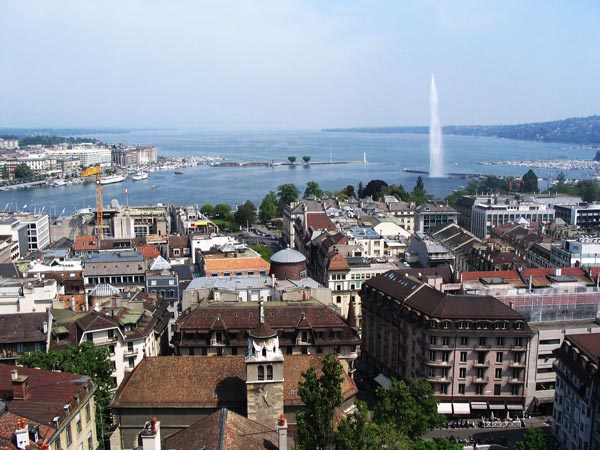
In the global imagination, Switzerland often represents an ideal society. One in which Italo Calvino would find quite a few cities morphing into picture perfect post cards. Switzerland is at once globally competitive and domestically redistributive, in tune with nature and well protected against its excesses, rooted in its culture, yet cosmopolitan and technologically advanced. Swiss cities are well planned, compact and sensibly connected to the countryside. Politically, they are models of participatory democracy, with cantonal (district wise) and municipal governments administering local affairs and overseeing urban development. Switzerland attracts successful people from all over the world, particularly in the fields of business, research and diplomacy. Many choose to settle in Switzerland because of its comfortable scale, charming landscapes, and well maintained cities.
At the same time, Switzerland is known for its aversion to anything that threatens the status quo. While in India change these days is often considered synonymous with economic growth and rising living standards, in Switzerland it is associated with risk and a possible reduction in the quality of life. It is extremely difficult for the young generation to innovate in Switzerland. Soaring birds, especially if they are rebellious and creative, have to fly far from their nest in order to live up to their potential and aspirations. For them leaving the middle ground often means simply going away.
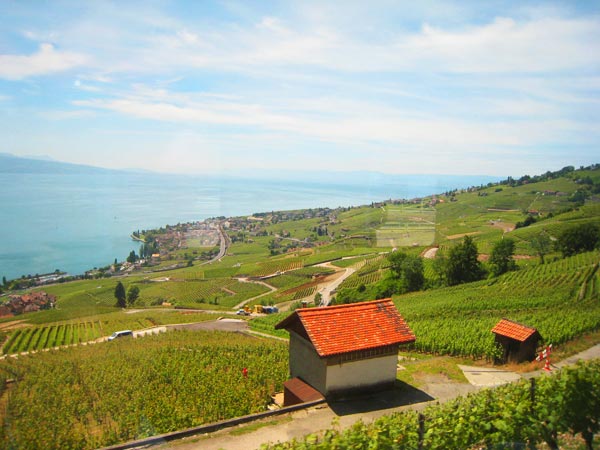
Vineyards on the coast of the Leman Lake in the Canton of Vaud, next to Geneva.
Genève, the French speaking Swiss city at the end of the Leman Lake, is truly open. It is funky and literally flexible with it multiple formal boundaries (the city, the canton and a part of the lake). Commuters come to it everyday from neighbouring France and nearly forty percent of its residents are not native. The city emerged in the European imagination during the 15th century, with its famous international fairs making it a hub on the ancient trade routes leading to the Mediterranean Sea. These trade fairs were economic and cultural events that brought in thousands of traders and merchants to this francophone city. The fairs were open, vibrant and significant urban moments that shaped its famous banking institutions and inaugurated its destiny as a global city.
Genève derives much of its force from this historical openness to the world. Culturally it appears amazingly rich. It has all the museums, cultural centres, art galleries and operas it needs.
Day long “disaster” installation in front the Grütli House, a heavily subsidised cultural centre in Geneva.
Yet, so many young arts practitioners acknowledge that something crucial is missing. The city hardly allows homegrown innovators and creators to survive. A truly creative city cannot just depend on its formal cultural infrastructure. That may produce a well educated audience, but one needs more than spectators to make for a truly creative city. One needs free actors who can experiment and express themselves without constraint. One needs affordable spaces for them to function as such. And it is here that the city fails to oblige.
A truly creative city must allow creative destruction of the status quo, especially when it is driven from within. It must have spaces that allow freedom and encourage the ability to take real risks for its emerging generation of practitioners. These are things that cannot be part of the formal cultural systems. Genève may support its most successful artists and creators through grants and other institutional arrangements. Subsidies from the national government also make themselves available to a handful of movie producers and musicians who depend on them. However, these are just not enough when free spaces for self-expression are being shut down.
Until very recently Geneva had its own version of the great European cultural practice of squatting. Squatting is something that one never thinks of in the context of Europe, let alone Switzerland. However the European squat movement was responsible for the cultural effervescence of cities like Paris in the 1970s, Copenhagen in the 1980s, Barcelona in the 1990s and Berlin in the 2000s. Similarly, Genève had several squats that provided cheap shelter for students, artists, nomads and other free spirits.
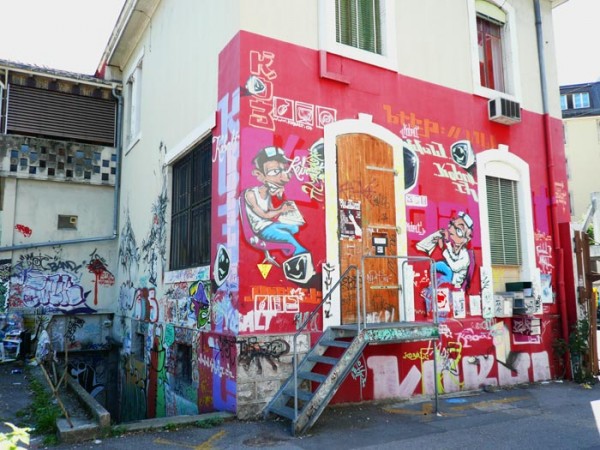
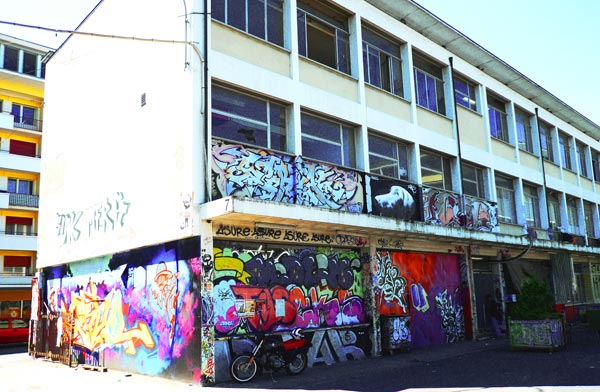
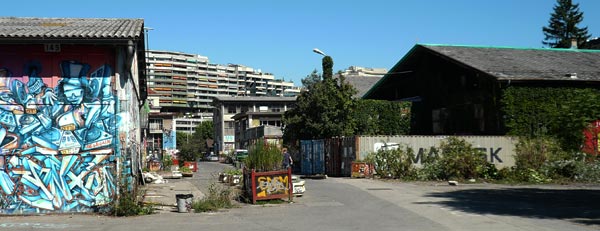
The site of Artamis in Geneva was squatted by artists, designers and musicians. The site is now being redeveloped and the occupants have be relocated elsewhere in the city.
To the Asian reader, the word squat usually evokes informal settlements built by poor immigrants on public land. In Europe squatting basically describes the occupation of an abandoned structure by a group of young people who cannot afford to rent a regular apartment. The degree of tolerance towards this practice varies from one country to the other. In the Netherlands squatting is authorized in any building that has not been used for over a year. This guarantees an optimum use of space in an urban context where it is scarce. Until recently, in Genève, an owner had to show a rehabilitation project for its property before the police could evacuate squatters.
Squats thus provided a natural habitat for those who could not afford formal housing or working space. It was an indirect subsidy from property owners to artists and creators who would not have been able to do their art if they had to work full time to pay their rent.
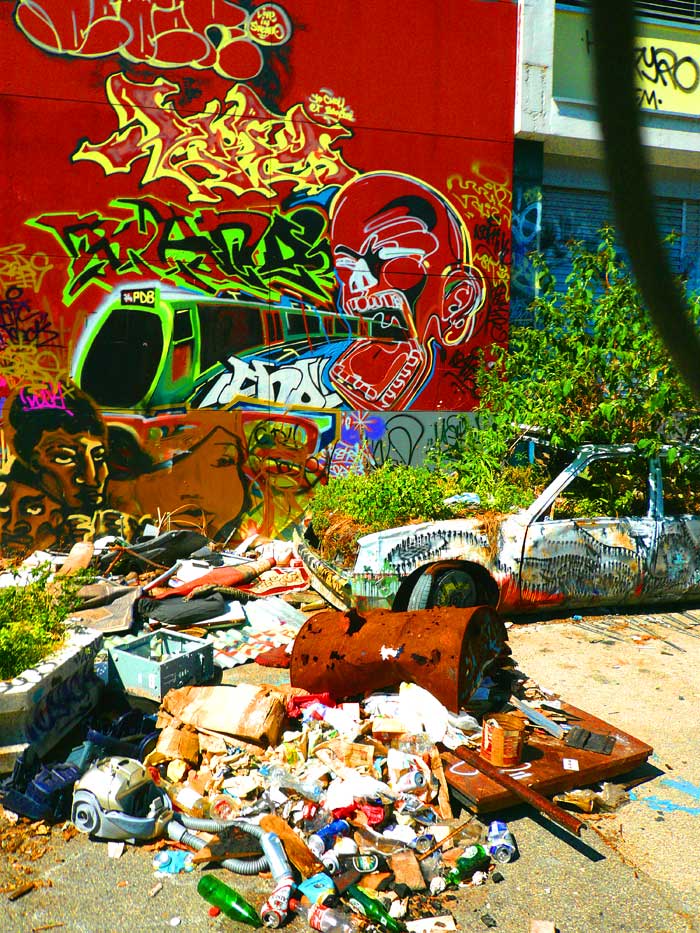
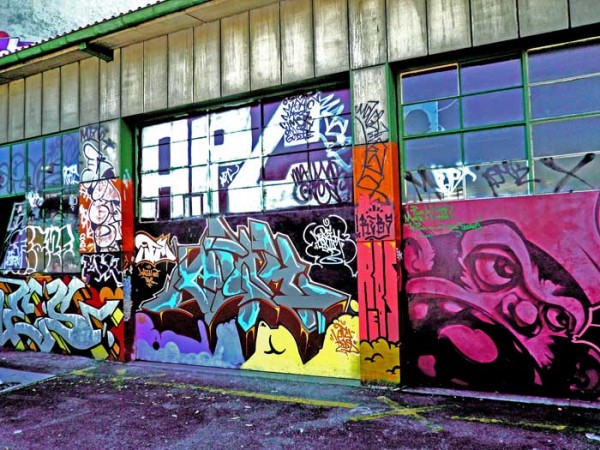
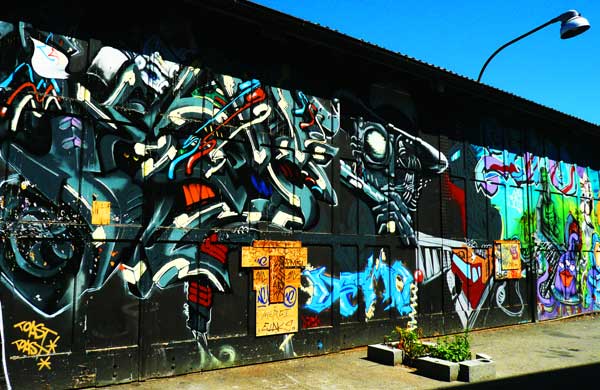
Artamis Summer 2008.
Genève use to have a fairly tolerant attitude towards squats. Many of them had activities open to the public such as art galleries, theatres, concerts, bars, and restaurants. These constituted a point of connection between the squatters and the public. They functioned as incubators and breeding ground for artists, writers, musicians, designers and so on. A whole generation of local creators emerged from the squats.
In the past few years a sharp rise in property prices and the rise of a new brand of political conservatism in Europe has unleashed a huge backlash against squats and squatters. The laws have changed and now the owner doesn’t need to present any plan for rehabilitation. The attitude of the authorities in Genève has changed, and squatting is no longer tolerated. Almost all the squats have closed down forcing many out of the city.
Ironically this happens just at the time when new ideas about the ‘creative class’ are spreading in universities, planning departments and the political arena. According to the proponents, the new urban elite is highly mobile and creative. In an economic context where innovation is vital to the conservation and conquest of new markets, cities must compete to attract and retain creative people. The creative class wants lively cities with a lively and inspiring cultural scene that multiplies networking opportunities and stimulates imagination.
Various murals and right above the Shark bar in Artamis .
Unfortunately, this idea is more often than not misinterpreted by policy makers to mean an investment in formal cultural infrastructure. It becomes an excuse for more construction-based projects to create new physical spaces such as galleries, museums and formal performing arenas. This in turn makes cities more expensive and actually pushes the creative class (except for a handful of successful, rich and corporate dependent practitioners) outside the city.
Today, Swiss artists are leaving to Berlin, Buenos Aires, Shanghai or Mumbai in search of places where they can afford to be creative. And Genève is increasingly becoming a bankers’ or tax evaders city. A beautiful postcard that strives to preserve its cute image for the greatest pleasure of Saudi, Japanese and Indian tourists.
In many ways Genève symbolizes what is happening in other parts of the world. City authorities are fetishizing art and cultural spaces while outlawing spaces where creators and innovators can survive.
Eventually, the architecture of construction always wins. It is more lucrative, even though unnecessary. While what is really needed, an architecture of improvisation, an architecture that is inspired by the history and practice of squatting, of re-use, adaptation, and innovation.
In contrast to the Swiss city, the Indian urban landscape is a peculiar place right now. In some ways it reflects similar global processes while in others it manages to allow for genuine creativity to unfold. Especially in its vast swathes of informal settlements or in its historical small towns cracking open their shells, coming into their own. These are the spaces that are starting to attract the global adventurer artist, seeking to escape his slick, expensive and closed world.
Squats, East and West, are places of innovation where alternatives to the global standard emerge. They are hyper-local urban spaces that policy-makers, urbanists and architects should respect, understand and support. In essence we must recognize that a city must not only be open to the outside world, it must also allow inner forces to drive cultural innovation and social change.