Goa’s urban network

February 15, 2011

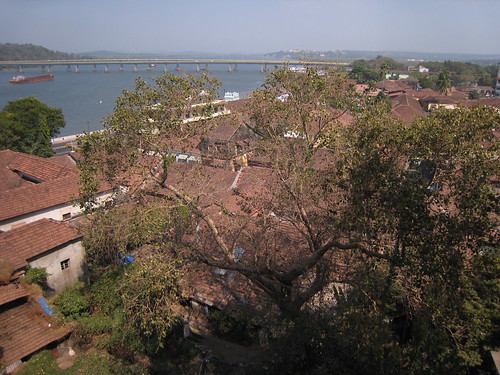
This introductory note on Goa has been written for graduate students of the landscape architecture program of the Royal University College of Arts in Stockholm. We are organizing a year-long programme on Goa’s urban systems with them.

The Studio aims at understanding the way habitats and settlements in Goa function, how they are organized and in what way do they resemble or differ from habitats and settlements in the rest of the country. Goa is the smallest state in  India with a distinctive history shaped by Konkan coastal experiences and Portuguese colonialism. The Konkan coast all along Maharshtra and Karnataka shows comparatively lower population levels than the hinterland of those states. The population levels of the coast are also comparable with the sparse demographics of the hilly tracts of the regions. Goa includes a coastal belt as well as hilly ghats that shape its landscape, making it a bio-diversity hotspot with  a demographic profile that is very distinctive.

Due to the long presence of Portuguese rule, four major urban settlements emerged, connected to trade, commerce and political rule. These are the port town of Vasco, the commercial center of Margao, the market city of Mapusa and the political capital of Panjim. The sea facing economies of these urban centers were also connected to the agrarian landscape of the rest of the state, which were dotted with villages and hamlets, mostly on the coastal belt. The four urban centers are intricately connected to the other settlements through economic exchanges and population movement giving the entire populated region of Goa a sense of being a connected network.

Through the landscape one sees paddy fields, private forests and water bodies that are enmeshed into the network by being constantly shaped by human presence and activity. Along the western hilly tracts the forests too are involved in an economy of use through the large mining industry and commercial exploitation of timber.

Most of the coastal belt is shaped by the tourist economy with its distinct civic infrastructure. The presence of Industrial estates – large zones of economic industrial activity – also dot its landscape making them destinations of everyday commuters.  The visual grammar of Goa gives you a sense of low population density and vacant spots, but in reality it is a highly dense, even urbanized system in which many habitats and settlements co-exist with forested and agrarian areas.

To the national imagination, the land use patterns of Goa seem difficult to understand, shaped as the hinterland is by a very different history and colonial experience, with a heavy concentration of large mega cities and extremely denuded and infrastructure deprived rural regions.  In relative comparison, many of Goa’s villages have infrastructure comparable to small Indian towns and in some coastal regions, even reproduce a condensed and highly urbanized consumer lifestyle thanks to tourism.

Goa is beset by a variety of pressures; the ongoing juggernaut of real estate development in the rest of the country looks at Goa as a prime destination for luxury and upper-middle class second homes for India’s rich, the mining lobby looks at its bio-diversity rich forests as spaces that can be exploited for more wealth, the idea that agricultural activity is no more the economy of future makes a lot of traditional land use vulnerable, and a combination of real-estate interests and tourist activities plays havoc with its coastal belt.

Along with all this, administrative policies in Goa are pressurized by the national framework, which forces categories and policies that work with larger population levels and different urban typologies. For example electoral constituencies in Goa are considered too low making for an inclusion of more territory per unit, even though these territories are internally very distinct. The idea that a network of villages and towns can potentially work as a system is totally disregarded and a larger urban discourse prefers looking at Goa as a city-state or a big urban center with a potential of becoming a bigger city.

All these factors play havoc with everyday life in Goa, which is consequently becoming a hotspot of restlessness and frustration to Goans of all kinds. Activism in Goa and its political consciousness is on high alert but intensely pressured by forces beyond their control. The rhetoric  of urban real estate, planning and urban design discourses typically undermine Goa’s unique urban trajectory and organization.

We aim to understand Goa’s spatial and historical configuration through the idea of the network of its towns and villages and help translate its distinction (or similarities) to policy makers, so that its future is more in control by the people who reside in it, by people who are part of its history.

It is also a strong contention that Goa’s spatial configuration can act as a reference point for several of India’s thousands of districts that are presently being denuded by the idea that dominant big-city centric urbanization of today is the only kind for everyone and all regions.  In this day and age when environmental concerns are becoming more and more real, when the practices of the construction industry attached to hyper-urbanization is being understood as being ecologically, socially and economically problematic, the story of Goa can contribute hugely as a counter-point.

The fact that there are different ways of being urbane, that are not necessarily connected to building construction and certain types of industrial development, which allow for the co-existence of natural density and social demographic density and where villages and towns, forests and fields can be accepted as functioning networks can open the way for a better policy that looks after the interests of most of India today.

Art, the City and Collective Action

January 19, 2011

This is an excerpt from our lead essay published in Art India magazine, January 2011.

One-Street-in-Khirkee-ColeAbasolo
A Street in Khirkee, by Jose “Cole” Abasolo. Produced during the Urban Typhoon Khirkee, New Delhi, November 2010.

At the simplest level, there is one thing that connects the world of urban practitioners – architects, planners, activists and designers – to that of contemporary artists involved in the messiness of everyday life. It’s the burning desire and audacity to interfere with the arrangements of their own contexts on all fronts. This interference is spiked by an unusual combination of aesthetics and politics, whereby both parties fiercely harness the forces of creativity to push forth their specific agendas. These agendas express themselves in any number of ways – from producing globalisation-fired, speculation-enriched glistening cities to fighting violent battles against apocalyptic injustices; from pushing inter-disciplinary public art projects in a world of faded funding to encouraging the gentrification of dysfunctional streets by promoting fresh art projects.

Often, artists and urban practitioners share common agendas and oppose their own brethren on the other side of the ideological spectrum. Freshly globalised cities thrive on symbolic capital and have more money for art projects, uniting the aesthetics of urbanism across a range of practices, from architecture to design. You also have the rebels, who align over issues of justice and inequality and work together in marginal urban spaces. Political engagement of this more direct kind definitely connects artists and urban practitioners of a certain sensibility, and we see ourselves closest to them, though with significant qualifications.

From neighbourhoods that are ignored by civic authorities to those that face social and economic prejudice: such spaces attract a certain kind of political investment that hopes to transform situations. For us, however, these urban contexts are more than sites of resistance. They represent a powerful counterpoint to those initiatives that today dominate contemporary urban environments, infecting building practices, cultural lives and notions of urban futures all over the world with their sinister capacities. The counterpoint has to be political in the truest sense of the term, where one moves beyond notions of victimhood, the politics of marginalisation and the desire to ‘help poor people’ and ‘save neighbourhoods’, and enters into a realm where contexts are understood and negotiated in finer ways.

The deeper we go, the closer we come to aligning with artists who share the same starting points – an attraction and empathy for worlds that fall outside dominant and mainstream urban ideologies. We can confidently say that the so-called slums, favelas, suburban ghettoes, street corners, urban villages and inner cities are breeding grounds for artists not simply because they are marginal or exotic spaces, but because they embody critiques and counterpoints through their very existence. One has to only look at the musical productions coming out of the ghettos of Baltimore, the favelas of Rio or the suburbs of Paris. Some of the most powerful forms of expression are emerging far from the centre. As architectural theorist and philosopher Yehuda Safran says, “The future is in the periphery.” Of course, artistic and cultural productions coming from the periphery are rarely treated with the respect they deserve. But when they are, what emerges is something we find truly significant as urban practitioners.

Urban spaces inspire artists to use them as subjects or themes. Artistic production that takes the context as a departure point are typically based on collaborations, which challenge the notion of the heroic and solitary artist, driven by a unitary coherence and a deeply personal aesthetic. Co-authored projects often derived their meaning and force from a shared understanding of the context and common sense of purpose. As a result, complex meanings get attached to processes rather than finished products. The making of the object, installation or performance, rather than the object itself, is taking the centre-stage. The process has its own aesthetic and it is something we experience in the world of urbanism too.

Plans and designs as finished products is a limited and limiting idea. Development projects that do not involve the people who will inhabit them often end up alienating them in one way or another. Super-developed urban infrastructure that provides for everything – art galleries, performance spaces, parks – can still produce, within a short span of time, bored and alienated youngsters. Similarly, habitats that are pre-fabricated ultimately come to life only when their inhabitants start to work on them by living in and transforming spaces through their needs. Our engagement with urban worlds has convinced us that at no point of time can one design a finished city – a promise that has been proven unrealistic and false, a countless number of times. What we can do is ensure processes of engagement and participation that are constantly active.

Ignoring this, the world of architecture and urban design finds itself in a creative impasse, banging against a wall of its own making, caught up in a political economy which limits its creativity and hopes to destroy only to rebuild in the same old way. The notion of a neighbourhood – or a building for that matter – as an ‘object’ that must be designed by an omniscient maestro has outlived its time. The modernist impulse, which drove urban planners and designers to produce grand solutions for ‘the poor’, or even for the city as a whole, is still driving ambitious souls powered by an endless supply of capital. In practical terms as well as intellectually, this has been exposed as fraudulent and dangerous. Who can still confidently argue that mass housing will solve the problem of the poor (and the middle classes, for that matter) in, say, Mumbai or Shanghai? We have seen this model fail throughout the world, with the richest countries suffering the most. Today, thousands of buildings less than ten years old are standing decrepit and unmaintained, waiting to be slowly washed away by the forces of nature.

Our generation of urban practitioners sees the city as an animate subject. Not as a dead corpse or mechanical ensemble, nor as a monstrosity in various stages of organic decay – visions that have, for long, populated the imaginations of urban thinkers and artists. The city we see emerging and are working towards is high-tech and rooted at the same time. What moves it are the millions of people, who day after day, make it their own by walking on the roads, running shops, standing and chatting at street corners, painting walls, making and repairing houses and getting involved in local affairs.

Many activists, politicians and urbanists, who have grown up in a world divided into discrete ideological blocks, are still unable to see local businessmen and concerned homeowners as agents of change. This wouldn’t have been the case if self-righteous establishments hadn’t taken supercilious stands or made grand gestures about cities that are ineffective, corrupt and unconvincingly imagined. This is as true of London and Chicago as it is of Delhi and Bangkok.

Artists engaged in seeing neighbourhoods as sources of inspiration and collective expression are leading the way out of ideological trenches towards a world where ‘community’ doesn’t necessarily imply communitarian politics and community art doesn’t have to be about the art of a community, but becomes the art of creating communities across cultural and social divisions. To the Net-generation, a ‘community’ refers to a collection of users with a common set of protocols aimed at facilitating boundless communication. The invention of these protocols is where we feel some of the most potent artistic and urban practices are converging, giving both a new charge.

In the world of art, co-production has been in effect for ages. Certain protocols have been devised explicitly to allow individual expression within a collective. You can see this in art practices in vogue before the age of autonomy of art. The institution of apprenticeship and the mastery of certain skills and methods had allowed generations of artisans to produce artifacts and architectures that bore no signature, yet expressed the highest levels of aesthetic coherence and taste. The object could live a life longer than that of the individual artist, as long as the skills and know-how that went into its making were transmitted to a future generation. This is also the way cities were built in pre-modern days with artisans reproducing age-old construction techniques and priding themselves on perfecting their masters’ styles. Some of these traditions have survived till date. The Compagnons’ associations, born at the time of the cathedrals in 12th century France, are still alive and teaching traditional carpentry techniques to new generations. Japan too has kept artisanal construction techniques alive to build temples and traditional houses even within the most futuristic urban environments.

These practices, however, are largely marginalised in a world that has still not recovered from the modernist revolution. Art forms that emerged most strongly in the 19th and 20th centuries, driven by a heroic sense of exploration and self-affirmation, had reservations about well-developed art practices from an earlier time, many of which were perceived as negating the figure of the artist-as-producer. Stylistic imperatives and technical restrictions were believed to repress the personal sensibility of the artisan. Breaking out of this labyrinth and existing in a world of infinite possibilities was at the same time terrifying and tremendously energising. New paths could be uncovered and explored, making full use of the availability of new materials and technologies, as emerging political ideologies saw tradition as the biggest impediment to social emancipation. Individual signature and innovation became more important than the reproduction of inherited practices and respect for cultural and spatial contexts. New aesthetic orthodoxies emerged to critique traditional styles. Art saw itself at the threshold of several new futures and possibilities, and the urban realm was the inevitable site and location for all of them.

With the emergence of industrial modernity, the notion of the urban took on a new connotation. As a site of cosmopolitanism, growth, democratisation and emancipatory economic transformation, the city was marked out as a unique space in the evolution of mankind. The 21st century has sealed this dimension of our collective future. The future, according to everybody, from social scientists to political economists to environmentalists, is irrevocably urban. However, this realisation is not a continuation of the last two hundred years of faith in the city as a site of all that is desirable, which was based on a clear understanding that the default world was not urban. This shift, from being aware of the urban as a site of progressive, democratising and modernising impulses in a largely non-urban world, to the realisation that the future (and even the present) is, in fact, nothing but urban, is a powerful one. It is definitely connected to the specific technological transformations that 20th century globalisation made possible. It is connected to an increasing awareness that huge tectonic shifts have taken place in our understanding of geography and the inter-connectedness of the world.

This vision, once ironically called the Global Village, convinces us more than ever that the choices for us in terms of habitats are not as unbounded as we once thought. Cities, for better or worse, are really the contexts in which we live and where humanity will probably perish, whenever that happens. For all those anguished souls, us included, who remain dissatisfied with the state of the world – this realisation forces us to look at the city afresh. If only because it is not simply that dazzling confluence of modernity and emancipation but simply, all that there is for us to work with, whether we like it or not. The questions, therefore, change from “Do we want to live in cities?” or even “What kind of cities do we want?” to “How do we cope with this urban reality?” and “How do we improve it?” The context rather than the ideology becomes the starting point for all creative processes.

Revisting the World Class City

January 10, 2011

WorldClassCityMexico
Shopping Mall in Santa Fe, Mexico City

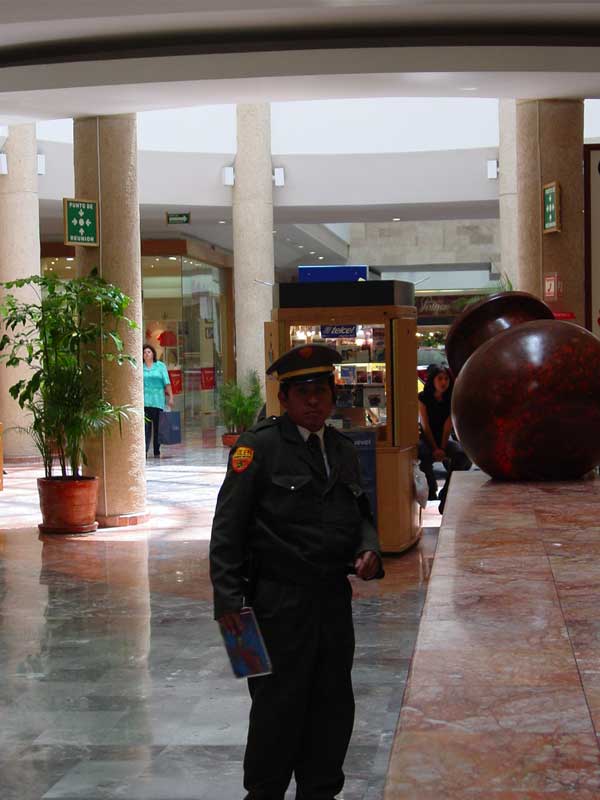
We  just spent a week at a seminar organized by the Indian Institute for Human Settlements in Bangalore, where a group of 60 students, professionals and academics debated the theme of the “World Class City” and its possible re-imagination.

The phrase “World Class City” has become ubiquitous in discussions on urban and economic development in India and other developing countries. One sees it daily in newspapers and hears it on TV and at the dining table. It is also omnipresent in policy circles and academia. Although critical minds get instinctively suspicious of such as term, it is hard to dismiss altogether, and even more so to “re-imagine” its meaning. For a start, the “World Class City” needs to be placed in its urban and ideological context.

The emergence of the “World Class City” in discourses on urban development is linked to the disappearance of the equally problematic notion of “Third World”. When the Soviet block (the “Second World”) disappeared as a distinct political regime, “First World” capitalism spread all over the world as it seemed to represent the only possible model of governance and development. Socialism was relegated to the museum of failed utopias and the world’s political imagination was suddenly reduced to whatever could be done within the frame of capitalism.

Since (almost) every country could now be measured on the scale of its economic production and accumulation (GDP), the political nomenclature of first, second and third worlds was replaced by terms referring to stages of economic development: underdeveloped, less developed, developing, developed, most developed…

In a way, one could say that at that time the world became more politically integrated and economically “global”. Without the Second World, there could not be a Third one. The world had become global again, with international trade networks expanding to new horizons, financial flows circulating freely from country to country, industrial processes realigning themselves along command and control centres and sites of production, and so on. With this relative erosion of political-economic borders, cities were propelled at the centre stage of the world economy. In an integrated global economy, their significance was no longer simply national –they became international entities, with high levels of specialization.

Cities came to be seen as the “hubs” of the global economy and a new nomenclature emerged to replace that of the Cold War era: first tier, second tier and third tier cities. This meant that potentially a developing country could have a second or first tier city. Shanghai and Sao Paulo are perfect examples of that. At this point, the aspiration of many political and industry leaders shifted from a national agenda to an urban agenda. Since cities were engines of growth, it made sense to invest heavily in their development, even if it meant leaving the country behind.

This is the broad context within which the imagination of the World Class City emerges. The World Class City is not simply your “Global City”, since, in a global world, most cities are global whether they want to be or not. World Class echoes the Cold War era notion of First World, since in a world dominated by the First World, World Class really means First Class. First Class as a status is relative by nature. On the one hand, it is based on a certain imagination of what our first tier global cities (New York, London, Tokyo) ought to look like, and on the other hand, it is a statement of superiority vis-à-vis the rest of the country.

The problem is that the cities that really stimulate our imagination when we think of World Class are not as classy when you view them from the ground. London is experiencing a rise in urban violence and unemployment and many neighbourhood shops are closing down. New York is enduring one of the most dramatic bed bug epidemic (of all things!) of its history and Tokyo has an increasing number of homeless people setting up tents and shacks in parks and squares.

The “World Class City” is a slogan that seems to be coming directly from a marketing agency and seems to be devised to sell the latest fashion in cosmetic urbanism. It is a visual narrative made of bits and pieces taken from distant places, which exist primarily as urban spectacles in our imaginations. One never encounters the World Class City in reality. The only places where this vision seems to have materialized are cities like Singapore and Shanghai, where authoritarian regimes can sustain its artificial existence. These are closer to the model of the theme park or the “special economic zones”, which achieve perfect order at the cost of forcefully containing the mess outside their boundaries.

In India the dream of transforming Mumbai into a World Class City has given way to the more realistic ambition of developing world-class buildings and infrastructures in some parts of the city. This version of the World Class City takes the form of firewalled islands of high-security and a world-’classiness’ connected to similar islands around the world. Outside, the Third World  continues to strive.

The World Class City as it is being envisioned and developed nowadays uses speculative projections that would humble the most spectacular of science fiction imagery and is a shortcut for the political glory of corrupt leaders or those without much imagination. The latest in that brand of development is Mumbai’s aptly named World One complex, which is planned to become the highest residential tower in the world, entirely self-contained and unabashedly exclusive. From the twentieth century ideal of “One World”, we have come to the vision “World One”. Real estate speculators and developers have resolutely decided to keep the rest of the city at the door.

Without its second class citizens and third world periphery, the World Class City would have no backdrop to pitch itself against. It uses the label ostensibly to carry the entire city on its merit, but in reality only exists, especially in new urban avatars, as a medieval fortress, an enclave that leaves behind the citizens that do not belong to its globally networked connections. The idea has currency in the business and politics of construction, often tied up with a more respectable sounding infrastructural dimension. These infrastructures function as corridors that connect the periphery to the centre, making the World Class City look like a walled kingdom reigning over a city-region that it is simultaneously exploiting and protecting itself against.

The World Class City is not as much a vision of the future, as it is a reproduction of a model that belongs to the Dark Age with added high-tech features. Our hopes  for the future do not rest in the World-Class enclaves of this world, nor in the regions they dominate, but rather in the spaces that are not yet fully ruled by them, where alternatives to the World Class City vision are waiting to be recognized by architects, planners, developers and policy-makers.

Activism Reloaded

January 6, 2011

Presentation at the Indian Institute of Human Settlements,
Bangalore January 7th, 2011.

WorldSocialForum

1. The Culture of Activism in Mumbai

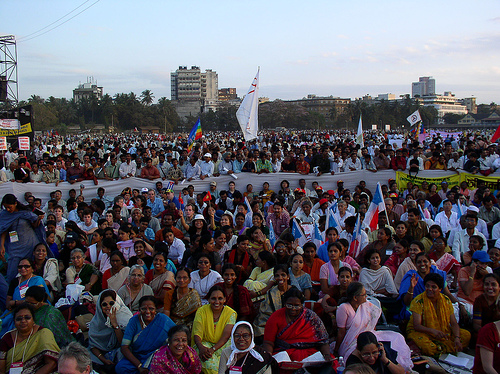
The traditional culture of activism in Mumbai was broadly nationalist socialist, rooted in the freedom struggle against colonialism. The activism around housing and urban inequality, that blossomed during post-Independence, inherited a similar vocabulary and rhetoric. At best it was proactive and effective, and at worst it became a victim of regional chauvinism or got stuck in narratives of victimhood, charity and the voiceless poor. Across the ideological spectrum it evoked communities and the participation of ‘the people’ through mass rallies, demonstrations  and centralized leadership. The activist often became the voice and representative of the poor and the poor itself became, like the community, a highly rhetorical figure of speech.

2. Knowledge Practices and forms of Engagement

The relationship between the intellectual and the activist has an old precedent in the city while the activist as intellectual and academic opened newer challenges to both, action and ideas. In many cases the activist as academic or intellectual followed a route of bringing attention to her constituency and speaking even more strongly on their behalf. What attracted us, and many like us to the interplay of activism and intellectual work is based on the recognition that knowledge practices are embedded in the world at large and these are the starting points of our political engagement.

Istanbulmashup

3. Contexts, Knowledge and Agency

As we produce knowledge about our immediate urban contexts, this knowledge transforms us into activists. Self-reflexivity about our roles as researchers of urban contexts gets heightened as soon as we raise questions. It is the  moment of articulating these questions that transforms us into political beings and it is this moment that remains the point of inspiration for our activism.  However the relationship between knowledge and politics is linked directly to its accessibility: more people who access it, participate in it and produce it,  the more political it becomes.

4. The User Generated City

Neighbourhoods that have been directly produced by their inhabitants embody knowledge about buildings, construction and urbanism. Incidentally the majority of human settlements around the world are of this nature. And if we believe Mike Davis’ apocalyptic predictions they are growing at ‘alarming’ rates, becoming ever more complex and impenetrable. We would rather see such neighbourhoods, which have grown outside of the formal planning and development paradigm as  knowledge systems, with their own modes interaction and engagements.

5. Community and Participation


Community is about both creating and being created by local modes of communication and knowledge sharing. “It is clearly no linguistic accident that “community” and “communication” share the Latin root communis, “in common.” Communities comprise people with common interests who communicate with each other.” (Melvin Webber, 1964). Participation is essentially about immersing oneself in the process, which in the urban context, means getting involved in its production. There can be no participation without communities and communication systems.

Hyping Up Neighbourhoods

December 8, 2010

Presentation at the JSTOR conference on Sustainable Digital Initiatives in India, Bangalore, December 9, 2010. The presentation is titled: “Hyping Up Neighbourhoods: Hyper-topographies of user-generated cities.”

1. The Culture of Friendship.

According to anthropologist Marilyn Strathern one of the biggest achievements of the web has been to break through kinship based hierarchical barriers to communication. Along with distance, proximity itself poses enough barriers to communication when class, age, gender and other markers come in the way. The web has promoted a mode and style of communication that works through the tone and conventions of informality which has far-reaching effects on social life than we imagine. Not just through collapsing huge distances but also breaking through  non-physical barriers in our backyards.

The web promotes a culture of friendship that we have still to fully understand beyond the quick moves made by social network sites. Social network sites themselves are based on a language that emerged in the early days of the web, when community users were exchanging information through bulletin boards and web-based communities. The culture of informality, sharing and collaborative sourcing is encoded in the DNA of the internet .

The fast absorption rate of new technology protocols by the youth that we observe in India is also thanks to dense off line social networks. The existence of those social networks is one of the strongest assets of India today and operates as much online as it already in offline spaces in familiar ways. Our work in Dharavi in Mumbai builds intensely on these social networks, which are cemented as much by friendship networks as by kinship and community bonds.  Dharavi is a so-called slum that we prefer to call a neighbourhood in formation, and it exemplifies the idea and practice of the user generated city. It was generated out of nothing by settlors, who transformed it from  marshlands and mangroves into what it is today without fully erasing both these elements that continue to exist.

http://www.airoots.org/2008/09/connecting

2. Airoots

The name of our blog is inspired by mangroves, which grow through a biological interdependence of each other as well as of land, sea, air, fresh and salt water sources. They occupy a space that is in between worlds, acting as a perfect metaphor for virtual and actual realities that help us connect with the web in the same way. As an environment that is full of elements found in each other. The actual has elements of the virtual and vice versa. When we met and started our collaborations and exchanges we were building on these elements all the time. Inspired by the dense networks of Dharavi in Mumbai and Shimokitazawa in Tokyo, our virtual exchanges made us see connections between the two and then we physically rooted ourselves in each others environments – Tokyo and Mumbai to develop our understanding of urban spaces in different avatars – virtual, actual and others. Through our web based collaborations we began growing roots into each others mind spaces, and this is really the power of the net – not only to expand but to promote interdependence and cross connections.

By focusing more on what is common than what is different, we could rethink in deeper ways about both cities, we realised that Dharavi was a version of Tokyo’s past and Tokyo is a version of Dharavi’s future. They both have a history of incremental development  and they both share a low-rise high density typology which we feel embodies these interdependent community and friendship based networks which make up their social and physical environments. The mashup collages we produced were themselves the best communication devices to present these interconnections.

http://www.airoots.org/2009/02/dharavi-tales/

http://www.airoots.org/2008/10/dharavikitazawa/

3. Urban Typhoon

The Urban Typhoon workshops built on the ideas of local action, participation and social networks. In 2008, we organized the Urban Typhoon Koliwada-Dharavi, in which about 130 people from Koliwada and the rest of the world joined voluntarily. Together we brainstormed on the future of Koliwada, a fishing village tucked in Mumbai and wrongly referred to as a slum.

In the process, we broke many barriers, including communication barriers since we could work together in teams with people speaking different languages and coming from completely different cultural and social backgrounds. We also broke some barriers in the way “activism” is usually conceived of in India, where mass mobilizations through rallies and slogans dominates the scene along with a tendency of speaking on behalf of the ‘oppressed’ people. Our mode of connection was through the same spontaneous frienship networks that allow people today to connect through vast distances via Facebook.

The virtual existence of the workshop as a project, months before its actualization in Dharavi is the way it came to life. The interdependence of the virtual and actual is what made the workshop possible. It is this connection that helps us locate our action and documentation processes best. At one level, digitizing, documenting or archiving the past is coming to terms with the virtual element of all that is seen to be worthy of archiving. But if we see elements of the two in each other, which is the way we define our activism as well, then the act of documenting what we are doing is almost coterminous with our action. Technologies available to all of us today make this possible in an unprecedented way. For us this defines the nature of our activism itself.

In the world of urban planning, participation is a buzz word. Anything, from rallies to surveys are seen to be part of the participatory process. For us participation is interaction and expression, spaces that allow more connections and interdependencies. Allowing Dharavi to grow and improve on its own, based on these processes is what epitomizes participation best. We facilitate the process through our own engagements – and most especially, through our skills of documentation of this process.

http://www.urbantyphoon.com

http://www.flickr.com/photos/urbzoo/sets/72157624795749494/show/

4. Dharavi.organic

Archiving research, projects, activist moments and processes is integral to what we do. We used the wiki site for this purpose. The wiki grew way beyond the workshop and we began using it as an archive for every one working in Dharavi. It also allowed many people to connect with each other directly. Film makers, journalists, media people and community members connected with each other through the wiki and initiatives were created or grew from these connections.

Today, dharavi.org is a well-used, growing, archive cum networking space and always comes up on google searches. This has influenced the way journalists, stidents and researchers look at Dharavi now. It is not easy to dismiss Dharavi as a slum anymore.

http://dharavi.org/

http://dharavi.org/index.php?title=C.Communities_%26_Nagars_of_Dharavi/New_Transit_Camp/Jaanibegum_House

http://dharavi.org/index.php?title=G._Surveys,_Projects,_Designs_%26_Plans_for_Dharavi/Projects/Columbia/Healing_Miti_River/Spring_09

5. URBZ: User-generated Cities

Continuing with our belief that the virtual and actual are constantly interdependent, we set up our office space in Dharavi from where we work with the neighbourhood. Working and learning from the context directly has informed our understanding of user generated cities the best. We can see for ourselves how the neighbourhood is constantly being produced and can participate in the process as well. The context of Dharavi is our subject, a living subject. It is a living repository of incremental development which is our main thematic informing our activism. And digitizing this process as it unfolds is one of our main mandates. Its complex layers, its palimpsest quality, its moving maps and constant movement is a challenge for digitizing in a manner familiar to all people involved in the practice of archiving and digitizing. And we know for sure we can learn a lot from each other in this regard.

After opening our office on MG Road, New Transit Camp, we have become involved with the Dharavi Shelter, a community initiative that aims at providing a creative space for the kids living in the neighbourhood. We are managing the space and producing the programme of activities, which include many activities that are producing valuable documentation about Dharavi. The art is also spilling over onto the street, where we are inviting artists to paint walls along with the local youth. Our latest initiative is a stand-up cybercafe, which will be based in the ground floor of the building where our office is located.

http://urbz.net/learning-from-dharavi-one-house-at-the-time/

http://urbz.net/

6. Documentation as Intervention

This interconnection of documentation and engagement is something that we developed in PUKAR when we worked there. The Youth Fellowship project and other action-research project that PUKAR is engaged with allowed us to use information and communication technology directly for this purpose.

Along with advising on research, we trained some of the 400 PUKAR Youth Fellows to use the web to present their research and connect with a larger community of researchers in Mumbai and around the world. We also developed the new PUKAR website, which allows them to keep their blogs and archive their work in multiple languages. The PUKAR site was entirely customized to the needs of PUKAR.

Using the same basic framework, we have developed other websites archiving our work in different parts of Mumbai, including the Eastern Waterfront, where we conducted an urban design studio with graduate students from Columbia University and in Khotachwadi, where we have been involved with the conservation of the architectural heritage.

http://pukar.org.in/

http://pukar.org.in/yf/

http://ewf.urbz.net/

http://ewf.urbz.net/site/sasoon-dock/

http://khotachiwadi.urbz.net/

7. Urbanology

We have recently incorporated the Institute of Urbanology in Goa, which aims at developing methodologies for urban research along with conceptual tools that will allow us to think about cities and urban interventions in a more grounded way. This accompanies  our engagements in consultancy, design and architectural practices and  we like to think of all these spaces as informing each other. The Institute is more focused on research, but defined and practiced in creative ways. One important element of this includes refining the processes of digitization and documentation based on the principles we have described above.

To summarize, we see online tools and techniques of digitization as intrinsic to the process of engagement. We understand our context as being a composite and interdependent whole of virtual and actual realities. We therefore relate to the context as a living subject with which we interact in multiple ways. The culture of the web is a major source of inspiration for our work, in particular its roots in friendly and open protocols, social  networks, peer learning. The web also augments our activism at the ground level.

http://www.urbanology.org/

Khirkee, New Delhi: A short introduction

November 7, 2010

Collage produced by participants in the community arts programme initiated by KHOJ in Khirkee

The idea of the urban system as discussed by Anthony Leeds, frames Delhi’s special urban history and habitats like Khirkee, in an interesting way. He rejects the idea that such villages were ‘rural’ spaces. He sees them as functional components of political kingdoms that were ruled by powerful, urbanized centers.

If political kingdoms were urban systems, Delhi was one par excellence, way before it reinvented itself in the twenteith century as a suburb of its own past in the form of New Delhi.

Unfortunately Delhi’s dynamic urban past sits uneasily with its bureaucracy mired and aggressive modern avatar.

Khirkee village – Window village – in a literal translation (deriving its name from the Khirkee Masjid built in the sixteenth century) is a large heterogenous collection of neighbourhoods weighed down by contemporary India’s confused official stance on what its urban life should be.

You see in its present, signs of dynamic civic initiatives in the last few decades, as the older village morphed into buildings and parks and decent roads thanks to the contribution of its several dominant communities. You also see familar middle class zealousness in guarding boundaries and some contempt or pity for its poor cousin, the unauthorized Khirkee extension.

Unauthorized colonies can be so for a number of official reasons ranging from being transgressive of history (ASI, The Archaeological Survey of India,  believes that the monuments deserve more civic respect through substantial evacuation of civic life) to being hostage to local officials who find it more remunerative to keep colonies in that unstable status. They are also unauthorized since processes of authorization are slow. The gaps in time are filled in by over eager builders and local landlords who make a quick buck by pushing construction activities  through bureaucratic hurdles and then get entangled in them.

During this process, the relative depression in real estate value, makes it ideal for new migrants to come and rent and live and set up shop – or even buy. A walk down Khirkee extension makes you see global faces along with regional migrant communities making it a truly cosmopolitan neighbourhood. And yet, its unauthorized status also means living with bad civic amenities, overflowing drains, uneven and crater filled roads and diseases of all kinds.

Things simply do not have to be this way. The sincere initiatives taken by so many of the residents of the neighbourhood during the last decade do not have to end in disaster. But for things to go in any other direction we need to go beyond the obvious and we hope that the workshop, with all your inputs, can enrich and exploit our understanding of this neighbourhood, its ability of transcending an undervalued urban past, its harnessing of the regenerative potential of community art initiatives and its explorations of the most genuine processes of participation in civic life.

The Urban Typhoon Workshop 2010, in New Delhi is being co-organized between URBZ and KHOJ and will be held in Khirkee village.

Fictions for a User-Generated City

August 9, 2010

Abstract of paper selected for presentation at a conference on Architecture and Fiction in Lisbon.

Cultural theorist Donna Haraway astutely observes: both fiction and fact are rooted in an epistemology that appeals to experience. However, there is an important difference; the word fiction is an active form, referring to a present act of fashioning, while fact is a descendant of a past participle, a word form which masks the generative deed or performance. A fact seems done, unchangeable, fit only to be recorded; fiction seems always inventive, open to other possibilities, other fashionings. (1989: Primate Visions, New York, Routledge).

We place our urban activism firmly in the space of fiction as understood in this epistemological sense. Besides writing, we use other fictional devices as starting and ending points of our theoretical and activist explorations.

In our presentation we focus on:

1. The circulation of a fictitious image about an urban neighbourhood.

2. The presence of a piece of architectural fiction – the ‘Tool-house’ connected to our work in Mumbai and Tokyo.

The purpose is to show how these have played a crucial explanatory and expressive role in our practice.

1. Fictitious Images:

Sometimes it makes sense for us to see concepts in the Weberian sense of being ‘useful fictions’. The word ‘slum’, which is the most common description of Dharavi in Mumbai (the main site of our engagement for the last four years), is more often than not a manipulated concept. It is evoked strategically to become a tool in the story of urbanism expressed in a particular way. It has been understood as such by a wide variety of commentators, groups and agencies. One such voice is that of urban historian Mike Davis.

We have been huge admirers of Mike Davis as a commentator in his analysis of the political economy of built form in LA from so many unusual angels. His intimacy with the city, his passion for its past and its present, allowed him to seamlessly connect a deeper imaginative engagement with a sharp political and economic eye. It allowed him to blur or delineate the boundaries of fiction and fact in ways that are concretely experienced.

Eventually LA comes across as a place with history, complexity and cultural depth that is an active backdrop to its volatile political economy.

We also owe him a debt in his attempt at providing a global perspective on the issue of habitats in terms of poverty and the false security of liberal economics connected to it. Few scholars have been able to pull out the issue of the political economy of housing from pure audit based analysis and locate it so strongly in the space of contemporary economic and political practices.

However, we also have a few points of disagreements with his analysis. The world of slums is homogenized by him as a discrete category, and the sense of history and depth he attributes to urban spaces such as LA are simply missing. It is an overwritten category and we believe it is possible to get out of this framework and still stick to a critical analysis of economic processes.

In fact we see ourselves as inspired by his gaze on Los Angeles, which we project on own urban experiences. Our fieldwork in places like Dharavi, Mumbai, reveals a complicated story, one in which history, imagination and fiction interact in special ways. Where the memory of a village is intertwined with that of caste and physical spaces, economic aspirations and mobility. We believe that Davis does not adequately critique the category ‘slum’ as a pre-fabricated, fixed, idea. When the slum is evoked at a global level – it follows a kind of apocalyptic moment, which ends with scenarios of wars and rioting converging effortlessly with cinematic representations of such habitats – evoking movies like City of God, Slum Dog Millionaire and District 9.

We see a complex variety of habitats subsumed under the label ’slum’  – all of them anchored in economic systems that cannot be framed in a narrow framework of choices. However, for us as activists, we do not choose to contest the label by suggesting it is fictitious but by rewriting its story altogether.

We therefore start our work in Dharavi by literally creating a fictitious image – in which a street of Dharavi is merged into one of Tokyo to reveal how the stories of these two mega cities – Mumbai and Tokyo get connected in a way that can only be brought to surface when one enters a terrain that perceives the relationship of fiction and fact in the way Haraway conceives of them.

We produce a narrative that connects Tokyo and Mumbai to each other. Both cities have neighbourhoods that are seen as “messy”, non-functional, irrationally laid out, hard to navigate, even harder to map out, nearly impossible to access by car, not neatly zoned, and happen to be mixed-use, full of narrow pedestrian streets with crowded storefronts, mobile vendors and groups of people hanging out.

In Tokyo, such a pattern of development emerged during the post-war period, when the government concentrated on transport and infrastructure and left housing to the people and private sector. Since land-holdings were small and resources scarce, many urban neighbourhoods in Tokyo mutated into urbanized versions of the villages they emerged from. They did not delete the earlier form. Add to this, you had a massive pressure of population and a growing economy that allowed informal production practices, mixed-use urban areas, and artisanal production to complement the countries growing global economy. What you got at the end were urban landscapes that looked astonishingly like the dense, economically dynamic neighbourhood of Dharavi. We became audacious and suggested that there was something more to the similarity seen in the landscapes of some neighbourhoods in Tokyo and those in Dharavi.

And that these are fairly deep and connected to the way in which urban economies, land-use and urban forms emerged historically. This made us re-look at the so called slummy world of Dharavi and asked the question; what was the main factor that brought these two cities closer on these counts?

2. The Tool-House.

The possible answer emerged over a period of time. Our research revealed that the slummy quality largely attributed to Dharavi’s messy, chaotic look emerged from the preponderance of the work-living combined function that each spatial unit of Dharavi represents. Its artisanal, village-like foundations made it possible for the typology of what we refer to as the ‘Tool- house’ to dominate its landscape. Seen by itself there is little to defend it from accusatory labels such as being a slum. And yet – when you juxtapose its architecture to a similar structure in Tokyo, you start seeing how limited the term is. What actually differentiates one from the other is simply they way they are both perceived. In Mumbai the structure and habitat is undervalued and in Tokyo it is simply accepted and retrofitted with inventive technology.

What we call the ‘tool-house’ emerged in Tokyo and Mumbai unselfconsciously – from their artisanal urban-village roots and became an anachronistic architectural presence. Seen without the label, the structure can be seen as either primitive or futuristic, with the label it represents a significant architectural rupture in the hi/story of urbanization.

The modern city emerged through an atomic division of functions, which had for long cohabitated in space and time. As working and living became spatially segregated, they also started being regimented along temporal lines. When the self-employed artisan became a factory worker s/he splintered the workshop-home and days of work. S/he would have to commute to a separate place and compartmentalize time in strict schedules demarcating work and leisure time. Ever since, the practice of separating residences from places of manufacture has shaped much of the way we think of cities, work, and time. In particular, the organizing of space according to these principles became the main purpose of urban planning.

For us, the tool-house is a piece of architectural creation that brings to surface the contradictions embodied within the history of urbanization. It has a cyborgic quality if juxtaposed against the exaggerated zoning logic between places of residence and places of work that are the norm in urban arrangements today.

It is true of course that the logic of the tool-house is intimately linked to the larger economic context of what is often referred to as ‘informality’, basically referring to decentralized production and the subsidizing of costs by using space in complex and layered ways. However if we get rid of the reductive label of informality and see it for what it is: as a valid economy in its own right with a corresponding architectural form (almost like global finance and glass buildings!) we see the tool house as having a dignified space in a valid urban landscape.

It would be useful to go back to the coinage of the term ‘informal economy’ by the anthropologist Keith Hart. It was meant to qualify the transactions of the shadowy world of gambling in Ghana in the 1970s – as an economy. We should remind ourselves of the need to put an emphasis on the word ‘economy’, instead of ‘informal’. From this perspective, the term ‘informal economy’ attempts to dignify all transactions outside the space of a regulated and controlled economy by acknowledging that these are also economic transactions. They follow certain rules and are rooted in some form of rationality. By focussing on the word ‘informal’ we get an impression that this is not a real economy at all, just something shadowy, or imperfect.

Today, the usage of ‘informal settlements’ places such habitats in some kind of a limbo, as it represents them as candidates for their formalization through some form of redevelopment or the other.? And its euphemistic use for the other fiction – ‘slum’ does not help us understand most of the world’s habitats.

Places like Dharavi are ultimately organically connected to the unit of the family, the community and the persistence of the village form in the modern metropolis. By ignoring these complexities, by oversimplifying their location and meaning, contemporary urban planning and architectural practices or analysis, do not mean much to many parts of the urban world.

3. User Generated Cities:

Both these examples – the Slum and the Tool-House, converge into our urban practices. At present, while we evoke and engage with Tokyo, our main site of activism is primarily in Dharavi, Mumbai. A site that has been fictionalized in unsatisfactory ways by cinema – both locally as well as globally. Where, reality often becomes a special effect that then contributes to more hyper- real narratives of political emancipation or change.

Documentaries on news channels ultimately frame their stories exactly like their fictional counterparts. These then find their own way into the space of policymaking – covering a huge bandwidth of useful or abusive fictions of their own  – from literally building on speculation, to manufacturing urban utopias through planned redevelopment projects or straightforward real-estate takeovers.

However, as mentioned above our response is simply to produce more narratives of all kinds. The process of doing so is a collective one. The modus operandi is the interactive workshop. (The Urban Typhoon and the MASHUP). We have a portal – part online – part on the ground called URBZ – User Generated Cities, which provides a set of tools for residents and users to start the process of taking charge of their neighbourhoods. The online side is an interactive website that allows users to work with a global community of supporters. It provides a way for them to showcase and upload their city/habitat/neighbourhood onto the virtual world in a manner that connects to a hyper-local scale where the smallest of information, the most unexpected image, the unlikeliest of stories becomes a source of local control. We use all existing online technologies and make them accessible to the residents through on-the ground activities. The goal is to eventually facilitate the emergence of a user generated space, a collectively authored piece of urban fiction, that is really, as Haraway put it..’ an active form, referring to a present act of fashioning’, making afresh, being inventive and opening up new possibilities for the world of cities at large.

Main References:

1. Davis Mike: Planet of Slums. Verso, (2006).

2. Brigman Jeb: Welcome to the Urban Revolution. How Cities are Changing the World, Harper Collins India, (2009).

3. Echanove Matias and Srivastava Rahul: ‘The Village Inside’ in Lynne Elizabeth, Stephen Goldsmith (eds), What We See: Advancing the Observations of Jane Jacobs, New Village Press, CA, (2010)

websites:

www.dharavi.org
www.urbz.net
www.airoots.org
www.urbanology.org

Slumdog Debates Continue…

July 4, 2010

Economic & Political Weekly EPW June 12, 2010 vol xlv no 24 41

Jonathan Shapiro Anjaria (janjaria@bard.edu) – Bard College, the United States
Ulka Anjaria (uanjaria@brandeis.edu) is at Brandeis University, the United States.

Slumdog Millionaire and Epistemologies of the City

Much of the critical and popular controversy surrounding the 2009 film Slumdog Millionaire is derived from misconceptions over the representational possibilities
of popular fi lm, as well as the overwhelming national framework of fi lm criticism. By locating the ways in which the dystopic aesthetic of Danny Boyle’s earlier film, Trainspotting, is energised when it meets the Mumbai slum, this essay argues
that Slumdog explores the role of informal knowledge in the navigation of changing urban landscapes. In this way, it is not despite, but through, the film’s refusal of realist generic conventions that it offers its interpretation of the city.

What the hell can a slumdog possibly know?
–Police Constable in Slumdog Millionaire

The swirl of excitement, commentary and controversy surrounding the fi lm Slumdog Millionaire (2009) in India and elsewhere calls for a careful analysis of the possibilities and pitfalls of transnational cultural production. Alternatively seen as a celebration of urban India’s global coming-of-age, an affront to cultural sensibilities, a sign of neoliberal hegemony or simply superficial cinematic diversion, Slumdog offers possibilities for thinking about the relationship between popular film and the contemporary Indian urban experience. With its uncompromising view of Mumbai’s underbelly, Slumdog wades into the troubling history of western representations of India. Film critics and prominent individuals alike have criticised the film, if not dismissed it outright, for its rehashing of old stereotypes of urban Indian squalor and backwardness. Like most representations of urban poverty, films such as this have the potential to create a sense of a troubled place “out there”, disconnected from the comforting world of the viewer. In this sense, it is tempting to read Slumdog as part of a filmic lineage defined by such films as Roland Joffé’s City of Joy –which, as Vincent Canby (1992) put it in his New York Times review, represents an “India [that] exists to be a vast, teeming rehab centre where emotionally troubled Americans can fi nd themselves” – with the Third World city acting as a passive backdrop to western fantasies.

….

DIY DUKAAN

June 16, 2010

Have you ever looked carefully at the little fruit shop jutting impossibly out of the corner down your street ? Or the paan wala perching precariously on a tiny piece of real estate sandwiched between a bus-stop and a compound wall? Or the condensed universe of a cobbler in a tiny crevice in an invisible part of the city seemingly impossible to inhabit? What unifies them all are the most astonishing design elements that have evolved over practice by the concerned artisans or street traders, who have managed to sculpt space for from thin air. As often happens we take these things for granted – unless you are part of the design and architecture world in which learning from these practices makes you watch carefully. However few allow themselves to learn from these moments – because prejudices come in the way. Instead of appreciating the creative modes of survival we dismiss them in a larger story of encroachment. Even though everyone knows that the real culprit are often the extortionists who collect hafta and keep the hawkers on a tight leash of uncertainty.

Once when you are driving down the empty roads (relatively speaking) late at night to the airport or railway station, pay some attention to these spaces – tiny cupboards hanging from walls and trees, tool-boxes tucked away between street corners and buildings and plastic bags containing entire worlds.

When Llorenc Boyer and George Carothers – urban practitioners working in the city – decided to follow up on suggestions about these amazing spaces and learn more from them, one was not quite sure where this would lead. But weeks of conversing with street vendors of all kinds, documenting and networking with them translated into a most unusual workshop series inaugurated last week in Dharavi. Christened the DIY Dukaan –( Do It Yourself) the series saw residents like Shaukat Ali and other traders from the neighbourhood to improvise existing design needs responding to new ideas and suggestions. What followed was a most intriguing day in which steel pallet racks, bamboos, pieces of plywood, wire meshes, nuts and bolts were brought together to morph into the most unexpected models for street vendors to use. What seemed to be in great demand were portable structures that could fold up so they could escape the municipal vans harassing their perfectly legal activity. Or ones they could store their stuff and take home in. Participants got to know that there are legally permitted structures measuring 2 by 3 feet which the BMC allows anyone to use to trade goods, provided the space is proportionate to public use of pavements.

Eventually the very act of taking that little structure seriously opened up many questions about trading on the street, balancing needs of public spaces and the creation of legitimate networks free from state extortion so that the city’s millions of entrepreneurs can do their thing in a way that helps the city at large.

At the end of that hot, humid but exhilarating day two neat little models emerged – one that was a simple foldable table that could be hung on shoulder straps and the other a box that could store material, open up into a structure to sell goods and which could grow into taller spaces allowing for protection from rain and sun.

The sheer explosion of ideas and energy that preceded and followed the creation of these little artisanal wonders convinced all observers that this could well be the start of a new journey to make the city and its special needs the basis for practical and effective interventions. There are certainly many waiting for the next session in the workshop series!

Mira’s Musings

May 28, 2010

miraroad

For an understanding of Mumbai’s original bedroom city, the end-stop for several lakhs of the city’s commuters, read this entry on Mira Road on www.urbz.net.

« Previous PageNext Page »