
Revisting the World Class City
January 10, 2011
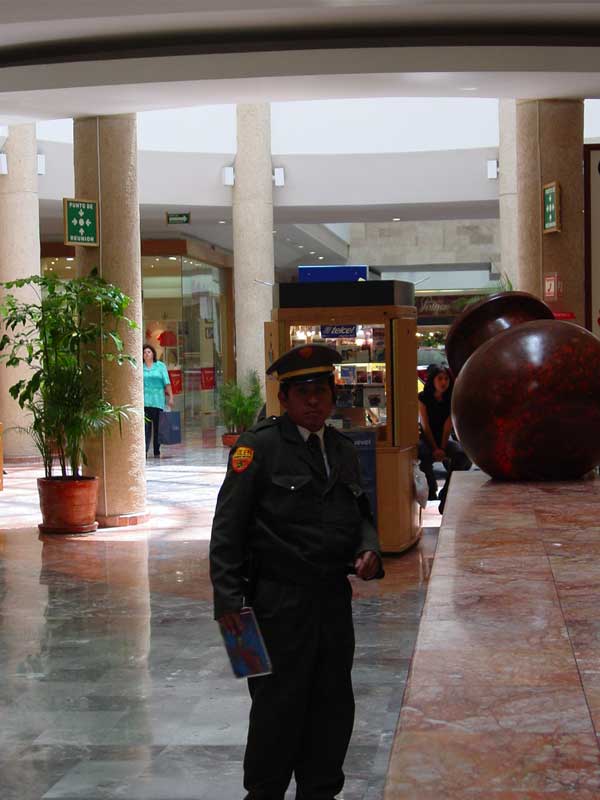
Shopping Mall in Santa Fe, Mexico City
We just spent a week at a seminar organized by the Indian Institute for Human Settlements in Bangalore, where a group of 60 students, professionals and academics debated the theme of the “World Class City†and its possible re-imagination.
The phrase “World Class City” has become ubiquitous in discussions on urban and economic development in India and other developing countries. One sees it daily in newspapers and hears it on TV and at the dining table. It is also omnipresent in policy circles and academia. Although critical minds get instinctively suspicious of such as term, it is hard to dismiss altogether, and even more so to “re-imagine†its meaning. For a start, the “World Class City” needs to be placed in its urban and ideological context.
The emergence of the “World Class City” in discourses on urban development is linked to the disappearance of the equally problematic notion of “Third World”. When the Soviet block (the “Second World”) disappeared as a distinct political regime, “First World†capitalism spread all over the world as it seemed to represent the only possible model of governance and development. Socialism was relegated to the museum of failed utopias and the world’s political imagination was suddenly reduced to whatever could be done within the frame of capitalism.
Since (almost) every country could now be measured on the scale of its economic production and accumulation (GDP), the political nomenclature of first, second and third worlds was replaced by terms referring to stages of economic development: underdeveloped, less developed, developing, developed, most developed…
In a way, one could say that at that time the world became more politically integrated and economically “globalâ€. Without the Second World, there could not be a Third one. The world had become global again, with international trade networks expanding to new horizons, financial flows circulating freely from country to country, industrial processes realigning themselves along command and control centres and sites of production, and so on. With this relative erosion of political-economic borders, cities were propelled at the centre stage of the world economy. In an integrated global economy, their significance was no longer simply national –they became international entities, with high levels of specialization.
Cities came to be seen as the “hubs” of the global economy and a new nomenclature emerged to replace that of the Cold War era: first tier, second tier and third tier cities. This meant that potentially a developing country could have a second or first tier city. Shanghai and Sao Paulo are perfect examples of that. At this point, the aspiration of many political and industry leaders shifted from a national agenda to an urban agenda. Since cities were engines of growth, it made sense to invest heavily in their development, even if it meant leaving the country behind.
This is the broad context within which the imagination of the World Class City emerges. The World Class City is not simply your “Global Cityâ€, since, in a global world, most cities are global whether they want to be or not. World Class echoes the Cold War era notion of First World, since in a world dominated by the First World, World Class really means First Class. First Class as a status is relative by nature. On the one hand, it is based on a certain imagination of what our first tier global cities (New York, London, Tokyo) ought to look like, and on the other hand, it is a statement of superiority vis-à -vis the rest of the country.
The problem is that the cities that really stimulate our imagination when we think of World Class are not as classy when you view them from the ground. London is experiencing a rise in urban violence and unemployment and many neighbourhood shops are closing down. New York is enduring one of the most dramatic bed bug epidemic (of all things!) of its history and Tokyo has an increasing number of homeless people setting up tents and shacks in parks and squares.
The “World Class City†is a slogan that seems to be coming directly from a marketing agency and seems to be devised to sell the latest fashion in cosmetic urbanism. It is a visual narrative made of bits and pieces taken from distant places, which exist primarily as urban spectacles in our imaginations. One never encounters the World Class City in reality. The only places where this vision seems to have materialized are cities like Singapore and Shanghai, where authoritarian regimes can sustain its artificial existence. These are closer to the model of the theme park or the “special economic zonesâ€, which achieve perfect order at the cost of forcefully containing the mess outside their boundaries.
In India the dream of transforming Mumbai into a World Class City has given way to the more realistic ambition of developing world-class buildings and infrastructures in some parts of the city. This version of the World Class City takes the form of firewalled islands of high-security and a world-’classiness’ connected to similar islands around the world. Outside, the Third World continues to strive.
The World Class City as it is being envisioned and developed nowadays uses speculative projections that would humble the most spectacular of science fiction imagery and is a shortcut for the political glory of corrupt leaders or those without much imagination. The latest in that brand of development is Mumbai’s aptly named World One complex, which is planned to become the highest residential tower in the world, entirely self-contained and unabashedly exclusive. From the twentieth century ideal of “One Worldâ€, we have come to the vision “World Oneâ€. Real estate speculators and developers have resolutely decided to keep the rest of the city at the door.
Without its second class citizens and third world periphery, the World Class City would have no backdrop to pitch itself against. It uses the label ostensibly to carry the entire city on its merit, but in reality only exists, especially in new urban avatars, as a medieval fortress, an enclave that leaves behind the citizens that do not belong to its globally networked connections. The idea has currency in the business and politics of construction, often tied up with a more respectable sounding infrastructural dimension. These infrastructures function as corridors that connect the periphery to the centre, making the World Class City look like a walled kingdom reigning over a city-region that it is simultaneously exploiting and protecting itself against.
The World Class City is not as much a vision of the future, as it is a reproduction of a model that belongs to the Dark Age with added high-tech features. Our hopes for the future do not rest in the World-Class enclaves of this world, nor in the regions they dominate, but rather in the spaces that are not yet fully ruled by them, where alternatives to the World Class City vision are waiting to be recognized by architects, planners, developers and policy-makers.
Very well put, ‘Without its second class citizens and third world periphery, the World Class City would have no backdrop to pitch itself against.’ and that has increasingly become the cashing marketing strategy for the ‘booming’ real estate in Bombay, nevermind if it is ready/required or not.
Comment by Pallavi — January 15, 2011 @ 10:06 am