If your guy isn’t comfortable

May 24, 2010

If your guy isn’t comfortable with you using your fingers to gently penetrate the area, there are other ways to stimulate his prostate. One way to do this is to give some loving to his perineum, or the smooth strip of skin between his testicles and anus. Since the prostate is internally located between the base of his penis and his anus so touching him on the outside of that area can externally stimulate the gland.

Cheap Jerseys from china “Tubig!” they shout at passing cars, scooters, buses. “Bugas!” They plead with their eyes, beg with their hands. Water. Assessing the sunken shell of his once thriving pub, Patterson understood that he had two choices: to pack up and leave New Orleans or to face the near impossible task of rebuilding Finn’s. “By the end of that day there were about 15 or 20 customers of ours who had turned up to encourage us to come back,” he said. “I guess it was that moment that we realised that this was our home and we weren’t going to leave.”. Cheap Jerseys from china

wholesale nfl jerseys “It’s fine,” he said. “As far as disappointing, I would certainly hope that when we do get to the playoffs and have a deep run, that things would flip. But you got to get there first. He left the meeting with the Leafs, and apparently turned to his advisors and said: more meetings. Think they scared him off, said an NHL executive. The Stamkos camp kept telling interested NHL teams they would be through the process before making any kind of decision. wholesale nfl jerseys

cheap nfl jerseys It’s no surprise that the Marlins weren’t too keen on claiming the tune as their own. It’s pretty clear from the lyrics that these are the words of a man who couldn’t give less of a shit about baseball. Instead of being a diehard fan, he seems more like a guy who just bought a big book of baseball terminology and built a few verses around it. cheap nfl jerseys

wholesale jerseys If you’ve decided that http://www.elitejerseyscheapnfljerseys.com you are indeed going to tell your friend that you’re in love, you should prepare emotionally for the ramifications of that. You should consider what might happen to your life if your friend decides that he/she doesn’t share your feelings and doesn’t want to be as close to your for awhile after the revelation. Think carefully about what you will do to protect yourself in this situation. wholesale jerseys

When they paraded the horse into the auction ring, announcer Terence Collier intoned, “He has been the talk since he got off the grounds. You can understand that. It’s not the first time a 9.4 was seen at a two year old sale, but we’ve never seen a better eighth performed by cheap nfl jerseys a two year old in training.”.

wholesale jerseys from china DO you have a habit of chewing ice? This is a bad habit. Chewing on ice may cause your teeth to crack or chip, which could cause serious issues. If you really want something to chew on, try sugarless gum. Lauren Carlini notched 37 assists and 11 digs. The No. 3 ranked Badgers volleyball team swept No wholesale jerseys from china.

Jane Jacobs Walk in Mumbai

May 5, 2010

Last week, Mumbai-based urban practitioners Marinha Fernandes, Kapil Chavan and Swati Sanghvi, organized a Jane Jacobs Walk in which at least sixty people participated to re-discover the streets of Kalbadevi, Girgaum and its many tributaries. These walks were part of a global event in which similar gatherings glided down urban alleys in cities as varied as New York, Toronto (North America) and Lusaka (Zambia) and La Paloma (Uruguay).

According to urbanist Jane Jacobs (1916-2006), in whose honour the walks are instituted, a walk is the best way to know a city, reclaim its streets and connect with its economic energy.

The streets chosen by the Mumbai team would have particularly fascinated Jane Jacobs, if she had had an opportunity to visit it in her lifetime. They are living testimonies to the economic vitality that she felt were significant to the health of a city. For her, local-scale production, manufacture and exchange of goods and commodities had the potential of regenerating the most lethargic of systems and her formidable scholarship proved this citing examples from Tokyo to the back-streets of American cities.

In colonial Mumbai, while the authorities were busy creating imperial cityscapes with their impressive architecture, this part of the city – the ‘native town’ as it were – was working around the clock to keep up the momentum of a thriving metropolis. They brought with them skills that had been shaped by centuries of trading and craftsmanship thanks to a dynamic trade and manufacture based inter-continental coastal economy backed from this end by Sindh, Gujarat, Marwar and other regions all the way down south. Communities from these regions adapted to the changes brought out in the newly emerging industrial world, but also revitalized the best of skills that they already had. And the city’s complex, enmeshed and flexible approach to urban life allowed them to create an architecture that matched their peculiar needs and interests. It is in these streets and by-lanes, shop-fronts and workshop spaces, that the business culture of Mumbai got shaped all through the nineteenth and twentieth centuries.

According to Jacobs, a city needs such creative energy of people and communities the way an orchard needs sunshine. And the growth and success of Mumbai as an economic powerhouse was definitely shaped by business practices that the narrow streets and tiny offices of this neighbourhood soaked up hungrily and nourished in return. Every modern business establishment in Mumbai has a story to say that links up this neighbourhood to their own success in some way or the other. It is this relationship between spaces, streets, economic activities and living that Jacobs saw as the fulcrum of good urbanism – something that was destroyed by urban planning practices geared towards cosmetic changes and speculative construction.

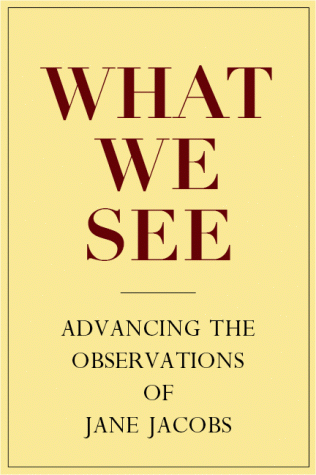
The New Village Press and the Centre for the Living City have also published a book this month – ‘What we See’ – a collection of essays in the memory of Jacobs, known among other things, for her vociferous criticism of Moses – an urban planner and engineer notorious for inaugurating the regime of freeways and car-based urban planning in the US.

Jacobs would have connected the decayed urban landscape dotting many parts of America today, to an economy in crisis because it has lost all moorings in local economies. One that has allowed runaway infrastructure and construction projects to dictate the process of urban living, rather than focusing on economic activities on the ground.

For Mumbai, Jacobs would have attributed its economic success to the way it balanced its financial sector with local production and exchanges, epitomized by its vibrant street economy and the neighbourhoods of the ‘native’ city. She would have explained its civic failure to the constant war the city waged against this very sector – epitomized by its anti-hawker, anti street-level and anti local business policies.

And yet – she would have remained optimistic seeing the way the streets of Mumbai continue to fight back!

“Informal neighbourhoods” or “neighbouroods in-formation”?

April 21, 2010

newbabylon
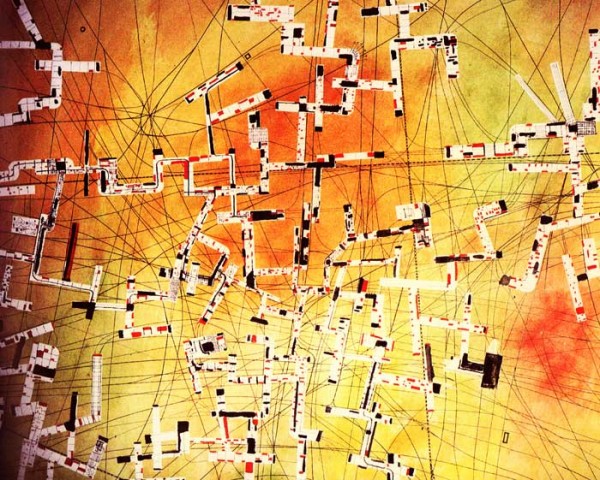
New Babylon by Constant Nieuwenhuys

Now that many commentators have replaced the word “slum” (the s… word) by the phrase “informal settlement”, we are compelled to wonder what do we really mean by the term “informal”. Do we mean unconventional? Unofficial? Unplanned? Undesigned? Or do we mean its form is imperfect, not fully formed, maybe even formless? All at once or a mix of the above?

Is it simply everything outside the formal, in which case we start asking what exactly is the formal? Is it really possible to conceive a pure formal settlement at work, like a machine or a perfectly orchestrated system? With no traces of what we call informal processes intrinsic to them?

Modernism pushed this vision to the extreme and some even tried to engineer urban systems in the same way as Henry Ford had organized his assembly line. A human scale of relating to space was the main casualty of such thinking, with some cities becoming as alienating as factories. Think of generic central business districts, master planned suburbia stretching along miles of roads, and satellite towns with rows of mass-produced buildings meant for the economically marginalized. This is the urban history of many cities and the future of so many more. The forces that produce hyperformal habitats dominate the urban development (i.e.: real estate market) of emerging megacities throughout Asia and so many other parts of the world.

But however much we organize, masterplan, regulate, institutionalize, and police our cities they remain a mix of systemic order and spontaneous, improvised, “informal” responses and actions, rooted in human emotions, needs and imagination. And this holds true on both sides of the imaginary line between the formal and the informal city.

Almost every commentary on formal processes, spaces and activities acknowledge that an ideal-typical formal equation does not exist in real life. Similarly, all those who have studied informal processes point out to the presence of structures and power equations, which approximate what happens in formal contexts. There is an inbuilt element of circular reasoning which is unavoidable when entering this discursive space. This becomes even more complex when understanding urban worlds especially in dealing with the huge variety of spaces most cities are made of. A variation punctuated by economic disparity, aspiration, hierarchy, equalities and inequalities and specific histories. These structuring forces are present in all forms of habitats, yet there is an enduring tendency to refer to some neighbourhoods as informal settlements.

The word “informal” may be more politically correct than the “s… word”, but at the end of the day it is equally dismissive and misleading, especially when it is meant to describe an extremely diverse range of habitats and living arrangements across the world. “Tales of two cities” have for too long dominated narratives of urban development in emerging countries. There isn’t some “other”, “informal” space. Instead, there are multiple urban histories and trajectories that must be recognized and respected.

Seeing this requires zooming down to the small picture –that always helps with the big picture as well. Rather than labeling entire neighborhoods “informal”, we should pay attention to what we see at the street level (and sensing what we can’t see). To illustrate our argument, we would like to take you to Dharavi’s Mahatma Gandhi Road, where we spend lots of time, working on and thinking about the potential futures of this iconic post-industrial Mumbai neighborhood.


Dharavi MG Road

Dharavi keeps on escaping simple definitions. First it was marked as a slum (the “largest in Asia”, if you recall the headlines from the 1980s onwards). Slowly researchers, the media and parts of the public started to question if Dharavi could really be called a slum. After all, it was composed of a diverse fabric including villages, municipal chawls, high-rises, self-standing houses built by rich merchants, transit camps as well as self-helped and incrementally developed structures. It was an economic miracle full of traders and producers, so far from any clichéd image of how an impoverished neighbourhood is supposed to look like. Moreover, the residents of Dharavi, an older settlement compared to other similar neighbourhoods in Mumbai – managed to lift themselves out of poverty in spite of the lack of infrastructure and public services. Today many of them have reached middle classdom and gone beyond.

On MG Road, we see bustling commercial activities with shops expanding onto the street, people buying, selling and chatting, tool-houses along the road where all kinds of goods are being manufactured and assembled, wholesale retailers, repair shops, restaurants and tea stalls, butchers and fish markets, temples, churches and mosques, crowded gyms and function halls, services ranging from hairdressers to fortune tellers, and so much more.

There is a lot happening in that stretch. The density of activities and the flow of people is so large that it may be easy think of it as a big mess where things get done and undone in an improvised and haphazardly manner. In reality, just like any other street bazaar in the world, MG Road has its own developmental dynamics, organizational principles, constraining factors, control mechanisms, evasion tactics, and collective memory. As soon as you start looking at these processes, the word informal looses all meaning.

In fact, one could interpret the work of anthropologist Keith Hart, who coined the term ‘informal economy’ to qualify gambling in Ghana in the 1970s, as a demonstration of the fact that the shadowy world of gambling based transactions are also an ‘economy’. The emphasis can as easily be placed on the word ‘economy’, instead of ‘informal’. From this perspective, the term ‘informal economy’ attempts to dignify all transactions outside the space of a regulated and controlled economy by acknowledging that these are also economic transactions, which follow certain rules and are rooted in some form of rationality.

After its conception, the term followed all kinds of journeys. It got loosely converged with the use of the term informal as used in organizational studies or management and then became the basis of creating an abstract set of terms for economic activities as a whole, dividing that world into informal and formal sectors (though with an acknowledgment that they are always full of internal contradictions). Such a conceptual path leads you to the term informal settlement – which simply does not do justice to the world of urban habitats as we argued above.

The term puts so-called ‘informal settlements’ on the brink as it represents them as candidates for formalization through redevelopment. How many times has the lack of infrastructure in some neighbourhoods (usually due to prejudice or civic mismanagement) become an excuse to label entire neighbourhoods as ‘informal’ and therefore in need of redevelopment, when often all they needed was investment in certain amenities, a legitimacy of status and a deeper understanding of existing land uses?

We feel that the word ‘informal’ has now become another catchword that can be affixed to all kinds of terms to give them a superficial edge: informal settlements, informal networks, informal cities, informal design. The term has not been adequately thought through and glosses over many dimensions of lived reality.

If we want to describe the cities of today, especially the parts that fall out of the grid or creep through it, we need to invent new terms that express not so much their form but rather the way they evolve. That is why we would rather describe MG Road as being constantly ‘in-formation’ rather than informal.

Saying that a habitat is ‘in-formation’ doesn’t necessarily mean that it is incomplete. Instead, the term echoes Kevin Lynch’s description of cities as “evolving learning ecologies” (1981 p.115) and seeks to capture the capacity of certain urban spaces to evolve continuously and adapt to the context. The hyphen between ‘in and ‘formation’ is there to emphasize the dynamic production of urban forms and its perpetual incremental improvement and conservation.

The terms in-formation also invokes the word ‘information’ in its system-theory sense as “any type of pattern that influences the formation or transformation of other patterns” (Wikipedia). If urbanists, architects, policy-makers, self-helpers, users and commentators, can stop describing some neighbourhood as ‘informal’ (and therefore in need of formalization) and understand how economic, social and cultural patterns influence the formation of physical habitats in planned as well as unplanned neighbourhoods, we will be that much closer to solving some of the most important challenges of our urban world.

Examining and learning from the way fellow humans use space across geographies and histories is without any doubt the most exciting trigger for creative intervention and architectural innovation.

Unfair Play at the Bombay Gymkhana

April 7, 2010

While it was not surprising to witness the Bombay Gymkhana authorities behaving disgracefully on the night of the TEDx Mumbai get-together – when they shut down the evening because of transgender intellectual-activist Laxmi Tripathi’s presence – it felt horrible. We saw, first hand, a drama that must have played and re-played itself through the corridors of this century-old elite club since the days of its inception.

In its colonial avatar, it never allowed Indians to walk through its sacred corridors with dignity. It shamelessly took a donation from a Parsee philanthropist even though he himself could never be a member. It did not take a stand when it saw Hindu upper caste cricket players make its star bowler sit outside their dining hall to have dinner in clay utensils while all of them enjoyed eating in their glistening crockery. It did not flinch in its resistance to women voters on its committees until it was virtually forced to do so hardly a decade ago.

In the late nineteenth century, when it came into being, many of the Gymkhana’s members must have worked at the (then) Bombay Municipal Corporation. It must have suited the British officers perfectly well to have a swanking sports club within walking distance from their offices. They made several allowances to all such establishments – including absurdly low land leases.

In a city where good quality sports facilities are scarce, the club, in free India, may justify its exclusive institutional existence (and occupation of prime land), by providing some decent infrastructure to its members and acting as a trustee to sports property in a city eaten by real estate sharks.

And yet that is not the way some of its arrogant members see this equation. They have inherited the same superficial, insecure, and fragile sense of self-esteem that their ancestors had. It would have done them and the club no harm when Laxmi Tripathi, representative of the country at UN meetings around the world, passed through its corridors and got lost in a private party hosted by one of its (surely many) enlightened members. But of course that was not to be.

While she was sure of who she was – the club members seemed to be confused (Euro-Indians? Indian Europeans? Narrow minded elites? Who knows? Some kind of trans-cultural group for sure with no hint of self-reflection at all).

Eventually they threatened to forcefully shut down the party if she did not leave. In a great moment of solidarity everybody chose to leave with her.

These are the moments when you want to examine the history of such establishments more carefully. We know how several such clubs have grossly violated their land lease contracts by making money through illegal constructions on what is virtually public land.  Many gymkhanas – Bombay included – found their 99 year old leases expired in the 2000s. And miraculously they arose again – subsidized heavily by the city and its public – whom they choose to treat in this atrocious way.

This brazen land use happens in the face of so many demolitions of simple constructions made by workers and residents in the city – especially in the so-called slum neighbourhoods. Just last week BMC authorities demolished a tiny building recently erected by a resident in Dharavi for local children to play in. How will those children feel as they walk along Azad maidan one day and see the grand facilities of the gymkhana and their lush lawns?

Mumbai has always prided itself on being a city with relatively fewer gates than that of divided and gate-enmeshed Johannesburg. That’s such a false sense of feeling good. Our gates are invisible and equally powerful – all in the mind and implemented through ideology. Far worse.

An Asian Story

March 27, 2010

The insistent and continuous comparing of India and China does not really stop. It may fade away from the media for a few months but continues to trouble and haunt policy makers, academics and all those in the grand race for global supremacy all the time – as is testified by the continuous evoking of these two countries in conferences. Actually, nations and histories frequently play themselves against each other . From the cold-war US/USSR domination to the rise of the Middle-East, to the surprising success of countries like Malaysia and Indonesia – nations have their moment of glory and then fade away in the space of global attention. Japan was a hot favourite in the 70’s and got inevitably discussed as a model of sorts and then it found its way out.

However – for those interested in the history and growth of cities the connections of India, China and Japan remain fascinating for many unexpected reasons. At one time ancient cities in the north of India – Magadh and Pataliputra – had significant connections with China and Japan – thanks to the presence of Buddhism and the independent trade networks that connected these territories for several centuries now. Though Japan can claim greater historical distance from the other two, the insidious way in which Buddhism negotiated its political turmoil and its older religious systems ultimately connected the three historical territories in ways that are difficult to ignore.  An architect scholar such as Kisho Kurokawa has represented the relationship of these historical linkages through an interesting metaphor. He points out that Buddhisms roots are in India – nicely muddied and enriched by the historical manure of centuries of prior spiritual discoveries, but it found its stabilizing structures in China’s robust and ancient socio-economic  institutions and beliefs and grew tremendously in its environment. However it eventually bloomed into its most sophisticated version in Japan – highly refined and taken to unexpected levels. Interestingly – some would argue that in its move towards refinement, Japan came back closer to the point of muddied origins. After all refinement is achieved by an even more intimate contact with purity and impurity – things that are familiar in a special way to India.

Such a trajectory is mirrored in several surprising ways in worlds not disconnected to Buddhism either. Take for example the way in which cities themselves in these varied environments grew. In India – after the mysterious and puzzling success of the Harrappan / Indus Valley Civilization – urban spaces were more or less messy affairs and far from being models of civic worlds. This has been documented time and again by travelers – however polite – in their writings. They frequently lament about the presence of dirt, lack of order and overt messiness everywhere on the subcontinent. A history that persists till today. India’s urbanism – like the story of Buddhism – appears to be stuck at the point of origin – organic and enriched by historical manure more than anything else. China – in comparision delves into strong institutional histories – rooted in centralized imperial administration (way before communism) and manufactures cities at the drop of a hat. Japan on the other hand – continues to confound categories. Its cities are at once refined, sophisticated, technologically advanced, as they are rooted in a messy aesthetic. Its official voices even say that so many Japanese cities are slummy – for the simple reason that those cities never really gave up their older forms. Interestingly – the magical quality of Japanese cities – like with Buddhism – reconnects to the point of origin that brings it back to India. Some scholars have pointed out that older Japanese urban neighbourhoods remind you, in a twisted way, of Indian slums.

What is the spiritual-urban lesson here for us? Should India imitate China’s history – without any of its supporting institutional structures – or should it risk a more sophisticated – Japanese inspired trajectory for its cities and come closer to where it already is – with just a few shifts in policy? Shifts that recognize that more than anything else Slums need a movement of attitude more than anything else – as we have pointed out several times in this blog…

Coming Soon

March 15, 2010

97660100041170L

What We See refreshes Jane Jacobs’ economic, social and urban planning theories for the present day. More than thirty renowned pundits and practitioners combine their personal observations with meditations on Jacobs’ insights for the living city.

The book models itself after Jacobs’ collaborative approach to city and community building, asking citizens and niche specialists to share their knowledge with each other. What We See asks us all to join the conversation about next steps for shaping socially just, environmentally friendly, and economically prosperous communities.

Edited by Stephen Goldsmith and Lynne Elizabeth. Foreword by Michael Sorkin.

In bookstores May, 2010.

New Village Press, New York

(http://www.whatwesee.org/home)

Contributors:

The way the city crumbles…

March 9, 2010

Mumbai and Pune are overseeing the birth of two new cities growing in between their long, expressway-connected urban sprawl. These are Amby Valley and Lavasa. Both these urban dreams have been conceived in the mode of planned cities even though they have very different starting points. One is an out and out imitation of American suburbia while the other uses very sophisticated rhetoric about new urbanism. The interesting thing is that they began with the idea of containing their membership, of controlling the process through which they would get users to come to the city, but may well land up eventually opening their doors. After all, no city in the world can afford to have gateways, no matter how exclusive the original intention. The problem with cities that like to think of themselves in utopian terms ultimately find their unrealistic vision coming undone for one basic reason – money, investment and sustainability.

You have to understand the workings of urban economies very carefully to appreciate that. A city is not just about beautiful buildings, clean streets and idyllic landscapes. They need to be economic generators primarily. If you isolate these features and make them the focus, people will get bored. At best you will produce a suburban landscape, at worst a bedroom city. Mumbaikars – who one presumes are a big market for these two projects – maybe fed up with traffic jams, garbage and badly managed civic services for sure. But just take them away from their city for a long period and they start missing it terribly. They are certainly not missing the jams and garbage but definitely primarily its energy that comes from the special way in which people, lives, work, fun, entertainment and commerce enmesh into each other. They like the easy access that the city’s layered economy allows them to cheap basic services – no matter how rich or moneyed they are. Everyone wants things delivered to their door steps, safety in numbers and car shopping even if they do complain against hawkers too. Giving them clean utopias will work up to a point. The unbearable pain of dealing with the city’s basic pressures may make them fantasize about the promised new urban land – but eventually when they are confronted with the reality of a cardboard cut, picture perfect city, they will back off.

What may eventually happen is that both Lavasa and Amby valley may loosen up a bit and allow the spirit of Mumbai – dirt and all – to flow through their haloed gateways and share that magic. New Mumbai too tried hard to preserve a sense of planned idealism but what remains of that today is a grid over which the standard layer of Indian working class – service oriented urban economy has settled down nicely and thickly. Informal settlements have become firmly entrenched in the landscape.

Such experiments convince us that you cannot really plan or manufacture a city. You have to be sensitive to the way in which markets, bazaars, jobs and needs organize themselves and facilitate the process through which these translate into decent settlements. The expressway connecting Mumbai and Pune could itself have been a stimulus with the potential of being harnessed effectively to create many organic urban spaces. Instead – what we have is one unholy sprawl which multiples the civic, environmental and problems of both Mumbai and Pune.

To create two islands of urban idealism inside this is a hopeless effort when the proper way to go about would have been to pay greater attention to the possibilities of the entire stretch and create ideal living conditions for everybody – not just the moneyed classes. But one presumes that everybody in the business of making these two cities knew that. No wonder they thought of having helipads and airports first thing…

When Enmeshed Worlds Remain Parallel

January 25, 2010

C&C

Right from Sharada Dwivedi and Rahul Mehrotra’s evocative title (Bombay; The Cities Within) , to the trite images of slums juxtaposed against high-rise buildings – Mumbai’s many personalities have been alternatively celebrated and chastised. The diversity of built-forms, the many different urban sensibilities (small town enclaves in South Mumbai, coastal villages in  the suburbs) and the contrasting economic and cultural lifestyles are still very pronounced experiences in Mumbai – making any first time visitor feel disconcerted beyond the normal lag of time, space and culture. It does take a special level of composure to walk from a street, crowded with makeshift homes with children playing around dizzily speeding cars or being accosted by a demanding beggar for your sandwich and then walking into a mega-mall lined by the latest branded items even if you do see the shocked face of the girl behind the counter marveling at your ability to buy goods worth her entire years salary. You don’t have to be a card-carrying socialist to know that these are- at the very minimum – moments demanding some element of erasure, forgetfulness and glossing over if you want to continue living with a semblance of normalcy. Visitors still wonder at how easy it is for such worlds to co-exist without erupting into easy violence. That’s when you realise that there are many ways in which people live around and through contradictions. Its not that you need Johannesburg style gated communities with electric walls to keep people apart. There are all kinds of gates – many a times invisible and even more effective. Older feudal structures in the mind are pretty strong, easily making a rebellious soul stop short of pushing the envelope. Combined by good old brute police force – this helps in creating a perfectly gate-less secure society. At least for the moment.

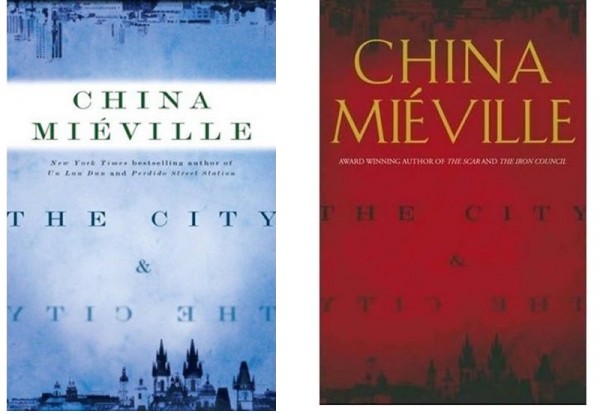
When we came across the theme of China Mievelle’s  wonderfully wierd fiction story ‘The City and The City’ (introduced to us by Carol Breckenridge) it lent itself easily to a comprehension of Mumbai’s extreme contrasts. In his novel two cities are enmeshed in each other, but citizens of one are conditioned to ignore the evidences (sometimes staring at them in their face) of the other. The office of the ‘Breach’ ensures that the urban worlds remain parallel (even though enmeshed intricately) and disconnected. When a body from one city is found in the other – the narrative starts to flow and the reader discovers the rules through which people can co-exist and remain disconnected.

For anyone in Mumbai who has rolled up a window in an air-conditioned car – in the face of a highly professionalized beggar economy, or walked over a sleeping homeless body, or appreciated the new arty graffiti on a wall once housing streams of homeless families, the novel touches a raw nerve. Reminds you, with the same moral force of your conscientious school teacher – that there is a world out there, which you see and need to respond to in a manner beyond glazed eyes. And yet that would be a ridiculously simple allegorical connection to make with the book. Thankfully our comparison is not moralistic nor intended to create victim – based hysteria. There always are deeper reasons behind the resignation to accept contrasts, particularly when they are so obvious.

But what Mievelle’s world conjures is the ability to see how deeply etched are the invisible worlds that exist around us in many scenarios. It is an ideologically divided Europe that is the inspiring context of his novel. It can work in several ways. Reminding us that there are schisms in several cities – energetically cosmopolitan New York, aggressively regenerating Moscow, ethnically complexed Paris, or migrant enriched London. Its possible for the office of the Breach to operate in all kinds of ways. Its possible for us to be oblivious of the obvious in more ways than simply not seeing the faultlines that are all too evident. Its about finding out where the faultlines actually are. And they may not at all be where you look for them.

Aerial Roots: Geddes and Tagore

January 14, 2010

gedd_tagore2

At the moment we are reading this inspiring text. Tagore is a legendary figure within the Indian intellectual, literary and public realms – as legendary as Gandhi and therefore almost as taken-for-granted and relegated into picture frames. As a poet, he was India’s earliest Noble laureate and invested substantially in the vision of Shanti Niketan, a special space of learning, about a hundred and fifty odd kilometers from Calcutta, which combined the magic of forests with intense urbane, cultural and learning experiences. Patrick Geddes is a more than special name in the world of urban practice – providing inspiring ideas on cities, regions and connections between the environment and habitats. He lived for several years in Mumbai and established the department of Sociology and Civics at the Bombay University in the late nineteenth century, besides doing planning surveys in several Indian cities. The fact that the two met a few times and had a great correspondence on issues linked to cities, forests, rural lives, and cultural practices, around the early twentieth century, fires our imagination. A detailed review to be posted very soon here…

Rabindranath Tagore and Patrick Geddes, the Correspondence
Visva-Bharati Press (India) and Edinburgh University Press (Scotland)
ISBN – 1-85933-203-X

Prawn Nagar – Dharavi, Mumbai

December 30, 2009


Softer landing for District 9’s Prawns in Dharavi

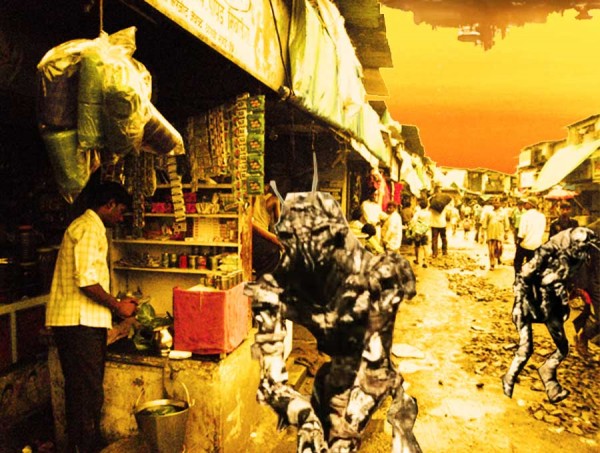
If the aliens hadn’t found their way to District 9 in Johannesburg but turned a few latitudes east, across the Indian ocean, over a tiny sliver of land jutting out obscenely and defiantly off the v-shaped south-Asian sub-continent, their fate in cinematic history would have been something else.

Imagine the spaceship hanging over the hot and humid city of Mumbai, specifically over its most mythified neighbourhood – Dharavi.

Its enterprising residents would have absorbed the presence of the craft and its seafood resembling occupants with relative ease. The metallic tentacles of Dharavi’s legendary recycling industry, would have eventually penetrated the most sophisticated barriers and shields to slowly and steadily dismantle the alien structure for absorption into a million-dollar industry that does not allow even the most ordinary piece of scrap to go unsold. How could tons of exotic metal be left to hang in mid-air? Notwithstanding any degree of technological superiority…Bits and pieces of the metal would have found their way into spare body-parts of second-hand cars, ships, toys and assorted machinery. The unusable celestial leftovers may be left to hang in space with no one caring much for aesthetics. Instead somebody would start a little sight-seeing tour by making an improvised crane-bridge to take curious onlookers and tourists for a closer look.

And what of the aliens themselves?

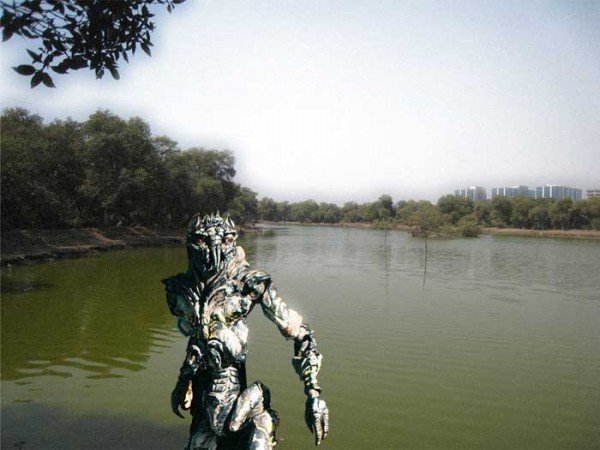
They would have managed to build a tiny little habitat between the crevices of the impossibly dense habitat. Maybe on the toxic watery edge of the mangroves. Not having access to tinned cat-food in Dharavi, could well have found the fish in the sewage water a worthy substitute, considering that a few older residents still fish there even now. And they would have found something worthwhile to do for sure. Their presence would have inevitably fired several wild allegations.


Prawns are said to be hiding in the Mahim Creek near Dharavi

Economically they could make leather goods in Dharavi even more globally competitive with a dash of their own technology. Of course, this could mean a legal crackdown – since scientific tests about the safety quotient of alien substance aren’t possible. But Dharavi’s grey zone economy would take care of that and eventually the aliens would become integral to the neighbourhood’s oldest and most prosperous economic activity, getting swallowed into its several residential, community based enclaves, taking the disputed figure of eighty –eight nagars to eighty nine.

It would have been difficult for any curious journalist to actually discover Prawn-nagar as the boundaries between enclaves are not easy to discern. The only way she would know she’s arrived would be on seeing a bunch of young prawns playing cricket with local Dharavi boys. They would point her out to a set of structures around a small clearing where a few adults would be having a heated argument with neighbours over the right to build a shrine in memory of their lost home – in the form of a replica of their ship.
The shrine would be the only way to connect to their past. No chance of returning home now – given the remains of their emaciated, skeletal, once proud extra-terrestrial space vessel. The other reason nobody would want to return is because the cost of homes in Dharavi would have increased four-fold by now.

Typically, the temptation of making more money eternally overrides any possibility of return.

The journalist would most likely be reporting the possibility of a riot because a prawn-girl and a local – earthling boy had fallen in love and were nearly lynched by both communities, only to be contained by an elderly local activist trying to broker peace.

The prawns would soon be part of political demonstrations trying to save Dharavi and a politician would eventually have got them voting rights. Against the will of a local right-wing party which tried hard to fight their presence tooth and nail – equating the aliens with worse – those from the states of UP and Bihar.

Sooner or later though, a clever prawn leader would have won over the local right wing forces by declaring Marathi as their earth-tongue. He would then have proceeded to pledge support to their drive against the real aliens – the hapless migrants of U.P. and Bihar.

That would pretty much have been the story.

Look out for regular updates from Prawn-nagar, Dharavi, Mumbai on airoots…

« Previous PageNext Page »