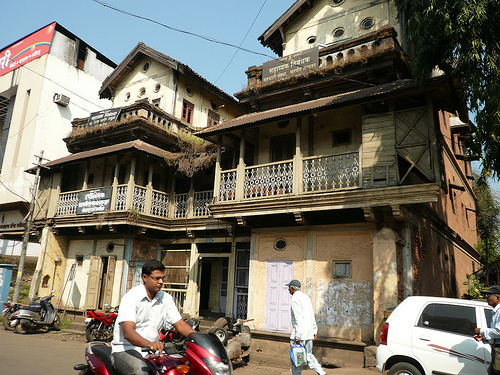
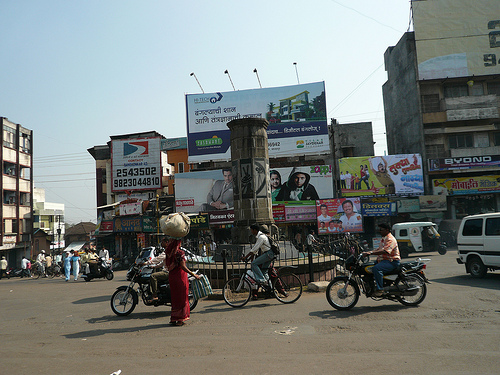
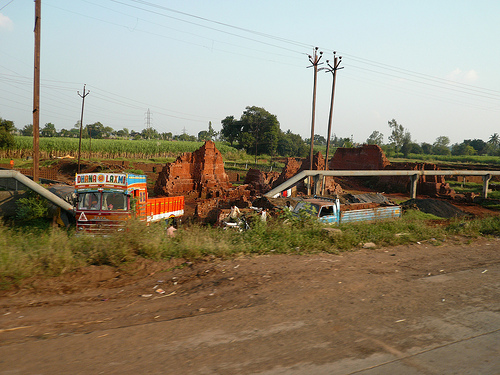
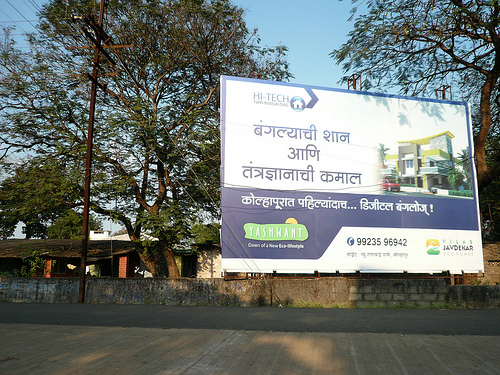
Kolhapur is a small town in the south-west region of the state of Maharashtra, not more than four hours drive from Goa. It is part of a district with the same name, on the prosperous sugar-cane growing belt which makes the rural areas relatively more prosperous than the town itself. Kolhapur is known for several artisanal goods such as leather slippers, pots (there is a local Kumbharwada, potters colony right in its inner city area) and once even had a bustling movie industry (around the early and mid-twentieth century), besides being a well known patron for classical music. It fascinates us not as a town alone, but as an urban system that includes a well-off country side and some distinctive architecture thanks to its princely lineage, ruled as it was by a king until the Indian independence. But most significantly of all, a group of enthusiasts who love their little part of the world. We found an architect who conducts studios with international students along with doing his practice, a high level of civic pride with the presence of several action groups including ‘Kolhapur Calling’ and several young people trained in Kolhapur’s well known educational center – Shivaji University – and its college of architecture D.Y. Patil.
Local Architectural Flourishes
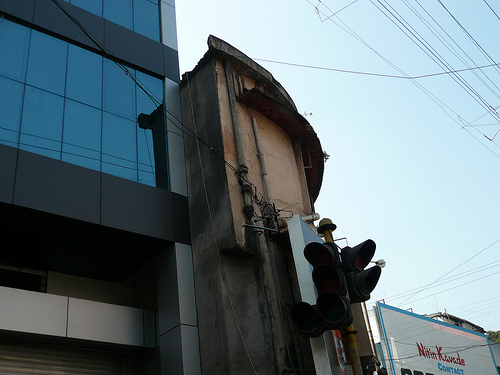
The ubiquitous black stone frequently used in coastal Maharashtra
Lost Lady
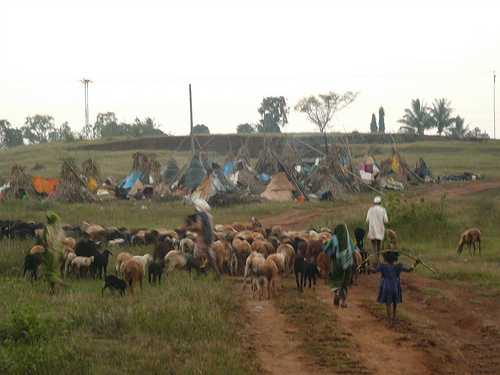
On the fringes, but in the urban system? Dhangar Nomadic Shepards
One of the most influential practices in the modern world is that of the ‘conference’. It is an easily funded event that helps bring together themes, ideas, practices, resources, and political will into a consolidated moment. A conference can circulate themes across vast territories through its participants attending it from all sorts of places. The media picks up strands of arguments and disseminates them further.
There is a new and curious kind of conference making its presence felt these days. The grand ‘Urban Conference’ which is – at one and the same time – an intellectual meet where all kinds of complex ideas are discussed, and a trade-fair in which those very ideas are audited through pure commercial interests. They are then rejected through sophisticated debate or endorsed wholeheartedly before being dispatched to the media. They commission their own research – often of high quality – but manage to moderate the findings in subtle ways. The conference itself validates its own research and gets it closer to policy makers in one swift and efficient move. In the grand ‘Urban Conference’ intellectuals rub shoulders with builders who rub shoulders with financers who rub shoulders with politicians who rub shoulders – or are supposed to – with citizens at large. The attempt is to sell an idea and get everybody to buy it in the surest possible way, through intellectual argument, monitored by money.
Sometimes established architects are pushed in the forefront, being made into unwilling stars of these glittering events. After all, they are the perfect candidates – intellectual, creative, skilled, hands-on and media savvy. They can be highly persuasive and useful since they are natural connectors of disparate worlds. They can make a suspicious academic who has spent most of her life critically discussing urban markets, feel comfortable with a brazen real-estate developer who slowly appears to her eyes as ‘a nice guy after all, with an interesting point’.
These convivial conglomerations of city makers – engineers, intellectuals, architects, academics and finance companies – discuss subtle and abstract themes (The Urban Age, India Habitat Summit). However, they are also skillful diluters of their own research through dazzling gestures that eventually reward grand infrastructural and architectural projects needing huge amounts of money and finance. One has often seen many brilliant and critical economists and historians sitting defeated in one corner sipping their wine, silenced by the promise of yet another sponsored trip to another destination.
Today – after the artificial propping of the Dubai real-estate bubble – fuelled so clearly by speculation gone haywire, it will be only a matter of time when such conferences start to play a bigger role in creating a global Mumbai real-estate bubble (enveloping the mad bubbly market that our city already is with regard to housing) in the Asian region. Mumbai can well be the next willing bakra on the roulette of global speculation. It is easy for this beleagured infrastructure challenged city to be seduced by such promises and make short-sighted choices in the process.
In fact such an impending conference is sending feelers already. It has a clear agenda. It wants to sell the idea of the vertical city – build taller and higher – as a one-stop shop for all the city’s ills. In an ad, it has even subverted the spirit behind the work of one of India’s leading and most respected architects, who wrote a book about the importance of low-rise high-density clusters in Mumbai, by labeling his session as ‘High Rise, High Density’.
Such is the power of these grand conferences! Exercising a little caution in dealing with them won’t harm us.
The Jawaharlal Nehru Urban Renewal Mission is a well-meaning programme that has put in some deeply thought out incentives for hundreds of towns and cities in India, including Mumbai, ostensibly to improve their civic life.
Within Mumbai city its impact has not always been so visible – barring a few newly designed buses that were purchased under its name. The programme has however seen all kinds of mixed responses elsewhere, including in the wider Mumbai Metropolitan Region. In many cases it has encouraged a huge hunger for new urban land by taking over and converting the countryside into real-estate investment zones. Its justification? India is going to be even more urbanized in the coming decades and it is important to be prepared.
However, to understand the full impact of the urban renewal plan, we need to step back a bit and see it in context of other policies as well. For example, water management and irrigation projects that were once directed towards rural areas are slowly shifting gears and becoming supply points for new urban centers. Rural areas, not withstanding the massive political investments, are actually being drained of their vital life-force – water, in the name of getting ready for an avalanche of urbanization set to double the population of our cities. This is backed by a move to facilitate a huge corporate centered investment in the area of exploiting natural resources (iron, bauxite, gas) to speed up development by going into and beyond the countryside.
In the name of making up for a bias against the urban – these policies only justify a wholesale takeover of the countryside. What will this land up doing? It will encourage more migration of the poor to specific, job-yielding cities. At the same time a lot of rural land will be made available for setting up new cities not really meant for poor migrants.
End result? Many if not most cities will still be bursting at the seams and no amount of investment in infrastructure will be able to cope up.
The fact is that urbanization took different forms in different countries if you are willing to look closer. In Italy, hundreds of small towns, with well connected routes into the countryside distributed populations more evenly. America’s urbanization is complex, with the experience of ‘suburbia’ making people live in rural-urban limbo while being well connected to urban development. In Japan, many villages got integrated into urban systems through sheer population expansion and great transport networks.
In India too, it is vital for us not to create a sharp divide between rural, urban and tribal regions at a policy level. Instead of isolating a town within a rural district which will only gobble up funds endlessly, (as the JNURM tends to do), there is a serious case for looking at existing administrative districts as specific urban units in which villages, towns, forests, food-production and management of natural resources are managed and integrated more locally. This will allow for a more decentralized pattern of urbanization.
It’s definitely a time to re-think urban policy. JNURM has been a good start – but its nowhere there.
It seriously needs to ask the following questions:
1) Are there adequate safeguards to distinguish legitimate urban investment to aid civic improvement, from purely commercial infrastructural, especially land-hungry projects? There are enough indications revealing how real-estate companies have jumped onto the rhetoric of urban development to produce planned cities by driving out agriculture from existing land use practices. Often they do not respond to the economic needs from within the local context – but derive their economic clout from speculative flows a la Dubai. They get bailed out, but the people dependent on the land rarely do. They land up at the threshold of cities hunting for jobs.
2) When isolating a town or city within a district, are the existing channels of connections with the villages and towns being paid adequate attention to? Are the villages and towns that are part of the urbanscape of a district being adequately integrated into urban policy decisions or will the town’s need for more infrastructure translate into conflicts with the countryside around it? It is possible to effectively integrate villages into urban systems, and modernize them through communication and transport networks and not necessarily through encouraging density of habitation.
We need to seriously define urban spaces not in terms of population density or modes of occupation alone but in terms of economic exchanges of goods, services and people across rural and urban zones. In the case of cities in India and maybe even China, understanding the concept of Urban Systems may be more accurate in terms of evolving ways of looking at urban life. An urban system may be defined as a cluster of habitats and economic activities that are networked and work functionally on an everyday basis. An administrative district can possibly be seen as an urban system, especially if people commute from far of villages to the towns everyday or markets of food and other natural resources show co-dependency between designated towns and villages.
It is vital to question the argument that one close set city is environmentally more sound than clusters of villages and towns. What is more pertinent to ask is what’s happening to the ’spare’ land around a big mega-city. In many cases they are example of unsustainable water-management projects, sites of extraction of mineral resources and other environmentally un-sound practices.
Conversely, agricultural practices by themselves do not indicate a ‘rural’ eco-friendly economy. Most commercial agricultural practices are commercially linked to markets that are often part of ‘urbanized’ centers – and encourage de-population of rural areas so that the land can be more effectively exploited for commercial gains. Again – far from being environmentally sound. In fact many developed economies with a high level of urbanization have a massive case of environmentally unsound practices in their vast, empty but not – so – pristine agricultural lands.
For countries like India, and possibly China, the mega-city approach may not be the best foundation for developing a sound urban policy. Nor would it be enough to treat small towns as versions of mega-cities in terms of their infrastructural needs. It makes better sense to look at existing networks of economic exchanges in which towns, villages and cities are seen in a more localized and integrated way.
For this we also need to question existing patterns of urban development which are being more and more co-opted by real-estate and infrastructure companies and spend time understanding how construction activities need to respond to the intricacies of economic life and needs outside the spell of speculative seductions.
Conceptually we need to accept that mega-cities as self-sustaining universes are only one example of urbanization. Networks of cities, towns and villages can together also count as a form of urbanization. In these days of carbon – sensitivity, we definitely need a kind of urbanization that escapes both – the tyranny of rural ideals as well as the one-track road towards mega-citification that we see so prevalent today.
Cities and diseases have an old relationship. The plague did more to improve basic sanitation in European and Asian cities than any other factor. We saw that after the Surat plague. Overnight, one of the most badly managed cities in garbage disposal transformed into a responsible urban settlement, thanks to some right-thinking bureaucrats and political responsibility.
For several million residents of Mumbai, living with dengue, malaria, tuberculosis, typhoid, cholera, jaundice and other illnesses has been part of everyday life. So far, there were invisible firewalls, that managed to keep some guard between areas with none or little civic infrastructure and those with some basic civic infrastructure, however badly managed.
Diseases could be selfishly contained to a small extent.
However, even if Mumbai’s gap between the poorest and the richest neighbourhoods gets wider, there is no guarantee that money could shield anyone from that cunning, tiny, vampire-like beast – the mosquito. A beast that has been mythologised in the literary imagination (The Calcutta Chromosome) as well as by Bollywood (Nana Patekar’s strange song).
The mosquito can enter through the smallest crevices in posh homes, glide into the most expensive, airconditioned cars, to transform perfectly healthy humans into physical wrecks. It does not distinguish its victims on the basis of ethnicity, language or class. Earlier, it used to be only the malarial, evening fear that made us alert. Now, it’s the 24/7 danger caused by the sun-loving, dengue – chikungunya carrying mosquitoes that keep us on our toes all the time. The recent bout of these relatively new entrants into Mumbai’s disease-scape has gotten everyone in a tizzy.
However, like much else in the city, these diseases have already been politicised. Politicians blame it on the overpopulation of the city thanks to ‘migrants’, while administration blames carelessness of housing societies. The BMC complains bitterly against those leaving stagnant water in tanks as open invitations to mosquitoes breeding, while residents blame BMC for not monitoring construction activities.
If anything, the recent spurt of disease can clearly be seen as a collateral damage, thanks to the several construction projects going on – new skyscrapers, roads, flyovers and stadiums. These are large-scale, in-your-face factors that somehow escape the attention of all those still looking for scapegoats in poor migrants and slums.
The fact is that the garbage disposal practices even in the most privileged neighbourhoods, despite being the most efficient in India, comes nowhere close to the needs of a tropical, humid and wet city. We need a combination of basic commonsense and simple science. Understand the way in which mosquitoes breed, deal with garbage disposal sensibly, ensures that large amounts of water do not stagnate or lie uncovered. Do all this with the basic understanding that our climate and dense context need special interventions.
Most importantly, we simply cannot afford to get into a blame game – whether the residents themselves or the easiest scapegoat ‘overpopulation’ or ‘migrants’. Even if Mumbai had one-third of the present population, with our politicians too busy with issues such as vulgarity, no one would be bothered anyway. Never mind that some of the same ones add to the construction blitzkrieg and the pestilence that follows. The blame game would have continued, and we would be still falling prey to the blood-sucking little beasts.
If only all of us were sensible enough to use scientific reason to think issues through, we would be free of dengue, malaria. Of course, also of the biggest disease that afflicts our city the most – mindless, dangerous, divisive politics.
The slum and the high-rise: Image from Ricky Burdett’s presentation at Urban Age Mumbai.
There is no discussion on urbanization in the “global south” (as the “third world” was recently rebranded) that does not indulge in self-righteous indignation over “inequality”. The photo of a slum (if possible with a barely naked child playing on a pile of junk – an angel in hell) juxtaposed with a shiny high-rise building has become as ubiquitous in powerpoint presentations and newspaper articles on urbanization, as the meaningless assertion that the world has suddenly become more urban than rural.
This imagery is so evocative that urbanists, architects and other social commentators cannot refrain from using it repeatedly, regardless of how much it simplifies a reality that is significantly more complex. The fashionable urban legend of the day is that “we” (who live in the first-world tower behind the slum) should take bold steps to improve the lives of slum-dwellers, because 1) they are one billion and growing, and soon they will outnumber us, 2) they resent us and are a latent threat and 3) our life style is anyway unsustainable and at the next financial breakdown, we’ll be with them.
The master of this genre is of course the dark urban prophet Mike Davis who ends his world tour of slum literature (Planet of Slums) with words crying to be absorbed into a movie script: “Night after night, hornet like helicopters and gunships stalk enigmatic enemies in the narrow streets of the slum districts, pouring hellfire into shanties or fleeing cars. Every morning the slums reply with suicide bombers and eloquent explosions. If the empire can deploy Orwellian technologies of repression, its outcasts have the gods of chaos on his side.” (Planete of Slums, p. 206)
Reality can be spectacular at times, but we should not mistake complexity for chaos. Understanding the dynamics of urban development in rapidly growing cities requires an analysis of the speculative and intensive processes that respectively produce the high-rise and the slum typologies -and everything in between (everything that’s missing from the picture). This is a task that we have humbly undertaken in the form of an essay that will be published soon.
We question a reading of urbanization that hinges its arguments on the  moral idea of inequality accompanied by anguished cries of despair regarding life in the slum. These cries are usually followed by massive construction projects that transform the space into monochromatic urban landscapes that eventually become the foundations of the same systems that produce those inequalities in the first place.
A closer observation reveals that the cries of despair are the sound track of a regime that has for long accepted inequality as a fundamental principle of economic life, revealing that they stem from impulses that are either absolutely radical or merely rhetorical. The latter is almost always the case.
From a radical Marxist standpoint, notions of equality, social justice and universal rights, disconnected from a critical understanding of the relationship of production that create inequality and injustice in the first place are mere ideological tools, reflective of bourgeois values and relations of exchange. (David Harvey, 2001 pp 272-3)
At the other end of the ideological spectrum, theories of economic incentives have for long argued that the prospect of greater wealth produces incentives for competition and innovation, which are essential to economic growth. The widening inequality between the rich and poor is a by-product of the economic growth that generates high living standards in the first place. The wealthiest societies are often the most unequal. This means that condemning rising inequality amounts to questioning the principle of economic growth which lies at the core of  capitalist societies. This is a fundamental critique with extreme implications that should be fully accepted by any commentator flashing the inequality card.
The fact of the matter is that such a fundamental critique is almost always tempered with reversals in actual practice. The lofty aim eventually boils down to ‘minimizing inequality’, a goal that is doomed to get lost in the labyrinthine mazes of relativity, with moving targets that are shaped by consumption practices, the complexity of aspiration and the slipperiness of speculation. These are wide enough gaps into which the same modes of production ram themselves in to produce exactly the kind of landscapes that generated cries of despair in the first place.
In the global south this usually translates into slum settlements being cleared up for middle class high rises, a process that simply generates more slums everywhere. These middle-class high rises are produced by mathematical calculations designed to accommodate as many people in as small pieces of land as possible, since the visual imagery of inequality – the slum – has to be erased or disguised.
Somehow the idea of rehabilitating into verticality – since it is visually connected to the world of mainstream aspiration is acceptable. It must be noted though that  the mathematics does not respond to the the question of scarcity of land, since there is ample available for luxury apartments that overlook space eating gardens, swimming pools and roads for cars. As high-rises emerge from the ashes, the rehabilitated slum dwellers are told to stay put and not participate in the temptations of their own speculation (meaning selling off their flats at market price and moving elsewhere). Eventually, the lack of economic activities (which were usually enmeshed in their erstwhile slummy habitats) pushes them to newer horizons. More pertinently, when the poor high-rises come in the way of newer construction projects, the ex-slum dwellers are then – in classic double speak -given huge amounts of money to just scoot. This is documented reality in several  cities around the world.
In the global north, the construction industry has a field time producing new ideal homes for everyone – lush countryside homes for the super rich, suburban utopias for the middle-class, downtown studios for the edgy and artistic, and anything that comes at a mortgaged price for anyone willing to give in to over-riding the alienation of living in a space that is either boring or dangerous – by something that is doomed to become boring or dangerous again. At the end of the day, the speculative processes kick in and make the political economy of producing habitats so unsustainable that they implode financially or produce masses of homeless people who do not have the skills and the community support of producing a slummy but livable habitat like their counter-parts in the south.
Our basic argument is this: the rhetorical response to the imagery of slummy habitats by juxtaposing them to glossy brochure habitats, using the emotional twang of inequality to ultimately make way for thought less urban practices has caused more harm than good.
Production practices of cities and built-forms are often invisible since they present themselves as the context within which the game of equity can be played. In reality they produce the context.
For us – who are often accused of being romantic about slums – this is the key point.
Slums are simply the entry point into a deeper and more realistic understanding of urban forms. They are a double-edged ideological tool that are used by everyone – merely as special effects.
District 9: Neill Blomkamp explains how he used reality as special effect
We are pushing for urban practices – architectural and planning related – that begin from this observation and take it ahead. Production practices of built-forms need a complex battery of skills, a combination of knowledge of the history, art, design and practice of construction in which communities, artisanal skills and several other  inputs are embedded. For us, the idea of the city devoid of an understanding of its economy is as sterile as an understanding of urban economy without the intricacies of people’s skills, their abilities and their aspirations.
The word slum in many parts of the world hides a huge variety of habitats within – from villages, to enterprising collective factories, to artisanal workshops – all of which have somehow become relegated to a world where the gods of the future- almost sacredly urban and technological in a high-rise sort of way – never deign to descend. The reason the gods never come there is because somehow their typology does not seem right. They are relegated to the same world of the past – rural – which is the alter-ego of the contemporary. In reality, this is so twentieth-century, industrial and passe.
Technologies of today and the future are all about the merging of categories and boundaries, of thinking afresh and escaping the hardness of mindsets. Design acknowledges it. Thus individual architectural projects are all about the most sophisticated moves possible in terms of attentiveness to the subtleties of aesthetics, scientific thought, environmental concerns and everything to do with the politics of people. But try visualizing cities afresh and we hit a dead-end.
Why? Because then you would have to give up your faith in the hardness of the industrial city, that bad-habit which we wont give up in terms of the totality of visualizing the urban, since it is enmeshed in the rhetoric of the ultimate promise – egalitarianism. Even as it’s lived reality is just the opposite.
To start visualizing afresh, the starting point has to be the other side of the fence. It has to be the category slum and all that it hides.
Built forms, like so many other artefacts and expressions emerge from the space of user-generated practices. This is where we start and would like to end. The present political economy of formal urban practice has relegated user-generated  cities into an ideological world where slums and high-rises comprise the archetypical myth within which other myths are generated. That of the slum of despair, where every one, from extra-terrestrial aliens to our very own poor have to live condemned lives.
Where the high-rise messiah is the one who saves them from this tormented life in hell. What could be more romantic, utopian and misdirected than that?
Girgaum Chowpatty is one of the most politicized sites of the city, notwithstanding a court ruling some years ago that declared the beach strictly for recreational purposes only. Even then, the ruling had qualified that the Ganesh visarjan ritual was a ritualistic recreational act, and made official one more moment in the neighbourhood’s long lasting trysts with politics.
After all, the Saarvajanik Ganesh mandals were an innovative attempt by Tilak at politicizing what was essentially a domesticated ritual. He made it a Mumbai event, one that would bridge divides between castes, classes and even religions to help prepare a united front against colonial powers. It was a master stroke. In one swift gesture, the meaning and significance of recreation, ritual and politics got merged into one quivering mass of humanity.
Tilak’s move was truly radical – he wanted the ritual to break through caste barriers, question prejudice and become a forum for discussion and debate. After 1893, community participation in the festival became huge, with poetry recitals, performances, intellectual discussions, music and dance becoming integral to the events and the tenth day procession to submerge the idol in water bodies becoming one more way of bringing the divided city together.
The Girgaum beach would never be the same after that, much to the chagrin of the elites who lived across on Malabar Hill and other posh neighbourhoods in the vicinity. Very much like their descendents today – who were the prime movers in banning political rallies near the beach – supposedly for causing traffic jams. Most of them didn’t seem to care that the site had been anointed by politics and that it was a historical space precisely because rallies helped the city come together in the name of some worthwhile cause or the other.
A few decades after Tilak’s move, another resident in the neighbourhood managed to transform the beach into a moment of ferment. Gandhi, who lived down Laburnum road, had inspired most of the neighbourhood to support his clever moves. When he started the famous Dandi march as part of the satyagraha to protest against the infamous salt tax in 1930, Girgaum Chowpatty resounded to his call with great gusto. Thousands and thousands of Gandhi’s followers descended on the beach to symbolically create salt echoing his act in Dandi, Gujarat. And when the followers were lathi charged and attacked by the police, they found an unexpected ally across the road – in the form of Wilson College. According to some records, its principal, opened the gates and transformed the space into a refuge for the Gandhians in open defiance against the colonial rulers.
For several years after that the beach was constantly used by Mumbaikars to voice their concerns. Especially since the powers ruling their lives, resided close by and could be heckled on their way home in the evenings. Along with Azad Maidan and Shivaji Park, the city repeatedly bristled with concern about different issues ranging from Dalit radicalism, to peasant movements, to fighting against the brief stint with authoritarianism during the Emergency in the mid 1970’s.
It was thus a pleasure to see how the gay movement too kept up an old Mumbai legacy celebrating the reading down of Article 377, and held one of the biggest gay pride marches in the country that made Girgaum Chowpatty resonate with politics. Once more the neighbourhood supported a stand against a colonial moment and celebrated along with the marchers fighting against discriminatory prejudice.
Institutions have been much misunderstood entities. In strict anthropological terms they refer to any stabilizing of ideas, beliefs, practices, traditions, lifestyles, knowledge practices and skills that one generation wishes to pass on to the next. By this definition, families, guilds, community associations, art schools that are based on the practices of a teacher – all qualify to be institutions. Musical traditions in South Asia codify themselves around gurus and become institutions of sorts. In Japan, martial arts, tea ceremonies and other arts and cultural practices center around the sensei and institutionalize themselves over generations. Much of knowledge, insights and learning have been generated through such inherited and evolved practices.
It’s only in the nineteenth century, with the emergence of the modern bureaucracy that a distinction came to be made between the primary and secondary nature of all organizations, with the former being part of the realm of domesticated, ethnicized or personal spaces and the latter being shaped by impersonal, universal principles that were sharpened by the development of bureaucracies. What such a distinction meant for knowledge and cultural practices was quite special. It privileged the development of modern day institutions only if they walked down the path of bureaucratic organization and relegated traditional knowledge practices to an informal realm – contained and preserved by traditional customs and private resources. As a result, the state, and subsequently large resource rich establishments, shaped the emergence of modern day educational, cultural and arts institutions, and made them more bureaucratic and impersonal. This was also the process through which the idea of tradition as a hyper-conscious space became more prominent pushing forth for a whole lot of speculation about the invention of traditions. This went hand in hand with the invention of other firmed up dialectical categories, including personal-impersonal, ethnic-modern, primary and secondary organizations, informal and formal practices, pure intellectual pursuits versus engaged and politicized practices, scientific versus religious truths so on and so forth – dialectical categories that plagued intellectual worlds for centuries but started to harden around this time.
Of course, in the real world, the informal and formal, the traditional and the modern played themselves out in complex ways. Thus modern day educational institutions could have large bureaucracies embedded in them along with age-old feudal practices and authoritarian teacher-patriarchs. Research practices could move between subjective and objective truths, between science and faith in various permutations and combination.
Eventually, these inner contradictions were contained by the idea of modern day institutions as respectable entities due to their validation as formal, organized and bureaucratic centers of learning and research. The more respectable they were the more they had to distance themselves from the other side of the wall; the informal, the personal, the engaged, religious, traditional…
What it did to the idea of institutions was particularly problematic. Any well organized bureaucracy, no matter what its ideology, beliefs, practices and track-record as a research center, could be passed off as an institution. Today, business enterprises running knowledge-for-cash programs are considered respectable institutions all over the world – going by the synonym of universities.
And small research centers, which connect knowledge to practices and are conscious of the power equations they are embedded in (they have no protection in the form of bureaucratic shields) have to prove themselves several times over before they can be understood as institutions.
The Dharavi School of Urbanology – see www.urbz.net for the latest update – is an institution in a more resilient sense of the term – when institutionalization meant a settling down of the ideas of practitioners who would like to learn more from the emerging generation.
It is located literally in the residual space of the grand journey of concepts that shaped the history of ideas and modern day institutional practices – the informal, hyperurban, dense space of a city – right at the other end of the spectrum.
What better place for a school of cities to be located in?
Its tiny. In the tradition of small centers of learning that could be found in narrow streets of old Edo, Alexandria, Baghdad, Benares centered around the beliefs and practices of people firmly committed to their dynamic beliefs.
It is a modern day myth that these were traditional spaces which preserved old forms of knowing. On the contrary, they preserved only by changing, evolving and adapting, unburdened by the categories of respectability and validation that modern day institutions are obsessed by. They were centered on their practices and produced insights through them – with the same effectiveness as those hot on the pursuit of pure knowledge.
The Dharavi School of Urbanology challenges notions of institutions as it goes on to establish itself with literally nothing.
Do come and nourish it with your passion, experience and playfulness.
It is only when the rains debilitate Mumbai that we discover the possibility of navigating the crowded streets of our city on our feet. People have traveled huge distances wading through gutter water making them associate the act exclusively with civic breakdowns. However, several research findings indicate that a good many of Mumbai’s daily commuters actually walk to work everyday on a routine basis. That’s’ because most of them live in informal settlements and relatively close to work.
In fact Mumbai’s streets are a visual proof that people use their two feet all the time. Few roads or streets are free of walkers. The presence of roadside hawkers indicate the vibrancy of the streets in this regard only too well and most regular walkers adapt to their presence. One of the most successful infrastructure projects that civic authorities undertook in recent times are the walkways near Bandra and foot overbridges across roads and highways. The aim may have been to keep people out of the roads for the cars – but they have helped nevertheless.
Walking sometimes reveals how relative notions of distances can be. It was only after suffering through traffic jams that lasted two hours between Girgaum and Prabhadevi during evening rush hour that made me realize that the same distance could be traversed in precisely that much time by walking as well. Of course that stretch included two great promenades – the Haji Ali and Worli Sea Face roads.
Walks have been regularly incorporated in the city’s tourist – especially heritage trail – agendas. Rahul Mehrotra and Sharada Dwivedi’s Fort Walks is an excellent guide through the city’s colonial past. Enterprising guides have developed the ‘Slum tours†through Dharavi. PUKAR, Mumbai’s very own innovative urban research collective uses walks as a method of inquiry. Walks become part of the research process. Recently, members of the center held a special walk through the erstwhile Mill areas of Mumbai, providing participants a glimpse of the rapidly transforming neighbourhood. This was done as part of a global event in the memory of an American urbanist Jane Jacobs who used the idea of the walk as a way of reclaiming neighbourhoods for its residents.
It’s a sure fire way of making places safer without acts of surveillance if you simply learn to use the streets in a feet-on way. Of course, it may be impractical in terms of being a regular act in a Mumbaikar’s life. In many ways it sounds almost improbable.
But already the infamous traffic jams – especially in the suburbs have transformed several commuters from stations to their colonies into regular walkers. A bit more investment in the basic infrastructure for this activity will surely bring in several more and make it a pleasurable activity.
Walks have been overtly political acts as well, especially in the form of demonstrations and of course through Gandhi’s legendary marches. The political dimension of the walks merges with its cultural one – becoming often a ‘carnavalisque’ reclaiming of public spaces. And while most Mumbaikars would baulk at this idea, given how impatient they are with any act that slows them down, one time of the year they find themselves joining in is round the corner. When the elephant headed God makes his devotees (who love walking to him to Sidhivinayak temple anyway every Tuesday) dance along during the chaturthi celebrations.
For several years one has had mixed feelings about this great celebratory invasion of Mumbai’s streets. I have found myself walking through miles of static traffic in thunderous music and – after exorcising the bourgeois impatience of a regular commuter – even danced along – especially when a subversive techno parade joined in a procession in a true spirit of the carnival.
Maybe this Ganpathi festival – Mumbaikars can join in by politicizing the already politicized event a bit more – and make it a celebration of the act of walking as well –by everyone who has a political axe to grind – and reclaim the streets of the city in another way.
The idea that nobility can exist in the tribal mind is linked to the conviction that the authentic tribe exists.
The category tribal often got juxtaposed against that of the civilized mind in twentieth century thought and pushed anthropologist Levi Strauss to talk about the noble savage. In his brilliant commentary he ultimately pointed out that the urban civilized mindset has much more in common with its imagined counter-point – the thoughts and way of thinking of the savage.
He took great pains in pointing out that this observation is distinct from that of the idealized tribal that many modern intellectuals value: the rousseauseque idea of the savage world as being noble, something for the modern world to idealize.
What the Levi-Strauss argument did was to deconstruct the categories tribal and savage itself and yet allow them to be imbued with enchantment and magic. To be able to see aura and enchantment in the mundane is the most unique of all gifts.
However, it is a complex gaze. It simultaneously unravels categories such as the noble and the civilized as absolute ones. It opens up the way to look at the ordinary (ordinary in every sense) as being imbued with aura as – having the ability of being both noble and savage together, and having several other qualities that make up the complexity of human experience.
To elucidate:
To be excited by the fact that you are meeting a royal – can be mechanically balanced in a modernist mind – by being equally excited on meeting a tribal. This can be represented as being just and egalitarian.
However – since these communities never exist in their pure sense (all royalty is complexly constructed by convenient omissions and additions and all tribal communities have evolved and adapted and been connected to global spaces and histories as well) – to come to terms with the disappointment on meeting someone who is neither royal, aristocratic or civilized nor is savage, tribal and authentic is the biggest challenge of all.
Those who manage to do so are indeed liberated from the vast landmine of categories and labels that litter the contemporary world.
There are few who manage to do that and it is a moment to be cherished when you meet them!
Out of sight, out of mind’ has been a credo much loved by city officials. If you can’t solve a problem – just hide it. Cities like Delhi have taken this to a fine art. You can’t imagine that India’s capital has a huge population living in shanties and temporary tenements, simply because you don’t see them. They have been shunted out to the peripheries, behind the river and tucked away in the crevices of posh colonies.
Design and architectural projects often have a dual use in this hide-and-don’tseek game. They fulfil their stated functions – transporting people, providing homes in high-rise structures – and also provide new visual vistas for the city.
The very same metropolis appears vastly different from a great height or from across a bridge. Once the visual signature becomes part of the public imagination, it shapes the way we think.
That is why the IMAX-scale Bandra-Worli Sea Link experience needs to be handled with care. On one side of the bridge lies glamorous Bandra, while on the other lies a 400-year-old fishing village that has been directly affected by the construction of the bridge. Now that the lives of the fishing community have been substantially impacted, having reached the point of no return, they are worried about another danger – that of coming under the entire city’s spotlight.
Already, one hears of complaints against the supposedly unpleasant sight of what is being described as a slum. The fact that some members of the village do not have access to private or public toilets is being used as an argument about the entire settlement.
The fact is that the village of Worli Koliwada has a full-fledged functioning local political body with a highly educated and informed leadership. They deal with the issues of religious diversity (many of the Kolis are Christians) and migrants (several tenants living in the village from all over the country) with sophistication and maturity. They have a systematic and inclusive approach in decision-making through regular community meetings. In these meetings they have regular discussions and debates about what is the best way ahead for them. The leadership has access to good and skilled people who have been associated with the village’s development for decades.
The villagers know fully well that entering the visual map of the city through the Bandra-Worli Sea Link can move both ways. It can make it even more difficult for them to survive if the media projects them as a slum, which needs to be dealt with through real estate development projects. Or it can do something else altogether – convince Mumbai’s authorities that the best way ahead is to recognise the fact that the villages of Mumbai, while needing special inputs in sewage, drainage and toilet facilities, are actually well-equipped with skills to evolve and modernise on their own.
The Worli Koliwada leaders are way ahead of many others in this regard. The authorities simply need to respond to them supportively and recognise their habitat as such. This will help the residents of the village – the Kolis as well as the tenants – to improve and transform their habitat according to their own aspirations and choices.
If this indeed happens, what Mumbai will be rewarded with at the end of the road, is a beautiful, modern habitat that preserves the city’s unusual urban legacy – one that includes villages, full of chapels and shrines, where the original Marathi manoos wove the city’s cosmopolitan fabric we are so proud of today.