
Activism Reloaded
January 6, 2011
Presentation at the Indian Institute of Human Settlements,
Bangalore January 7th, 2011.
1. The Culture of Activism in Mumbai
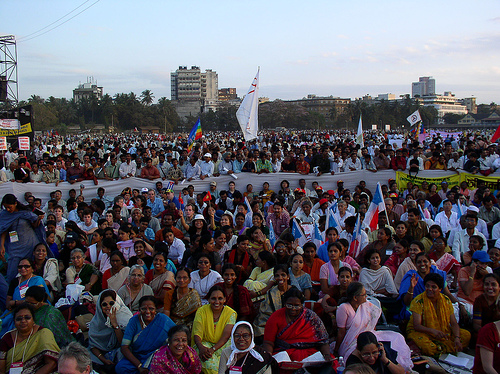
The traditional culture of activism in Mumbai was broadly nationalist socialist, rooted in the freedom struggle against colonialism. The activism around housing and urban inequality, that blossomed during post-Independence, inherited a similar vocabulary and rhetoric. At best it was proactive and effective, and at worst it became a victim of regional chauvinism or got stuck in narratives of victimhood, charity and the voiceless poor. Across the ideological spectrum it evoked communities and the participation of ‘the people’ through mass rallies, demonstrations and centralized leadership. The activist often became the voice and representative of the poor and the poor itself became, like the community, a highly rhetorical figure of speech.
2. Knowledge Practices and forms of Engagement
The relationship between the intellectual and the activist has an old precedent in the city while the activist as intellectual and academic opened newer challenges to both, action and ideas. In many cases the activist as academic or intellectual followed a route of bringing attention to her constituency and speaking even more strongly on their behalf. What attracted us, and many like us to the interplay of activism and intellectual work is based on the recognition that knowledge practices are embedded in the world at large and these are the starting points of our political engagement.
3. Contexts, Knowledge and Agency
As we produce knowledge about our immediate urban contexts, this knowledge transforms us into activists. Self-reflexivity about our roles as researchers of urban contexts gets heightened as soon as we raise questions. It is the moment of articulating these questions that transforms us into political beings and it is this moment that remains the point of inspiration for our activism. However the relationship between knowledge and politics is linked directly to its accessibility: more people who access it, participate in it and produce it, the more political it becomes.
4. The User Generated City
Neighbourhoods that have been directly produced by their inhabitants embody knowledge about buildings, construction and urbanism. Incidentally the majority of human settlements around the world are of this nature. And if we believe Mike Davis’ apocalyptic predictions they are growing at ‘alarming’ rates, becoming ever more complex and impenetrable. We would rather see such neighbourhoods, which have grown outside of the formal planning and development paradigm as knowledge systems, with their own modes interaction and engagements.
5. Community and Participation

Community is about both creating and being created by local modes of communication and knowledge sharing. “It is clearly no linguistic accident that “community†and “communication†share the Latin root communis, “in common.†Communities comprise people with common interests who communicate with each other.” (Melvin Webber, 1964). Participation is essentially about immersing oneself in the process, which in the urban context, means getting involved in its production. There can be no participation without communities and communication systems.