
One Worker, Many Faces

September 22, 2009
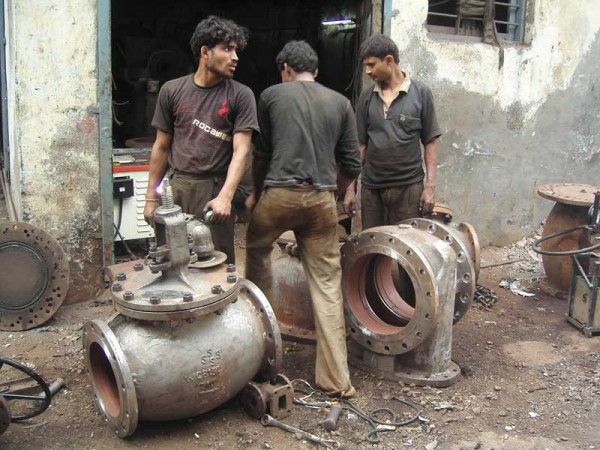
Metalworkers, Dharavi
Dharavi: Informal Economy, Industrial Work

Our perspective on Mumbai is informed by the historical role that the city’s informal sector played when the decline of the textile mills started from the 1980s onwards. That was when some activities of the industry got decentralized and dispersed in several poor neighbourhoods all over and around Mumbai. Notably the ‘loom town’ of Bhiwandi in Thane District. Several other of Mumbai’s informal settlements absorbed processes of the industry – especially stitching and production of clothes.

It is well known that Dharavi has been a traditional manufacturing base for leather goods, pottery and food processing. But it also housed a local service sector that grew around its own vicinity. Besides, it provided subsidised housing for hawkers and poor retailers servicing large parts of the city. The tool-house typology that we talk about essentially looks at Dharavi as a composite of residential, manufacturing and retail activities as expressed in its built-forms.

This composite economic framework works equally well when seen in the context of Mumbai as a whole. The city grew around the docks – a service sector – in the 18th and 19th centuries and that sector continued to hold its own all through the 20th century – even when manufacturing was at its heyday.

It must specially be noted that industrial manufacturing in India was a complicated affair given that it was yoked to a colonial economy and accompanied a forceful displacement of artisanal production practices. In fact the mass migration of artisanal communities to cities such as Mumbai saw the emergence of neighbourhoods such as Dharavi – primarily through the experience of the leather workers and potters.

It is true that along with the gradual disappearance of gigantic 19th century industrial production complexes, the city witnessed the vanishing of a hundred year old evolving history of dignified labour practices. However, some would say the whole experience was unsustainable and so the dissolution was to be expected – especially when seen in the light of the larger role of industrial manufacture vis-a-vis traditional modes of manufacture.

Neighbourhoods like Dharavi lived parrallel lives to industrial sectors in Mumbai from the 1930s to the 80s – testifying to the fact that while manufacture was central to Mumbai’s history, so was the composite – service-artisanal manufacture economy of Dharavi. When formal industrial manufacture declined, Dharavi absorbed and subsidized the processes within its fabric.

We see Dharavi and other spaces in Mumbai as those which encompass a range of different co-dependent economic activities – manufacture, retail, services and others (in the case of Dharavi Koliwada, even fishing right until the 1990s)! We certainly dont see manufacture as ever having left Mumbai. And we dont see it as ever being the sole economic factor in the city’s history either.

Post the publications of Cambridge historian Raj Chandavarkar’s two classics, ‘The Origins of Industrial capitalism in India – Business Strategies and the Working Classes in Bombay – 1900 – 1940’ (1994) and – ‘Imperial Power and Popular Politics in India’ (1850 – 1950) (1998), there has been very little scholarly study on Mumbai’s economic life.

Given the city’s socialist intellectual moorings (hard to imagine today that it even existed!), most of the scholarship has been split between straightforward studies of financial practices, some very good analysis of the city’s informal economy, a lament on the decline of the organized manufacturing sector and wistful goodbyes to the golden history of industrial rule of the twentieth century.

For most of its life, the production of wealth has never been Mumbai’s problem. The fact that it does not seem to translate into the city’s lived experience has been the real issue. Even when the city’s textile mills thundered in full bloom, when the docks were stretched to their full capacity and the middle-classes commuted to banks, colleges and offices in neatly ironed clothes in not-so-crowded BEST buses and local trains, the quality of life for workers was not at its best. Chawls and tenements were made livable because of the enthusiastic and robust cultural resources that communities themselves bought to the city from their rural homes. It was certainly not because their unions always succeeded in having their demands met. Only because we constantly compared city lives to what was left behind (which was often worse in terms of social and cultural status) that the city felt it was providing a better deal to its working classes.

It is that very resource – working hard for very little thanks to the cultural and community support of migrants that made Mumbai’s poorer neighbourhoods what they are today. Far from being cesspools of crime and decay, they produced schools within a generation of taking roots and participated wholesomely in the city’s economic aspirations, besides rising to the occasion in terms of fulfilling the city’s economic needs of production and subsidized retail.

When the grand industrial mills were killed by real-estate greed, these marginal neighbourhoods – from Bhiwandi in Thane to Dharavi, from the streets and gullies in Mohammedali Road to the tenements and habitats that mushroomed around manufacturing units in Kandivli and Vikhroli, continued to subsidize the city through hard work and community back-up.

The reason why we don’t use the appellation ‘worker’ to the millions of the city’s daily wage earners who don’t work in the formal sector is because in the history of modern cities, organized manufacture has a special status – especially since it is linked to the progressive practices of labour reform.

However, for a city like Mumbai that does not take us very far. All through its history, the docks, the services of finance, industrial manufacture, neighbourhood retail, consumption, street hawking, artisanal production (especially leather and pottery) and even fishing jostled for space and attention. There was no evolutionary peak in terms of industrial manufacture and a revolutionary organization of its workforce (which by all accounts was a caste-complicated affair).

As we become more and more aware of the city’s multi-dimensional economic history, we acutely start to feel the need of a vision that rewards the most basic and unself-conscious worker who makes the city tick with hard labour and community support – even if she does not have the legacy of organized industrial history behind her.

It’s only when we do that, and allow them to live with dignity in habitats of their choice, can we hope to create an urban future that is closer to a world of lived equality rather than one that is enshrined in slogans and posters.

The Tool-House (Expanded)

September 9, 2009

This article was published in the Mumbai Reader 2009 (Urban Design Research Institute)

DharaviTool-House

One of the most enduring artifacts of pre-industrial society in contemporary times is the tool-house; the habitat of the artisan where work and residence co-exist amicably. Conceptually located between Le Corbusier’s machine for living and Ivan Illich’s convivial tool, the tool-house is an apparatus fulfilling economic and sheltering purposes.

In the past, production practices took place mostly in the artisanal homes of rural areas, while cities were political and trading centers. Today, in a post-industrial hyper-urbanized era, versions of the tool house can be found in an artists loft, a web-designers den, a hidden restaurant in an immigrant enclave or in an up-market artisanal shopfront behind which an old family continues to perform a traditional occupation.

Tool-houses can be found across cultures and socio-economic backgrounds. Middle-class homes in housing colonies often double up as clothes stores over the weekend while their kitchens service huge clienteles. Parisian hôtels particuliers are conceived to provide a range of professional services for their owners and guests, acting as semi-private salons and gentleman’s clubs.

Yet, as a structure epitomizing such dual use, the tool-house, does not have the legitimacy it deserves. In fact in many places it is considered outdated, or worse, an invalid urban form, thanks to strict zoning laws and rigid conceptions of urban order. With the universalizing principles of the industrial revolution becoming mainstream, homes and workspaces have been decisively cut off from each other.

The modern city emerged through an atomic division of functions which had for long cohabitated in space and time. As working and living became spatially segregated, they also started being regimented along temporal lines. When the self-employed artisan became a factory worker he splintered his workshop-home and his days. He would have to commute to a separate place and compartmentalize his time in strict schedules demarcating work and leisure time. Ever since, the practice of separating residences from places of manufacture has shaped much of the way we think of cities, work, and time. In particular, the organizing of space according to these principles became the main purpose of urban planning.

In practice however, several parts of the urban world are littered by sprawling collections of built-forms that do not reflect this neat divide. In fact informal settlements around the world are the best expressions of the enduring presence of the tool-house. The reason for its resilience is basic economics. In a context where more than 40% of people are self-employed, and urban development keeps pushing up the price of space, the home needs to double up as a productive site. In low income neighbourhoods, it is not uncommon to find a small tool-house partially rented as storage space, used as a shop in the front and as a workshop space in the back in addition to serving as a shelter for an extended family. Interestingly, several economic commentaries these days talk of the return of the home-based workspace (in the US this is supposed to be a good anti-dote to outsourcing) and the re-emergence of the post-industrial artisan. The contemporary world is proving to be a live exhibition space for different eras and epochs to be displayed, with regard to the world of industry and commerce.

With a little bit of imagination, a walk through any Mumbai slum also becomes a trip through a moment in the dawn of the industrial revolution. When the economic regime had still not drawn the rules of how we should live, work and sleep. Several of Mumbai’s informal settlements are shaped by the contours of the tool-house. You can see every wall, nook and corner becoming an extension of the tools of the trade of its inhabitants, where the furnace and the cooking hearth exchange roles and sleeping competes with warehouse space, with eventually a cluster of tool-houses making for a thriving workshop-neighbourhood.

Unfortunately, in spite of the way things actually unfolded, perceptions about industrial society were often limited. The movement from the home to the factory was mostly described as representing progress for humanity, and measured in terms of output increase. The discourse looked at the village as a counterpoint to the city, and as being culturally and economically backward. Not surprisingly, over the last century, it is agriculture more than any other economic activity that has been scaled up to fit the requirements of the industrial age.

Voices such as Gandhi’s were a few of the critical ones that questioned such narratives. His vision of rural India was essentially an artisanal one – with the tool of the charkha becoming a potent symbol, linked to narratives of economic self-sufficiency in a colonial age dominated by the frenzy of industrial production. However, rather than isolating the space of the artisan, Gandhi’s vision encapsulated a totalizing notion of rural self-sufficiency and located the village exclusively within this landscape.

A look at the living conditions of contemporary rural India reveals that Gandhi’s vision is desperately lost. Yet, if we turn our eye to our much decried dirty and messy cities, we actually see post-industrial versions of the village form flourishing in all kinds of ways. It would not be too much of a stretch to say that if the Gandhian village was the soul of his India, the tool-house was actually its heart. If we detach the village from its exclusive rural setting and accept it as a valid urban form, we soon realize that one of its most persistence features, the artisanal home, deserves much greater attention.

Through the twentieth century, the modernist urban imagination was firmly tied to the industrial age, even though in actual experience, processes of living, production of goods and the evolution of structures were discontinuous and fragmentary. Formal and informal economic practices have co-existed in several ways. Manual energy has supported mechanical energy and vice versa. Yet, the idealized vision of this age was always one that saw human scale economic operations as redundant, or on the verge of disappearance. The reality is absolutely to the contrary. A lot more production takes place in informal settlements with a combination of manual and mechanical energy than we would like to acknowledge. Cheap human labour is what energizes and subsidizes such a gigantic economy as India. A substantial amount of that energy is located in informal settlements, slums and urban villages, and a million tool-houses where massive and decentralized production processes take place.

The reason why urban landscapes formed by tool-houses are so crucial for urbanists is that it makes explicit the relationship between production, livelihood and spaces that expresses the lives of more than half of humanity. Not to be able to see this dimension in slums reveals a terrible lack of imagination and aborts the complex and organic evolution of urban forms.

In reality – tool-house landscapes indicate a need for a sharp restructuring of the way in which labour, work, and capital are understood in the post-industrial city. They can help us to concretely visualize a future in which the dated dichotomy of the formal and the informal organization of production and services is transcended. Where the new spatial-temporal order that internet-based and mobile communication technologies have introduced in our lives are acknowledged, and the complex dialectic between the artisanal/organic, decentralized and industrial mass-based product in the contemporary economy is recognized.

Cities of the future can keep being formed by the empty development and one-dimensional growth of real-estate development or they can rearrange themselves in less predicable ways following our aspirations and localized needs. Where urban development is left to local actors we observe the (re)emergence of live-work spaces that are in fact less dehumanizing than the housing block and its twin office tower that are being systematically promoted by urban developers all across the ideological spectrum – from real estate investors to NGOs, passing by the government, as the only acceptable way towards modernity.

It might be time to acknowledge that for all its lack of infrastructure and overcrowding, several informal settlements reveal a trend that can be well integrated into a post-industrial landscape. They will then emerge not as much slums in dire need for redevelopment but as a highly successful model of bottom-up development, with the tool house being at the core of its system.

The Dharavi Redevelopment Project’s latest design produced by Mukesh Mehta – that accommodates the recommendations of a panel of experts – pretends to respect the living and working conditions as epitomized in the tool-house dominated landscape of the neighbourhood. Actually it only reinforces a segregation by superimposing economic and residential functions onto each other, in distinct layers.

The fact of the matter is that the logic of the tool-house is intimately linked to the larger economic context of informality, decentralized production and the subsidizing of costs by using space in complex and layered ways. It is organically connected to the unit of the family, the community and the persistence of the village form in the modern metropolis. By ignoring these complexities, the attempts at making over Mumbai’s informal settlements will simply not hold water.

More airoots writing on urban villages, tool-houses and user-generated cities in the upcoming book What We See: Advancing the Investigations of Jane Jacobs

Magical Urbanism

August 26, 2009

magicalurbanism

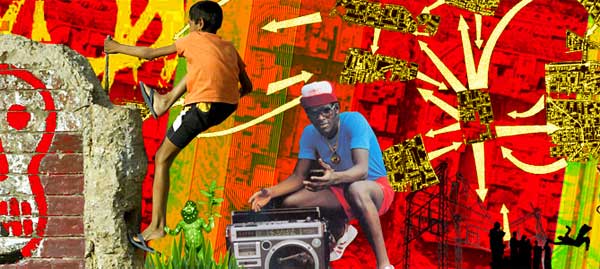
That reality often exceeds imagination is well known. What is less often discussed is how imagination can transform reality. The urban realm offers infinite possibilities, at least in the mind. But what happens when multiple minds connect and start focusing on an idea from various perspectives, with the firm intention of actualizing it? What if that idea is stretched across the world, powered by information technology and substantiated by localized action? This is how wars, religious congregations, political campaigns, real-estate projects, festivals, movie shoots, parties and all types of creative-destructive events get realized.

A dark illustration of this capacity to actualize wild ideas is the Mumbai attacks on November 26, 2008. A small group of well-trained and hyper-determined youth navigated across the Arabian Sea and came ashore to Colaba, in South Mumbai. Equipped with state of the art killing machines, they put the whole city to a standstill for more than 3 days. They killed Mumbai’s top cops, hijacked police cars, twice and rampaged the city’s best hotels. Till the end they defied India’s best commandos. For a moment it seemed that the country’s entire army could not stop them. And the whole world was their audience.

The televised images of the attacks evoked a kind of senseless urban violence that had only been prefigured in Hollywood movies and video games like ‘Grand Theft Auto’ or emulated in US suburban school killings. The fact is that fantasies of radical transgression, including bombing and killing have always been part of a certain subversive imagination, which is particularly appealing to the youth. Especially those who have been brainwashed into negating their violent impulses, desires, drives, aspirations and ego-trips. Attraction to extreme violence, in fictional or actual form is often a response to an unbearable level of frustration caused by the repression of perfectly healthy impulses – impulses to do with expression of anger, creativity and active control of their lives.

It is unfair to expect any self-denial of these impulses from the youth. And it is even worse to lock them up in a world running on autopilot, where any sense of agency is deemed dangerous or impulsive. To them, such a world seems headed straight to a crash. So many youth across the world feel trapped in rigid urban and social structures; stuck in a reality that they are not allowed to reinvent. As a result they often respond passionately to fictionalized versions of reality, which are full of possibilities, including the most extreme and destructive ones. Most often these fictions remain in the realm of the imagination, but sometimes, when intent and determination are high enough, they do translate into reality.

All that is needed for this leap from fiction to reality to happen is an audacious idea, collective determination, a space for intervention and some special effects. That’s what we call the magic formula. It can be used in all kinds of ways. Not all of them as dramatic, psychopathic and morbid as the 26/11 attacks. In fact, it is so important to open avenues for creative-destructive expression and action in cities today. Otherwise youthful energy turns into frustration, alienation and violent expression of despair. We can use the magic formula to create a new reality, even when the odds are against us. The more we are able to do so, the less self-destructive we will be.

The space of youthful imagination is highly potent. It is like a fertile jungle continuously producing a million new audacious ideas. It is violent and exciting, destructive and creative, all at the same time. It is a space where one can get lost, discover, experiment and grow. A sacred grove of sorts, that one can come back to at any point in time to reconnect to a vital creative energy that helps accomplish wonders.

The workshops we organize draw on the radical aspirations of the youth to a different future. They open up a  time and space for individual and collective expression through bold interventions in the urban realm. They break up existing social, cultural and political hierarchies and modes of subordination, at least for a moment. The workshops are intensive 3 to 5 days long events which bring together people from completely different linguistic, cultural and economic backgrounds. They exchange local and global knowledge in search of uniquely suited solutions for specific sets of issues. The result comes in the form of a multimedia explosion (interviews, videos, stories, music, drawings, architectural renderings, photoshopping, images, etc) that sends shockwaves throughout the system. Successful workshops lead to the creation or consolidation of local initiatives, which we continuously support by deploying Web-based networking and communication tools. These can help maintain the momentum of the workshop by keeping human connections alive and by giving global visibility to local projects.

Our next workshop will happen in Mumbai in the last week of November. In May, we are planning a workshop in Geneva in the neighborhood of Les Paquis, where residents are struggling with a new brand of street violence (yes, Switzerland has it too!). In June, we may be doing a workshop in the Bay Area in California with our friends from the Center for the Living City. After this we are hoping to do something in Amsterdam, Santiago de Chile and Buenos Aires. Lots of explosive creative potential out there!

If you have a feeling that tells you to act now, to project yourself onto the world around, express your dreams, defeat your fears and realize your aspirations, please join any of our workshops. Better still, call us to your neighborhood… invoke the Urban Typhoon. Unleash the global imagination in your hillside favela, your suburban township, your artist hamlet, your satellite town, your generic city, your urbanizing village… They are all fascinating and full of potential. All they need is a little magical urbanism.

Chowpatty: Place To Be

August 25, 2009

Girgaum Chowpatty is one of the most politicized sites of the city, notwithstanding a court ruling some years ago that declared the beach strictly for recreational purposes only. Even then, the ruling had qualified that the Ganesh visarjan ritual was a ritualistic recreational act, and made official one more moment in the neighbourhood’s long lasting trysts with politics.

After all, the Saarvajanik Ganesh mandals were an innovative attempt by Tilak at politicizing what was essentially a domesticated ritual. He made it a Mumbai event, one that would bridge divides between castes, classes and even religions to help prepare a united front against colonial powers. It was a master stroke. In one swift gesture, the meaning and significance of recreation, ritual and politics got merged into one quivering mass of humanity.

Tilak’s move was truly radical – he wanted the ritual to break through caste barriers, question prejudice and become a forum for discussion and debate. After 1893, community participation in the festival became huge, with poetry recitals, performances, intellectual discussions, music and dance becoming integral to the events and the tenth day procession to submerge the idol in water bodies becoming one more way of bringing the divided city together.

The Girgaum beach would never be the same after that, much to the chagrin of the elites who lived across on Malabar Hill and other posh neighbourhoods in the vicinity. Very much like their descendents today – who were the prime movers in banning political rallies near the beach – supposedly for causing traffic jams. Most of them didn’t seem to care that the site had been anointed by politics and that it was a historical space precisely because rallies helped the city come together in the name of some worthwhile cause or the other.

A few decades after Tilak’s move, another resident in the neighbourhood managed to transform the beach into a moment of ferment. Gandhi, who lived down Laburnum road, had inspired most of the neighbourhood to support his clever moves. When he started the famous Dandi march as part of the satyagraha to protest against the infamous salt tax in 1930, Girgaum Chowpatty resounded to his call with great gusto. Thousands and thousands of Gandhi’s followers descended on the beach to symbolically create salt echoing his act in Dandi, Gujarat. And when the followers were lathi charged and attacked by the police, they found an unexpected ally across the road – in the form of Wilson College. According to some records, its principal, opened the gates and transformed the space into a refuge for the Gandhians in open defiance against the colonial rulers.

For several years after that the beach was constantly used by Mumbaikars to voice their concerns. Especially since the powers ruling their lives, resided close by and could be heckled on their way home in the evenings. Along with Azad Maidan and Shivaji Park, the city repeatedly bristled with concern about different issues ranging from Dalit radicalism, to peasant movements, to fighting against the brief stint with authoritarianism during the Emergency in the mid 1970’s.

It was thus a pleasure to see how the gay movement too kept up an old Mumbai legacy celebrating the reading down of Article 377, and held one of the biggest gay pride marches in the country that made Girgaum Chowpatty resonate with politics. Once more the neighbourhood supported a stand against a colonial moment and celebrated along with the marchers fighting against discriminatory prejudice.

Published in Mumbai Mirror, August 26, 2009

Audacious Learning: The Dharavi School of Urbanology

August 17, 2009

Institutions have been much misunderstood entities. In strict anthropological terms they refer to any stabilizing of ideas, beliefs, practices, traditions, lifestyles, knowledge practices and skills that one generation wishes to pass on to the next.  By this definition, families, guilds, community associations, art schools that are based on the practices of a teacher – all qualify to be institutions. Musical traditions in South Asia codify themselves around gurus and become institutions of sorts. In Japan, martial arts, tea ceremonies and other arts and cultural practices center around the sensei and institutionalize themselves over generations. Much of knowledge, insights and learning have been generated through such inherited and evolved practices.

It’s only in the nineteenth century, with the emergence of the modern bureaucracy that a distinction came to be made between the primary and secondary nature of all organizations, with the former being part of the realm of domesticated, ethnicized or personal spaces and the latter being shaped by impersonal, universal principles that were sharpened by the development of bureaucracies. What such a distinction meant for knowledge and cultural practices was quite special. It privileged the development of modern day institutions only if they walked down the path of bureaucratic organization and relegated traditional knowledge practices to an informal realm – contained and preserved by traditional customs and private resources. As a result, the state, and subsequently large resource rich establishments, shaped the emergence of modern day educational, cultural and arts institutions, and made them more bureaucratic and impersonal. This was also the process through which the idea of tradition as a hyper-conscious space became more prominent pushing forth for a whole lot of speculation about the invention of traditions. This went hand in hand with the invention of other firmed up dialectical categories, including personal-impersonal, ethnic-modern, primary and secondary organizations, informal and formal practices, pure intellectual pursuits versus engaged and politicized practices, scientific versus religious truths so on and so forth – dialectical categories that plagued intellectual worlds for centuries but started to harden around this time.

Of course, in the real world, the informal and formal, the traditional and the modern played themselves out in complex ways. Thus modern day educational institutions could have large bureaucracies embedded in them along with age-old feudal practices and authoritarian teacher-patriarchs. Research practices could move between subjective and objective truths, between science and faith in various permutations and combination.

Eventually, these inner contradictions were contained by the idea of modern day institutions as respectable entities due to their validation as formal, organized and bureaucratic centers of learning and research. The more respectable they were the more they had to distance themselves from the other side of the wall; the informal, the personal, the engaged, religious, traditional…

What it did to the idea of institutions was particularly problematic. Any well organized bureaucracy, no matter what its ideology, beliefs, practices and track-record as a research center, could be passed off as an institution. Today, business enterprises running knowledge-for-cash programs are considered respectable institutions all over the world – going by the synonym of universities.

And small research centers, which connect knowledge to practices and are conscious of the power equations they are embedded in (they have no protection in the form of bureaucratic shields) have to prove themselves several times over before they can be understood as institutions.

The Dharavi School of Urbanology – see www.urbz.net for the latest update – is an institution in a more resilient sense of the term – when institutionalization meant a settling down of the ideas of practitioners who would like to learn more from the emerging generation.

It is located literally in the residual space of the grand journey of concepts that shaped the history of ideas and modern day institutional practices – the informal, hyperurban, dense space of a city – right at the other end of the spectrum.

What better place for a school of cities to be located in?

Its tiny. In the tradition of small centers of learning that could be found in narrow streets of old Edo, Alexandria, Baghdad, Benares centered around the beliefs and practices of people firmly committed to their dynamic beliefs.

It is a modern day myth that these were traditional spaces which preserved old forms of knowing. On the contrary, they preserved only by changing, evolving and adapting, unburdened by the categories of respectability and validation that modern day institutions are obsessed by.  They were centered on their practices and produced insights through them – with the same effectiveness as those hot on the pursuit of pure knowledge.

The Dharavi School of Urbanology challenges notions of institutions as it goes on to establish itself with literally nothing.

Do come and nourish it with your passion, experience and playfulness.

Walk the City

August 12, 2009

It is only when the rains debilitate Mumbai that we discover the possibility of navigating the crowded streets of our city on our feet. People have traveled huge distances wading through gutter water making them associate the act exclusively with civic breakdowns. However, several research findings indicate that a good many of Mumbai’s daily commuters actually walk to work everyday on a routine basis. That’s’ because most of them live in informal settlements and relatively close to work.

In fact Mumbai’s streets are a visual proof that people use their two feet all the time. Few roads or streets are free of walkers. The presence of roadside hawkers indicate the vibrancy of the streets in this regard only too well and most regular walkers adapt to their presence. One of the most successful infrastructure projects that civic authorities undertook in recent times are the walkways near Bandra and foot overbridges across roads and highways. The aim may have been to keep people out of the roads for the cars – but they have helped nevertheless.

Walking sometimes reveals how relative notions of distances can be. It was only after suffering through traffic jams that lasted two hours between Girgaum and Prabhadevi during evening rush hour that made me realize that the same distance could be traversed in precisely that much time by walking as well.  Of course that stretch included two great promenades – the Haji Ali  and Worli Sea Face roads.

Walks have been regularly incorporated in the city’s tourist – especially heritage trail – agendas. Rahul Mehrotra and Sharada Dwivedi’s Fort Walks is an excellent guide through the city’s colonial past. Enterprising guides have developed the ‘Slum tours” through Dharavi. PUKAR, Mumbai’s very own innovative urban research collective uses walks as a method of inquiry. Walks become part of the research process. Recently, members of the center held a special walk through the erstwhile Mill areas of Mumbai, providing participants a glimpse of the rapidly transforming neighbourhood. This was done as part of a global event in the memory of an American urbanist Jane Jacobs who used the idea of the walk as a way of reclaiming neighbourhoods for its residents.

It’s a sure fire way of making places safer without acts of surveillance if you simply learn to use the streets in a feet-on way. Of course, it may be impractical in terms of being a regular act in a Mumbaikar’s life. In many ways it sounds almost improbable.

But already the infamous traffic jams – especially in the suburbs have transformed several commuters from stations to their colonies into regular walkers. A bit more investment in the basic infrastructure for this activity will surely bring in several more and make it a pleasurable activity.

Walks have been overtly political acts as well, especially in the form of demonstrations and of course through Gandhi’s legendary marches. The political dimension of the walks merges with its cultural one – becoming often a ‘carnavalisque’ reclaiming of public spaces. And while most Mumbaikars would baulk at this idea, given how impatient they are with any act that slows them down, one time of the year they find themselves joining in is round the corner. When the elephant headed God makes his devotees (who love walking to him to Sidhivinayak temple anyway every Tuesday) dance along during the chaturthi celebrations.

For several years one has had mixed feelings about this great celebratory invasion of Mumbai’s streets. I have found myself walking through miles of static traffic in thunderous music and – after exorcising the bourgeois impatience of a regular commuter – even danced along – especially when a subversive techno parade joined in a procession in a true spirit of the carnival.

Maybe this Ganpathi festival – Mumbaikars can join in by politicizing the already politicized event a bit more – and make it a celebration of the act of walking as well –by everyone who has a political axe to grind – and reclaim the streets of the city in another way.

Random Thoughts: The Noble Savage

August 7, 2009

The idea that nobility can exist in the tribal mind is linked to the conviction that the authentic tribe exists.

The category tribal often got juxtaposed against that of the civilized mind in twentieth century thought and pushed anthropologist Levi Strauss to talk about the noble savage. In his brilliant commentary he ultimately pointed out that the urban civilized mindset has much more in common with its imagined counter-point – the thoughts and way of thinking of the savage.

He took great pains in pointing out that this observation is distinct from that of the idealized tribal that many modern intellectuals value: the rousseauseque idea of the savage world as being noble, something for the modern world to idealize.

What the Levi-Strauss argument did was to deconstruct the categories tribal and savage itself and yet allow them to be imbued with enchantment and magic. To be able to see aura and enchantment in the mundane is the most unique of all gifts.

However, it is a complex gaze. It simultaneously unravels categories such as the noble and the civilized as absolute ones. It opens up the way to look at the ordinary (ordinary in every sense) as being imbued with aura as – having the ability of being both noble and savage together, and having several other qualities that make up the complexity of human experience.

To elucidate:

To be excited by the fact that you are meeting a royal – can be mechanically balanced in a modernist mind – by being equally excited on meeting a tribal. This can be represented as being just and egalitarian.

However – since these communities never exist in their pure sense (all royalty is complexly constructed by convenient omissions and additions and all tribal communities have evolved and adapted and been connected to global spaces and histories as well) – to come to terms with the disappointment on meeting someone who is neither royal, aristocratic or civilized nor is savage, tribal and authentic is the biggest challenge of all.

Those who manage to do so are indeed liberated from the vast landmine of categories and labels that litter the contemporary world.

There are few who manage to do that and it is a moment to be cherished when you meet them!

The Worli Village Link

July 15, 2009

Out of sight, out of mind’ has been a credo much loved by city officials. If you can’t solve a problem – just hide it. Cities like Delhi have taken this to a fine art. You can’t imagine that India’s capital has a huge population living in shanties and temporary tenements, simply because you don’t see them. They have been shunted out to the peripheries, behind the river and tucked away in the crevices of posh colonies.

Design and architectural projects often have a dual use in this hide-and-don’tseek game. They fulfil their stated functions – transporting people, providing homes in high-rise structures – and also provide new visual vistas for the city.

The very same metropolis appears vastly different from a great height or from across a bridge. Once the visual signature becomes part of the public imagination, it shapes the way we think.

That is why the IMAX-scale Bandra-Worli Sea Link experience needs to be handled with care. On one side of the bridge lies glamorous Bandra, while on the other lies a 400-year-old fishing village that has been directly affected by the construction of the bridge. Now that the lives of the fishing community have been substantially impacted, having reached the point of no return, they are worried about another danger – that of coming under the entire city’s spotlight.

Already, one hears of complaints against the supposedly unpleasant sight of what is being described as a slum. The fact that some members of the village do not have access to private or public toilets is being used as an argument about the entire settlement.

The fact is that the village of Worli Koliwada has a full-fledged functioning local political body with a highly educated and informed leadership. They deal with the issues of religious diversity (many of the Kolis are Christians) and migrants (several tenants living in the village from all over the country) with sophistication and maturity. They have a systematic and inclusive approach in decision-making through regular community meetings. In these meetings they have regular discussions and debates about what is the best way ahead for them. The leadership has access to good and skilled people who have been associated with the village’s development for decades.

The villagers know fully well that entering the visual map of the city through the Bandra-Worli Sea Link can move both ways. It can make it even more difficult for them to survive if the media projects them as a slum, which needs to be dealt with through real estate development projects. Or it can do something else altogether – convince Mumbai’s authorities that the best way ahead is to recognise the fact that the villages of Mumbai, while needing special inputs in sewage, drainage and toilet facilities, are actually well-equipped with skills to evolve and modernise on their own.

The Worli Koliwada leaders are way ahead of many others in this regard. The authorities simply need to respond to them supportively and recognise their habitat as such. This will help the residents of the village – the Kolis as well as the tenants – to improve and transform their habitat according to their own aspirations and choices.

If this indeed happens, what Mumbai will be rewarded with at the end of the road, is a beautiful, modern habitat that preserves the city’s unusual urban legacy – one that includes villages, full of chapels and shrines, where the original Marathi manoos wove the city’s cosmopolitan fabric we are so proud of today.

MUMBAI SOAKED / UNSOAKED

June 17, 2009

From the Mumbai Mirror Column

Waiting for the rains is one of the most painful moments in a Mumbaikar’s life. Covered in sweat, burnt by the dazzling sun and constantly looking skywards, the Mumbaikar goes about daily chores praying for that redeeming magical moment.

The wait has become increasingly torturous over the years. At one time, we just blamed the rain gods for any delay. Now, even the most devout believers have figured out the nuances of the global warming debate and are less inclined to spend time and resources on pujas and yagnas.

That is the pre-monsoon scenario. When the possibility of it raining seems dim. When the memory of floods and the weeks without sun seem distant and vague. As soon as the impossible happens, when the clouds actually burst open, the mood changes.

From the initial euphoria over the collective natural air-conditioning that the monsoons usually bring, the complaints start to trickle in and eventually become a flood of their own.

Loud howls of protest rent traffic jammed roads and highways. Complaints about the inefficiency of the city’s authorities are punctuated by dark philosophical pronouncements about global weather change.

Everybody starts cursing – after having savored the initial celebration.

Did the city always respond to the monsoons in this dual-faced way? Not really. It couldn’t have. Like many fishing villages everywhere, those who live at the edges of waterways – on the sea, in creeks and along water bodies – Mumbai’s residents too related to the monsoon in a manner that saw it as organically connected to the water systems in which it is embedded.

The seven islands converged, sometimes by force, but always incrementally over a period of time, without actually removing the city’s watery foundations. This allowed the rains, even if temporarily inconvenient, to be accommodated into the landscape. The city had wells providing water, way into the 20th Century.

Several of the lakes that were developed, in Thane, Kalyan and around the national park, were part of efforts that always saw the monsoons as a blessing that brought in water which needed to be stored and contained.

The Koliwadas of Mumbai, guardians of the city’s waterways, were dignified habitats that saw fishing as a modern-day urban occupation well until the 1960’s and ’70’s. They still exist, but shorn of civic dignity, and with a more embattled life as a fishing community.

What went wrong? Why did the city that once mostly celebrated the monsoons turn into a paranoid nervous wreck waiting for it with anticipation and dread?

Or more precisely, what did the city do to transform itself from a monsoon-friendly, flood-tolerant city, into a death-trap in which the sea becomes a monster snapping at its heals and when lakes and rivers rise ominously, threatening to engulf it?

Several of the answers to these questions will be revealed this month in a brilliantly conceived multi-media exhibition in which the National Gallery of Modern Art (NGMA) at Kala Ghoda will transform itself into a temporary university specialising in the art, science and technology of the monsoons.

Anuradha Mathur and Dilip da Cunha, the force and brains behind the exhibition, aptly titled ‘SOAK: Mumbai in an Estuary’ invite the residents of Mumbai to come and re-think the monsoons in a manner that is unique and quite simply an eye-opener.

They assert that Mumbai is an estuary – a geographical terrain that lets the sea in and integrates its rhythms into the vast urban system that constitutes it.

One that includes a colonial city, glitzy suburbs, fishing villages, towns, rivers, lakes, a forest and several habitats that defy definition. When the city forgets this, when it drives wedges in its own physical self, that’s when the problem starts.

Of course, that’s a very inadequate summary of what they are saying. The exhibition, that starts in a couple of weeks, will reveal a lot more.

URBZ MASHUP Tokyo & Istanbul

June 10, 2009

mashup

The URBZ MASHUP workshop invites artists, designers, architects, urbanists and creative people who share an interest in cities and urban life to explore a city, debate, ideate, create fictions, photo-collages, music and videos.

The first URBZ MASHUP will take place in Tokyo, hosted by Temple University Japan, in the first week of July 2009. The second one will be held at Istanbul Technical University in the first week of August, followed by Mumbai in November. Other workshops are planned in Rio, New York and Amsterdam in 2010. Each workshop will remix and mashup the material produced in other cities.

The workshop lasts for 5 days. It is followed by a seminar and an exhibition. Each workshop comprises a mix of international and local participants. The participants form small teams of 3 to 5 people and explore the city for two and a half days. Each group chooses a street or neighborhood and documents it using various media including drawing, photo, audio, video and text.

On the third day, all participants get back to the workshop space and remix the material they have gathered in a free and creative way. On the fifth day, the material produced is uploaded in an online gallery on www.urbz.net. A selected number of pieces will be printed and exhibited at the workshop space itself. URBZ provides a virtual environment to exhibit what has been  produced.

The URBZ MASHUP workshop is a non-profit event aimed at stimulating imagination, facilitating creative explorations and generating cultural exchanges between cities and people.

For more info: www.urbz.net/mashup

mashup

« Previous PageNext Page »