
One Worker, Many Faces
September 22, 2009
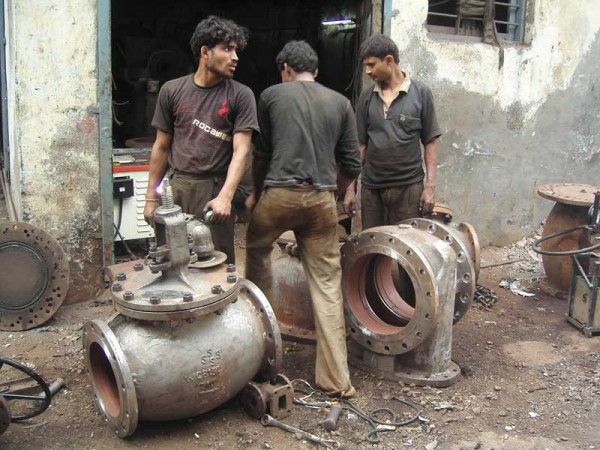
Dharavi: Informal Economy, Industrial Work
Our perspective on Mumbai is informed by the historical role that the city’s informal sector played when the decline of the textile mills started from the 1980s onwards. That was when some activities of the industry got decentralized and dispersed in several poor neighbourhoods all over and around Mumbai. Notably the ‘loom town’ of Bhiwandi in Thane District. Several other of Mumbai’s informal settlements absorbed processes of the industry – especially stitching and production of clothes.
It is well known that Dharavi has been a traditional manufacturing base for leather goods, pottery and food processing. But it also housed a local service sector that grew around its own vicinity. Besides, it provided subsidised housing for hawkers and poor retailers servicing large parts of the city. The tool-house typology that we talk about essentially looks at Dharavi as a composite of residential, manufacturing and retail activities as expressed in its built-forms.
This composite economic framework works equally well when seen in the context of Mumbai as a whole. The city grew around the docks – a service sector – in the 18th and 19th centuries and that sector continued to hold its own all through the 20th century – even when manufacturing was at its heyday.
It must specially be noted that industrial manufacturing in India was a complicated affair given that it was yoked to a colonial economy and accompanied a forceful displacement of artisanal production practices. In fact the mass migration of artisanal communities to cities such as Mumbai saw the emergence of neighbourhoods such as Dharavi – primarily through the experience of the leather workers and potters.
It is true that along with the gradual disappearance of gigantic 19th century industrial production complexes, the city witnessed the vanishing of a hundred year old evolving history of dignified labour practices. However, some would say the whole experience was unsustainable and so the dissolution was to be expected – especially when seen in the light of the larger role of industrial manufacture vis-a-vis traditional modes of manufacture.
Neighbourhoods like Dharavi lived parrallel lives to industrial sectors in Mumbai from the 1930s to the 80s – testifying to the fact that while manufacture was central to Mumbai’s history, so was the composite – service-artisanal manufacture economy of Dharavi. When formal industrial manufacture declined, Dharavi absorbed and subsidized the processes within its fabric.
We see Dharavi and other spaces in Mumbai as those which encompass a range of different co-dependent economic activities – manufacture, retail, services and others (in the case of Dharavi Koliwada, even fishing right until the 1990s)! We certainly dont see manufacture as ever having left Mumbai. And we dont see it as ever being the sole economic factor in the city’s history either.
Post the publications of Cambridge historian Raj Chandavarkar’s two classics, ‘The Origins of Industrial capitalism in India – Business Strategies and the Working Classes in Bombay – 1900 – 1940’ (1994) and – ‘Imperial Power and Popular Politics in India’ (1850 – 1950) (1998), there has been very little scholarly study on Mumbai’s economic life.
Given the city’s socialist intellectual moorings (hard to imagine today that it even existed!), most of the scholarship has been split between straightforward studies of financial practices, some very good analysis of the city’s informal economy, a lament on the decline of the organized manufacturing sector and wistful goodbyes to the golden history of industrial rule of the twentieth century.
For most of its life, the production of wealth has never been Mumbai’s problem. The fact that it does not seem to translate into the city’s lived experience has been the real issue. Even when the city’s textile mills thundered in full bloom, when the docks were stretched to their full capacity and the middle-classes commuted to banks, colleges and offices in neatly ironed clothes in not-so-crowded BEST buses and local trains, the quality of life for workers was not at its best. Chawls and tenements were made livable because of the enthusiastic and robust cultural resources that communities themselves bought to the city from their rural homes. It was certainly not because their unions always succeeded in having their demands met. Only because we constantly compared city lives to what was left behind (which was often worse in terms of social and cultural status) that the city felt it was providing a better deal to its working classes.
It is that very resource – working hard for very little thanks to the cultural and community support of migrants that made Mumbai’s poorer neighbourhoods what they are today. Far from being cesspools of crime and decay, they produced schools within a generation of taking roots and participated wholesomely in the city’s economic aspirations, besides rising to the occasion in terms of fulfilling the city’s economic needs of production and subsidized retail.
When the grand industrial mills were killed by real-estate greed, these marginal neighbourhoods – from Bhiwandi in Thane to Dharavi, from the streets and gullies in Mohammedali Road to the tenements and habitats that mushroomed around manufacturing units in Kandivli and Vikhroli, continued to subsidize the city through hard work and community back-up.
The reason why we don’t use the appellation ‘worker’ to the millions of the city’s daily wage earners who don’t work in the formal sector is because in the history of modern cities, organized manufacture has a special status – especially since it is linked to the progressive practices of labour reform.
However, for a city like Mumbai that does not take us very far. All through its history, the docks, the services of finance, industrial manufacture, neighbourhood retail, consumption, street hawking, artisanal production (especially leather and pottery) and even fishing jostled for space and attention. There was no evolutionary peak in terms of industrial manufacture and a revolutionary organization of its workforce (which by all accounts was a caste-complicated affair).
As we become more and more aware of the city’s multi-dimensional economic history, we acutely start to feel the need of a vision that rewards the most basic and unself-conscious worker who makes the city tick with hard labour and community support – even if she does not have the legacy of organized industrial history behind her.
It’s only when we do that, and allow them to live with dignity in habitats of their choice, can we hope to create an urban future that is closer to a world of lived equality rather than one that is enshrined in slogans and posters.
Very Well written. These small scale industries do contribute a lot..
Good Capture
Comment by JD — March 5, 2011 @ 1:57 pm