Tales of Lucid Sleep

August 26, 2008

lucid

(This is a forthcoming graphic novel to be published in 2009)

The pre-history of our story is connected to an island far away from Mumbai. It starts during a time when the city itself was nothing more than a lazy collection of seven water circled spits of land, inhabited by a fishing community, birds, beasts, insects, some bored goddesses living in makeshift shrines and a handful of forgotten ancient monuments.

The island in our story still exists, around ninety kilometers south of Mumbai. It is overgrown with trees that have airoots sniffing for a whiff from the past. Remembering the days when it was literally a compact city. It’s twenty two acres of black stonewalls are littered with cave-like rooms and shelters, water bodies and the remains of an ancient, unknown shrine of a religion that does not resemble any of the known faiths that have known to have settled down in this part of the country; neither Jewish, Islamic, Hindu, Buddhist or Christian.

Historians surmise that the unknown faith must have flaked off the thriving sea trade connecting Africa and India. They talk of trade, trafficking, wars, and even an African kingdom that ruled parts of western India for a few hundred years. A kingdom that controlled the seas, from one continental coast to another, harnessing the energy of a thousand exchanges, of goods, services, ideas, music, flora, fauna, and people. Near our island, there still exists a palace that belongs to that old African kingdom. We even know that its royal descendent still lives; in a large south – Mumbai flat.

Our story is half connected to his kingdom, and only partially connected to the region’s African history. Most scholars simply gave up trying to decipher the remains of what is known of that hazy period. No one could logically trace the trading routes that must have given rise to that mysterious faith, no one managed to trace the place they must have come from.

No one even knows that the neighbouring flat of the African king (who still lives in South Mumbai) is owned by a descendent of this lost kingdom.

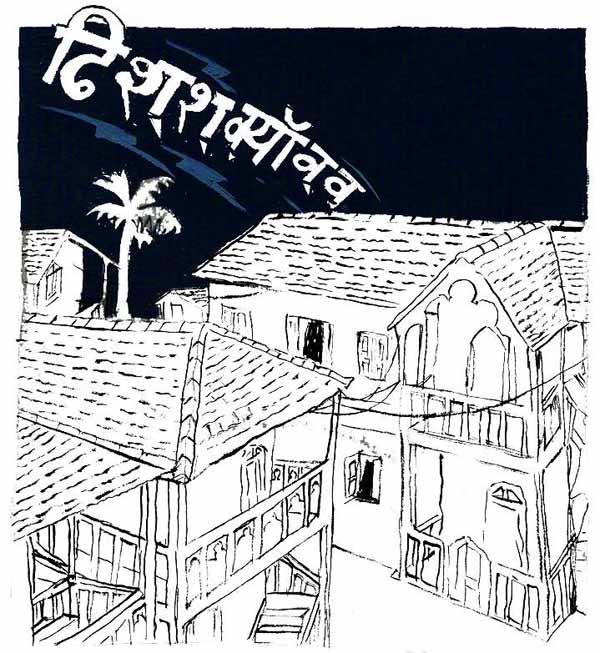
No one knows that the children playing below the table in this image are supposed to carry on an old legacy, connected to the city’s hidden past.

Our story begins from under the table.

Urban Fables

01: The Query of the Sunset Peacock
(Inspired by Marc Reisner’s ‘Cadillac Desert’)

The great bath was full. Fashionably dressed men and women jostled with each other to undress, take a quick dip and hurry to feast at the temple. The brick-lined floor just outside the enormous reservoir of water was still warm with the evening sun.

That is when the sunset peacock chose to make its first appearance in town*. Right in front of the chief of the council of town elders who was hurriedly drying himself, thinking hungrily of the food laid out in the temple courtyard.

‘Why do you hurry – o chief?’ said the strange creature startling the elderly man enough for his robe to slip – and make a beautiful courtesan standing next to him, to first giggle and then convert it elegantly into a cough.

The voice of the sunset peacock was expectedly harsh and unmelodic.

‘Who the hell are you?’ asked the chief of the man who was dressed as if he had escaped from the theatre troupe that had arrived last week from a primitive kingdom** in the south-east, and performed noisily for slaves and poor courtesans at street corners, wearing the most garish of clothes.

On a closer look, he saw that the man had a human form only up till his waist, after which he really was a peacock.

‘And what is a creature like you – not fully human as yet – doing in the great bath where the waters are meant only for the most evolved, even among the fully human?’

‘I, the sunset peacock, come as a harbinger of bad times o chief. Us peacocks – even if we are not fully formed birds as yet – always arrive to celebrate the arrival of rains before they come, so you can enjoy our dance and fill your reservoirs in time as a bonus. But I come with sad news. This year you won’t be able to see our dance in time. Incidentally, you may have to cut down a bit on your baths too. I think you may need to keep some of it for drinking. But that’s nothing compared to the real tragedy – the inordinately long wait before you get to see our dance.’

The chief continued to take his ritual dip and even winked at the courtesan who winked back, slipping into her bronze jewels, smiling to herself.

The peacock man bristled with anger at their disdainful response.

‘Do you mock me with your silences and half-smiles?’ he asked and proceeded to unfurl his tail into a gigantic fan of feathers that had a thousand eyes in hues of silken blue and resplendent green. They reflected the flickering light of the torch-lights hung on the brick walls and made his rich black skin shine with those very shades.

The whole bath turned at once into the most festive space you could ever imagine. And even though there was no actual thundering of drums you could hear the beats.

‘No – we don’t mock you with our half-smiles’, said the chief, still smiling. ‘We are a bit worried about the water though. Do you feel the rain gods are angry? Do we need to propitiate them in some way? Maybe make a sacrifice? I was told that in the days of yore our ancestors actually sacrificed a peacock to make the rain-gods happy.’

‘No,’ said the sunset peacock hurriedly, ‘that’s all superstition. Just answer my question. If you get it right then I shall ensure that the rain gods actually hasten their journey and arrive on time.’

‘Go ahead – shoot,’ said the chief, still half-smiling, already making his way towards the temple courtyard, thinking of the buffalo meat that would have been garnished with exotic herbs brought from a faraway land beyond the oceans.

‘I’ll give you three chances. What marks the boundary of your great city?’ asked the sunset peacock in his loudest and croakiest of voices.

The chief stopped short at once – turned back to face him and said –

‘Where the last brick-house gaze at the fields beyond and our neat brick-lined roads become dirt paths?’

‘Wrong! Next Try’.

‘Where the last port of our great ships dock their sails?’

‘Wrong again! Last try.’

‘Let me guess’ said the courtesan unexpectedly.

The two looked at her with quizzical eyes.

‘The fields beyond our towns that fill our granaries, the river that feeds them and the forests that nourish them in which the peacocks – who really love to live in dry arid city boundaries – occasionally like to feast? Or should I say the city has no boundaries at all?’

The sunset peacock smiled.

‘You are a wise woman. But since the question was not directed at you, I am afraid this time the rains won’t be on time and you will be deprived of our dance. But next time around I hope the chief of the council is a wiser man.’

So saying the sunset peacock gave a loud croak and flew off.

The chief lost his appetite for the feast and walked away from the courtesan who gave a giggle again, before elegantly converting it into a cough.

* A town that would be located – on a contemporary map – in modern day Afghanistan. But this story is set in an ancient era when the moderate whispers of the Buddha had not been heard and the rational wisdom of Islam hadn’t yet made its appearance.

** Primitive only from the standards of the town in which the story is set. It was, after all, a town that was part of an urban civilization so advanced for its times that it would make modern day LA envious with its stunning vistas of grid streets, roads at right angles and miles of uniformly built habitats.

02: The Dancing City

When Vatsayana finished compiling the Kamasutra, a goddess visited him.

She saw him lying exhausted across his wooden desk, legs stretched on either side.
Her ethereal eyes glided over the room. The oil in the lamp was nearly extinguished, making the room blink occasionally, with its few last minute bursts of flaming energy. The room was quiet, except for the sound of crickets and the hoot of an owl immediately outside the window. Palm leaf scrolls lay around untidily – with Vatsayana’s passionate scribbles, scratches, and sensual drawings.

As was her habit, the voluptuous goddess – wearing little else but jewelry as was the fashion of those times – walked into the dream Vatsayana was dreaming. She became immediately embarrassed to see it heavy with memories of his research. Embarrassed not in a coy manner, but out of politeness. The way you do when you step into someone else’s intimate moment. She was far too urbane and sophisticated for coyness. After all, she was the patron goddess of Ujjain – the city in which Vatsayana lived – in the year 400 B.C. She had seen far too much, felt far too much, and desired far too much to be shy about anything.

She quickly transformed her embarrassed gaze into a mildly contemptuous look. After all, she told herself, she was in his dream now and may as well play her part.

She saw explicit images from his book. They looked as if they belonged to different worlds. There were basic drawings he had sketched while doing his research. Then there were images from the future. Temple engravings, miniatures, and scrolls – in a hundred different unknown languages and mysterious scripts. She saw books and films, videos and even websites.

Then she saw Vatsayana’s staring face, looking confused.

‘What troubles you good man?’ she asked him, giving one of her effortless smiles.

Vatsayana looked up at her, bowed his head, folded his hands and said, ‘I do not quite understand this dream. What do you think will happen to my stories and drawings great goddess?’

The goddess smiled, ‘Those are images from the future. Your book is going to be read for a thousand years and more, and in many different ways. There is something about it that will be loved and valued for a long time.’

Vatsayana turned to the images for a closer look.

The goddess continued to speak. ‘You are destined to become a famous man. You will hold the torch of pleasure in this land for centuries – even when the land has forgotten to value pleasure.’

Vatsayana beamed.

‘But I have a request great sage,’ the goddess looked at him with cautious eyes.

‘What is it?’ asked Vatsayana suspiciously.

‘I would like to be known as the co-author of the book. After all, if it was not for the city of Ujjain the book would not have been written.’ She turned her gaze away from him even as she spoke. She knew what she wanted was not going to be granted so easily.

She was right. Vatsayana scowled.

‘Hello,’ he said, his turning loud, ‘I was the one who went from house to house, peeping into bedrooms and kitchens, prayer rooms and drawing rooms. I was the one who interviewed courtesans and householders. I spent time with women, men and eunuchs asking them intimate details of their lives. I was the one who read the sacred scriptures about fashion, history, food and sex. Here I am lying exhausted after years of research. And now you come around asking to be a co-author? How fair is that?’

The goddess breathed in deeply before giving out a long sigh.

‘Yes, yes, I understand. But believe me, learned one, this book could not have been written on the banks of a great river, or in a monastery in the great mountains or in the peaceful environs of a rural hamlet. It could only have been written in a city – such as mine. Where courtesans roam freely, with their head held high. Where pleasure and dancing is still seen to be as natural as eating delicious food. Where the gaze of a spiritual master, a gourmet cook, a musician and a pleasure giver are not arranged in any hierarchy. Where the bustle of the market place sits comfortably with the warmth of homes. Where you can trade in anything you wish or belong permanently to anyone or anything you wish to belong to. It is this world of a city, where dancing is allowed till late into the night – that made it possible for you to write the book in the first place. I should be known as the co-author. I am saying this for the good of the future.’

‘And what if I refuse?’ said Vatsayana, with a mutinous expression.

‘Seeing the future, I know that you already have,’ replied the goddess sadly. ‘I can see it is going to be known as your book. It will seen to have emerged from a vague hoary past of this land. From some vaguely defined idea of tradition and spirituality. It will contribute to the archive of sexual and spiritual literature – without of course – any connection with me. It will thrive in expensive bookshops in its cities even when dancing, pleasure and music get frowned upon. However, it will always be known as your book.’

‘Then that is what I desire. I should be its sole author.’ Vatsayana said with finality and opened his eyes.

The goddess is said to have cried in anger before leaving Ujjain forever.

Since then, cities on this land soon lost their status as fountainheads of culture and a dynamic tradition and became stern places where dancing, music, and pleasure were curtailed or outlawed.

The bookshops in those cities, however, still stock copies of Vatsayana’s Kamasutra since it is difficult for them not to see it as part of their tradition. However, they frown upon pleasure, music and dancing as being outside the purview of that very tradition.

If you roam these cities at night, after the curfew hour and when everybody is supposed to have returned home – it is said that you can still occasionally hear the angry cry of the goddess.

03: Buddha of the Urbs

It was just another evening in Pataliputra, four hundred odd years BC. Cloth merchants from a province in China had arrived with bundles of the finest silks that aristocratic families had been eagerly awaiting for months. The river ports were bustling with ships that had come all the way from towns that mushroomed off the banks of the River Ganga. Greek soldiers walked the streets watching appreciatively the latest fashions adorned by women selling spices in the bazaar.

In a drinking saloon, off the main street, next to a bull-fighting ring sat a disillusioned young man with a glass of flower-beer in his hand. His name was Athan and he was an architect employed by the richest courtesan in the province. He was to design her ‘Special Chamber for Festive Nights’ and he was depressed because he also happened to be in love with her. The thought of designing a chamber that would not necessarily be used by him was devastating. He was contemplating giving up his profession and returning to his village on the outskirts of the kingdom to grow mahua flowers so he could produce more beer and drown his sorrows and extinguish his love once and for all.

Then he saw a middle-aged man with the most enlightened face he had ever seen appear at the door with a begging bowl. The saloon owner poured him a drink and the man thanked him and started to leave. Even through his drunken haze, something about the man drew Athan to him and he called out ‘Come in good sir and I shall treat you to a meal.’

The man with the most enlightened face joined Athan and they began a conversation.

Athan discovered that the man was a king’s son and had become a wandering monk out of choice. He was on the verge of discovering deep spiritual truths but for now had only managed a few half-formed insights on the nature of cities. He was happy to share it with Athan, who looked delighted and informed him that he was an architect and any knowledge about cities was most welcome.

‘I am still working at it’ said the enlightened one, ‘My spiritual quest is really ultimately about making better cities. I am now quite convinced that the way of the wandering monk is what the city can learn the most from.’

Athan frowned – ‘Please explain?’

‘The real wealth of this city comes through various acts of wandering. Trading wealth comes from the traveling traders who come from China or from other kingdoms from down the river. Quite a bit of the food and the flower-beer comes from the nomadic fishermen, food-gatherers and hunters living in the forests around. It is the pleasure provided by the wandering woman which provides the greatest joy to most men. It is this spirit of the wanderer that must become the inspiration of all future cities’.

Since Athan still looked a bit distracted, the enlightened one said, ‘The matters of your heart and knowledge of the city are all connected good man. Listen carefully to me and you will be able to help shape a new vision for the future of humanity at large. Besides, you will be able to solve the problem of your heart as well.’

Athan smiled enthusiastically when he heard this. ‘Okay, shoot’ he said, ‘Go on…what are these words of wisdom?’

The man paused and continued, ‘I am still working things out, but basically I follow the middle path. All that lies in between interpreting something and over interpreting it. If you get that balance, you will be able to produce that great urban vision. So here goes;

Over-Interpreting food security can paradoxically create droughts.
Don’t force farmers to produce grains only to fill granaries. The poor will still manage to die of hunger. Instead, allow the freshest of food to come and go everyday and make sure that the food of the forest and the rivers play as much importance in your daily diet as do grains from a farmers field.

Over-interpreting what is a city and a forest will create degraded habitats.
Don’t look at homes only in the form of extremes – as forests on one hand and villages and cities on the other. They are connected by the world of movement all the time. In fact nomads and wanderers still provide the most important services to kingdoms. Wanderers and nomads can still camp anywhere they wish. If the cities of the future value their life, they will produce lighter homes and more wholesome cities, full of excitement and colour. Besides, villages and huts will be valid urban homes and the forest will become the pride of place within all cities.

Over-interpreting joy only in terms of owning things or sacrificing all that you have will both cause bitterness.
Cities attract goods like magnets do iron fillings. And yet the neat arrangement of goods in the market place and their convenient availability should not make you forget that the biggest joy one gets is actually walking to the market, enjoying meeting people and bargaining. That is the sediment of the wanderer still in you. On the other hand giving up taste and pleasures altogether because the goods in the market don’t satisfy you will also make you bitter. The trick is to have some things in the market and some things that can only be got when you travel, move into another town or forage for yourself. This will prevent you from extremes of cluttering your life or and giving up everything.

And finally something specially for you.

Over-interpreting relationships only in terms of permanency and possession will cause unhappiness.

Don’t look at relationships as if they are only about settling down. Nurture the wandering lovers soul in you as well. Enjoy the moments of togetherness without trying to possess her. Your love will become only joy and you will carry forth the most cherished memories through your own wanderings. The fact that she may have more than one lover will cease to agonize you.

It was the last bit that really got Athan’s attention. He thanked the enlightened man profusely and returned to his courtesan. He spent a wonderful night with her, built her a light traveling chamber that could move with her as she wished and returned to his village to regenerate a mahua orchard so that he could produce beer. With that money he planned to build a wandering city-camp that could move through the kingdom, embodying the ideals of the enlightened man.

Unfortunately, the young man was murdered on his way home. The contractor who was supposed to supply him large chunks of stone to build the ‘Special Chamber of Festive Nights’ wasn’t happy with his change of heart. The stone was used to cover up Athan’s body and still stands on the banks of the river in the guise of a temple.

04: The Battle of the Firewall – The First Announcement:

The flea-market of the Agoma forest was the largest in the region. The thick wilderness was really a node of inter-continental trade routes and nomadic meeting points. It spawned temporary cities – complete with movie groves, courtesan-gardens and wild sport-dens – that got dismantled soon after business transactions were completed. Even though, occasionally, the dismantling happened spontaneously with a good fight that followed particularly harsh disagreements and counter-accusations of cheating. There could be blood-shed, though no one really got killed. You never wanted to really kill a potential customer – bad for profits.

The forest had the most elaborate network of underground cables – made up of roots that belonged to a distant cousin of the mangroves – that connected all the great forests of the region. This web was a huge bonus for trading communities and individual mavericks, mystics, programmers and magicians who were keen on getting the best possible deals for their goods – mainly forest food and medicines, spells, images, stories, music, movies and knowledge software. They always knew that the flea-market of Agoma would get them the best customers and prices, thanks to this underground web of knowledge flows.

Animals and birds kept away from the melee, even sacrificing a trip to the lake that lay nearby, for their evening drink. Why one earth would you want to come in the way of thousands of human beings shouting at each other, their faces painted in ludicrous colours and most of them drunk on mahia juice?

They kept their distance. But the Nogas – half human, half-beasts – had no such compunctions – most of them could speak as loudly as the ‘fully humans’ and give them a piece of their beastly mind.

That evening – Naliya – her long hair conditioned by rice beer, her beautiful human face polished by a special venom-based spell her mother had given her and a firm resolve in her heart, slid through the grass with her maroon snake-body glistening with the reflected light of the flea-market. Her stomach was fattened by the prophecy she had consumed last evening and she was determined to find the recepient to convey the message from the future, or suffer from constipation that night.

She headed straight for the section of programmer-wizards and knowledge-software dealers, who hung around together behind a thick cluster of Mahia trees. It was always easy to find them. You just had to follow the smell of the lucid-sleep spell – a special spell made up from mahia flowers – that this tribe loved. It helped them with their job – which needed constant movement between worlds without really moving their butts. Something that this particular spell facilitated with unsettling ease. And there – below the tamarind tree, looking intensely at his magic cube, his fingers dancing away on a wooden keyboard was the recepient of the prophecy. Ornest was a knowledge-software dealer – specializing in image-spells.

She coiled herself into a seated position and stared at him defiantly. She was going to say what she had come to say.

‘The end of the Age of Agoma is round the corner. The Kingdom of Aan is spreading its tentacles through minds, souls, bodies and forests. Get ready for the Battle of the Firewall – Get ready for a New Age – of Truth, Beauty and Purity and of A Grand Urban Revival. And Get Ready for the End of Lucid Sleep.’

Khotachiwadi Graphic

August 25, 2008

Mumbai, like many colonial cities is full of lost, invisible streets and forgotten neighbourhoods. Some of them are completely reinvented, a few get improvised upon and most simply destroyed.

When the Khotachiwadi neighbourhood project was in full swing (2004 – 2005), this small Portuguese flavoured village in Girgaum, South Mumbai, yielded many arguments. Mainly about questions of urban density and growth, about the need to understand that villages have a valid place in cities and that more often than not, a village, a slum or a low rise habitat are considered synonymous, without good reason.

During the project, lead mostly by the residents, we began by evoking ‘heritage rhetoric’, locating Khotachiwadi within the debates about the city’s past. But that was only to subvert the discourse of heritage altogether. At the end of the day, the project insisted that the neighbourhood story should be primarily written into the city’s future. It consciously rode on fake nostalgia to push forth a sheer activist agenda. It talked of Mumbai’s diversity of built forms and the need to acknowledge the variety of architectural styles that make up its neighbourhoods.

The arguments were articulated with confidence mainly because they were accompanied by the imaginative beats of fictional and non fictional stories that circulated in Khotachiwadi. These stories brought to light the virtual neighbourhood, made up from the imagination of its inhabitants, that overlay on its twisting, narrow streets and its ornate bungalows. They emerged from the memories of those who grew up there, merged with the fresh perceptions of those who are still growing up there to eventually become prophecies of sorts.

Either way, they underlined the anachronism and the naturalness of Khotachiwadi.

Something that became really vivid only by drawings and graphics.

The comic story, forever young, the perfect accompaniment to urban legends, best encapsulates the subversive impulses of the project. Impulses that seem to be ostensibly concerned with the past, but in reality are looking straight ahead.


Graphic Credits:
Abhijit Khanvilkar and Prashant Prakash Jadhav

The Unknown Firewalls

July 4, 2008

(This story appeared in ‘Shockwave and other Cyber Stories’ published by Puffin India, last year.)

Mana broke through firewalls that his dad had installed on the family computer, like a samurai warrior slicing through an imperial army. Unlike the samurai though, he quickly restored the dismantled software without leaving any bloody trails. His dad never ever guessed. In fact, he smiled complacently – always giving a reassuring look to Mana’s mother – whenever his son was on the computer.

That is how Mana managed to make full use of those rare weekends, when his parents left him alone in their twentieth-storey flat in Sion, a neighbourhood in Mumbai. They would be off to Pune to look in on his grandmother, while he remained glued to their computer in the study.

The study had two large windows. Through one, you could see a wooded hill, lined with dilapidated fort walls, and a temple perched on its summit. Through the other, you saw sprawling clusters of villages, mangroves, shanties, half-constructed buildings, and an eternally crowded railway station. The scenes in the windows hardly changed from day to day and kept him connected to the real world all through his virtual journeys. He would come up – as if from underwater – take a deep breath, feel reassured by their familiarity, and then dive in again.

This weekend was typical – a weekend of unpredictable cyber explorations. With a few magical moves, he jumped over the clumsy barriers in the computer and crossed over to hidden worlds, stumbled onto unknown sites and got into multiple conversations with virtual strangers.

Much of Saturday flew by at dizzying broadband speeds. When he finally logged off, exhausted, his mind was bursting with a million images, disembodied voices and disconnected tunes.

The fleeting friendships he had developed over the last few hours with seven different virtual personas on a website he had recently discovered — Life 2.0 — had been boring and repetitive. His own virtual self, an eighteen-year-old college student named Anam (Mana spelt backwards), couldn’t answer the breathless, questions posed to him by one ‘FiestyZinta’ – and he had hurriedly logged off. She had wanted to know more about his thoughts on a movie which he had found incredibly boring. About a rich boy in love with a poor girl. Wasn’t there anything more interesting to discuss for god’s sake?

That night, through the maze of confused dreams that intense bouts of surfing inevitably produce, he heard her voice for the first time.

‘Mana?’ the voice queried, a foreign accent lacing even that single word.

He grunted in his sleep.

‘Mana’? it said again.

He woke up and stared into the dark. The room looked back at him innocently. Clearly, it had not heard anything at all, and he returned lovingly to his pillow.

‘Mana?’

He sat up. Where was the voice coming from? He wrenched himself out of bed. Everything looked normal. He drew back the curtains to reveal the silhouette of the hill, circled by a road glittering with street lamps and moving vehicular lights.
He looked towards the door between his room and the study.

‘Mana?’ the voice repeated, now urgently.

The study. That was where the voice was coming from. He walked slowly to the door and entered the study. The Mac, with its large sleek flat screen, perched on an ornate teakwood desk, was blinking with life. It glowed a bluish-green colour and had a face on it – with slanted, staring eyes.

‘What the…?’ Mana started. ‘I had switched it off!’ he whispered fiercely to himself, as he rushed forward.

The beautiful face smiled. It was made with fluid pencil-strokes — like in a comic book. In fact, it could have slid off a Japanese manga.

‘Don’t worry, Anam – I came through Life. 2.0, the website you were surfing a few hours ago. You had permitted a request to access your computer even when it was switched off, and that’s how I am here.’

‘But…that’s impossible!’ Mana’s voice was thick with fear.

‘That’s what your dad thinks about your breaking through his child-protection programs too, Anam, and he spends so much time downloading all that free software!’ she laughed.

He could see her slender neck as she threw her head back.

‘You were logged on to the site for a few hours now. That’s how I managed to discover you.’

Then without any warning, her face abruptly developed a serious expression, disconcerting the sleepy and confused Mana even further.

‘Anam – I need your help. They are after me. You must help me to fight them off.’

‘What do you mean?’ Mana’s tired eyes widened. Her words exorcised his sleep.

‘I can’t tell you anything more. But I can feel their presence. Help me.’

‘How can I?’ Mana asked in spite of his puzzlement and fear, and even as one part of his mind silently assured him — ‘Don’t worry, this is just one of your stupid dreams, Mana’.

‘There are many firewalls around you. And I don’t mean just in your computer. You need to break them. That’s where you ought to start.’

‘What exactly do you mean?’ Mana’s voice had a sharp, shrill edge. ‘Where are you? You can’t live inside a website, can you? What firewalls are you talking about?’

‘We live in a strange world these days, Anam. I live very far away, yet so close. I have been observing you for weeks now.’

She glanced furtively behind her. ‘They are taking me over right now – even as we speak. Think of this as a computer game if you must. But help!’

Then the screen went blank. It switched off completely, without a beep or a sign-off tune, leaving Mana sitting foolishly, open-mouthed.

‘I have to be dreaming!’ he muttered, though he was certain he was not.

He walked up and down the room agitatedly. Then he sniffed. There was an unfamiliar smell in the room, concentrated most intensely near the computer. He sniffed again. It smelt of fresh rain and heavy, moist air. He inhaled deeply and traced the scent of mangroves, a hint of fish, and something heady and wild he couldn’t recognize. He hadn’t smelt anything like that in his life. Whatever it was, was potent and intoxicating. He wanted to just sit there and soak it up. Where was that smell coming from? Had the virtual girl left it behind? How could she have? The virtual world was supposed to be odourless.

Mana could not sleep and found himself returning repeatedly to inhale the mysterious aroma. Then he squatted on the couch, waiting for the maid, Pratima Tai, to ring the bell. He stared blankly as dawn gradually materialized through the large glass windows. When Tai arrived, she immediately took over the house with her characteristic briskness — cleaning, dusting, and wiping ferociously, after serving him lassi and poha.

She stopped abruptly on reaching the computer. She screwed up her nose, and her eyes, large with suspicion, probed the room. ‘What did you drop here, Mana?’ she asked him sternly. ‘It stinks!’

‘Nothing, Tai! I don’t know where the smell is coming from’.

She fixed her skeptical gaze at him while liberally sprinkling a strong disinfectant to get rid of the smell. The stare indicated that she didn’t believe him for a second. In spite of all her efforts, the smell persisted – much to Mana’s relief – and her dismay.

That afternoon Mana went back to Life 2.0 but found it impossible to trace that haunting face. He waded through thousands of images and chat rooms in vain. She hadn’t left him a name, or any other clue. How was he supposed to save her if he couldn’t even locate her? This was absurd! He should stop surfing and do something old-fashioned, like watch television or – he winced – even read a book.

However, as soon as he had settled on the couch, a commotion outside his door made him and Tai rush out. They were met with an unexpected sight; a group of domestic help from other flats in the building had congregated near the lift.

When they saw Pratima, they beckoned to her urgently, and cleared the way for a small girl to emerge from the crowd. She was of Mana’s age – around thirteen – and had a beaming, pretty face that was thickly and awkwardly layered with make-up.

Tai screamed. Mana recognized the girl as her daughter Reena. She seemed oddly dressed in an embroidered sari studded with fake diamonds, and was laden with shining plastic jewellery. Bright-red lipstick was smeared across her lips. A golden tiara crowned her face. She could have jumped out of the godly paintings that were kept in his family puja room.

Something else shook Mana like an electric shock. The very same smell, the one that lurked around his computer,wafted towards him from the girl. As Tai pulled her daughter into the house, the girl turned to Mana and spoke to him in rapid Marathi: ‘She’s waiting for you… she needs your help… you must save her!’

‘What are you saying, girl?’ Tai looked worriedly at her daughter. ‘And what are you doing here, wearing these fancy clothes? How did the security guard allow you in? Who gave you these clothes? And what is this smell?’

The girl looked at her mother with her large kohl-rimmed eyes and answered in a steady, sweet voice: ‘The security guard is from our village, Aai. He knows us. And it was the goddess herself who dressed me — the one who lives in the temple on the hill. She appeared this morning just after you left for work. Didn’t you tell me that she possesses young girls and makes them tell the truth? The truth is that Mana has to save her!’

‘You are such a liar, Reena, always making up stories!’ Tai looked sternly at her daughter. ‘Who does Mana have to save? Don’t listen to her, baba – I think she’s a little sick today.’

That evening, a deeply troubled Mana decided to do something he had never done in all his thirteen years.

He walked across the road, towards Sion station and into Dharavi – the cluster of huts, chawls, buildings and shanties that lay sprawled across the close-set streets in his neighbourhood. His parents had driven around it quite often, but he had been explicitly forbidden to enter it. His school was in a different direction and most of the shops he went to lined the main street, so he really had had no reason to venture inside.

‘It’s a dangerous place, and full of dodgy people,’ his dad had solemnly told him once. ‘Except,of course, Pratima Tai’ he had responded hurriedly to his son’s indignant query. ‘She is different.’

Mana knew he simply had to talk to Reena. How had she known about the woman in the computer? Even the exact words she had said. And what was her connection with the smell?

He was standing uncertainly below the station bridge. How would he find her in this maze of narrow streets and lanes, crowded with leather boutiques, dhabas, restaurants, bakeries and small workshops that made all kinds of things?

He sniffed the air – hoping for a whiff of that smell again. Instead, petrol fumes blocked his nose. He walked aimlessly for a long time, dodging low-lying roofs, kicking pebbles and peeping into huts in impossibly narrow lanes. The chaotic, colourful scenes of the streets captivated him. It looked like a perfectly normal, busy neighbourhood; why had his dad banned him from coming here?

Then, without any warning, as he walked by a chikki factory, it reached his nose, cutting through the dense, rich fragrance of melting jaggery and cardamom — that faintly fishy odour, with the suggestion of rain, mangroves and that special strain of intoxication mixed in it. It lifted his spirits rightaway and he felt like singing. He figured the smell came from behind a black glass door that had the words ‘Dharavi’s Favourite Cyber Cafe’ painted across in bright red. The café was sandwiched between a shirt shop and the chikki factory. The door was still swinging shut; someone had just walked in, inadvertently allowing a sliver of the smell to escape.

Mana hesitated a moment outside the door, before walking in. His eyes took some time to adjust to the darkness, and his heart skipped a beat in anticipation. The source of the smell was definitely somewhere close.

‘Do you want to surf, brother?’ a voice addressed him in Hindi. Mana’s eyes outlined the shape of a large, bulky man sitting behind a desk.

‘Uh yes,’ he replied.

He was promptly led to a computer at the very end of the cramped room, squeezing himself between two rows of cubicles set tightly next to each other. Intent, focused eyes, glinting in the reflected glow of computer screens, stared into monitors. The surfers looked as if they were far away, in another universe, leaving behind their soulless bodies in the café.

In a few moments, Mana began to make sense of the room more clearly. Mildew had conquered the walls, which must have once been painted a bright blue. They were bare, except for a photo-frame near a door, just behind his cubicle. The image in the frame was of a goddess, in customary celestial finery. He scrutinized it while settling into his plastic chair. There had been too many mentions of goddesses recently for him to ignore it.

The goddess was perched on an ostentatiously caparisoned and decorated elephant. She looked familiar – he remembered seeing a similar portrait in the temple on the hill near his building. That one too had four hands with discs circling each index finger. There they were weapons – sudarshan chakras – but here they looked like computer disks. However, the landscape on which her image was painted looked incongruous: immediately behind her, painted in elegant brushstrokes was a Japanese shrine, set amidst a row of low-roofed wooden houses. An Indian goddess on an elephant in Japan! Must be photoshopped, of course, Mana thought. Somebody, – perhaps a researcher studying the neighbourhood, must have gifted it to the cyber-café owner. Mana settled down on his chair, still sniffing the air like a curious pup. The smell had vanished.

He took some time to get used to the unfamiliar mouse, the worn- out keyboard and the slower speed. Besides, he had never used a PC before. After making many impatient sounds and cursing silently, he finally managed to reach Life 2.0 and keyed his password in. He noticed that the image of the goddess and the door behind him were reflected very clearly on his screen. Then the reflection weakened as the screen became awash with the signature bluish-green of the website.

A face materialized on the screen. She was there! The slant-eyed girl who had pleaded with him last night. Only, this time she looked more terrified than before.

‘I am so glad you came, Anam! Please help me! They are coming to get me. They are all around me, trapping me in!’ Her voice sounded different – deeper and coarser – through the cheap speakers.

Mana was worried that the girl’s urgent whispers would be heard by the entire cyber café. Luckily, no one stirred. He looked on helplessly. A big teardrop shimmered in one luminous eye. It was as skillfully sketched as her face. Her lips were pursed tightly and she looked devastatingly sad.

Mana asked her again in a whisper he feared everyone could hear: ‘How do I help you? I don’t even know where you are!’

Her eyes widened. ‘But you are so close! You just have to walk through the firewall. That’s one thing you are really good at!’

As she spoke, Mana saw something weird; something that truly, completely astounded him.

The reflected image of the goddess on his computer screen moved! As he gasped, it slowly slid off its frame and glided into the website page . The image on the computer screen and the reflected one on its glass surface had merged into each other! And the Japanese girl didn’t look surprised at all. She looked relieved and quickly made way for the goddess and her large vehicle.

Mana immediately whirled around. To his bafflement, he saw that the image in the picture-frame had not moved an inch. The goddess was still there, frozen in the frame. He returned his startled gaze to the screen, just in time to see an unusual drama unfolding.

The Japanese girl was smiling through her tears. He could see her entire body now, slim and elegantly attired in a white silk kimono. Within seconds, the image of a crowded Tokyo street rolled out behind her, as if being sketched furiously, till it looked three-dimensional. Then the goddess started to guide the elephant skillfully though the street. Clearly, the elephant was used to crowds and moved in and out of the heavy, fast traffic with surprising ease. The goddess then beckoned to the Japanese girl, who leapt over a row of cars towards them, and was soon pulled onto the elephant’s back. Pandemonium followed. A strangely attired woman on an elephant in the middle of Tokyo! It was unbelievable. Police sirens started to blare and people ran helter-skelter. The birds perched on electric wires strung across the low rooftops, cocked their heads disbelievingly. Even the faces on posters and billboards – all brilliantly drawn – seemed to look on in shock.

Then the elephant – along with its two remarkable passengers — wound its way slowly through the dense network of the Tokyo neighbourhood, placidly ignoring the stir they had caused.

Amid the panicking crowds and disorderly traffic, Mana spied a group of clouded images –it was more like he felt them before he saw them – ominous shadowy presences determinedly chasing the elephant. Who were they? What were they? He soon realized that he was pressing the keyboard and actually guiding the elephant through the narrow, confusing by-lanes. The elephant would move to the left or right, faster or slower just as he wished. It bypassed the crowds and the obstructing police as well as the threatening shadows effortlessly, with Mana’s help. The formless, dark pursuers did not have the advantage of the aerial view that he had on his screen. Amidst shouts of alarm and raucous whistle-blowing, Mana finally guided the beast to a door in a small building that looked vaguely familiar.

The door was painted over in red Japanese letters, but Mana could actually read it, much to his own surprise. It said, ‘Shimokatazawaa’s Favourite Cyber Café’ and even though the door looked very small, the elephant managed to enter with disconcerting ease. The two women, balanced precariously on its back, ducked elegantly at the door, leaving behind some dazed policemen, a befuddled, restless crowd and some growling shapes that subsequently vanished into thin air.

Just then, back in the Dharavi café, Mana heard the door behind him creak open. He turned. A blast of the intoxicating smell hit him at once. He could feel his heart beating distinctly faster. He felt an uncontrollable urge to walk through the door. He looked around furtively. The café owner was dozing at his desk, chin on his chest. The others still looked as if they were lost in faraway worlds. Mana glanced once more at the still image of the goddess in the photograph, left his Life 2.0 web page open on the screen and yanked open the door.

He was not quite sure what to expect. Maybe the door was a firewall that protected a hidden, unknown, virtual world that he was about to enter. Maybe it was a portal leading him, magically, to a neighbourhood in Tokyo. After what he had just witnessed – he was ready for anything.

It was dark, the air clogged with that intoxicating, now overpowering smell and filtering through were the faded notes of an old Hindi-movie song! Now this was truly unanticipated although, given the circumstances, not astounding.

He soon realized that the room was not quite as dark. A small earthen lamp in one corner gave out an eerie glow. There was an old radio placed on the floor. Numerous incense sticks had been pierced into a banana. Behind its smoky, fragrant emissions sat a small figure, cross-legged, looking very much like the goddess in the photo.

‘Reena?’ Mana’s voice was hoarse with surprise and fear.

She stared at him through the flickering light.

‘Yes — and no,’ replied the girl, in the same Japanese-accented English he had heard on his computer.

Mana went into a tizzy at once. Was he turning mad? He knew there was a hint of insanity in his family even though they were not supposed to refer to it as such. His grandmother – whom his parents kept visiting in Pune – lived in a special institution. Had he inherited something? Or was he simply being punished for his excesses on the Internet, for breaking through protective firewalls? Was this some kind of a moral lesson?

Reena smiled.

‘No,’ she declared in a language that Mana knew was alien to her and in an accent that was alien to both.

Then, realizing that she had read his mind, he choked.

‘You are not mad’ she said. ‘This is not a moral science lesson. My world has always been inside out and upside down. It’s just that you folks are catching up with us only now – thanks to the Net. It is only now that you can move across the globe, sitting in front of your computer to have conversations with people in places you didn’t even know about. But you know what I find really funny?’

Mana obligingly changed his frightened, sulky expression into an inquiring one.

‘What I find funny is that it takes you so long to break through the firewalls around your own neighbourhood’

Mana was stupefied. This was maddening. He had not understood what she was trying to say.

With some difficulty, he managed to express his confusion. ‘Y…yes. That’s all very well. But what is this all about really? Who are you? Why did you ask me for help? I just don’t understand…’

The song had ended. The fragrance from the incense sticks had enveloped him thoroughly now, sending confused signals to his brain. He felt frightened and elated at the same time. Frightened because he didn’t quite understand what he was feeling and elated because, whatever it was, it felt nice. Gave him a warm sensation all over.

‘No – you are not dreaming! I am a spirit. I live in a shrine in a neighbourhood in far away Tokyo. I have been choked and possessed by unfamiliar smells for years now – toxic fumes of glass and concrete and paint, of rubber and smoke and tar, That’s what I wanted you to save me from. I had forgotten the smell of my own childhood, the one encapsulated in these incense sticks – of fish, the salt, seawater, decaying leaves, the smoky fires of artisans working in their huts and – the most important ingredient, the one that really spurred you on – that enchanted smell. It makes you fall in love.’

She paused, savouring the sight of him squirming at her words and then continued.
I travelled the world searching for these smells – and found them in this neighbourhood, of all the places! Though I must say, I am already suffocating with the stink of glass and concrete that has started to colonize it. Things are changing rapidly. You must do something about it – or we will really suffer!’

If Mana thought that any explanation would help him reduce the confusion in his mind, he was sorely wrong. He felt positively dizzy now.

‘And where do I come in?’ he managed a squeak.

‘Oh I was just playing a game with you! It was fun wasn’t it? That mad chase on the streets of Tokyo?’

She smiled slyly at his gaping mouth and added in a softer voice, ‘I love pushing people to break through firewalls. While you managed quite well with the programs your dad installed in your computer, you fared badly with the ones he had installed in your mind.’

‘What do you mean?’ Mana seemed to find his voice again, squeaky though it was.

‘It took you so long to cross the street and reach this little café. You didn’t even know that it existed.’

As he continued to look as if nothing had sunk in, she said – enunciating every word clearly – ‘You didn’t know that Reena had played in it since she was three years old and had turned out to be more of an otaku – a geek, I mean – than you.’

Mana’s eyes popped at this last sentence. There were too many shifts taking place. Like opening and shutting wildly different websites in rapid succession. Or like having many cyber chats at once and forgetting which sentence ought to go into which window.

‘You never really knew the servant girl who tagged along with her mother for years in your house. You didn’t ever bother to befriend her. You saw her through the blocks in your mind – so many of them that you really never saw her at all.’ Reena’s Japanese accent dropped like an outsized robe to reveal her own voice.

Mana’s eyes continued to bulge.

‘Y.. You are Reena aren’t you?’ he managed to stutter.

The girl smiled. ‘Yes — and no. I am so many people now. Sometimes I am the Japanese spirit in a shrine in Tokyo. I can understand her fears. They seem so familiar. Just like those of the goddess on the hill, the patron goddess of our village. And sometimes I even am …’ and her mischievous smile turned ghostly as she said this – ‘FiestyZinta…’

Trading Places

June 9, 2008

Twin Street-Connect

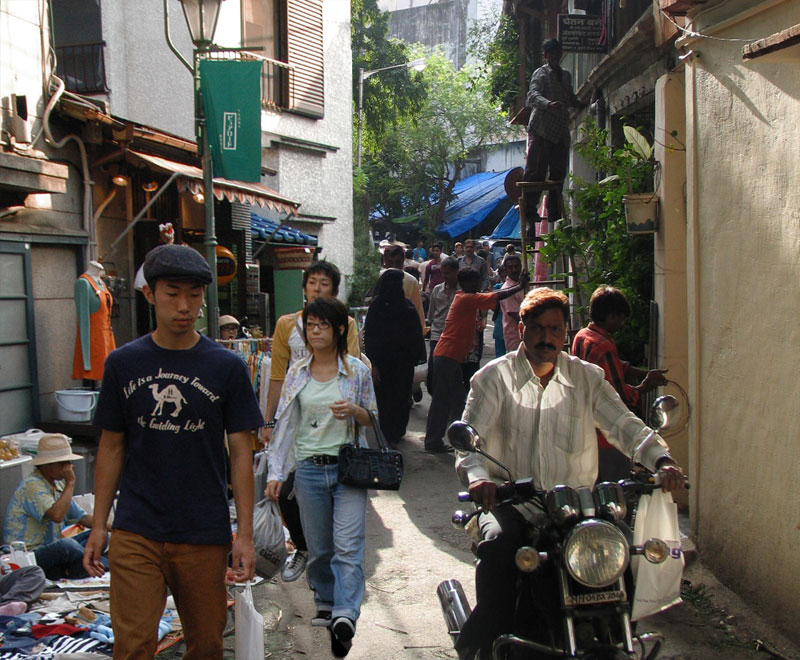
Street Connect: Where Shimokitazawa, Tokyo and Khotachiwadi, Mumbai meet.

Trading Places is a new initiative of Urbanology that re-cycles the name of an older project. The new Trading Places is a space for an exchange of narratives, images and random thoughts on lives and where we live them. At the broadest level it is an imaginary where cities from the past in one part of the world merge and collide in cities of the present and future in other parts – maybe even other worlds. This creates new contexts for drama and desire, opens up possibilities of living lives in newer ways. The idea of trade also implies movement – the exchange of goods and objects, fantasies and dreams that propel us to live lives in motion, make homes in new worlds and then move on and return to familiar places to relive past lives. It focuses as much on the journey as it does on the places themselves. It collapses the idea of the journey and destination, of nomadism and primordialism, of tribalism and sedentary habitats – and allows us to unleash our imaginations in all possible ways. After all, places, cities, journeys are as much about dreams and desires as they are about themselves. And bards, story-tellers, movie-makers, writers have inevitably conjured new worlds, places, habitats and cities, however deeply foregrounded they may have been by drama, personalities and moral commandments.

In specific terms, Trading Places invites storytellers and image makers from all kinds of backgrounds and in any language to help imagine these moments in new ways. To produce narratives and images about journeys and destinations, by delving into the past or the future, by creating drama and sculpting desire in ways that consciously mix and merge contexts, by focusing on the journeys and acts of exchange and conjuring destinations that surprise.

In May 2009 – Trading Places will come out with a publication of the best narratives and images that we find on our website – that launches in October 2008.

The theme for the first round of exchange is ‘Africa and I’. We would like these words to evoke whatever it does, keeping in mind the objectives outlined above. Do e-mail us your entries (contact <at> urbanology.org), before September 15th 2008.

Dharavi 2025

June 5, 2008

Maria is from Rio, Brazil. She is a film-maker who made a documentary on Dharavi sixteen years ago. When she first arrived her project involved a comparative study of Rocinha, the largest favela in Rio, and Dharavi. She had a clear agenda. She wanted to show Dharavi’s industriousness, how relatively non-violent it was and how fast its people were developing their environment.

Instead, she was caught in a huge upheaval – the Great Dharavi ‘Riots’ of 2009 when Mumbai came to a stand still.

The Western, Central, and Harbour railway lines had been completely cut off by peacefully dissenting residents. Her camera had captured instances of police brutality after having filmed the neighbourhood in minute detail, based on two months of conversations with researchers, activists and residents of Dharavi.

Luckily the film and camera survived the violent frenzy, though she herself was badly injured. Her last footage showed an interview with a fiery man, Bhau, who predicted apocalyptic transformations unfolding in Dharavi in the next decade. He spoke on his terrace watching the neighbourhood burn.

She never forgot his words: “They say they will redevelop Dharavi, but look at what they’re doing. These high-rise buildings mushrooming all round us. People who move in are selling and leaving their flats already. They need money because they cannot continue with their livelihoods in these buildings. People living in these high-rises don’t know their neighbours anymore. The street life you love so much will be gone. They say this is development, but it looks just the opposite to me.”

Maria is here again – nearly a decade and a half later. There is a scar on her left cheek – a legacy of the earlier visit. She stares at it in her mirror, in her hotel room near Sion station. The neighbourhood has indeed transformed beyond recognition.

She glances through the widow of her twenty-third floor room, feeling completely estranged from the cityscape around her. She cannot remember ever having felt so uncomfortable in Dharavi, even at the time it was considered to be a filthy slum. In fact, even during the riots.

Her hotel is in one of the nicer looking parts of Dharavi. The well-aligned middle-class condos must have once gleamed when they were freshly built. Unfortunately, the construction methods and materials of the European consortium, which won the bidding for redeveloping this part of town, did not fare well in the roughness of the Mumbai weather. The crisp white had longed turned yellow and green. The smell of moisture floated in the air.

She comes out of the hotel lobby looking up at the row of buildings and remembers how an advertisement on her last visit had promised to turn Dharavi into a “world class township”.

Memories of the energy that electrified the small narrow street flood her mind. She takes a cab to the 90-feet road junction where some of the “Old Dharavi” still remains. To, Kumbharvada – a village belonging to one of the earliest settlers in the neighbourhood had fought tooth and nail against the forced development. They had managed to ensure that their neighbourhood remained relatively unaffected by the plan.

As she walks through the pedestrian area, she sees souvenir boutique shops. There is one advertising tours through the streets of the old neighbourhood. The cost per trip is marked in rupees, yuan, yens, and euros. A colourful billboard gets her attention. It publicizes a theme-park: “Experience the Original Dharavi”, and below “Leather, Pottery and Suing Classes. Register Now!”

billboard2025

Maria turns away.

She spots a few unchanged huts. Nothing could make those potters move, not even the tens of thousands of rupees per head offered by the developers. They stood their ground and now are making a fortune selling “authentic” crafts to tourists. Not to mention the revenue from the camera charge, since thousands of tourists and movie crews come every year to shoot them at work. The Kumbhar youth are no longer potters but professional tourist hustlers. There are rumours that their pottery is no longer even made in Dharavi, but farmed out to industrial potters in a far out suburb.

Apart from the Kumbhars, Maria remembers another community who had been there since before Dharavi even had a name – the Kolis. She discovers they were offered massive amounts of money and most of them have moved out. Besides, the neighborhood has changed beyond recognition. Nothing remains of the village-type houses she had once filmed.

Eventually she manages to find a few old timers who stayed behind. They say they don’t recognize themselves in Dharavi anymore. The “spirit” they tell her, is gone.

She also interviews a few aging activists from a local heritage conservation NGO called SPARC (Society for the Protection of Authentic Residential Centres). They are fighting gentrification, but it has long been a lost cause – they sigh.

Maria learns more from them. Apparently, at first a few adventurers and artists had moved in, thrilled to live in the center of the city, in what remained of the “largest slum in Asia”. Gradually the place gained in respectability and some new type of nostalgia hit the middle-classes. By 2010, in the context of rising nationalism, some intellectuals claimed that slums were the “true Indian vernacular architecture”. It became hype to live in what was seen to be an exotic endangered urban species.
Bohemian youth from Mumbai bought studios in the historical part of Dharavi and set up small shops selling street fashion items and stylish 1990s second hand furniture. Soon art galleries and trendy bars were attracting the intelligentsia from all over Mumbai. Roofs were converted to terraces and gardens. Architecture magazines in India and abroad covered ‘Old Dharavi’ in special issues. There were interviews of all those who claimed to know Dharavi from when it was still a slum.

Maria had learned this through specialized websites at the time. This was now well-known urban history. Today of course, artists were deserting the place. It had become a caricature of what it was when they had first moved in.

The few remaining artists she meets recall the fight they had to put up against city authorities to obtain permission to first organize the National Arts Festival on the streets of Dharavi. Of course, now the event attracts thousands of tourists from all over the world. Initially puzzled by the popularity of the event, the civic authorities soon understood that they could make a lot of money through the tourism economy and the rental of space for vending booths, and eventually took over the control of the festival under the pretext of reestablishing order, safety and hygiene.

Wandering through the historical parts Maria soon finds herself at the edge of the rehab zone, a grimy part of town. The proximity to this vertical slum had for long kept less adventurous settlers from moving in to Old Dharavi. However, thanks to the political pressure exercised by the ‘Dharavi Homeowner Coalition’, a strong police presence had supposedly made this part relatively secure and safe.

Maria soon discovers that the police were hand in glove with ruthless local gangs that had come up all over the rehab zone.

Her walk is interrupted. A man pushes her – and tries to grab her camera. ‘What do you think your doing Miss? This is no zoo – step off and take that fucking camera with you’.

This would never have happened on her last visit! Where are those smiling children jumping in front of her? Where are those busy people carrying goods up and down the streets? Where are those old people inviting her to their home for chai? Everything seems so dull and depressed now.

So – this is the new face of Dharavi. Most of the old residents have left. Bhau too has gone away to some remote forest according to a shopkeeper, near Sion station.

Maria takes a taxi back to the hotel. They are soon stuck in traffic. From the window she watches the decrepit middle – class buildings – most of them twenty-storied tall. They are all over the place with flyovers intertwining through them, full of honking cars. The density of the neighbourhood is extraordinarily high. Even though the population is said to have halved since redevelopment – cars and congestion have only increased.

How ironic, she thought, that old “polluting” local industries of Old Dharavi, including the dantesque 13th Compound with its hundreds recycling factories, were replaced by high energy consumption buildings and crowded roads.

She decides to get off the car and take a break in an air-conditioned Barista. Glancing at the papers she stares at a particular story. There’s a new plan being floated to set up a Mini- SRZ in Dharavi. SRZ’s or Special Residential Zones are luxury apartments only sold in Euros and Yens. This plan – also called the Dharavi Redevelopment Project II intends to raze the decayed rehab zone as well as the middle-class buildings to substitute them with structures made with new construction technology. It includes a project to construct an artificial lake called ‘Mithi Lagoon’ between four new flyovers that would be constructed as part of the project. Each new building would be a minimum of 60 stories high. All the ‘old’ residents would be given new flats in this new township – though –it was clarified – they would occupy a different enclave. They could not mix with the euro and yen paying clientele.

Shocking! mumbles Maria and then stares at the man behind the counter. She recognizes Raghu at once. He used to be her assistant when working on the documentary. It takes him sometime to recognize her but when he does, he is thrilled. He is one of the few original residents still around.

They chat all through for hours and in the evening he invites her to an underground nightclub ‘Zhopdi’ located at the boundary between the middle-class area and the rehab zone. The club was well known, along with many others in Dharavi, for its bar-dancing and raucous crowds. (Bar-dancing had been reinstated ten years ago after a group called ‘Reviving Urban Folklore’ had fought a case and won’).

Tonight though, there would be no bar dancers.

It is a special night dedicated to a flea-market called ‘Navi Chor-bazaar’ that has been a regular affair for the last five years. The streets around the market get filled up with sound systems and all kinds of urban tribes come out, Raghu informs her. Nobody knows who organizes it – but the music is fabulous. A world famous DJ Indecent, an old friend of Raghu’s comes from Mankhurd to play.

Raghu takes Maria inside the club through the back door, waving at the menacing bouncers. Backstage they meet forty-five year old DJ Indecent. He used to work in a cyber-café in Dharavi as a kid. He is the man to know in the club. Maria immediately starts talking about Dharavi and the recent changes. DJ Indecent draws a bitter portrait of Dharavi.

The nightclub is the only place that brings in the old residents back sometimes…for a few hours at a time. They use to come all the way from Khopoli, Pen and Dahanu, but the new crowd is driving them away.

Tonight Dharavi resonates with old music and remixes from the early 2000s. Maria takes out her iAll and starts to film Indecent: “Before it became so popular, I used play the real shit. The crowd was small but they knew what was up. Now with all these kids coming just to be seen I have to play the commercial things they like. You know, you got to earn a living. Really, in Dharavi if you want to listen to the good stuff you’ve got to go to another old Koli enclave. Some kids there organize the wildest parties in abandoned houses.”

The nightclub is circled by flea market stalls selling stuff that once used to be made and sold in Dharavi. From leather purses to chikki to clothes. Against the throbbing music the club comes into its own to drench everyone in a powerful wave of nostalgia. Even Maria cannot escape it.

As she walks home she realizes that the film script she had prepared for the new documentary is useless. She wanted to find the same people she interviewed 16 years ago to document their evolution in the redeveloped neighbourhood. But instead she only finds missing people and broken lives. As if the development of the striving area she remembered had been aborted mid-way. All she gets is bitter interviews, shoots of urban decay on one side, and of tourists spending their hard currencies in Old Dharavi on the other. Everyone she meets is so cynical; the reality around her seems so fake. Dharavi doesn’t belong to its people anymore, she hears herself speak.

She feels an intense disconnect and then begins to doubt her ideas. Is her memory playing tricks on her? Is she idealizing the past? The summer night is hot and humid yet she shivers. Nothing makes sense.

Bhau’s words come to her mind. Just as she is thinking about where he could be, she trips on a body sleeping on the streets. It rises. She apologizes rapidly and as she is about to start walking off, the man yells “Maria!?”

Taken aback she comes closer and recognizes Bhau’s former liftman. She is thrilled and greets the old man warmly. Her hand makes for her iAll and a long interview ensues. He soon informs her that Bhau now lives with some nomads in a forest that still miraculously exists on the Konkan coast. A sense of hope rises in her. She has to find Bhau. Tomorrow she will take the train.

She gets back to her hotel room feeling low and elated at the same time. She washes her face in her tiny bathroom lit by a flashing neon.

She falls asleep the moment her head touches the pillow. Images of her old documentary mix with the images of today’s visit in her dreams. She sees smalls crowded streets, proud people, police, riots, blood and fire, high-rise buildings emerging from dust, the thug who harassed her, his sad dark eyes staring.

She is in a forest. A laughing Bhau guides her through an environment that feels strangely familiar. It is a restless jungle, everything is moving in every direction. Trees become huts; people get in and out and flood the ground like monsoon water. She smiles in her sleep.

(Published in the Mumbai Reader, UDRI, Mumbai 2007)

« Previous Page