
Khotachiwadi Graphic
August 25, 2008
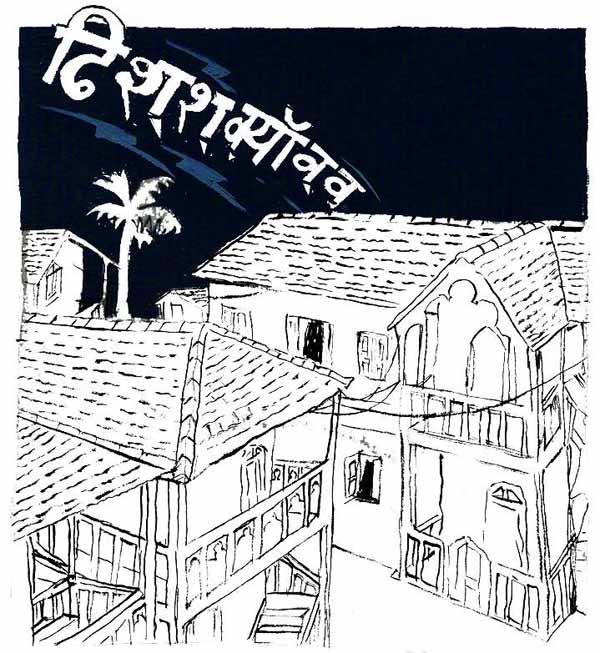
Mumbai, like many colonial cities is full of lost, invisible streets and forgotten neighbourhoods. Some of them are completely reinvented, a few get improvised upon and most simply destroyed.
When the Khotachiwadi neighbourhood project was in full swing (2004 – 2005), this small Portuguese flavoured village in Girgaum, South Mumbai, yielded many arguments. Mainly about questions of urban density and growth, about the need to understand that villages have a valid place in cities and that more often than not, a village, a slum or a low rise habitat are considered synonymous, without good reason.

During the project, lead mostly by the residents, we began by evoking ‘heritage rhetoric’, locating Khotachiwadi within the debates about the city’s past. But that was only to subvert the discourse of heritage altogether. At the end of the day, the project insisted that the neighbourhood story should be primarily written into the city’s future. It consciously rode on fake nostalgia to push forth a sheer activist agenda. It talked of Mumbai’s diversity of built forms and the need to acknowledge the variety of architectural styles that make up its neighbourhoods.

The arguments were articulated with confidence mainly because they were accompanied by the imaginative beats of fictional and non fictional stories that circulated in Khotachiwadi. These stories brought to light the virtual neighbourhood, made up from the imagination of its inhabitants, that overlay on its twisting, narrow streets and its ornate bungalows. They emerged from the memories of those who grew up there, merged with the fresh perceptions of those who are still growing up there to eventually become prophecies of sorts.
Either way, they underlined the anachronism and the naturalness of Khotachiwadi.
Something that became really vivid only by drawings and graphics.
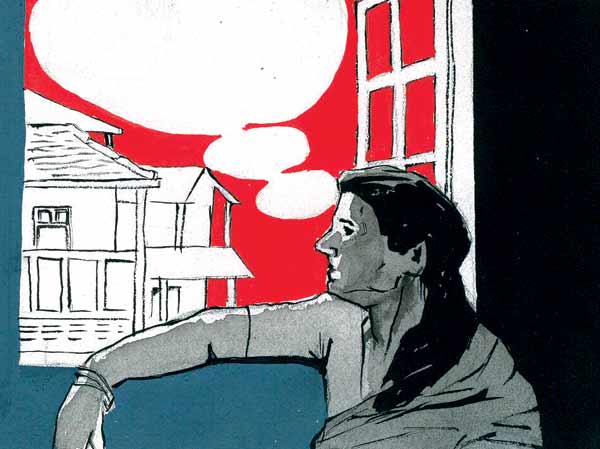
The comic story, forever young, the perfect accompaniment to urban legends, best encapsulates the subversive impulses of the project. Impulses that seem to be ostensibly concerned with the past, but in reality are looking straight ahead.

Graphic Credits:
Abhijit Khanvilkar and Prashant Prakash Jadhav
I am a journalist in Mumbai keen to know what happned after the graphic novel on Khotachci wadi was done
Have there been any follow-ups? are more novesl of this natureplanned for other parts of Mumbai?
Thanks
brian
Comment by brian de Souza — September 24, 2008 @ 12:36 pm
hello,
i am a final yr. student of architecture doin research on khotachiwadi, girgaum, mumbai. my basic intention is to analyse the village. i hav gt some drawings of the community bt i need 3 get the plans( ground flr, 1st flr, roof) of each house of the wadi 4 doin d same. i cud do the documentation myself bt if d drawings r already prepared, i wud save a lot of time and cud directly focus on analysis which is my basic intention. if u knw ne source by which i cud get the drawings, it wud b very helpful 4 me. if the drawings would b used in my thesis then d credits would be given to the source.
hope to get a positive reply,,
thanks
Devashree
Comment by Devashree — May 27, 2009 @ 1:12 am
hi ..
i m a final year student from school of interior designing,C.E.P.T. university .
i m doing the thesis on interior of khotchiwadi’s houses .
for that i need the email ID or any contact no. of Devashree to get her help .
it is a kind request to help me.and waiting for your positive , immediate and supportive reply.
thanks.
Regards,
Vidhi Gandhi.
Comment by vidhi — February 25, 2011 @ 1:46 pm