Prawn Nagar – Dharavi, Mumbai

December 30, 2009
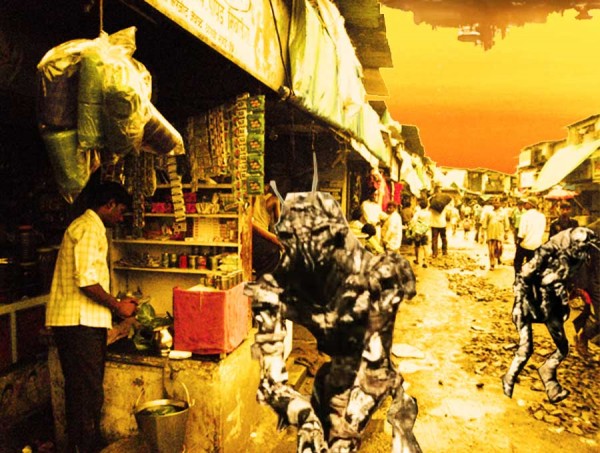

Softer landing for District 9’s Prawns in Dharavi

If the aliens hadn’t found their way to District 9 in Johannesburg but turned a few latitudes east, across the Indian ocean, over a tiny sliver of land jutting out obscenely and defiantly off the v-shaped south-Asian sub-continent, their fate in cinematic history would have been something else.

Imagine the spaceship hanging over the hot and humid city of Mumbai, specifically over its most mythified neighbourhood – Dharavi.

Its enterprising residents would have absorbed the presence of the craft and its seafood resembling occupants with relative ease. The metallic tentacles of Dharavi’s legendary recycling industry, would have eventually penetrated the most sophisticated barriers and shields to slowly and steadily dismantle the alien structure for absorption into a million-dollar industry that does not allow even the most ordinary piece of scrap to go unsold. How could tons of exotic metal be left to hang in mid-air? Notwithstanding any degree of technological superiority…Bits and pieces of the metal would have found their way into spare body-parts of second-hand cars, ships, toys and assorted machinery. The unusable celestial leftovers may be left to hang in space with no one caring much for aesthetics. Instead somebody would start a little sight-seeing tour by making an improvised crane-bridge to take curious onlookers and tourists for a closer look.

And what of the aliens themselves?

They would have managed to build a tiny little habitat between the crevices of the impossibly dense habitat. Maybe on the toxic watery edge of the mangroves. Not having access to tinned cat-food in Dharavi, could well have found the fish in the sewage water a worthy substitute, considering that a few older residents still fish there even now. And they would have found something worthwhile to do for sure. Their presence would have inevitably fired several wild allegations.
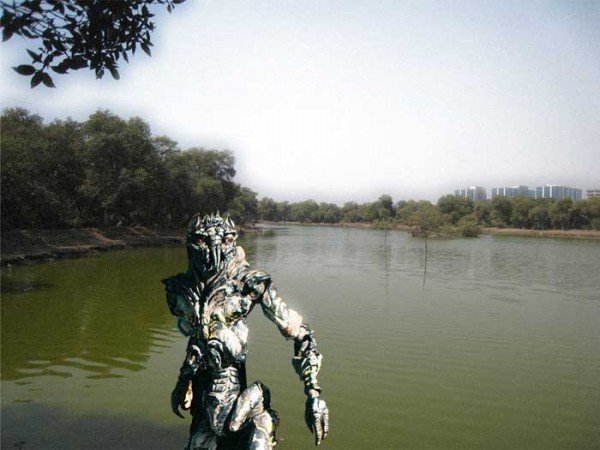

Prawns are said to be hiding in the Mahim Creek near Dharavi

Economically they could make leather goods in Dharavi even more globally competitive with a dash of their own technology. Of course, this could mean a legal crackdown – since scientific tests about the safety quotient of alien substance aren’t possible. But Dharavi’s grey zone economy would take care of that and eventually the aliens would become integral to the neighbourhood’s oldest and most prosperous economic activity, getting swallowed into its several residential, community based enclaves, taking the disputed figure of eighty –eight nagars to eighty nine.

It would have been difficult for any curious journalist to actually discover Prawn-nagar as the boundaries between enclaves are not easy to discern. The only way she would know she’s arrived would be on seeing a bunch of young prawns playing cricket with local Dharavi boys. They would point her out to a set of structures around a small clearing where a few adults would be having a heated argument with neighbours over the right to build a shrine in memory of their lost home – in the form of a replica of their ship.
The shrine would be the only way to connect to their past. No chance of returning home now – given the remains of their emaciated, skeletal, once proud extra-terrestrial space vessel. The other reason nobody would want to return is because the cost of homes in Dharavi would have increased four-fold by now.

Typically, the temptation of making more money eternally overrides any possibility of return.

The journalist would most likely be reporting the possibility of a riot because a prawn-girl and a local – earthling boy had fallen in love and were nearly lynched by both communities, only to be contained by an elderly local activist trying to broker peace.

The prawns would soon be part of political demonstrations trying to save Dharavi and a politician would eventually have got them voting rights. Against the will of a local right-wing party which tried hard to fight their presence tooth and nail – equating the aliens with worse – those from the states of UP and Bihar.

Sooner or later though, a clever prawn leader would have won over the local right wing forces by declaring Marathi as their earth-tongue. He would then have proceeded to pledge support to their drive against the real aliens – the hapless migrants of U.P. and Bihar.

That would pretty much have been the story.

Look out for regular updates from Prawn-nagar, Dharavi, Mumbai on airoots…
Kolhapur Photo Diary

December 28, 2009

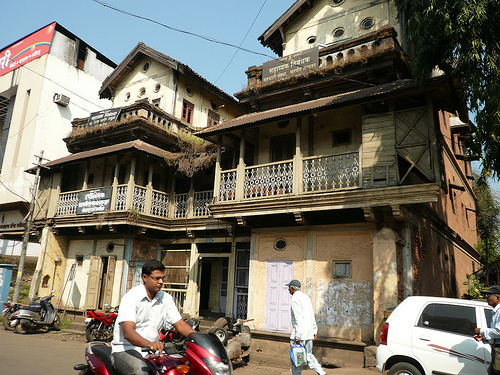
Kolhapur is a small town in the south-west region of the state of Maharashtra, not more than four hours drive from Goa. It is part of a district with the same name, on the prosperous sugar-cane growing belt which makes the rural areas relatively more prosperous than the town itself. Kolhapur is known for several artisanal goods such as leather slippers, pots (there is a local Kumbharwada, potters colony right in its inner city area) and once even had a bustling movie industry (around the early and mid-twentieth century), besides being a well known patron for classical music. It fascinates us not as a town alone, but as an urban system that includes a well-off country side and some distinctive architecture thanks to its princely lineage, ruled as it was by a king until the Indian independence. But most significantly of all, a group of enthusiasts who love their little part of the world. We found an architect who conducts studios with international students along with doing his practice, a high level of civic pride with the presence of several action groups including ‘Kolhapur Calling’ and several young people trained in Kolhapur’s well known educational center – Shivaji University – and its college of architecture D.Y. Patil.

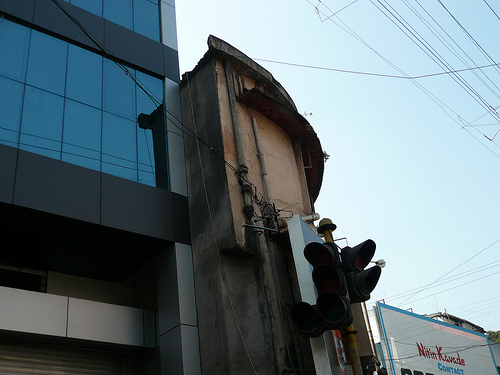
Local Architectural Flourishes

Local Architectural Flourishes

The ubiquitous black stone frequently used in coastal Maharashtra

The ubiquitous black stone frequently used in coastal Maharashtra

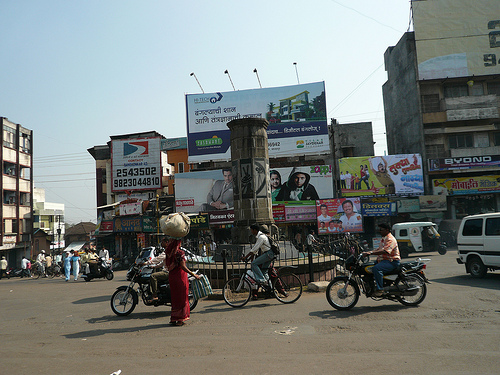
4166885609_20a36ff776

Lost Lady

Lost Lady

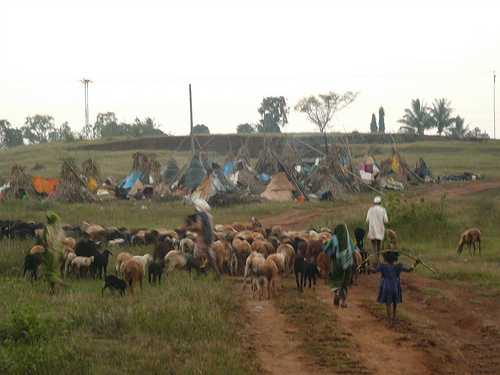
On the fringes, but in the urban system? Dhangar Nomadic Shephards

On the fringes, but in the urban system? Dhangar Nomadic Shepards

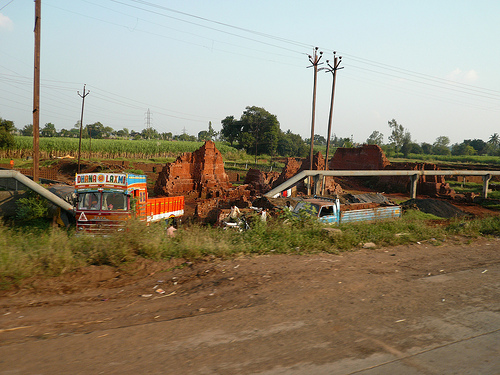
Brick Kilns - made right outside the city

Brick Kilns - made right outside the city

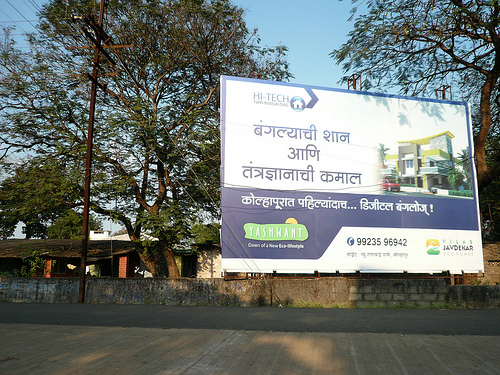
Digital Bungalows: Thats what the poster says!

Digital Bungalows: Thats what the poster says!

One Worker, Many Faces

September 22, 2009

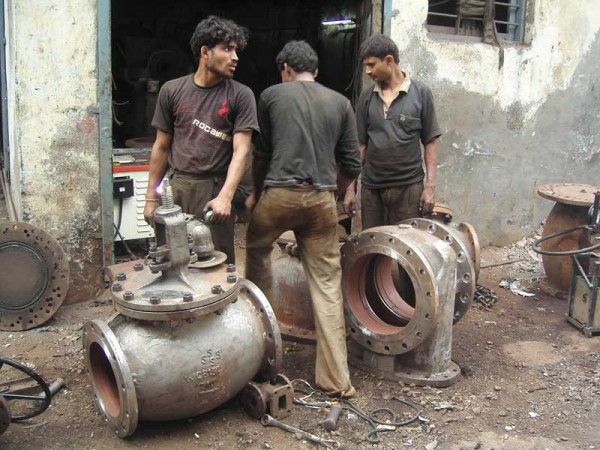
Metalworkers, Dharavi
Dharavi: Informal Economy, Industrial Work

Our perspective on Mumbai is informed by the historical role that the city’s informal sector played when the decline of the textile mills started from the 1980s onwards. That was when some activities of the industry got decentralized and dispersed in several poor neighbourhoods all over and around Mumbai. Notably the ‘loom town’ of Bhiwandi in Thane District. Several other of Mumbai’s informal settlements absorbed processes of the industry – especially stitching and production of clothes.

It is well known that Dharavi has been a traditional manufacturing base for leather goods, pottery and food processing. But it also housed a local service sector that grew around its own vicinity. Besides, it provided subsidised housing for hawkers and poor retailers servicing large parts of the city. The tool-house typology that we talk about essentially looks at Dharavi as a composite of residential, manufacturing and retail activities as expressed in its built-forms.

This composite economic framework works equally well when seen in the context of Mumbai as a whole. The city grew around the docks – a service sector – in the 18th and 19th centuries and that sector continued to hold its own all through the 20th century – even when manufacturing was at its heyday.

It must specially be noted that industrial manufacturing in India was a complicated affair given that it was yoked to a colonial economy and accompanied a forceful displacement of artisanal production practices. In fact the mass migration of artisanal communities to cities such as Mumbai saw the emergence of neighbourhoods such as Dharavi – primarily through the experience of the leather workers and potters.

It is true that along with the gradual disappearance of gigantic 19th century industrial production complexes, the city witnessed the vanishing of a hundred year old evolving history of dignified labour practices. However, some would say the whole experience was unsustainable and so the dissolution was to be expected – especially when seen in the light of the larger role of industrial manufacture vis-a-vis traditional modes of manufacture.

Neighbourhoods like Dharavi lived parrallel lives to industrial sectors in Mumbai from the 1930s to the 80s – testifying to the fact that while manufacture was central to Mumbai’s history, so was the composite – service-artisanal manufacture economy of Dharavi. When formal industrial manufacture declined, Dharavi absorbed and subsidized the processes within its fabric.

We see Dharavi and other spaces in Mumbai as those which encompass a range of different co-dependent economic activities – manufacture, retail, services and others (in the case of Dharavi Koliwada, even fishing right until the 1990s)! We certainly dont see manufacture as ever having left Mumbai. And we dont see it as ever being the sole economic factor in the city’s history either.

Post the publications of Cambridge historian Raj Chandavarkar’s two classics, ‘The Origins of Industrial capitalism in India – Business Strategies and the Working Classes in Bombay – 1900 – 1940’ (1994) and – ‘Imperial Power and Popular Politics in India’ (1850 – 1950) (1998), there has been very little scholarly study on Mumbai’s economic life.

Given the city’s socialist intellectual moorings (hard to imagine today that it even existed!), most of the scholarship has been split between straightforward studies of financial practices, some very good analysis of the city’s informal economy, a lament on the decline of the organized manufacturing sector and wistful goodbyes to the golden history of industrial rule of the twentieth century.

For most of its life, the production of wealth has never been Mumbai’s problem. The fact that it does not seem to translate into the city’s lived experience has been the real issue. Even when the city’s textile mills thundered in full bloom, when the docks were stretched to their full capacity and the middle-classes commuted to banks, colleges and offices in neatly ironed clothes in not-so-crowded BEST buses and local trains, the quality of life for workers was not at its best. Chawls and tenements were made livable because of the enthusiastic and robust cultural resources that communities themselves bought to the city from their rural homes. It was certainly not because their unions always succeeded in having their demands met. Only because we constantly compared city lives to what was left behind (which was often worse in terms of social and cultural status) that the city felt it was providing a better deal to its working classes.

It is that very resource – working hard for very little thanks to the cultural and community support of migrants that made Mumbai’s poorer neighbourhoods what they are today. Far from being cesspools of crime and decay, they produced schools within a generation of taking roots and participated wholesomely in the city’s economic aspirations, besides rising to the occasion in terms of fulfilling the city’s economic needs of production and subsidized retail.

When the grand industrial mills were killed by real-estate greed, these marginal neighbourhoods – from Bhiwandi in Thane to Dharavi, from the streets and gullies in Mohammedali Road to the tenements and habitats that mushroomed around manufacturing units in Kandivli and Vikhroli, continued to subsidize the city through hard work and community back-up.

The reason why we don’t use the appellation ‘worker’ to the millions of the city’s daily wage earners who don’t work in the formal sector is because in the history of modern cities, organized manufacture has a special status – especially since it is linked to the progressive practices of labour reform.

However, for a city like Mumbai that does not take us very far. All through its history, the docks, the services of finance, industrial manufacture, neighbourhood retail, consumption, street hawking, artisanal production (especially leather and pottery) and even fishing jostled for space and attention. There was no evolutionary peak in terms of industrial manufacture and a revolutionary organization of its workforce (which by all accounts was a caste-complicated affair).

As we become more and more aware of the city’s multi-dimensional economic history, we acutely start to feel the need of a vision that rewards the most basic and unself-conscious worker who makes the city tick with hard labour and community support – even if she does not have the legacy of organized industrial history behind her.

It’s only when we do that, and allow them to live with dignity in habitats of their choice, can we hope to create an urban future that is closer to a world of lived equality rather than one that is enshrined in slogans and posters.

Of UFOs and Futuristic cities

March 24, 2009

One of the most dramatic consequences of the current economic recession in the United States is the physical decline of once prosperous cities. By decline one does not simply mean a couple of run-down streets but the total collapse of neighbourhoods. While the reputed availability of homes in Detroit for less than US $ 10,000 seems like a worst case scenario the reality is darker. Apparently, near Cleveland abandoned homes are being auctioned off at even lower prices and in some cases are being stripped off their relatively more valuable accessories to make reasonable margins.  Even in richer cities over-built spaces that cannot be maintained are being re-used and adapted for other services. Shopping malls are being converted into under-used public libraries (which may not be such a bad thing) but what really disturbs many concerned citizens is the rising tendency of civic governments to cut costs by shutting down or reducing the strengths of schools, public transport and public hospitals. To add to the dystopic scenario one has also come to frequently see the public distribution of free food for the hungry and blankets for the homeless in some big cities.

Of course for countries like India which still live comfortably in two worlds – with starvation and thirst on the rise in the lives of as many people as exist in the entire United States on one hand and a still growing and relatively prosperous economy on the other  – the lessons to be learned are considerable.

There is even less reason to invest in cities that drain energy and are expensive to maintain. Absolutely no reason to invest in a landscape that is filled by the urban equivalent of empty calories – mirage buildings and structures that are fuelled by a volatile speculative economy which pushes millions to live in infrastructure deprived neighbourhoods.  And simply no value in promoting thoughtless real-estate development projects that build on manipulated market realities.

Of course official discussions about the state of the world rarely mention the holy cow of construction related activities and investments as being major factors responsible for heating up the economy in the first place. The fact that these provided a false shield of expectations and aspirations that justified over spending and over-investment is something that cannot be empirically proved in a discussion that is so centred on symptoms. These are usually about financial mismanagement and the presence of what NYU based Prof. Arjun Appadurai  slyly refers to as UFOS – or Unidentified Financial Objects. However as urban engaged citizens we can certainly take the hint and express what we experience.     

What is undeniable is that everywhere in the world all those who have been resisting the whole-sale destruction of neighbourhoods and habitats that were being eyed hungrily by real-estate developers and construction companies are now heaving a sigh of relief. From New York to Panjim, from Mexico to Brasilia, the one thing that even recession hit concerned citizens feel happy about is the temporary respite their efforts have received thanks to the economic melt-down. At one time, money coming from mysterious sources would flow like water into huge construction projects making any attempt at reasonable debate and discussion futile. Now in many cases – especially where the recession has had a stronger impact – there is silence. In countries such as India which are still chugging along, the situation is a bit more unpredictable. Things could go either way.

Yet countries such as India are in a special position to make fresh choices. They simply need to accept the fact that there are several counterpoints to markets connected to the shimmering ethereal one in ’stockland’. There are real energies that flow through the streets of big cities and are energized by ordinary citizens going about earning livelihoods and using resources judiciously out of sheer necessity. They have ably demonstrated their ability to make workable habitats out of nothing. For once let’s trust these energies and see how its users mobilize resources to keep improving their environments and create great cities the likes of which have never been seen before. 

Delhi Turns

March 2, 2009

Recently Bollywood has been producing a spate of movies set in Delhi. Not just set there but with unmistakably Delhi characters and often with the ancient city itself playing out a fairly animated role. While Mumbai has always paid cinematic acknowledgements to Delhi, (Chashme Baddoor is a notable ancestor of Khosla Ka Ghosla), its only recently that you see the city emerging with an urban cinematic identity that is its own.

Not urbane in the way Indian cinema used the grand cosmopolitan colonial settings of Calcutta and Bombay but through a more honest and grittier acknowledgement of its surrounding rural context. In Oye Lucky as well as Dev D, you see a Delhi that has all the rough-edged brashness of small town north India which rejects the sophistication that an older urban sensibility demanded. For someone like Pankaj Mishra – the celebrated archivist of small town Indian crassness (see Butter Chicken In Ludhiana) – Delhi may well turn out to be the ultimate urban nightmare. But there is reason to believe that such a Delhi may well represent a more honest and heart-felt urban sensibility for India. Which may not be such a bad thing, if we distance ourselves from colonial aesthetics for a bit.

The new cinematic representations of Delhi go straight to its underbelly and expose its twin connections with neighbouring small-town ferment and global aspirations. The city emerges as a cross-section of several highways; ancient trade routes, modern tourist pathways, caste mobility, continuous urbanization of its villages and a major point of international connectivity as well.

The consequent moral uncertainty, competitive politics and crass consumerism allows for much more creativity, open-mindedness and experimentation than relying on more conventional urban indices – Manhattan-like landscapes which our Mumbai-based films love showing when telling their moral tales of fashion and the media industry. Just portraying a glamorous story against a backdrop of tall buildings does not make for a truly urban fable.

The unfortunate fact is that more established (and relatively sophisticated) cities in India are full of parochial political parties, moral policing and goondaism. It is Mumbai, Bangalore and Chennai which see more demands to curb dancing, drinking and having fun compared to Delhi. Of course – Delhi’s cities remain dangerous, especially for women, thanks to the same blurring of boundaries that makes it such an edgy place – its cops are as notoriously corrupt as any other in the country and the city’s infrastructure is still nowhere near completion – not withstanding the metro success story.

Yet – Delhi seems to be at an exciting time of its contemporary history. In fact it is located at the same historical point when Bombay, Madras or Calcutta were still making themselves over at the turn of the last century – when people came to them from all over the sub-continent and could still make those cities theirs since no one had yet written the rules.

The contemporary urban vacuum that existed in Delhi all this while – which made Mumbaikars and other colonial city wallahs turn their noses up at its village and small town characteristics – is being filled in by a rough, gritty edginess that makes any city alive. An urban quality that paradoxically comes with the freedom of not being urbane and sophisticated in a contrived way. As long as Delhi can keep its moral police at bay, as long as it can yield stories that are genuinely rebellious, as long as it transcends parochial politics, it can be a real inspiration for the new emerging urban India that is more firmly connected to its rural and small town roots. As Mumbaikars we hate saying this – but that’s the way it is!

« Previous Page