
Homegrown Homes
March 14, 2012

Construction site in Shivaji Nagar, Govandi. Photos Prianka Chharia.
Every home tells a story – its making and its use, the way its dwellers have shaped it over time, the moments they lived inside, what it used to be, what it may become.
When inhabitants describe their homes, it is their own story they are telling. As if they are enmeshed in the spaces they inhabit. Over time, users fill their homes with memories and fantasies, which become invisible furniture harder to move than the heaviest of shelves.

A rented flat in the Raphaels’ house, where the URBZ office is located. Photo by Miriam Bonino.
In that sense, a house is more than a physical structure –it is an assemblage of people, affects, materials and activities. The ‘form’ that this assemblage assumes is dependent on the availability of material, physical constraints, social aspirations, rules and regulations, economic opportunities, aesthetic sensibilities and so on. The way these elements relate to each other produces the drama of neighbourhoods and the stuff of cities.
At the convergence of many elements, the house is a dynamic and possibly unstable construction; a mashup of disparate impulses and imperatives that pull it together, and sometimes apart.
In some of the neighbourhoods where we work, houses are so responsive to the life and activities that inhabit them that they seem to keep morphing before our eyes. They fluently take on new functions, get extended and consolidated. Sometimes they are destroyed and rebuilt on the same footprint in only a few weeks.
Take for instance, the house from where we write these lines. It was originally built in the early eighties by the Greater Mumbai Municipal Corporation along with dozens of others. Each building began as a simple arrangement of corrugated metal sheets. They acted as transitory shelters for displaced slum dwellers. The first residents soon left, replaced by fresh migrants.

The Raphaels in front of their home in Dharavi’s New Transit Camp. Photo by Brooks Reynolds.
The Raphaels arrived 25 years ago from the southern state of Kerala. They used the house to run different types of businesses. In turn it became a tobacco stand, general store, gift shop, ice cream bar, Chinese takeaway and a mobile phone shop. About fifteen years since their arrival, the structure transformed into a brick and cement house with a little toilet attached. Three years on, it sprouted two more floors. The space now includes three businesses, four families, a few seasonal workers, an embroidery workshop and our office – a little rectangular room with whitewashed walls and windows that stares into a low-rise roof-leaden landscape of corrugated cement sheets, blue plastic sheets and tiles.
The surrounding brick and cement forest is made of tens of thousands of such stories. Together they form the untold urban history of Mumbai, a saga of neighbourhoods ‘in-formation’, building, working, selling, making, shopping, resting, sleeping all over the city.

Above: Roof of Utkarsh Nagar, Bhandup, Mumbai Northern suburb. Below: A street of Utkarsh Nagar where Konkan lifestyle was reproduced. What may look like a slum from above is a village inside.
While the official mind still frames them as slums, in reality, most of these neighbourhoods aren’t slummy at all and none is ‘informal’ in any sense of the term. Many of them have historically developed from villages, nearly 200 of which are officially recognized by the city today. These villages are part of an earlier moment, when fishing and paddy cultivation were part of the landscape of Mumbai’s northern regions.
Since they pre-dated colonial notions of urban planning and functional zoning, these habitats easily absorbed newcomers and activities. Plots of land were converted into settlements like it continues to happen in many rapidly expanding cities around the world. The blurry edges of the metropolis seamlessly merged from rural to urban, making these categories irrelevant and inadequate.
Tokyo, where strict definitions of villages and cities were not imposed onto land use, is another city that managed to retain its ability of combining high-density dwellings with agricultural plots in metropolitan areas. The same tendency to accept diverse uses has produced its remarkable urban fabric, shaped by low-rise, high-density neighbourhoods in which local businesses rub shoulders with small homes.
In Mumbai likewise, the malleability of the village seems to have survived in many of the city’s neighbourhoods. They stand outside the ideological spaces of urban planning and design. Yet, they cannot be termed informal. They are socially very organized and deeply enmeshed in the city’s economy in spite of being under tremendous political and legal scrutiny. Local culture and religion play an important role in shaping them. Sacred sites often determine their spatial organization, a pattern recurrent in habitats ranging from Indian villages to Japanese neighbourhoods. The stability conferred by such strong cultural anchors allows habitats to be constantly reinvented, without losing their local imprint.
The creative upgrading and reconstruction of houses has sometimes been compared to the transmission of myths. Myths are retellings colored by new personalities and with added features making them perpetually relevant to changing contexts. This plasticity of form and its impermanence is what allows for creative architectural practices as well as powerful myths to live on.
If houses resemble myths, one of the most potent storytellers of contemporary urban India is the contractor. A dynamic figure, he is the embodiment of the rags to riches tale that permeates his world. He has lived and worked on small construction sites – his technical training ground – often from a very young age.

Construction worker on a roof in Dharavi. Photo by Francesco Galli.
Working where he grew up, he knows every street and corner, the travails of every inhabitant and the flexibility and restrictions of each rule and regulation that entrap him. He works closely with upwardly mobile households telling them of the latest techniques and how these can be factored into their small but determined savings. His business model relies on good reputation and strong local networks. He is friends and enemies with local municipal officers with whom the emerging landscape has to constantly play games of legality with.
The contractor represents a rich possibility of transformation, using existing vocabularies of construction. To start a dialogue with him with regard to technology, design and aesthetics is a sure way to enrich the language of the city’s architecture.
Mumbai’s built forms are distinctive. Its colonial structures originated as weird mashups of European and Mughal fantasies, its villages were enmeshed in urban growth and its neighbourhoods were physical reproductions of small towns, with quaint vernacular flourishes.
All through the process, the figure of the contractor played a vital role. In non-government, community lead construction projects, it was the contractor who dominated. The difference between then and now is that earlier the question of design involved in building processes was infused by cultural confidence.
It is difficult to recreate that spontaneity in today’s unplanned neighbourhoods when they are trapped in an official rhetoric of ‘slums’ or are only seen as wasted real estate. Yet, it is well worth stimulating creativity there. It is only when a new story is told, which understands the particular language, respects its main players and engages with its political economy, that neighbourhoods ‘in-formation’ can grow into their full potential.

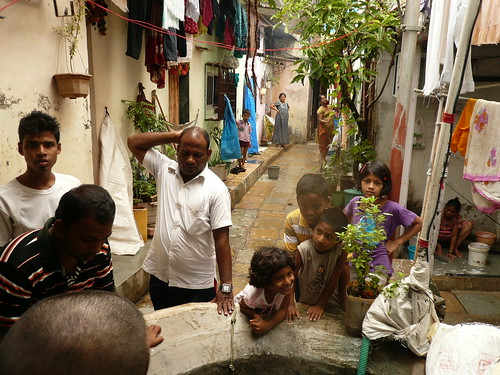
A street in Utkarsh Nagar, Bhandup.
Sharing our own fantasies with contractors is one way we build trust and open up collaborations. Strange stories are exchanged, sometimes bordering on sci-fi; of the great megalopolises of Tokyo and Mumbai, mysteriously merging into one another, tales of cyborgic structures, where the house becomes a technological extension of the artisanal tools of trade. We also get mutually stimulated by exotic notions of design and aesthetics and feel the potential for new mashups to emerge with complete disregard of any purist architectural style.
The more such stories are shared, the quicker will perspectives change and more effective the transformation of such neighbourhoods. The coming together of worlds that have been for too long separated by their own economic and social Berlin Wall is long overdue. Vulnerable First World economies and Third World resiliency are increasingly discovering each other, offering new opportunities for urban practitioners on both sides.
As urbanologists, we get inspired by the places we live and work in and find ways of engaging with them. Our practice involves entering into the life of the neighborhood, becoming one of the characters, getting involved in the ongoing drama, moulding and being moulded by the unfolding events, mixing, merging and mashing up the different strands that emerge with every moment.
Editorial Published in DOMUS 955 (Italian Edition), Feb 2012