
To See the Queens
April 10, 2009

New York’s second largest borough, Queens, has a little secret tucked away in its sprawling suburban style landscape. It’s known as Willets Point, a stretch full of scrap yards, auto repair shops, small businesses and waste processing sites that jostle each other on roads full of pot-holes. There are no sewers or sidewalks and the neighbourhood is known to get wildly flooded during heavy rainfalls. It has recently come in the limelight because of its proximity with the new Citifield Stadium, home of the New York Mets. The city now wants to redevelop it. The many businesses of Willets Point oppose any redevelopment project that would disregard their interests and their efforts of turning this leftover space into a lively industrial area .
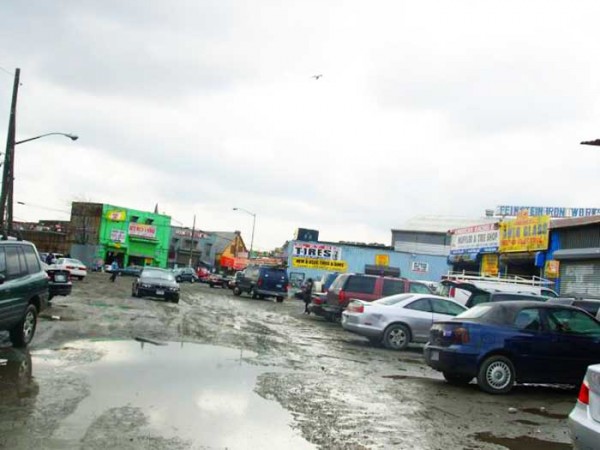
Of course, this is only a work space. No one lives here. People commute and the place gets deserted at nights. Nevertheless, for us as Mumbai-based urbanologists – the visit, lead by Roberta Brandes Gratz, author of ‘The Living City’, was more than insightful. Here was a slice of urban life that connected New York to other cities around the world in which raw economic necessity and a tougher set of choices shaped the landscape more than the luxury of planned architectural interventions that is otherwise New York’s signature.

Roberta Brandes Gratz and her “urbanist” ride.
Willets Point is of course up for transformation by development lobbies – or at least there was a talk about it till the economy imploded. Now – like many urban sites around the world things remain in limbo. The fact is though, hundreds of workers involved in the formal and informal businesses that make up this neighbourhood are aware that along with development – everybody wants better roads, drainage and facilities – there will be a fair share of displacement too.

As is the case in several cities – the people who suffer the most from such moves are also those whose ‘wretched’ lives are evoked as the very reason for validating such transformations. And yet nothing really changes for them, wherever they may happen to be.
In all likelihood, several of the workers in Willets Point also live in those neighbourhoods of Queens in which issues of overcrowding, illegal merging of economic and residential activities and illegal businesses have become a major cause of civic concern. All around Jackson Heights (also known as little India/Pakistan/Bangladesh/Nepal) houses and garages are packed with immigrants from Asia and Latin America. Many of them have come to the US to work and send money back home and therefore value a cheap rent more than space and intimacy.

Rahul’s flair brought us right to ‘House of Spices’, the biggest distributor of Indian food in the US, opperating from Queen’s Willets Point.
From the outside, as you walk through the streets of Queens you would never guess the immense ferment going on beneath. According to Seema Agnani, an urban activist affiliated to the not-for-profit initiative ‘Chaya’ the anxieties of local civic governments are linked to the mismatch of their expectations with the newly arriving populations who have their own notion of what is appropriate urban living.
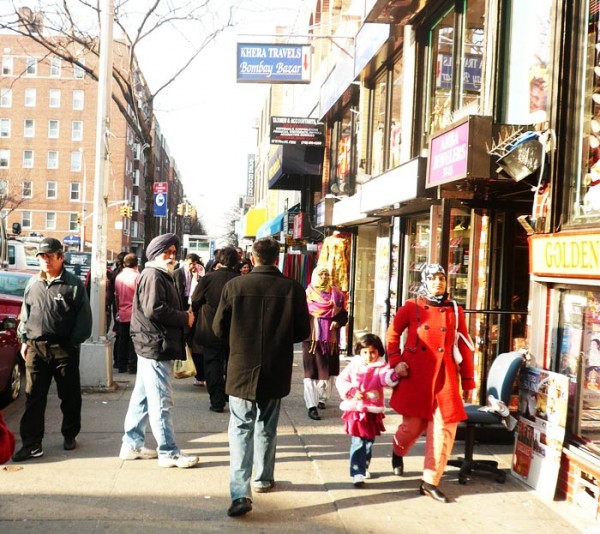
Jackson Heights, Queens. Queens is the most ethnically diverse borough of New York City.
Thus, a landlord may see no problem in allowing larger families to occupy a space ostensibly designed for a family of four. But this is enough reason for the authorities to issue a notice and declare the residents as illegal occupants.
Similarly, it often happens that the sheer need for survival forces people to run businesses in residential zones that are not commercial areas forcing the emergence of a grey, underground economy.
Strolling through the seemingly quiet tree-lined streets of Queens, we found it intersting that the same words which are used to justify displacement and redevelopment in Mumbai – overcrowding, immigrant populations, informal economy – are also part of the vocabulary of New York city planners and developers. As traveling urbanologists we always learn more from similarities than differences.
Movie on Willets Point showcasing residents’ views