
Mess is More
April 1, 2009
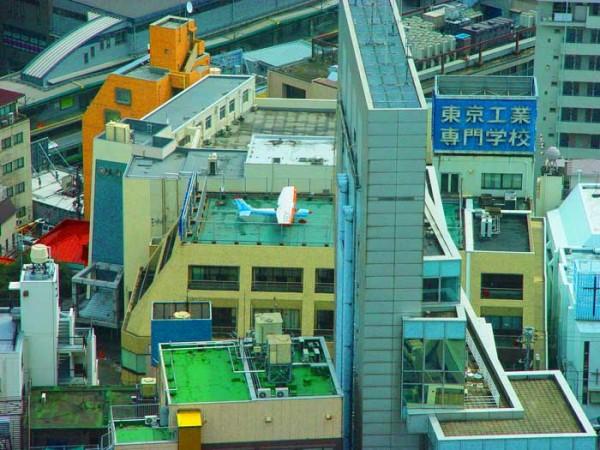
Shibuya, Tokyo: The Japanese capital, which is also the biggest urban agglomeration in the world and a model of efficiency, is often described as an urban mess.
“Mess” belongs to the same four-letter words family as “slum”, “junk” and “dirt”. These words describe an useless, problematic and probably stinky thing. Something that needs to be dealt with rapidly and drastically. They justify disgust, white-washing and other slum clearance.
We have been so unfair to mess. It doesn’t hide or lie. Mess is the new pure. It leaves everything in the open. Think about any of the hundreds of construction sites in a city like Mumbai: the large hole in the ground lets you see the canalization system – or the absence thereof -, tents or shanty cottages where workers live, raw material, cables, machines everything that goes into the building and all the garbage produced by the construction.
Mess is everything together at the same place and at the same time. It is confusion (with-fusion) to the fullest.
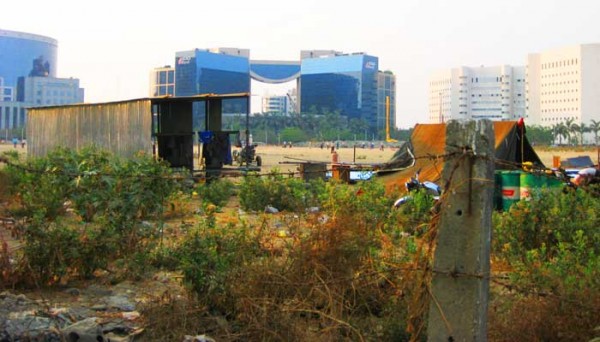
Construction site at the Bandra-Kurla Complex, the new financial centre of Mumbai. Migrant construction workers stay in tents and shacks on the site. The prehistory of many slums is often a massive construction project.
95% of our DNA for which no function has been found is called “Junk DNA”, inferring that it is useless. This is how our psychology functions: We dismiss what we cannot grasp. Nothing unsettles us more than not being able to recognize familiar patterns and functions. When things are merged to the point that we cannot recognize what they are, we call it junk or mess. In architecture, Rem Koolhaas theorized junkspace as the sum total of the architectural and industrial achievement of modernity. The important word here is “sum”; in the sense of a big pile of things morphed into each others. All parts make sense individually but juxtaposed they become a weird anti-structure, connected spatially but disconnected in every other way, at first sight.

Willet Point: A beautiful messy, informally developed, and amazingly economical auto repair cluster adjacent to the new CitiField stadium in the borough of Queens, New York City.
Anthropologist Mary Douglas said that dirt is simply ‘matter out of place’. Meaning that more often than not, what constitutes dirt is not it’s intrinsic properties. It is about where it is located. Something gets classified as dirt when it is found where it should not ‘rightfully’ be. Thus the category dirt is immediately linked to evaluation and subjectivity. Everything that is dirty becomes part of a larger scheme of things of which we approve or disapprove. She also suggests that since dirt is so much about the subjectivity of placement, it always relies on metaphor and allegory and shapes our worldview in subtle ways.

African street vendors selling affordable Prada bags and more in Barcelona.
The fear of dirt comes from perceptions about its ability to change location. Dirt is often perceived as animated or full of animated things that are out of control and potentially transgressive. Because these things are not easily identifiable, they are always threatening. Who knows what might jump out of the dirt pile and bite your neck? Consequently, it either needs to be fixed – or destroyed – especially when it starts taking a life of its own.

Tepito Market in Mexico City. Probably the largest ‘informal’ street market in the world. These clothes were sold for 1 peso.
City planners often label entire neighbourhoods as slums, by which they mean dysfunctional and informal habitats that should be redeveloped. Slums are often imagined as threats to the city: terrorism, crime, disease. Large chunks of the city which have been ignored and left to rot for so long, suddenly emerge as autonomous organisms within the city. What’s more, they keep on growing and spreading their tentacles everywhere. They recycle and produce, turn leftover spaces into markets, even enter your homes and screens -till you realize that you are part of it. The informal economy is on your screen and in your wallet.

Collective laundry space used by slum dwellers living next to Banganga Tank in Mumbai.
What makes slums look so messy is their dense piling up of uses and functions. And since everything is so interconnected, social networks, economic activities and the built fabric, it is impossible to distinguish one thing from the other, as if each part was contaminating the other. The standards response is to negate it all. Forget generations of incremental development, creative responses and collective arrangements. This is just a SLUM, one big dirty pile of things that are fusing into each others and confusing us a little more everyday. It should be cleared, masterplanned and redeveloped with neatly segregated and orchestrated functions. Live here, work there and play somewhere else. Or even better: work here and live out of sight.

Last village (labeled as a slum) to be cleared in Honk Kong in 2001. In the last years, dwellers were forbidden by the authorities to repair their housing and do any new construction.
From the world of germs to those of immigrants, from hygiene to unsuitable, dangerous habitats – the discussions of urbanism and dirt are full of mixed metaphors and wrapped morals. Playing with these words and investigating their psycho-cultural meaning could perhaps help us understand the way they have been used to justify all types of abuses. There is more to slums than meets the eyes. We should probably stop bugging on the appearance of slums start understanding them as relationships and processes in motion responding to context and aspirations.
Brilliant. And is the case with so many brilliantly-put perspectives, simple and obvious–in retrospect. Thank you. Were I to pick one article from airoots recently that made the point that one man’s slum is another’s community, this would be it. Which is saying a considerable bit. You all do a tremendous, much-needed service.
Comment by Lucy Sloan — April 8, 2009 @ 4:52 am
Thank you for putting in words, what I experienced in Ahmedabad. I am going to write my Bachelor-Thesis for Architecture exactly about this. Influenced from the media I wanted to find out with my first visit: what can be improved (concerning the architecture). After leaving I was rally surprised, how well everything is organized, how clean and creative a slum can be. Writing the thesis will not be as easy as expected, but hopefully inspirening and eye-opening. Thank you for inspiring me!
Comment by Elli — June 20, 2009 @ 9:22 pm
Great article. Elli, I too am working on a thesis involving this exact issue. We should chat. Shoot me an email. jking10@pratt.edu
Comment by Jessica — August 23, 2010 @ 3:13 pm