
Magical Planning
October 5, 2008
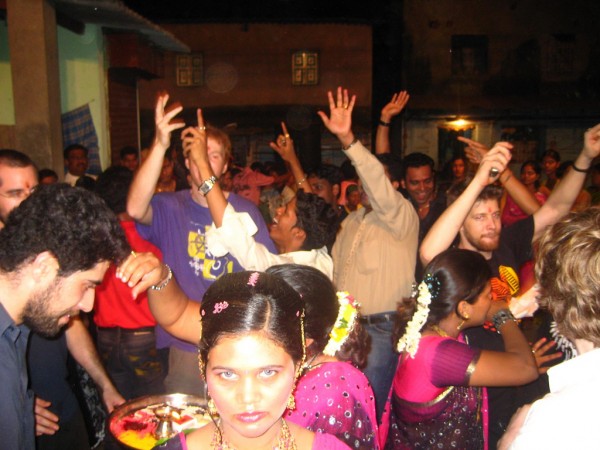
Celebration of the Holy Festival, last day of the Urban Typhoon Workshop in Koliwada-Dharavi
Sorry Manuel Castells and David Harvey and all those great theorists who have taught us how capital and technology produce the city and constrain also its future development. Apologies to Paulo Freire too who’s tried his best to wake us up from our delirious “magical consciousness” to teach us that we are “subjects in and with an objective world”.
You really are great and we are trying, but we just cannot (and don’t really want to) get liberated from our imagination. We love the world of possibilities more than the world “as it is”. We know that “in theory†the two are not incompatible, but in practice, they don’t fare that well together. So while you go ahead to keep describing it, we’ll imagine it the best we can.
Language and imagination are the best tools we have. And now the mighty Web allows us to drop ideas right in the reader’s heads, enhanced with special graphics, sound and moving images. After having tried both, we are convinced that unrestrained imagination has much more transformative potential than analysis. Don’t get us wrong. We love theories, they are beautiful narratives.
But as Yehuday Safran said, the world is shaped “above all through language, and its sublime, monstruous imagination.” We support all the truth seekers. Seeking truth is a beautiful project to undertake, so beautiful in fact that it really doesn’t matter if it ever gets realized. But sometimes another path is equally fruitful. What we like is trying out our imagination on reality to see what works. And imagination is at its best when it is naive, magical and wild.
Look at cities. They are first and foremost the products of collective imaginations. Dreams of grandeur and power produce avenues, churches and skyscrapers. Immigrants create heavens for themselves in far away lands, which they dreamt about on their way. When they cannot actually create heavens, they dream of going back with some money to recreate them there.
These heavens are simple really – homes that are the realization of life-long dreams. At the very least, people use imagination and decoration to make their shacks feel special. As Hiroshi Hara said, “There are as many worlds as there are rooms.”
It is also clearer today that communities are imaginary. More than ever before, we live in a deterritorialized world, where the outside and inside have supposedly lost their meaning. Resorting to the imagination is therefore a matter of survival. It is especially when localities get produced by an exterior context that inhabitants dont control, that they need to use their imagination to generate a context from within. A context that can be based on historical narratives, cultural affinities or fantasies – whatever one chooses.
It is worth fighting for an imagined space, especially if it is a stage for human relations and interactions. But it is not worth fighting for a space that restrains or limits imagination in any way. There is no point defending a place that cannot be transformed; unless it is a place worth preserving for the story it embodies, such as a ruin (especially if it is haunted with good spirits). Places must inspire or they must be rethought completely!
The Web is the greatest creation since the letters of the alphabet. In fact the Web is a product of the wild imagination of Tim Berner Lee who dreamed of hypertextuality to communicate the ideas of his time – just like Gutenberg shaped the printing press to communicate the ideas of his. The power of the Web is that it provides the most advanced space possible for the textual/visual expression of imaginaries. Moreover it connects ideas to each other on an infinite plane. What’s more, it acts as a mirror between the virtual world of imagination and the physical world. And it works both ways!
Much more than simple text alone, it allows others to contribute and evolve one’s own imaginary. Just like you could add a comment under that post or copy-paste it onto your blog. These simple moves enhance the potential for materialization of ideas into the physical world.
Here is a concrete example.
There was always a point in time during the organization of the Urban Typhoon workshop when the whole event was nothing more than a Web page. It was no more than wishful thinking by a small group of people. At that point we didn’t have any money to get the guests over, commitment from the local community was at best uncertain, and we had almost no registered participants.
Nonetheless this vision, expressed in the form of a decent Website, made people believe that it was real – and they registered. Contacts were done via email, but it was only on the day of the workshop that people actually materialized. Participants never doubted that the event was really happening, but we only knew that it was real when we saw them actually apparating, one by one – notwithstanding the fact that we were the ones to have invited them in the first place!
It was always harder to convince local people that the workshop was really going to happen. It was even harder to convince them to participate, even though that was the whole idea to start with. We had been invited but community members in the first place but most local people had no interest in participating until the the outsiders popped out of the World Wide Web with their eyes full of great expectations and a pre-emptive love for the neighborhood.
The outsiders had no problem imagining that a fantastic event was going to happen in a fantastic place. They connected the place to the event, while the locals could not connect the fantastic event to their everyday, banal place. At first they simply could not imagine and refused to believe, but that was only until they became overwhelmed by the enthusiasm and faith of the numerous believers.
The materialization of this event comforted us. We felt kicked and gleeful, in our back-of-the-classroom-dreaming pupil approach; our favourite kind!
Next thing in line is the Koliwada Design Cell, which will be the fantastic vehicle that will take us on a journey towards the realization of a participatory development project for Koliwada. All the walls on our way will disintegrate! Lets try out some magical planning.