
An interview with SANAA
October 5, 2008
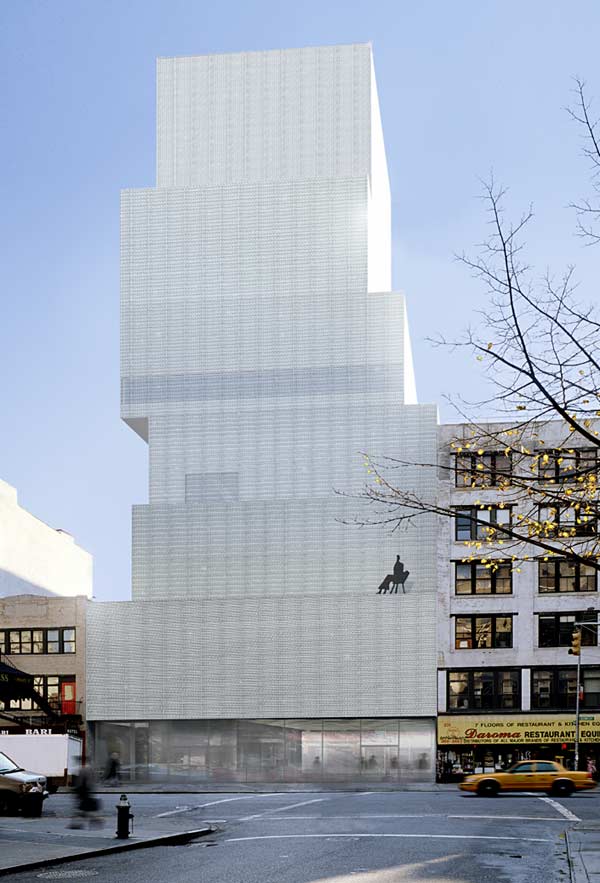
New Museum, New York City which opened in December 2007
SANAA (Kazuyo Sejima + Ryue Nishizawa) is one of the most en vogue architecture office in Tokyo. They recently designed the New Museum in Manhattan. They also designed the Learning Center at the Ecole Polytechnique Fédérale de Lausanne (EPFL). Here is an excerpt from an interview we made for the Taiwanese magazine EGG, which published a special issue on SANAA in Summer 2007. For the full interview click here.

Gallery space in the New Museum
How does the New Museum project in New York relate to the city?
N: New Museum was a difficult project. It is difficult for a museum to be so open to the outside. It needs walls to hang up the paintings. An enclosed space is necessary. One of the striking features of the New Museum is that it is right in the middle of the city. It is not in the outskirts like many museums. Also it doesn’t exhibit classical art, it is very contemporary. This is why they wanted to be in the middle of the city. So the question for us was how to open up the museum in this context.
So how did you manage?
N: We opened up the ground floor, people can get in and out for free, go to the cafe or the bookstore.
S: The design of the New Museum is based on the concept of shifting box, which allows us to create an open skyline. The building literally opens up to the sky. The shifting boxes create terraces allowing people to go in and out in the middle of the building.
N: As people go up the atmosphere changes. Each floor has a different relationship to the city and offers a different experience. The ground level is very messy, in direct contact with street life. From the top we can see the skyline of New York and the Chrysler building. Of course the clients wanted walls to exhibit art, but we wanted windows because the view is so interesting!
In Japan buildings are typically not built to last more than 20 or 30 years, whereas in Europe architects don’t usually think about their work as temporary. How do you view your work in time?
N: Most of the Roman buildings are gone, except for a few bridges and the Pantheon which are still standing. In Japan some ancient temples remain thanks to maintenance. We expect our buildings to stand for a really long time, but I cannot say forever. Maybe a hundred years at the maximum. But the city has a longer life span. The city lives through many generations.
S: With many changes.
N: Yes, I feel nothing changes in European cities. The notion is that the city must preserve the same form forever. I go to Asian cities and I see everything changed since the last time. The population is growing. The life of the people is changing and the city is changing with it. In China and Tokyo I see many things happening, many changes. This is like moving with the life. This is a very different viewpoint. In Europe the idea is that cities must stay the same, in Asia cities must change. I cannot say which one is the good view.
Tokyo is the biggest city in the world and yet it is often described as a collection of small villages. What is your idea of Tokyo, thinking specifically about the notion of scale from very small to extremely big?
S: I use a very limited part of Tokyo, so in this sense Tokyo feels like a village. I cannot say I have an overall image of Tokyo. Physically I cannot tell what are the boundaries of Tokyo.
N: Tokyo appears to be very much disorganized but actually it is a city which works really well. There is no train delay. Every morning huge crowds are moved in a very orderly way from one point to the other. Very few crimes are committed in Tokyo. It is actually very orderly, even if the landscape looks disorderly. Some Westerners come to Tokyo and say this is chaos! Maybe it is true but people manage it very well.
S: It is a chaotic but also extremely dynamic place. Somehow it looks generic and not well organized but so many things happen in Tokyo. One bad aspect of Tokyo is that people cannot spend time without money, which is also related to the physical reality of the city. But since the economy was bad for so long, we gradually learned how to enjoy the city without much money!