
The future is in the periphery
September 22, 2008
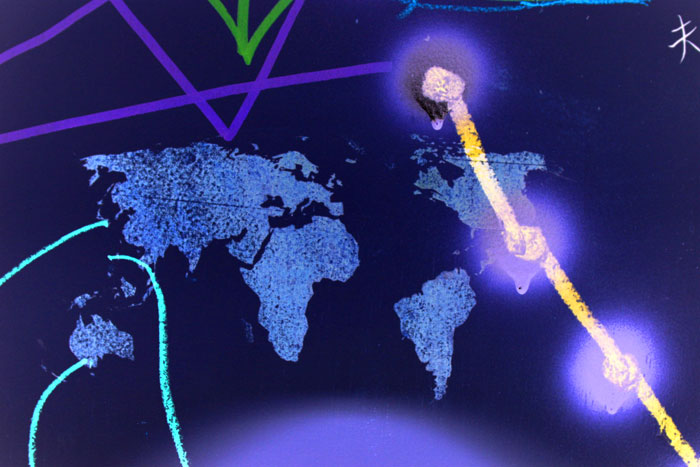
This sentence stayed with us since we first heard it from Yehuda Safran, one of our mentors and inspirations. We were at a workshop in Taichung, the third biggest city in Taiwan, which aimed at producing ideas for a leftover industrial site called TADA. While the site was not itself in the periphery of Taichung, the city certainly was in the periphery of Taipei the capital city, and Taiwan itself is in the periphery of China. At a time when all eyes are turned to the urbanizing dragon, what meaning could this dead site in an unknown city in a doomed country really have?
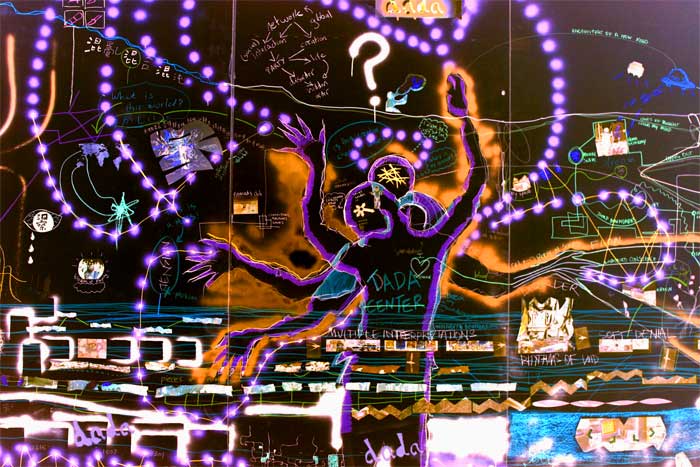
Well, it probably has as much meaning we can infuse it with. We imagined how much of a place of creation that old industrial site could be and devised 99 rules to preserve freedom and stimulate the imagination. We were so stimulated by that place onto which we could project our wildest dreams that we produced a small book, the TADA Manifesto, in four days. For a moment that abandoned brewery in the middle of nowhere was the most inspiring place on earth. It was full of potential because we could make it ours.
New York was creative when no one was looking. SoHo, The East Village, the Lower East side in Manhattan and more recently Williamsburg in Brooklyn were cultural hotbeds for as long as the city was bankrupt and these places were ignored. That’s when people like ABC No Rio and CBGB could squat buildings and Futura were spray painting subway tunnels, when artists that are now established, recognized and often not so inspired anymore, were still crackheads, rebellious gays, punks, bums and squatters. There was nothing there to see. No hype and no romance. These much venerated places were at the periphery of a city on the verge of a breakdown.
Now that New York is universally recognized as a creative city all we see instead of artists are art directors, graphic designers, ad producers and their like. Established and wannabe communication professionals, commercial artists and other marketers come enmasse to such cities, where they know there is an industry that can use their know-how. Rather than breaking new grounds this so-called “creative class” recycles tired clichés and remixed proven formulas. New York is good at attracting people from elsewhere, but doesn’t breed much local talent anymore. Of course just like everywhere, pockets of innovation remain. New York is big enough and its periphery is full of creative tension and driven people. But as a rule, creative work seems to happen where no one is looking.
Some type of “observer effect” seems to be at work. Once too many people start observing and pointing out how creative a place is, it stops being creative (Berlin is recognized as one of the most creative city in the world right now. That must be the beginning of the end). Nothing messes up the creator’s work more than attention to the public and the media, let alone the market. What will they think? Should I be more/less explicit? Is this over the top? How can I justify my creation? How can I make it a commercial success?
The creative process is profoundly egocentric, free and subversive. It seems to come from a visceral need to project the self onto the world, but only really for the self’s sake not for the world. The world can go to hell. Indeed the creative act is usually destructive, at least the risk of destroying what’s around can’t stop it. As the creator dives into the self and indulges in the most gratifying self-expression, he abandons himself and the world to his creation. As if the creation had to happen at all cost, even at the expense of the creator’s own existence. Creation drives the creator, not the other way around.

Take for instance what is happening in the periphery of Geneva at the moment, at the CERN, where scientists have built the world’s largest and highest-energy particle accelerator complex (LHC). They try to confirm the existence of the Higgs Boson, a hypothetical massive scalar elementary particle that exists only in their theories by recreating the condition of the big bang. The experiment was supposed to start this month but because of technical problems it is delayed. We’ve heard that some scientists had concerns about the possibility of this experience creating a black hole that could grow and swallow the universe. Of course CERN-commissioned safety reviews have concluded that the risk of complete destruction of the universe is extremely small, even smaller than the possibility of a technical problem happening at the LHC.
After all, it would be a shame to call off the experiment after so many people put so much passion into it, right? In fact they can’t stop it. They are absorbed already. The drive to create is what keeps us going in the face of emptiness and what drives us into it. When there is nothing but a hole at the center, our best hope is the periphery.
Download the Tada Manifesto (41 MB)