
The Tokyo “default†model
August 26, 2008
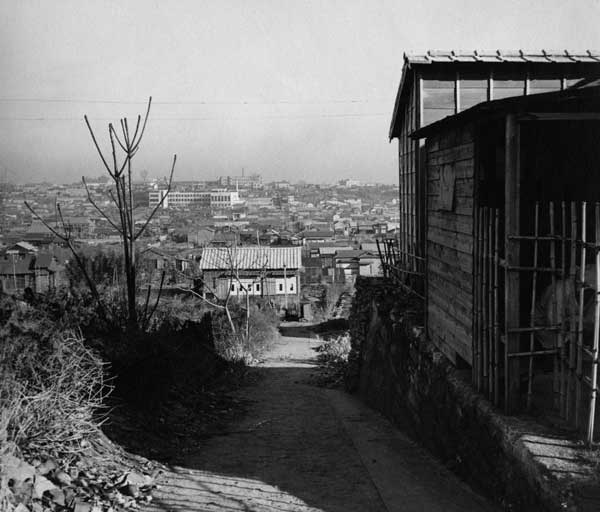
This photo, taken on higher ground and looking across a valley, gives an idea of the extent of Tokyo’s destruction caused by the Allied B-29 fire bombing of the city. Ohio State University – Archives
Tokyo represents a default model of development for developing cities around the world. An alternative vision can be generated by the study of the “shadow history†of Tokyo’s urban development. That is, by looking not at the history of urban planning in Tokyo, but rather at what developed outside the plan.
Greater Tokyo developed gradually from the Edo period onwards. The central area of Tokyo was very much planned from the start. The periphery however largely grew spontaneously. Villages surrounding the city were swallowed up by the sprawling city and small lots of farming land were gradually converted to residential, commercial and industrial uses.

Tokyo hut dwellers 1955, photo by Horace Bristol/Three Lions/Getty Images
During the Second World War firebombs dropped by the Allied air force destroyed most of Tokyo. The Ministry of City Planning had been producing ambitious urban plans based on modern planning theory since the 1920s. However, for a number of reasons, including the pressing needs for economic redevelopment and shelter, the lack of financial resources, and the absence of legal mechanisms for land acquisition by the state, the plans were never implemented . The government focused instead on industrial and infrastructure development to support the economy, leaving the reconstruction of residential and commercial areas to local actors, who rebuilt the city from scratch.
In the suburbs therefore planning was usually limited to water supply and railway transport system. For a long time “traditional Japanese urban development and management strategies were still wide still practiced and quite effective†(Sorensen 2002, p.149). Moreover, the government relied extensively on local self-reliance before and particularly during the war, and to a lesser extends afterwards. All these factors contributed to create strong neighborhood organizations and a sense of community and local identity.
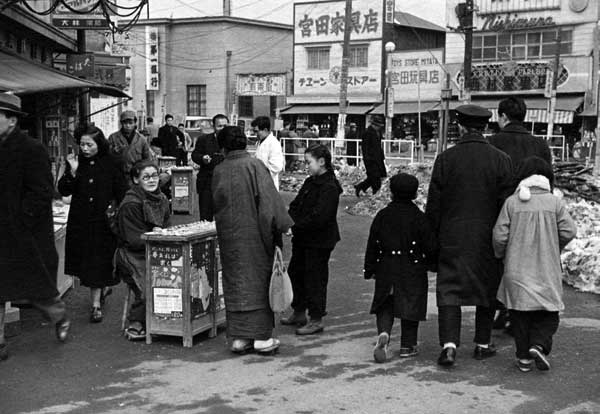
Shibuya: The shoppers wear the wartime period heavy winter garments. The seated lady is selling lottery tickets, a device encouraged by the Occupation as a stimulus to the domestic economy. Ohio State University – Archives
This pattern of development has basically been maintained even till today. This explains why Tokyo has both; one of the best infrastructures in the world and a housing stock of great variety. The residential urbanism of Tokyo is characterized by low rise buildings and high population density. “In spite of some deliberate planning attempts to widen major streets and introduce reinforce concrete buildings the majority of neighborhoods were characterized by flimsy wooden constructions, and slum-type housing dominated many areas until the 1960s†(Carola Hein et al 2003, p. 26).
While the architecture has incrementally been upgraded, the urban typology is still very much informal and messy-looking, with extremely narrow and labyrinthine streets, shack type structures built with metal sheets and wood. What can be mistaken for urban mess by the casual observer (especially if that observer happens to be a classically trained planner or architect), is actually a highly efficient and complex urban organization. As Ryue Nishizawa of Sanaa put it in a recent interview, “this is not master planning in a Western way. The city is developing without a master plan, in a natural way… Tokyo appears to be very much disorganized but actually it is a city which works really well. There is no train delay. Every morning huge crowds are moved in a very orderly way from one point to the other. Very few crimes are committed in Tokyo. It is actually very orderly, even if the landscape looks disorderly. Some Westerners come to Tokyo and say this is chaos! Maybe it is true but people manage it very well.†(Nishizawa [SANAA] 2007).

Neighborhood retailer in Shimokitazawa. Photo by Save the Shimokitazawa.
An important characteristic of the “Tokyo default model†is mixed-used zoning. This was, again, not a planning choice, in fact, it could happen only because there was no central plan. Many positive outcomes mixed-use have been observed – such as safety and continuing liveliness of central city areas. In spite of being the largest metropolitan area in the world (32 million people), Tokyo is also one of the safest cities in the world. (This is clearly the case in Dharavi as well as many writers – including Kalpana Sharma in ‘Re-discovering Dharavi’ – have pointed out). Small-scale industrial activity, such as printing, wood work, textile manufacturing, and so on can been seen all over Tokyo’s neighborhoods. This leniency towards mixed-use has permitted to preserve small-scale family type businesses in one of the most advanced economy in the world. It also prevent the high degree of residential segregation along income lines that one finds in the US.
The Tokyo model suggests that it is possible to upgrade informal settlements in situ, by focusing on infrastructure development and relying on community self-determination. Master plans are needed for infrastructure development (roads, water, electricity, sewage), but local urban development is better determined at community level, with the help of experts and the technical and financial assistance of the government and the private sector.

Low-rise high density in Shimokitazawa. Photo by Save the Shimokitazawa.
The accidental Tokyo model for the organic city can liberate thousands of urban neighborhoods in Asia, Africa and Latin America from otherwise being condemned to being referred to and treated as slums. It can break through Mike Davis’s apocalyptic vision that weighs under its own predictions because of a weak conceptualizing of the category ‘slum’ itself, which reflects a devastatingly circular logic that traps millions of the urban poor into a situation of forced victimization.
Tokyo challenges this. It connects the raw material of traditional urbanism (resident-authored, socially and economically enmeshed in local contexts) to the most high-tech, almost futuristic experience of urban life. Its railway network inter-weaves thousands of neighborhoods into a large metropolis without violating inner-urban worlds too much. While its high-rise pockets and neon-lights may blind one into believing that it is an evolution of Manhattan and Singapore, a deeper look at Tokyo (escaping the large avenues and getting lost in the narrow streets hiding behind) reveals a city that is gloriously untidy and medieval in its essence. This untidiness is really an expression of its human scale, fidelity to low-rise high-density structures and dynamic neighborhoods that are experienced as organized spaces even if they do not look it.
However, Tokyo too has long being victimized by a “global urban design styleâ€, that we could refer to as the generic city, which completely dominates the mind of city planners and developers in cities all over the world. The resistance underway in Shimokitazawa epitomizes the struggle between that vision and the desire of local communities to preserve the urban character of their neighborhoods. After all, before we decide otherwise for the future, Tokyo is only a “default†model born as much out of the capacity of central planners to develop an outstanding infrastructure as by their incapability of master planning the biggest megacity in the world and the consequent necessity to defer urban development to local actors.
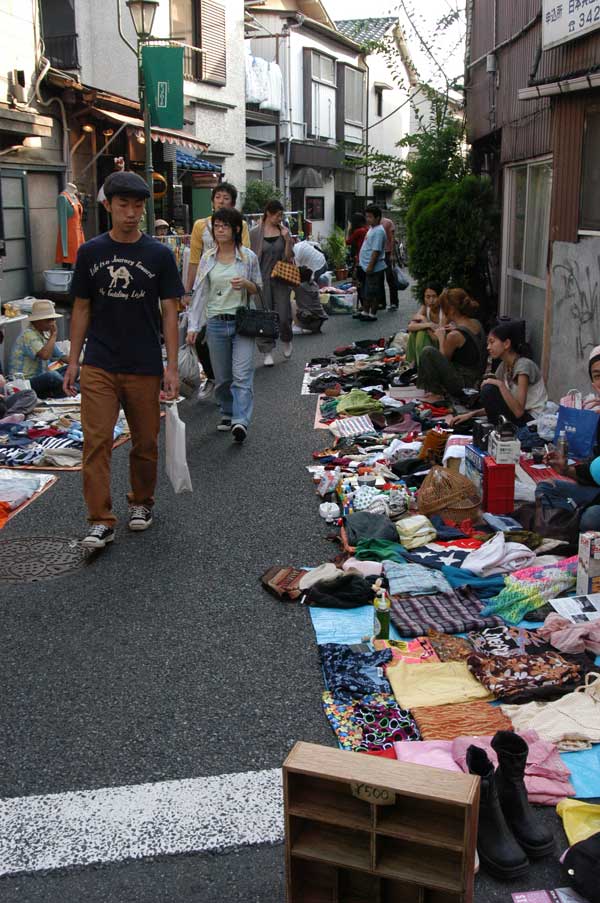
Local actors taking over in Shimokitazawa. Photo by Save the Shimokitazawa.
interesting interpretation.
i am in final days of phd at university of tokyo studying the effect of the zoning you describe on suburbia and see much the same thing even in small city suburbs of japan. it is fascinating to me that the same pattern of mixed land use can be found in low density areas where population and economic pressures are not as intense as in tokyo.
i think it happens because zoning here is cumulative rather than prescriptive, and because the zoning is in the building code instead of urban planning laws. which means currently the entire nation is governed by the same 12 highly inclusive zones, no matter if it is city centre or urban fringe.
at the same time i think too that the lack of crime and the trains and so on really only work because this is japan. in another country and another culture there is no reason it would necessarily work automatically. a lot of cultural control is in play here that makes the city liveable.
Comment by will — August 26, 2008 @ 6:29 pm
Very insightful. So was your comment too, Will, especially the part about the zoning being part of the building code instead of some urban planning laws. I would certainly like to learm more, do you know where I can read more about this. i find it partcularly interesting since i´m from Chile, and like the rest of South America, the urban model here tends to copy the american suburban model.
Comment by Daniel — August 27, 2008 @ 11:28 pm
there isn’t so much available in english unfortunately. the best book about planning in japan is by andre sorenson, called “The Making of Urban Japan: Cities and. Planning From Edo to the Twenty-first Century”. he takes a slightly darker view of the effect of this situation however as the result is sprawl – sprawl with mixed land use, but still sprawl.
Comment by will — September 8, 2008 @ 4:57 pm
I am living in the asagaya/koenji area in suginami burrow of Tokyo. It is one area where there is still some of the old character but it is changing fast. The big thing with codes and zoning to some extent is safety. Houses are so close that when there is a fire the neighbors feel the heat literally and with tatami mats and drunk people falling asleep with cigarettes well .. you can see the problem. emergency vehicles cant get down these narrow streets and have to repel off neighbors balconies just to get to injured people as well.
Comment by Mark — October 4, 2010 @ 1:52 pm