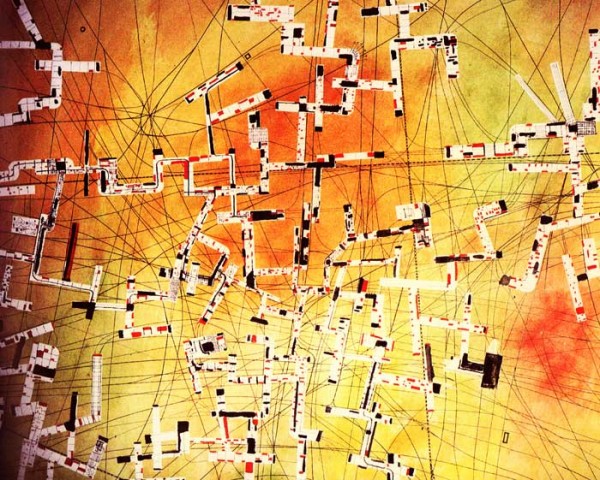
Urban Fables 2.1: The Downpour

November 28, 2010
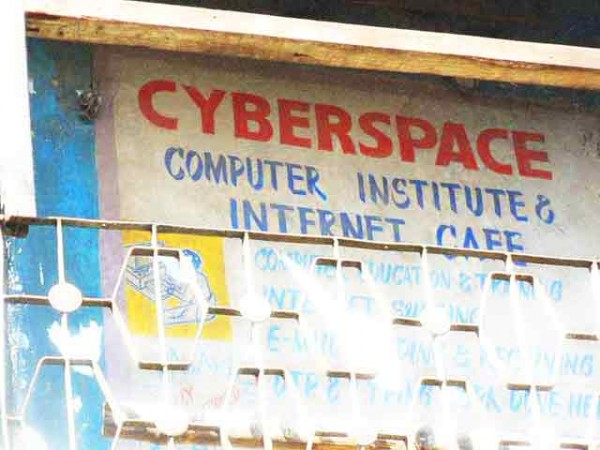
cybercafe

This is a series of new fiction pieces that accompany a longer narrative we are working on.

1. The Downpour

The seven-computer cyber cafe was housed in the smallest room possible, testifying to the words hung on the wall near a window right next to Neel’s terminal.

‘This physical world of ours is unimportant, secondary, immaterial’. The words, in golden hue, circled the image of a guru with a white beard and wise eyes.

All of them – words, guru and enlightened halo – were embossed on cheap calendar paper, laminated and given new life by Neel, the cyber cafe owner, only last week. Additional words on the image, ostensibly also voiced by the guru, claimed that the physical world is so immaterial that it can fold inside out in ways that you cant imagine, just like a flexible, lithe dancer’s body.

That part made no sense to Neel.

The guru also happened to be his grandfather, now dead. He would have been safely forgotten, if it had not been for Neel’s dad who found this particular picture attached to a 1934 calendar, tucked away in an old trunk. He insisted that his son put it up in the cyber cafe.

‘He was a real guru and his blessings will have the power to get your shop to actually make money’.

Neel in fact did make more profits last week then he had done in all of the six months since the café’s inauguration. He was now planning to reframe the image in a proper wooden picture and was even ready to build a little altar around it.

He had seen images of his grandfather before of course, but none in this glorious guru-avatar. He knew a bit of his grandfather’s story. Mainly that he had left this fishing village to build his ashram in the hills on the outskirts of the city fairly early in life.

Neel’s family, which had come to the village,when it was all mangroves, sea, ponds and coconut trees, more than four hundred years ago, never took to fishing. That was the condition they were allowed to stay on the fringes of this habitat in the first place. Consequently, every generation found something new to do. His grandfather became a guru. His dad and mom ran a pharmacy and he decided to open a cyber café the day he graduated.

The village itself had transformed beyond belief in the last forty odd years. The edge and the center were all mixed up and the city from the south had pushed itself in and around it, transforming the DNA of the whole neighborhood. It was neither village or city now but something else. Something intense and wholesome, dense and textured. Where space had danced intricately to create all kinds of patterns and sculpted unusual structures, all of them emerging from the bodies and lives of everyone who lived there.

Right now he was curled up in one cubicle, all alone, his rich blue denim shirt merging with the blue of the room, the color evoking his name, which meant blue too. The room had been freshly painted, the intense, plastic aroma overpowering the damp monsoon smell that normally hung around this time of the year.

The last user had left two hours ago, daunted by the rain, which had finally put a stop to his sex-heavy conversation with an anonymous friend. The thought of being trapped in floods had eventually managed to douse his feverish desire to continue.

The cyber cafe was ten feet long, five feet wide with a roof so low it made you duck and walk straight to your chair as soon as you climbed into the room atop an iron ladder creeping up the small two-and-a-half storey high building.

He was not worried about the flood, as he just had to step down the ladder and into his little alcove where he slept, just below the cafe. His parents lived on the ground floor, behind the shop that now sold and repaired mobiles as well as medicines.

Through the tiny window next to the computer, he could see water falling over his neighbor’s roof and rolling down into the gutter. The rain was falling in heavy sheets providing ambient sound that was deafening. The gigantic drops fell onto the corrugated cement roofs with an aggression that threatened to blow holes like bullet shots into them.

Neel’s parents had cleaned up the drain below their house just last week, in anticipation of precisely such a downpour. If they had not, the ground floor would have been knee deep in water tonight.

The room was dark, except for the glow emanating from the sole computer switched on. It reflected right onto the laminated image placed on the wall at Neel’s elbow, making it come alive.

Neel looked into the glowing eyes of his guru grandfather.

‘Thanks for the money grandpa. If only I had known, I would have resurrected you earlier’.

His grandfather’s piercing eyes seemed to shine back approvingly.

A familiar, crunching sound pierced through the din of the rain. Of somebody stepping on and climbing up the iron ladder to the cafe.

Neel turned around in surprise. The entrance to the cyber cafe was really like an open trap door that made the visitor pop headfirst, then heave up the ladder into the room, immediately double up, and reach out to any available chair.

The woman whose face emerged startled Neel. She did not seem to be anyone he had imagined entering his little den at this time of the night. She had straight, black, thick, hair. Her face was unnervingly beautiful and impeccably made up.

In fact, Neel was so disconcerted that his mind seemed to melt in a haze. The next morning though, he remembered everything in vivid detail.

He remembered her black shirt and trousers fitting her perfectly proportioned, full, and sexy body. Of her rich, glowing olive colored skin. He remembered her walking confidently to the computer right next to his.

She placed a fifty-rupee note on the table, barely glanced at him while switching on the computer and sent text messages on her mobile while it came to life.

She then logged onto to google earth (or that’s what he imagined) and peered intently at the images, unfolding and shifting with clicks on the dirty mouse made by her slender hands.

It was because he was trying to peer at her in frank admiration of her beauty and to get a closer view of her cleavage that he managed to notice what exactly she was looking into.

She had zoomed into the country, then the state to get a birds-eye view of the city and the region around it. She was obviously on some very advanced real-time version of the site. He could see wisps of cloud layering the geological configurations and realized that the water movements on the ground were marked out with some glowing bluish green hue that pierced the thin layer of mist.

He remembered being hypnotized by the image. It made him lose all sense of proportion. He felt he was in a large dark room and the images were all around him on a gigantic wall. It was as if he could see every trickle and flow of water on the region around his city. Springs trickled into streams, which flowed into rivers. He saw the familiar dark shadowy shape of Mumbai surrounded by movements of water, as if it was trapped in a large network of rivulets. Then she zoomed in and he was seeing the city up close. There was a thickening of flows in several parts but one strand was larger and thicker than the others. She zoomed in again and he realized he was seeing his own neighborhood, Koliwada surrounded by mangroves on one side and the dense conglomeration of human structures on the other. The thick flow of water, glowing blue on the screen in his eye, was thick and ferocious and the sound of the rain in his ears made him panic. Made him feel as if the river on the computer was actually all around him.

He remembered her staring at him with a hint of a smile as she saw his eyes locked onto her computer.

He turned away embarrassed.

Then a small piece of his roof gave way and water poured inside. He yelped and ran towards it trying to pull the attacked computer away. He managed to save it, dragged out a blue plastic sheet to block the broken roof, and strung it across some nails on the wall. He then turned around, wet, but triumphant, only to see the woman do the weirdest thing possible.

She was standing near the image of his grandfather. He could not make out  her gestures entirely, but if it wasn’t for how she looked and the way she was dressed, he would have been sure her head was bowed down a bit and she was praying with folded hands.

Then she turned, smiled at him, and walked across the room and down the ladder in the most elegant way possible.

He remembered running to her computer. It was switched off. He saw the fifty rupee note. He caught hold of it and rushed to the trap door. It was way too much for the time she had spent.

It was only as he climbed down the steep ladder did he realize what exactly was wrong with her presence in his cyber café.

He nearly slipped on the wet iron railings at the realization. The rains lashed him on all sides. He barely saw her turn around the corner through the downpour and hastily returned to the cafe. Soon he was in bed in his little alcove, shivering with the cold and the layer of fear that had enveloped him. He pushed his thoughts away, not allowing them to take over his sleep.

Next morning it was still pouring. The grey, dark, wet morning did not do much to help him relax. Nothing really made sense. It was only when he went across the bustling street, dodging gigantic pools of water and sludge, to the tea-shop run by his friend, had his first smoke and morning chai, when he let loose the self-imposed barrier in his brain.

She had been bone dry. She did not have an umbrella. No raincoat. Her hair was absolutely untouched by the rain, as were her clothes. Her skin did not have a touch of moisture whatsoever. The chair she was sitting on had been dry too. The fifty-rupee note was stiff and fresh.

That was not all.

She did not seem to be particularly short but had not crouched in the cafe . She had walked across to and from the tiny room as if its size did not act like an obstruction to her elegance and gait even the tiniest bit.

The fact that she was staring at her grandfather’s picture in apparent prayer, now became the least intriguing part of her.

If it were not for the crisp fifty-rupee note in his pocket, he would have convinced himself that his imagination had conjured her up.

(to be continued…)

Khirkee, New Delhi: A short introduction

November 7, 2010

Collage produced by participants in the community arts programme initiated by KHOJ in Khirkee

The idea of the urban system as discussed by Anthony Leeds, frames Delhi’s special urban history and habitats like Khirkee, in an interesting way. He rejects the idea that such villages were ‘rural’ spaces. He sees them as functional components of political kingdoms that were ruled by powerful, urbanized centers.

If political kingdoms were urban systems, Delhi was one par excellence, way before it reinvented itself in the twenteith century as a suburb of its own past in the form of New Delhi.

Unfortunately Delhi’s dynamic urban past sits uneasily with its bureaucracy mired and aggressive modern avatar.

Khirkee village – Window village – in a literal translation (deriving its name from the Khirkee Masjid built in the sixteenth century) is a large heterogenous collection of neighbourhoods weighed down by contemporary India’s confused official stance on what its urban life should be.

You see in its present, signs of dynamic civic initiatives in the last few decades, as the older village morphed into buildings and parks and decent roads thanks to the contribution of its several dominant communities. You also see familar middle class zealousness in guarding boundaries and some contempt or pity for its poor cousin, the unauthorized Khirkee extension.

Unauthorized colonies can be so for a number of official reasons ranging from being transgressive of history (ASI, The Archaeological Survey of India,  believes that the monuments deserve more civic respect through substantial evacuation of civic life) to being hostage to local officials who find it more remunerative to keep colonies in that unstable status. They are also unauthorized since processes of authorization are slow. The gaps in time are filled in by over eager builders and local landlords who make a quick buck by pushing construction activities  through bureaucratic hurdles and then get entangled in them.

During this process, the relative depression in real estate value, makes it ideal for new migrants to come and rent and live and set up shop – or even buy. A walk down Khirkee extension makes you see global faces along with regional migrant communities making it a truly cosmopolitan neighbourhood. And yet, its unauthorized status also means living with bad civic amenities, overflowing drains, uneven and crater filled roads and diseases of all kinds.

Things simply do not have to be this way. The sincere initiatives taken by so many of the residents of the neighbourhood during the last decade do not have to end in disaster. But for things to go in any other direction we need to go beyond the obvious and we hope that the workshop, with all your inputs, can enrich and exploit our understanding of this neighbourhood, its ability of transcending an undervalued urban past, its harnessing of the regenerative potential of community art initiatives and its explorations of the most genuine processes of participation in civic life.

The Urban Typhoon Workshop 2010, in New Delhi is being co-organized between URBZ and KHOJ and will be held in Khirkee village.

The Globlurban Spread

October 3, 2010


Istanbul

These are the first paragraphs of a longer essay written for the “Futureland” exhibition catalog of Portuguese photographer Nuno Cera.  The project is supported by the Fundação EDP in association with Trienale de Arquitectura de Lisboa.

No matter how much we hear and read about them, we still can’t fully grasp what ‘megacities’ are. The towering skylines of Shanghai and Hong Kong or the birds-eye sprawls of Cairo, Mumbai and Los Angeles are what often come to mind. But what does a megacity look like from the street level? How does it look from down below and at the edges? Is it still “mega”? And what about the “city” itself – when exactly does it dissolve into its neighbourhoods or connect to the movements of its people?

The ‘megacity’ is a strange animal. Outsized and unruly, it seems to escape all definition and defy any representation. Maybe the megacity is just a myth. A pure product of the imagination. A chimerical creature that only appears when we invoke it through an elaborate ritual that involves flying around the world and calling its name in as many languages and from as many sites and angles as possible. In, out, up, down, over and under.

This is pretty much what Nuno Cera did. He flew over Mexico City, dived deep into Shanghai, got lost in Dubai, searched for the edges of Jakarta, followed fictional paths driving through Los Angeles and walking through Istanbul, looked up at Hong Kong from the streets, jumped out of random train stations in Mumbai, and visited the roof tops of Cairo. Travelling through these multiple yet interconnected realities, he also reappropriated each of these cities as fictional constructs.


Mexico City

Such fictional moves consist primarily of evacuating the cities of their teeming humanity.  Like a poet who pares down sentences so that the barest of fragments provide a powerful resonance of the whole, the fictionalized accounts of these mega – cities basically imagining them through their emptiness -, is another way to convey their immensity. They are mediated by images you have seen in cinema, they remind you of a walk in your own neighbourhood and they speak to you through their emptiness.

Time and space expands and contracts in the world of high speed, information-inflected global travel. In this roller-coaster ride of fragments and wholes, tiny pieces and the larger picture all seem to have the same proportion. They become slivers of uneven but manageable experiences giving us the superficial sense of having taken it all. They consolidate themselves at airports, when each place condenses itself neatly into the destination and arrival labels on flashing electronic boards, giving us a sense of departure and arrival with temporary definiteness.


Los Angeles

When we land and take in the new landscape shooting up towards us through the aeroplane window, a new opening emerges and we feel we have walked into another whole city. In fact, we may only be moving into yet another frame of the same movie. What the photos show is not a variation of the same creature in different parts of the world, nor is it nine distinct megacities. But rather one contiguous experience. The megacity appears when we see all the images collated together, in a continuous stream.

None of Nuno’s images actually shows their object – the sharply defined megacity itself. It is to be found only in the quick blur occurring when we switch our attention from one image to the other. As if made from the gutter-space between each frame of a graphic novel. The megacity is nothing but a blur. A blur that swallows towns, villages and neighbourhoods. A global megacities blur. A giga globurban spread that fuses everything together, even cities as distant and distinct as Los Angeles and Cairo. The globurban spread is the new Babylon. Welcome to Futureland: A greyish continuum stretching around the world like a gigantic cloud unifying all humans in a shared sense of utter confusion.


Dubai

The nine cities Nuno explores in his work were surely selected for what they share as much as what sets them apart. All of them are experiencing rapid urban growth. They have expanded tremendously, both horizontally and vertically over the past decades. They are all acting as regional hubs and global nodes. Their power often exceeds that of their own nation states, yet they are themselves victimized by capricious economic forces that they have no control over.

The skyscraper, the suburban housing block and speedways are the architectural symbols of the global status of the megacity. These artefacts are rising defiantly, ever greater and more numerous. Nuno’s photos show them as quasi-totemic entities, as if they were impersonations of an obscure and all-pervasive power. From one city to the next we see the same markers: the glittering rise of Dubai, Shanghai and Hong Kong, the suburban sprawl of LA and Istanbul, the endless urban maze of Cairo and Mexico City, the alternatively crumbling and shining structures of Mumbai and Jakarta.


Hong Kong

These cities are all restructuring in response to the same global impulses and imaginaries. They are connected through road, sea, airways, information networks and consumption patterns. However integrated this overarching system may be, it is also deeply fragmented at all levels. It suffices to get off a car in LA and start walking the streets to realize how local and disconnected most places really are. People don’t actually inhabit a network or a symbol. They live along roads and inside buildings which, whether we want it or not, belong to the immediate context at least as much as the global one. At the end of the day, the final frontiers of lived urban experience are the concrete moments of occupying space and time. Where the historical and cultural trajectories shaping particular urban experiences become visible.

The smells of Mumbai’s urban masala, the electric heat of the million feet going up and down Istanbul’s alley ways, the cries of retailers in Cairo, the contained temperate climate in desert-defying Dubai, the bubbly pop/sub-cultural landscapes of LA, the exhilarating architectural ambitions of Shanghai, the unruly markets of Mexico City, the audacious streets of Jakarta are as distinct as the worlds they have emerged from.


Jakarta

As soon as we get local and start feeling the social and cultural fabric of a place, we are out of megacity bandwagon and the “global”, “mega”, “city” categories seem meaningless. The only things left are here and now, what’s near and immediate. Yet, we also know that this local reality is not only made of buildings and roadways. There are multitudinous presences everywhere. Millions of bodies congregating in streets and markets, busily coming and going, operating in enmeshed worlds of local and global boundaries, often unconscious of where one begins and the other ends. Entering Nuno’s juxtaposed images, we immediately see through the impersonality of the mega structures and touch the teeming humanity they encase.

All images by Nuno Cera

Fictions for a User-Generated City

August 9, 2010

Abstract of paper selected for presentation at a conference on Architecture and Fiction in Lisbon.

Cultural theorist Donna Haraway astutely observes: both fiction and fact are rooted in an epistemology that appeals to experience. However, there is an important difference; the word fiction is an active form, referring to a present act of fashioning, while fact is a descendant of a past participle, a word form which masks the generative deed or performance. A fact seems done, unchangeable, fit only to be recorded; fiction seems always inventive, open to other possibilities, other fashionings. (1989: Primate Visions, New York, Routledge).

We place our urban activism firmly in the space of fiction as understood in this epistemological sense. Besides writing, we use other fictional devices as starting and ending points of our theoretical and activist explorations.

In our presentation we focus on:

1. The circulation of a fictitious image about an urban neighbourhood.

2. The presence of a piece of architectural fiction – the ‘Tool-house’ connected to our work in Mumbai and Tokyo.

The purpose is to show how these have played a crucial explanatory and expressive role in our practice.

1. Fictitious Images:

Sometimes it makes sense for us to see concepts in the Weberian sense of being ‘useful fictions’. The word ‘slum’, which is the most common description of Dharavi in Mumbai (the main site of our engagement for the last four years), is more often than not a manipulated concept. It is evoked strategically to become a tool in the story of urbanism expressed in a particular way. It has been understood as such by a wide variety of commentators, groups and agencies. One such voice is that of urban historian Mike Davis.

We have been huge admirers of Mike Davis as a commentator in his analysis of the political economy of built form in LA from so many unusual angels. His intimacy with the city, his passion for its past and its present, allowed him to seamlessly connect a deeper imaginative engagement with a sharp political and economic eye. It allowed him to blur or delineate the boundaries of fiction and fact in ways that are concretely experienced.

Eventually LA comes across as a place with history, complexity and cultural depth that is an active backdrop to its volatile political economy.

We also owe him a debt in his attempt at providing a global perspective on the issue of habitats in terms of poverty and the false security of liberal economics connected to it. Few scholars have been able to pull out the issue of the political economy of housing from pure audit based analysis and locate it so strongly in the space of contemporary economic and political practices.

However, we also have a few points of disagreements with his analysis. The world of slums is homogenized by him as a discrete category, and the sense of history and depth he attributes to urban spaces such as LA are simply missing. It is an overwritten category and we believe it is possible to get out of this framework and still stick to a critical analysis of economic processes.

In fact we see ourselves as inspired by his gaze on Los Angeles, which we project on own urban experiences. Our fieldwork in places like Dharavi, Mumbai, reveals a complicated story, one in which history, imagination and fiction interact in special ways. Where the memory of a village is intertwined with that of caste and physical spaces, economic aspirations and mobility. We believe that Davis does not adequately critique the category ‘slum’ as a pre-fabricated, fixed, idea. When the slum is evoked at a global level – it follows a kind of apocalyptic moment, which ends with scenarios of wars and rioting converging effortlessly with cinematic representations of such habitats – evoking movies like City of God, Slum Dog Millionaire and District 9.

We see a complex variety of habitats subsumed under the label ’slum’  – all of them anchored in economic systems that cannot be framed in a narrow framework of choices. However, for us as activists, we do not choose to contest the label by suggesting it is fictitious but by rewriting its story altogether.

We therefore start our work in Dharavi by literally creating a fictitious image – in which a street of Dharavi is merged into one of Tokyo to reveal how the stories of these two mega cities – Mumbai and Tokyo get connected in a way that can only be brought to surface when one enters a terrain that perceives the relationship of fiction and fact in the way Haraway conceives of them.

We produce a narrative that connects Tokyo and Mumbai to each other. Both cities have neighbourhoods that are seen as “messy”, non-functional, irrationally laid out, hard to navigate, even harder to map out, nearly impossible to access by car, not neatly zoned, and happen to be mixed-use, full of narrow pedestrian streets with crowded storefronts, mobile vendors and groups of people hanging out.

In Tokyo, such a pattern of development emerged during the post-war period, when the government concentrated on transport and infrastructure and left housing to the people and private sector. Since land-holdings were small and resources scarce, many urban neighbourhoods in Tokyo mutated into urbanized versions of the villages they emerged from. They did not delete the earlier form. Add to this, you had a massive pressure of population and a growing economy that allowed informal production practices, mixed-use urban areas, and artisanal production to complement the countries growing global economy. What you got at the end were urban landscapes that looked astonishingly like the dense, economically dynamic neighbourhood of Dharavi. We became audacious and suggested that there was something more to the similarity seen in the landscapes of some neighbourhoods in Tokyo and those in Dharavi.

And that these are fairly deep and connected to the way in which urban economies, land-use and urban forms emerged historically. This made us re-look at the so called slummy world of Dharavi and asked the question; what was the main factor that brought these two cities closer on these counts?

2. The Tool-House.

The possible answer emerged over a period of time. Our research revealed that the slummy quality largely attributed to Dharavi’s messy, chaotic look emerged from the preponderance of the work-living combined function that each spatial unit of Dharavi represents. Its artisanal, village-like foundations made it possible for the typology of what we refer to as the ‘Tool- house’ to dominate its landscape. Seen by itself there is little to defend it from accusatory labels such as being a slum. And yet – when you juxtapose its architecture to a similar structure in Tokyo, you start seeing how limited the term is. What actually differentiates one from the other is simply they way they are both perceived. In Mumbai the structure and habitat is undervalued and in Tokyo it is simply accepted and retrofitted with inventive technology.

What we call the ‘tool-house’ emerged in Tokyo and Mumbai unselfconsciously – from their artisanal urban-village roots and became an anachronistic architectural presence. Seen without the label, the structure can be seen as either primitive or futuristic, with the label it represents a significant architectural rupture in the hi/story of urbanization.

The modern city emerged through an atomic division of functions, which had for long cohabitated in space and time. As working and living became spatially segregated, they also started being regimented along temporal lines. When the self-employed artisan became a factory worker s/he splintered the workshop-home and days of work. S/he would have to commute to a separate place and compartmentalize time in strict schedules demarcating work and leisure time. Ever since, the practice of separating residences from places of manufacture has shaped much of the way we think of cities, work, and time. In particular, the organizing of space according to these principles became the main purpose of urban planning.

For us, the tool-house is a piece of architectural creation that brings to surface the contradictions embodied within the history of urbanization. It has a cyborgic quality if juxtaposed against the exaggerated zoning logic between places of residence and places of work that are the norm in urban arrangements today.

It is true of course that the logic of the tool-house is intimately linked to the larger economic context of what is often referred to as ‘informality’, basically referring to decentralized production and the subsidizing of costs by using space in complex and layered ways. However if we get rid of the reductive label of informality and see it for what it is: as a valid economy in its own right with a corresponding architectural form (almost like global finance and glass buildings!) we see the tool house as having a dignified space in a valid urban landscape.

It would be useful to go back to the coinage of the term ‘informal economy’ by the anthropologist Keith Hart. It was meant to qualify the transactions of the shadowy world of gambling in Ghana in the 1970s – as an economy. We should remind ourselves of the need to put an emphasis on the word ‘economy’, instead of ‘informal’. From this perspective, the term ‘informal economy’ attempts to dignify all transactions outside the space of a regulated and controlled economy by acknowledging that these are also economic transactions. They follow certain rules and are rooted in some form of rationality. By focussing on the word ‘informal’ we get an impression that this is not a real economy at all, just something shadowy, or imperfect.

Today, the usage of ‘informal settlements’ places such habitats in some kind of a limbo, as it represents them as candidates for their formalization through some form of redevelopment or the other.? And its euphemistic use for the other fiction – ‘slum’ does not help us understand most of the world’s habitats.

Places like Dharavi are ultimately organically connected to the unit of the family, the community and the persistence of the village form in the modern metropolis. By ignoring these complexities, by oversimplifying their location and meaning, contemporary urban planning and architectural practices or analysis, do not mean much to many parts of the urban world.

3. User Generated Cities:

Both these examples – the Slum and the Tool-House, converge into our urban practices. At present, while we evoke and engage with Tokyo, our main site of activism is primarily in Dharavi, Mumbai. A site that has been fictionalized in unsatisfactory ways by cinema – both locally as well as globally. Where, reality often becomes a special effect that then contributes to more hyper- real narratives of political emancipation or change.

Documentaries on news channels ultimately frame their stories exactly like their fictional counterparts. These then find their own way into the space of policymaking – covering a huge bandwidth of useful or abusive fictions of their own  – from literally building on speculation, to manufacturing urban utopias through planned redevelopment projects or straightforward real-estate takeovers.

However, as mentioned above our response is simply to produce more narratives of all kinds. The process of doing so is a collective one. The modus operandi is the interactive workshop. (The Urban Typhoon and the MASHUP). We have a portal – part online – part on the ground called URBZ – User Generated Cities, which provides a set of tools for residents and users to start the process of taking charge of their neighbourhoods. The online side is an interactive website that allows users to work with a global community of supporters. It provides a way for them to showcase and upload their city/habitat/neighbourhood onto the virtual world in a manner that connects to a hyper-local scale where the smallest of information, the most unexpected image, the unlikeliest of stories becomes a source of local control. We use all existing online technologies and make them accessible to the residents through on-the ground activities. The goal is to eventually facilitate the emergence of a user generated space, a collectively authored piece of urban fiction, that is really, as Haraway put it..’ an active form, referring to a present act of fashioning’, making afresh, being inventive and opening up new possibilities for the world of cities at large.

Main References:

1. Davis Mike: Planet of Slums. Verso, (2006).

2. Brigman Jeb: Welcome to the Urban Revolution. How Cities are Changing the World, Harper Collins India, (2009).

3. Echanove Matias and Srivastava Rahul: ‘The Village Inside’ in Lynne Elizabeth, Stephen Goldsmith (eds), What We See: Advancing the Observations of Jane Jacobs, New Village Press, CA, (2010)

websites:

www.dharavi.org
www.urbz.net
www.airoots.org
www.urbanology.org

Slumdog Debates Continue…

July 4, 2010

Economic & Political Weekly EPW June 12, 2010 vol xlv no 24 41

Jonathan Shapiro Anjaria (janjaria@bard.edu) – Bard College, the United States
Ulka Anjaria (uanjaria@brandeis.edu) is at Brandeis University, the United States.

Slumdog Millionaire and Epistemologies of the City

Much of the critical and popular controversy surrounding the 2009 film Slumdog Millionaire is derived from misconceptions over the representational possibilities
of popular fi lm, as well as the overwhelming national framework of fi lm criticism. By locating the ways in which the dystopic aesthetic of Danny Boyle’s earlier film, Trainspotting, is energised when it meets the Mumbai slum, this essay argues
that Slumdog explores the role of informal knowledge in the navigation of changing urban landscapes. In this way, it is not despite, but through, the film’s refusal of realist generic conventions that it offers its interpretation of the city.

What the hell can a slumdog possibly know?
–Police Constable in Slumdog Millionaire

The swirl of excitement, commentary and controversy surrounding the fi lm Slumdog Millionaire (2009) in India and elsewhere calls for a careful analysis of the possibilities and pitfalls of transnational cultural production. Alternatively seen as a celebration of urban India’s global coming-of-age, an affront to cultural sensibilities, a sign of neoliberal hegemony or simply superficial cinematic diversion, Slumdog offers possibilities for thinking about the relationship between popular film and the contemporary Indian urban experience. With its uncompromising view of Mumbai’s underbelly, Slumdog wades into the troubling history of western representations of India. Film critics and prominent individuals alike have criticised the film, if not dismissed it outright, for its rehashing of old stereotypes of urban Indian squalor and backwardness. Like most representations of urban poverty, films such as this have the potential to create a sense of a troubled place “out there”, disconnected from the comforting world of the viewer. In this sense, it is tempting to read Slumdog as part of a filmic lineage defined by such films as Roland Joffé’s City of Joy –which, as Vincent Canby (1992) put it in his New York Times review, represents an “India [that] exists to be a vast, teeming rehab centre where emotionally troubled Americans can fi nd themselves” – with the Third World city acting as a passive backdrop to western fantasies.

….

DIY DUKAAN

June 16, 2010

Have you ever looked carefully at the little fruit shop jutting impossibly out of the corner down your street ? Or the paan wala perching precariously on a tiny piece of real estate sandwiched between a bus-stop and a compound wall? Or the condensed universe of a cobbler in a tiny crevice in an invisible part of the city seemingly impossible to inhabit? What unifies them all are the most astonishing design elements that have evolved over practice by the concerned artisans or street traders, who have managed to sculpt space for from thin air. As often happens we take these things for granted – unless you are part of the design and architecture world in which learning from these practices makes you watch carefully. However few allow themselves to learn from these moments – because prejudices come in the way. Instead of appreciating the creative modes of survival we dismiss them in a larger story of encroachment. Even though everyone knows that the real culprit are often the extortionists who collect hafta and keep the hawkers on a tight leash of uncertainty.

Once when you are driving down the empty roads (relatively speaking) late at night to the airport or railway station, pay some attention to these spaces – tiny cupboards hanging from walls and trees, tool-boxes tucked away between street corners and buildings and plastic bags containing entire worlds.

When Llorenc Boyer and George Carothers – urban practitioners working in the city – decided to follow up on suggestions about these amazing spaces and learn more from them, one was not quite sure where this would lead. But weeks of conversing with street vendors of all kinds, documenting and networking with them translated into a most unusual workshop series inaugurated last week in Dharavi. Christened the DIY Dukaan –( Do It Yourself) the series saw residents like Shaukat Ali and other traders from the neighbourhood to improvise existing design needs responding to new ideas and suggestions. What followed was a most intriguing day in which steel pallet racks, bamboos, pieces of plywood, wire meshes, nuts and bolts were brought together to morph into the most unexpected models for street vendors to use. What seemed to be in great demand were portable structures that could fold up so they could escape the municipal vans harassing their perfectly legal activity. Or ones they could store their stuff and take home in. Participants got to know that there are legally permitted structures measuring 2 by 3 feet which the BMC allows anyone to use to trade goods, provided the space is proportionate to public use of pavements.

Eventually the very act of taking that little structure seriously opened up many questions about trading on the street, balancing needs of public spaces and the creation of legitimate networks free from state extortion so that the city’s millions of entrepreneurs can do their thing in a way that helps the city at large.

At the end of that hot, humid but exhilarating day two neat little models emerged – one that was a simple foldable table that could be hung on shoulder straps and the other a box that could store material, open up into a structure to sell goods and which could grow into taller spaces allowing for protection from rain and sun.

The sheer explosion of ideas and energy that preceded and followed the creation of these little artisanal wonders convinced all observers that this could well be the start of a new journey to make the city and its special needs the basis for practical and effective interventions. There are certainly many waiting for the next session in the workshop series!

Mira’s Musings

May 28, 2010

miraroad

For an understanding of Mumbai’s original bedroom city, the end-stop for several lakhs of the city’s commuters, read this entry on Mira Road on www.urbz.net.

If your guy isn’t comfortable

May 24, 2010

If your guy isn’t comfortable with you using your fingers to gently penetrate the area, there are other ways to stimulate his prostate. One way to do this is to give some loving to his perineum, or the smooth strip of skin between his testicles and anus. Since the prostate is internally located between the base of his penis and his anus so touching him on the outside of that area can externally stimulate the gland.

Cheap Jerseys from china “Tubig!” they shout at passing cars, scooters, buses. “Bugas!” They plead with their eyes, beg with their hands. Water. Assessing the sunken shell of his once thriving pub, Patterson understood that he had two choices: to pack up and leave New Orleans or to face the near impossible task of rebuilding Finn’s. “By the end of that day there were about 15 or 20 customers of ours who had turned up to encourage us to come back,” he said. “I guess it was that moment that we realised that this was our home and we weren’t going to leave.”. Cheap Jerseys from china

wholesale nfl jerseys “It’s fine,” he said. “As far as disappointing, I would certainly hope that when we do get to the playoffs and have a deep run, that things would flip. But you got to get there first. He left the meeting with the Leafs, and apparently turned to his advisors and said: more meetings. Think they scared him off, said an NHL executive. The Stamkos camp kept telling interested NHL teams they would be through the process before making any kind of decision. wholesale nfl jerseys

cheap nfl jerseys It’s no surprise that the Marlins weren’t too keen on claiming the tune as their own. It’s pretty clear from the lyrics that these are the words of a man who couldn’t give less of a shit about baseball. Instead of being a diehard fan, he seems more like a guy who just bought a big book of baseball terminology and built a few verses around it. cheap nfl jerseys

wholesale jerseys If you’ve decided that http://www.elitejerseyscheapnfljerseys.com you are indeed going to tell your friend that you’re in love, you should prepare emotionally for the ramifications of that. You should consider what might happen to your life if your friend decides that he/she doesn’t share your feelings and doesn’t want to be as close to your for awhile after the revelation. Think carefully about what you will do to protect yourself in this situation. wholesale jerseys

When they paraded the horse into the auction ring, announcer Terence Collier intoned, “He has been the talk since he got off the grounds. You can understand that. It’s not the first time a 9.4 was seen at a two year old sale, but we’ve never seen a better eighth performed by cheap nfl jerseys a two year old in training.”.

wholesale jerseys from china DO you have a habit of chewing ice? This is a bad habit. Chewing on ice may cause your teeth to crack or chip, which could cause serious issues. If you really want something to chew on, try sugarless gum. Lauren Carlini notched 37 assists and 11 digs. The No. 3 ranked Badgers volleyball team swept No wholesale jerseys from china.

Jane Jacobs Walk in Mumbai

May 5, 2010

Last week, Mumbai-based urban practitioners Marinha Fernandes, Kapil Chavan and Swati Sanghvi, organized a Jane Jacobs Walk in which at least sixty people participated to re-discover the streets of Kalbadevi, Girgaum and its many tributaries. These walks were part of a global event in which similar gatherings glided down urban alleys in cities as varied as New York, Toronto (North America) and Lusaka (Zambia) and La Paloma (Uruguay).

According to urbanist Jane Jacobs (1916-2006), in whose honour the walks are instituted, a walk is the best way to know a city, reclaim its streets and connect with its economic energy.

The streets chosen by the Mumbai team would have particularly fascinated Jane Jacobs, if she had had an opportunity to visit it in her lifetime. They are living testimonies to the economic vitality that she felt were significant to the health of a city. For her, local-scale production, manufacture and exchange of goods and commodities had the potential of regenerating the most lethargic of systems and her formidable scholarship proved this citing examples from Tokyo to the back-streets of American cities.

In colonial Mumbai, while the authorities were busy creating imperial cityscapes with their impressive architecture, this part of the city – the ‘native town’ as it were – was working around the clock to keep up the momentum of a thriving metropolis. They brought with them skills that had been shaped by centuries of trading and craftsmanship thanks to a dynamic trade and manufacture based inter-continental coastal economy backed from this end by Sindh, Gujarat, Marwar and other regions all the way down south. Communities from these regions adapted to the changes brought out in the newly emerging industrial world, but also revitalized the best of skills that they already had. And the city’s complex, enmeshed and flexible approach to urban life allowed them to create an architecture that matched their peculiar needs and interests. It is in these streets and by-lanes, shop-fronts and workshop spaces, that the business culture of Mumbai got shaped all through the nineteenth and twentieth centuries.

According to Jacobs, a city needs such creative energy of people and communities the way an orchard needs sunshine. And the growth and success of Mumbai as an economic powerhouse was definitely shaped by business practices that the narrow streets and tiny offices of this neighbourhood soaked up hungrily and nourished in return. Every modern business establishment in Mumbai has a story to say that links up this neighbourhood to their own success in some way or the other. It is this relationship between spaces, streets, economic activities and living that Jacobs saw as the fulcrum of good urbanism – something that was destroyed by urban planning practices geared towards cosmetic changes and speculative construction.

The New Village Press and the Centre for the Living City have also published a book this month – ‘What we See’ – a collection of essays in the memory of Jacobs, known among other things, for her vociferous criticism of Moses – an urban planner and engineer notorious for inaugurating the regime of freeways and car-based urban planning in the US.

Jacobs would have connected the decayed urban landscape dotting many parts of America today, to an economy in crisis because it has lost all moorings in local economies. One that has allowed runaway infrastructure and construction projects to dictate the process of urban living, rather than focusing on economic activities on the ground.

For Mumbai, Jacobs would have attributed its economic success to the way it balanced its financial sector with local production and exchanges, epitomized by its vibrant street economy and the neighbourhoods of the ‘native’ city. She would have explained its civic failure to the constant war the city waged against this very sector – epitomized by its anti-hawker, anti street-level and anti local business policies.

And yet – she would have remained optimistic seeing the way the streets of Mumbai continue to fight back!

“Informal neighbourhoods” or “neighbouroods in-formation”?

April 21, 2010

newbabylon
New Babylon by Constant Nieuwenhuys

Now that many commentators have replaced the word “slum” (the s… word) by the phrase “informal settlement”, we are compelled to wonder what do we really mean by the term “informal”. Do we mean unconventional? Unofficial? Unplanned? Undesigned? Or do we mean its form is imperfect, not fully formed, maybe even formless? All at once or a mix of the above?

Is it simply everything outside the formal, in which case we start asking what exactly is the formal? Is it really possible to conceive a pure formal settlement at work, like a machine or a perfectly orchestrated system? With no traces of what we call informal processes intrinsic to them?

Modernism pushed this vision to the extreme and some even tried to engineer urban systems in the same way as Henry Ford had organized his assembly line. A human scale of relating to space was the main casualty of such thinking, with some cities becoming as alienating as factories. Think of generic central business districts, master planned suburbia stretching along miles of roads, and satellite towns with rows of mass-produced buildings meant for the economically marginalized. This is the urban history of many cities and the future of so many more. The forces that produce hyperformal habitats dominate the urban development (i.e.: real estate market) of emerging megacities throughout Asia and so many other parts of the world.

But however much we organize, masterplan, regulate, institutionalize, and police our cities they remain a mix of systemic order and spontaneous, improvised, “informal” responses and actions, rooted in human emotions, needs and imagination. And this holds true on both sides of the imaginary line between the formal and the informal city.

Almost every commentary on formal processes, spaces and activities acknowledge that an ideal-typical formal equation does not exist in real life. Similarly, all those who have studied informal processes point out to the presence of structures and power equations, which approximate what happens in formal contexts. There is an inbuilt element of circular reasoning which is unavoidable when entering this discursive space. This becomes even more complex when understanding urban worlds especially in dealing with the huge variety of spaces most cities are made of. A variation punctuated by economic disparity, aspiration, hierarchy, equalities and inequalities and specific histories. These structuring forces are present in all forms of habitats, yet there is an enduring tendency to refer to some neighbourhoods as informal settlements.

The word “informal” may be more politically correct than the “s… word”, but at the end of the day it is equally dismissive and misleading, especially when it is meant to describe an extremely diverse range of habitats and living arrangements across the world. “Tales of two cities” have for too long dominated narratives of urban development in emerging countries. There isn’t some “other”, “informal” space. Instead, there are multiple urban histories and trajectories that must be recognized and respected.

Seeing this requires zooming down to the small picture –that always helps with the big picture as well. Rather than labeling entire neighborhoods “informal”, we should pay attention to what we see at the street level (and sensing what we can’t see). To illustrate our argument, we would like to take you to Dharavi’s Mahatma Gandhi Road, where we spend lots of time, working on and thinking about the potential futures of this iconic post-industrial Mumbai neighborhood.


Dharavi MG Road

Dharavi keeps on escaping simple definitions. First it was marked as a slum (the “largest in Asia”, if you recall the headlines from the 1980s onwards). Slowly researchers, the media and parts of the public started to question if Dharavi could really be called a slum. After all, it was composed of a diverse fabric including villages, municipal chawls, high-rises, self-standing houses built by rich merchants, transit camps as well as self-helped and incrementally developed structures. It was an economic miracle full of traders and producers, so far from any clichéd image of how an impoverished neighbourhood is supposed to look like. Moreover, the residents of Dharavi, an older settlement compared to other similar neighbourhoods in Mumbai – managed to lift themselves out of poverty in spite of the lack of infrastructure and public services. Today many of them have reached middle classdom and gone beyond.

On MG Road, we see bustling commercial activities with shops expanding onto the street, people buying, selling and chatting, tool-houses along the road where all kinds of goods are being manufactured and assembled, wholesale retailers, repair shops, restaurants and tea stalls, butchers and fish markets, temples, churches and mosques, crowded gyms and function halls, services ranging from hairdressers to fortune tellers, and so much more.

There is a lot happening in that stretch. The density of activities and the flow of people is so large that it may be easy think of it as a big mess where things get done and undone in an improvised and haphazardly manner. In reality, just like any other street bazaar in the world, MG Road has its own developmental dynamics, organizational principles, constraining factors, control mechanisms, evasion tactics, and collective memory. As soon as you start looking at these processes, the word informal looses all meaning.

In fact, one could interpret the work of anthropologist Keith Hart, who coined the term ‘informal economy’ to qualify gambling in Ghana in the 1970s, as a demonstration of the fact that the shadowy world of gambling based transactions are also an ‘economy’. The emphasis can as easily be placed on the word ‘economy’, instead of ‘informal’. From this perspective, the term ‘informal economy’ attempts to dignify all transactions outside the space of a regulated and controlled economy by acknowledging that these are also economic transactions, which follow certain rules and are rooted in some form of rationality.

After its conception, the term followed all kinds of journeys. It got loosely converged with the use of the term informal as used in organizational studies or management and then became the basis of creating an abstract set of terms for economic activities as a whole, dividing that world into informal and formal sectors (though with an acknowledgment that they are always full of internal contradictions). Such a conceptual path leads you to the term informal settlement – which simply does not do justice to the world of urban habitats as we argued above.

The term puts so-called ‘informal settlements’ on the brink as it represents them as candidates for formalization through redevelopment. How many times has the lack of infrastructure in some neighbourhoods (usually due to prejudice or civic mismanagement) become an excuse to label entire neighbourhoods as ‘informal’ and therefore in need of redevelopment, when often all they needed was investment in certain amenities, a legitimacy of status and a deeper understanding of existing land uses?

We feel that the word ‘informal’ has now become another catchword that can be affixed to all kinds of terms to give them a superficial edge: informal settlements, informal networks, informal cities, informal design. The term has not been adequately thought through and glosses over many dimensions of lived reality.

If we want to describe the cities of today, especially the parts that fall out of the grid or creep through it, we need to invent new terms that express not so much their form but rather the way they evolve. That is why we would rather describe MG Road as being constantly ‘in-formation’ rather than informal.

Saying that a habitat is ‘in-formation’ doesn’t necessarily mean that it is incomplete. Instead, the term echoes Kevin Lynch’s description of cities as “evolving learning ecologies” (1981 p.115) and seeks to capture the capacity of certain urban spaces to evolve continuously and adapt to the context. The hyphen between ‘in and ‘formation’ is there to emphasize the dynamic production of urban forms and its perpetual incremental improvement and conservation.

The terms in-formation also invokes the word ‘information’ in its system-theory sense as “any type of pattern that influences the formation or transformation of other patterns” (Wikipedia). If urbanists, architects, policy-makers, self-helpers, users and commentators, can stop describing some neighbourhood as ‘informal’ (and therefore in need of formalization) and understand how economic, social and cultural patterns influence the formation of physical habitats in planned as well as unplanned neighbourhoods, we will be that much closer to solving some of the most important challenges of our urban world.

Examining and learning from the way fellow humans use space across geographies and histories is without any doubt the most exciting trigger for creative intervention and architectural innovation.

« Previous PageNext Page »