The industrial revolution decisively cut-off homes and workspaces from each other. The impact of this incision was most strongly felt in the house of the artisan. If there was any space that used itself most creatively and productively it was the artisan’s workshop-cum-home that produced most of the goods that circulated in the pre-industrial economy.
The gigantic scale of the modern city was unleashed through many forces – mainly energy-based revolutions – but its architectural character owes a lot to the atomic split that happened when the workshop-home of the artisan was splintered. Since then, the logic of separating residences from places of manufacture has shaped much of the way we think of cities.
Yet – many cities in India are littered by sprawling collections of built-forms that do not reflect this neat divide. In its new-avataar – in what we term the tool-house – the artisanal home continues to exist in many different lives. This could be mistaken for an expression of backwardness, if we didn’t see the same arrangement was not happening at accelerating rates in our classic first wold global cities: London, New York and Tokyo. What is the artist’s loft if not a tool-house? Our creative cities are indeed reorganizing their industrial structures into polyvalent spaces.
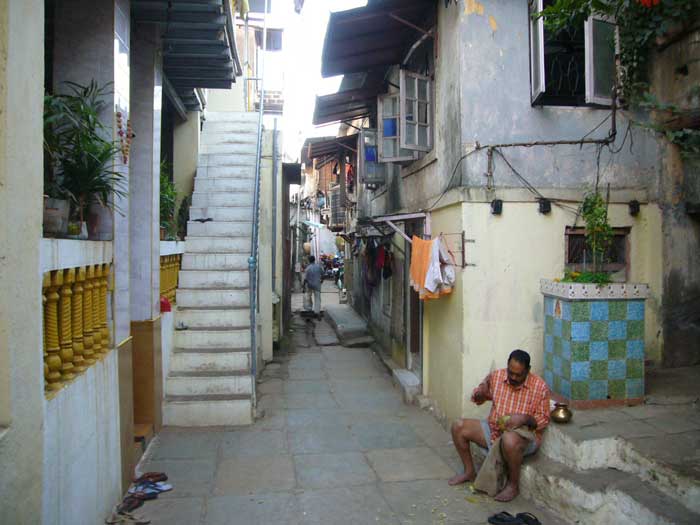
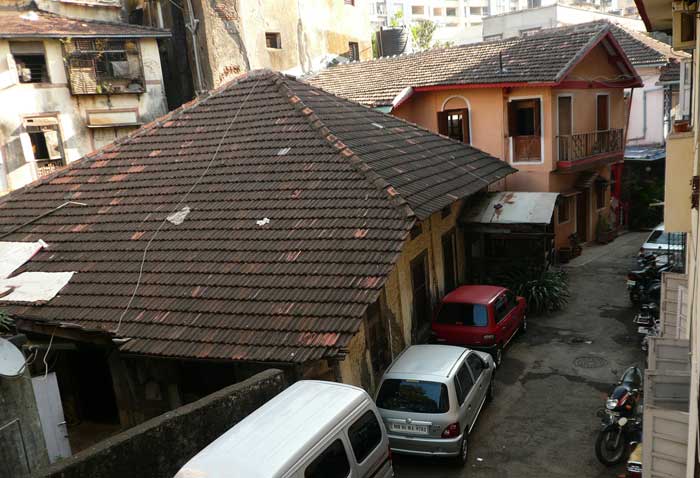
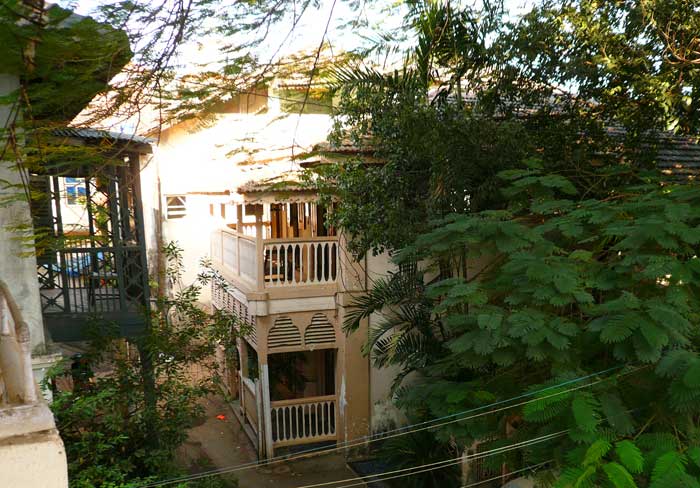
A tool-house emerges when every wall, nook and corner becomes an extension of the tools of the trade of its inhabitant. When the furnace and the cooking hearth exchange roles and when sleeping competes with warehouse space. A cluster of tool-houses makes for a thriving workshop-neighbourhood and its public spaces emerge as a dynamic by-product of such an auto-organized habitat.
This explains why a walk through any so-called Indian slum – is also an imaginative walk through a moment in the dawn of the industrial revolution. When it had still not drawn the rules of how we should live, work and sleep. When it had still not marked itself off as the moment of taking humanity into the great urban age and when it still produced fantastic and flexible narratives about the future of humanity. The industrial revolution and urban transformation have always been discontinuous and fragmentary. The echoes of the moments of its transition repeatedly re-appear everywhere. Just look out for the presence of the tool-house – more real and ubiquitous than the much-hyped robot.
The reason why urban landscapes formed by tool-houses are so crucial for urbanists is that it makes explicit the relationship between production, livelihood and spaces that expresses the lives of more than half of humanity. Not to be able to see this dimension in slums reveals a terrible lack of imagination and aborts the complex and organic evolution of urban forms. To see them for what they are – maybe through the lens of a sci-fi possibility – is to do real justice to the multiplicty of urban forms.
In reality – tool-house landscapes indicate a need for a sharp re-structuring of the way in which labour, work, and capital unfold in the post-industrial city. It can help us to concretely visualize a future in which the dated dichotomy of the formal and the informal organization of production and services, the new spatial order that internet-based and mobile communication technologies have introduced in our lives, and complex dialectic between the artisanal/organic and industrial mass-based product in the contemporary economy.
Cities of the future can keep being formed by the empty development and one-dimensional growth (literally) of real-estate development or they can rearrange themselves in less predicable ways following our aspirations localized needs. Where urban development is left to local actors we observe the (re)emergence of live-work spaces that are in fact less dehumanizing than the housing block and its twin office tower that are being systematically promoted by urban developers from all across the ideological spectrum from real estate investors to NGOs passing by the government as the only way on to modernity.
It might be time to acknowledge that for all its lack of infrastructure and overcrowding, Dharavi is not as much a pre-industrial settlement as it is a post-industrial one. Not as much as slum in dire need for redevelopment as a highly successful model of bottom-up development, with at the core of its system the tool-house.
Just when Dharavi vanishes from Mumbai…architects will want to re-examine its complex structure for referencing the future…mad prophecy… but just you wait… talk to the international researchers flocking into the labyrinthine streets of Dharavi, you will soon find out that they come less to propose their own models than to learn from Dharavi. Get over it, Dharavi is not backwards, but forward.
One of the most insidious changes taking place in our world these days is to do with auditing. Everything and every body gets quantified, measured and valued in as numerically accurate terms as possible. Anthropologist Marilyn Strathern elaborates this in her edited book ‘Audit Culture’, which should be read by every philanthropist, bureaucrat, and policy maker. She refers to social and cultural auditing as reductive and destructive. It forces educational institutions to devalue learning and to privilege acquisition of degrees and certificates. It makes donor agencies transform the idea of social change into a snake and ladder game. It makes governments and bureaucrats even more powerful than they are. They decide what is good for everyone – especially those who are deemed incapable of making decisions on their own.
Even activists and social leaders fall into the auditing trap all the time. Though they work through its reverse logic. They flatten every aspiration into the denominator that they think is appropriate for everyone. To them, the poor or the unprivileged must be treated as one – or they are being unjust to their comrades. They must calculate their strength in strict numerical terms and present themselves as a united front.
No wonder when the city authorities tried to deal with housing shortage for the poor they viewed the whole exercise as a massive auditing task. The need to do surveys was considered the most logical consequence of this process.
However, the surveys soon became tools of control – so that families could be relocated into a pre-fabricated notion of an ideal housing size. A size that was audited into existence in the meanest way possible. The basic idea being; how can you squeeze all the poor in the city in the smallest possible area so that the cost of building their homes gets subsidized by the rich who then choose their own homes as per their means.
The Kolis of Mumbai complained that the slum rehabilitation process would leave them high and dry – since they had inherited larger homes but lived in village like habitats that got labeled as slums by a myopic government And would now have to be re-located in the standard norm of a 300 whatever square feet flat. Their complaint was seen to be unfair by everyone – the state, as well as the housing activists..
This is blatantly unfair. The poor of the city seem to have lost their right to even assert their own needs as per their distinct histories.
Recently, members of several BMC chawls, among them the Omkar, Rang Tarang and Ram Gunta Co-operative Housing Societies have started an agitation requesting that they be exempt from the slum rehabilitation scheme since their housing histories could not be collapsed into the category ‘slums’. They feel they have the resources to develop their own tenements in a manner that fits into their middle-class aspirations and can be created through the existing land size that they have.
It is only in our beloved city that everyone, the state as well as housing activists would consider such a positive, straightforward request as being unfair. It is after all, a city where the rich are exclusively allowed the sinful luxury of inequality, while the poor have to celebrate their chaste egalitarian ideals through willful restraint. They must never challenge the precarious balance of equality among the united nation of the poor. Which of course, is the surest way of ensuring they always remain so.
1. Need It: Define the project’s vision, based on what’s collectively needed in the neighborhood but not provided, via a collaboratively-written declaration, manifesto or constitution. Secondly, develop a program for how this will be executed. You can see some of this on the Elements restaurant home page.
2. Get It: Use precedents as models to explain what doesn’t exist yet. For example, a beta community looking to develop truly attainably-priced green condo efficiencies, like at the Bearden Arts Building in Washington DC, should look at San Francisco’s Cubix Yerba Buena, or downtown apartments in Tokyo and Paris.
3. Do It: Have the beta community start meeting to define the vision and program, with professional designers and the development team transforming those into tangible floor plans, renderings and product offering suggestions. The Gear Factory in Syracuse produced floor plans based on beta community input, and so will the Bearden Arts Building.
4. Be Open: Don’t write off ideas you don’t like because you don’t think other people will like them either… only to find out you’re in the minority. This happens a lot with pedestrian-only streets and smaller home sizes. Openness is also one of the tenets of a creative community.
5. Share: This is a big one for self-righteousness – don’t talk louder because you think your idea is the best, even if it’s ‘going to save the world’, like demanding that a restaurant serve more ‘raw food’. It’s not a pure democracy either – decision-making by committee leaves you with the status quo. However, if you share your values with others, a clear vision and program will emerge that will then be a lot easier to interpret into real design.
6. Contribute: Time to give back to your community. Nothing will happen without people attending meetings, offering their feedback and referring others. This is where being social network bilingual is highly productive – make sure your beta community champions can speak both languages. Also, the goal is a whole that is larger than the sum of its parts, so think ‘community-first’. Ironically, it’ll often be more individually rewarding as well.
7. Communicate: This is what open source is all about – the ‘sponsor’ providing the business plan and updates as if it were a co-op, and listening to their members just as well. Here’s an example from a beta community agreement in New Orleans: “The purpose of the Broadmoor Beta Community is to provide NCD (the developer sponsor) with an identifiable group of future tenants and customers for a third place that is eventually established in the neighborhood. NCD understands that the Broadmoor Beta Community’s commitment to the social and financial success of this third place is directly proportional to how much NCD listens to and incorporates the ideas and input of the Beta Community.“
8. Convene: Crowdsourcing works best when people meet face-face to make decisions, or at least have a solid deadline (resulting in virtual convening), rather than contributing individually on their own time. As they say, the more things change, the more they stay the same.
9. Include: Two things here: 1) Ensure you’re getting proper representation of the neighborhood that you’re working in, even if it means taking a little more effort and time to find them; and 2) Provide some training or ongoing assistance if they lack social network skills, much less be social network bilingual. While technology has helped bring people together, it shouldn’t be an excuse to exclude anyone either.
10. Acknowledge: Recognition is a powerful motivator. Are you still recognized for contributing to nonprofits years ago, or forgotten among the masses? People are recognized in every beta community project for their efforts on a monthly basis – sometimes being rewarded with free dinners to favorite restaurants like with CreativesDC, or even with profit sharing as with the Elements restaurant.
11. Process: This is where the rubber meets the road. How do you take the collective values of hundreds of participants and interpret that into design and programming that inspires them? This is a matter of working with a new generation of architects and developers with not only the skills, but the mindset to be able to professionally synthesize ideas into a tangible form.
12. Be Critical: Innovation can’t happen when there’s groupthink – “a type of thought exhibited by group members who try to minimize conflict and reach consensus without critically testing, analyzing, and evaluating ideas.Design by committee doesn’t work. But, if people were courageous and stated what they really wanted, “That side alley should be outdoor dining for cafes!“, perhaps we’d have more inspiring destinations.
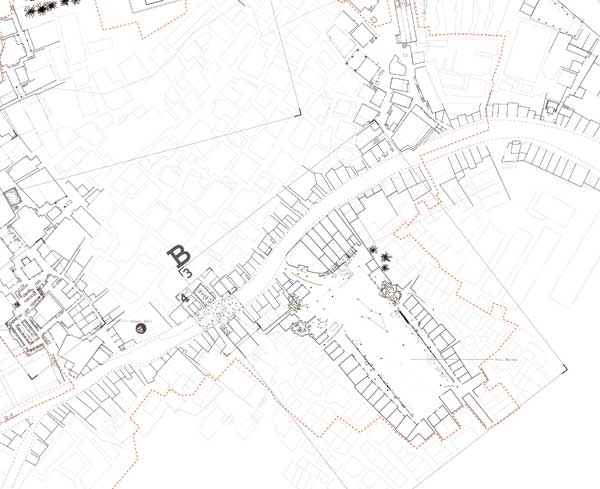
Koliwada Map: This map of Koliwada was based on collection and synthesis of historical documents and maps, studies and surveys from SPARC, KRVIA and SRA, satellite views, and on-site photographic surveys. All maps and sketches in this text produced by Wahid Seraj for the Urban Typhoon Workshop in Dharavi-Koliwada, March 2008.
The first mistake of virtually all slum redevelopment schemes, no matter how well intentioned, is to start from scratch instead of using existing structures and patterns as a starting point. Planners often use structural and demographic surveys as raw data, but these only provide snapshots of the state of things at a given point in time. They do not capture the dynamic interactions between people, structures and streets, which are vital for sustainable planning and development.
The end result of most redevelopment projects is a series of grids in every direction, up, down and sideways, that erases all the existing formations imprinted on the territory. The constant movement of people within urban spaces and across neighbourhoods, as well as fresh migrations – factors that every city has to reckon with – find no legitimate expression. Nor does the versatile use of space, a trademark of slum life.
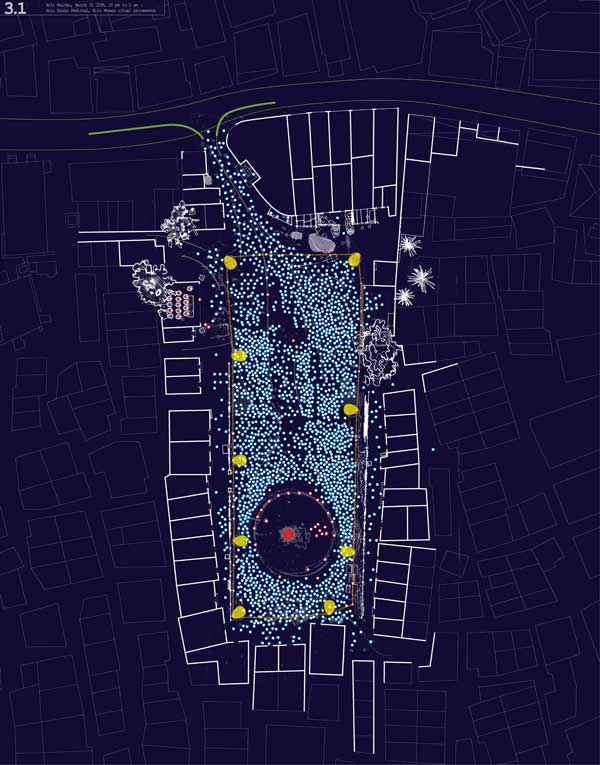
The Holi Maidan is Koliwada’s main open public space. At the time of the annual Holi Festival, a Hindu celebration, more than 10,000 people gather in and around the central space, including Dharavi Main Road. The drawing records the movement of crowds and ritual processions around the central fire during Holi.
A tabula rasa approach to slum redevelopment only results in the formation of new slums in the periphery. Those who cannot be absorbed in the new housing or afford maintenance move out and new slums emerge.
Most redevelopment projects, until very recently, translated the issue of slums redevelopment only in terms of housing needs. Such an approach buries over organic connections between local livelihood systems and residential requirements.The livelihood issue becomes secondary and at most, reduced to questions of employment. As research on the informal economy began to throw new light on the way cities function, especially in the context of slums, the understanding of these spaces became more informed. It became clearer that the new global economy relied a lot more on locally produced goods and services that are dependent on cheap labour, and that these activities are organically connected to the forms of habitats in which they exist.
The Tool-House: Live-Work Typology of a Kumbarwada Potter Family House:This drawing reflects the necessity to understand the particular urban life-styles of traditional communities. Many of Dharavi’s residents live and work at the same site, a reality completely dismissed by the ongoing Dharavi Redevelopment Plan. One must understand that shelter issues are inextricably tied to residents’ means of livelihood.
However, it is one thing to understand the organization of slums in terms of its economic role and another to incorporate this understanding into urban planning. At best, what emerges are token gestures to livelihood issues, – either in the form of building a local market or providing space for economic activities within new homes.
What happens if we work from the other side of this spectrum. If we take as the starting point the existing resources at hand? What we get is a rich legacy of user-generated space patterns that are organically connected to the way people live and earn livelihoods. These patterns are based on the principles of incremental development. In other words, they have evolved over time, over generations and through the absorption of new migration inflows, constant movement within and between neighbourhoods and through continuous class mobility.
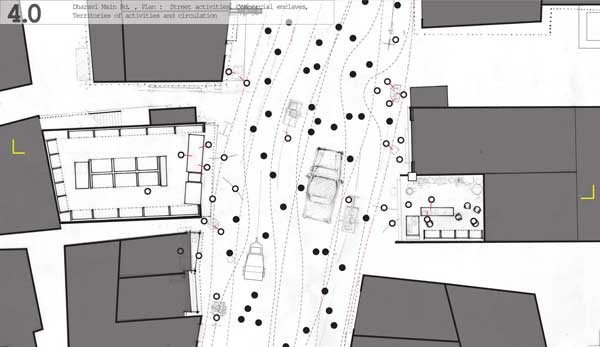
Fragment of Dharavi Main Road: Mapping of Street Activities and Territories, Public and Commercial: Dharavi Main Road is 25 ft.-wide road running through Koliwada and across Dharavi. In the section that crosses Koliwada alone, one finds almost one hundred non-residential sites, such as churches, temples, shops, restaurants and small-scale industrial workshops. Reflecting Dharavi’s high-density street-scape, the road also accommodates heavy and continuous pedestrian traffic, cars, motorcycles and mobile street vendors.
It is our contention that these patterns of incremental development are embodied within the streetscapes of such localities. It is in the street that the genetic code of a habitat gets imprinted. They emerge as walking paths connecting markets, homes and nodes of transport hubs. As they evolve, accommodating cars and other forms of local transport, street bazaars, spaces for youngsters to hang-out, for children to play, for neighbours to exchange news and gossip, for people to shop and set-up shop, they follow the needs of the residents very directly. The signature of a neighbourhood is often a streetscape.
Ideally, slum redevelopment schemes should build upon the incremental logic that most slum histories embody. And a pragmatic way to do so would be by recognizing the street layout that has evolved within such habitats.
In the case of Mumbai, we clearly see two dominant patterns of slum formations with their distinctive streetscapes. (Actually there are three patterns, the third, post-modern version is linked to the redevelopment projects outlined above and is the most nasty and dangerous one!).
The first one is best exemplified by the presence of fishermen’s villages in the city. They were villages that at some point got absorbed in the sprawling megacity to be eventually assimilated as slums. Self-standing houses, some of them more than 100 years old, within these habitats, are a clear marker of that history. The second type is the slum that emerged gradually as immigrant workers settled into temporary camps wherever they could and consolidated them over time.
As A. Jockin, founder of the National Slum Dwellers Federation poetically puts in an interview; first the man comes to work from the countryside, then his wife joins him. Because she needs privacy she puts her sari on strings and that becomes their home. This gets multiplied a million times.
In incrementally developed neighborhoud the connection to the village is very direct, since migrant workers and their families bring with them skills and crafts from their hometowns. They are soon joined by fellow villagers who reinforce the reproduction of traditional patterns.
Villages, whether they are in Asia or in Europe have strikingly similar features. The most important one, and the most easily overlooked, is high-density levels of populations and structures. We generally assume that because they are typically surrounded with open fields, villages have a low density and that high density is usually found only in cities. In fact, in most French, Italian, or Indian villages houses are so narrowly built to each other, that cars cannot get through, making rural settlements mostly pedestrian.
Getting a little deeper in the study of the structure of villages, one can observe an interesting hierarchy of streets, with broader roads serving smaller roads all the way down to the entrance of the hut. Anyone who has ever walked in a slum has observed the same type of network, leading the visitor from a large road with rickshaws and cars to smaller roads shared by pedestrians and vehicles bringing goods in and out, to smaller roads penetrating inside specific nagars. Even within the nagars some streets are busy with people going from one point to the other, which themselves open to smaller lanes taking the visitor to clusters of houses.
These communal lanes are often used by the residents of the huts alongside it as space for social interaction and production, and are clearly not public in the sense of the larger roads. They will make the visitor walking along these lanes almost feel uninvited, nearly as uncomfortable as if he was walking into someone’s private property.
The street layout is initially shaped by social and economic relationships, and then influences them in return. The interconnectedness between spatial and social structures should be fully acknowledged by any architect and planner engaged in slum redevelopment. While it is true that these structures are often communal and unequal, changing the spatial structure alone will never suffice to change social structure. It must be understood once and for all that relocating every family in 225 sqft or 300 sqft flat in high rise structures will not make everybody equal or suddenly propel them into middle-classdom! Unless one pretends to tackle social and economic issues alongside spatial issues, architects and planners should not pretend that they will be able to address issues of equality in a given settlement. When we think about these issues we have to remember one of Thomas Jefferson’s most enlightened quotes: “There is nothing more unequal than the equal treatment of unequal people.†The same goes for the serpentine, complex and uneven streets that can be found in villages and slums!
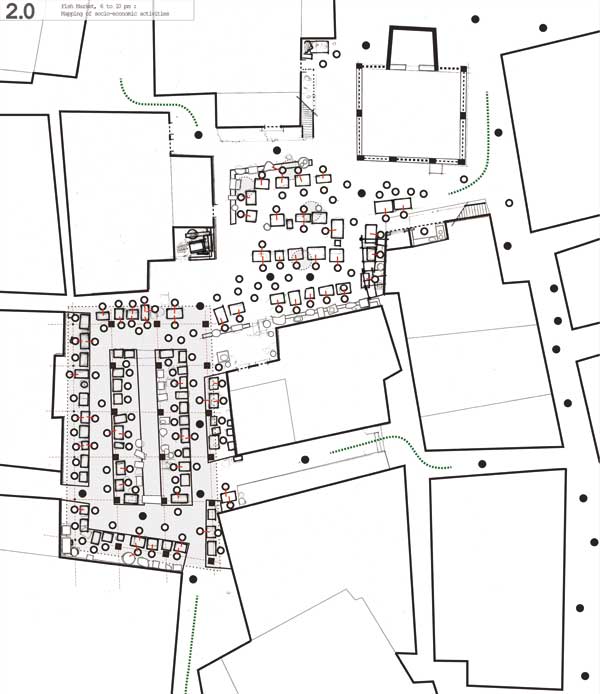
Koliwada’s Fish Market: Mapping of Socio-Economic Activities of the Market in Relationship to the Morphology of Space: The Fish Market is the witness of Koliwada’s roots as a traditional fishing village. The fish market has existed at its current location for the last 70 to 100 years.
The fact is that habitats constantly change and evolve, as families start to grow with new members being added, as new businesses come into the neighbourhood and as new families migrate. Add to this, the need for infrastructural expansion, including sewage, water supply and road networks means that the ongoing transformation of habitats is an everyday reality. Most habitats, harness the resources for making these changes from within. The necessary skills are brought to surface and used to the best of their abilities.
As change unfolds, the street patterns remains a point of continuity from the past and the anchor for the future. Once they are seen as the starting points, then the transformations become more productive. Many cities around the world have evolved in this way. And most are bookmarked in public memory by their streetscapes. Indeed, it is precisely these organic patterns that give so much charm to European old towns. There is a reason why despite being invaded by hordes of tourists the ancient quarters of cities such as Barcelona, Basel, Lyon, and Florence keep their local character and charisma intact. What is important to note is that this happened despite the fact that many buildings have been torn down and rebuilt or floors have been added up to 7 or 10 stories high. All the transformations happened over a period of time by responding to specific user needs and without altering the streetscapes too much.
The same holds true for Tokyo, which more than any other city has kept its village-like fabric and street patterns while completely transforming itself. In fact, the success story of Tokyo –which transformed itself from being a gigantic pile of debris produced by US fire bombs during the Pacific war to being the largest, most advanced and urbane city on earth – is the story of incremental urban and economic development.
We deliberately focused here on the importance of preserving the organic street layout of slums to preserve identity and continuity in social and economic arrangements. There are many others reasons that we will elaborate in future essays. These include: visual coherence, functional efficiency, respect of local autonomy, sustainability and quality of life.
It should finally also be clearly stated that the preservation of existing street layouts should be a means to maintain and improve existing quality of life. It is not an ideology that should blindly followed. It should always be considered on a case-to-case basis and in consultation with residents, since in some instance the benefits of modifying the layout of some streets can in fact be greater than the advantage linked to its preservation.
Published in The Indian Architect & Builder, December 2008
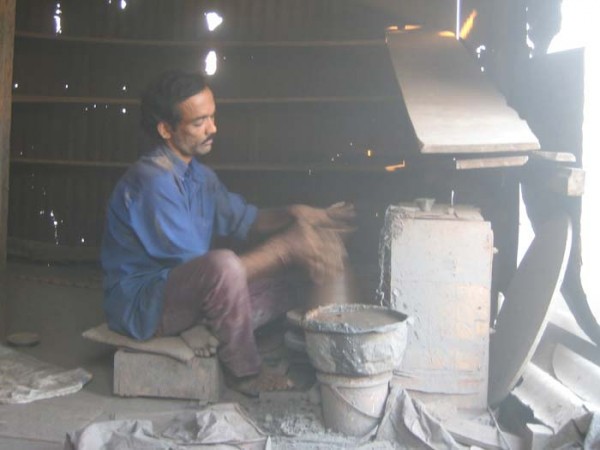
Ranchhod Savdas Tank from Kumbharwada, the potters neighbourhood in Dharavi, has very clear dreams and ambitions. He wants Kumbharwada to be known as the best pottery production center in the world. He wants the new generation of youngsters in Kumbharwada to find this traditional occupation so lucrative that they would take to it spontaneously. He wants to modernize production techniques, respond to the latest demands in terms of designs and choices and generally build on the hundred year old dynamic history of this neighbourhood that was founded by his ancestors and their families.
He is also very annoyed at the inability of the city, its media and civic authorities to see the value of his dreams and the fact that they are inextricably linked to those of the city at large. After all the city has been built on similar ambitions; it has seen enterprises emerge from nothingness, it has been nourished by the sweat of its hard-working resident-workers and it continues to evolve and modernize in many sectors.
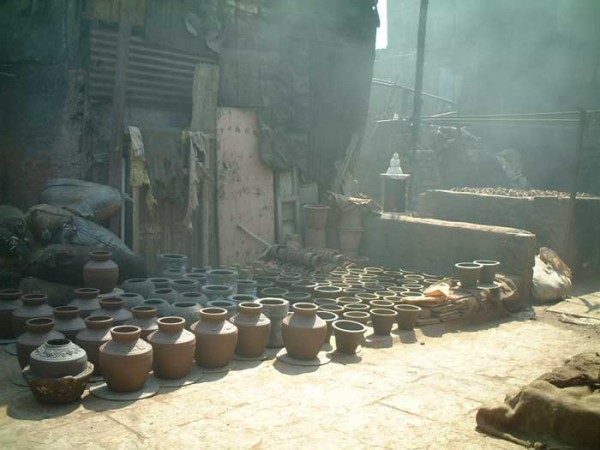
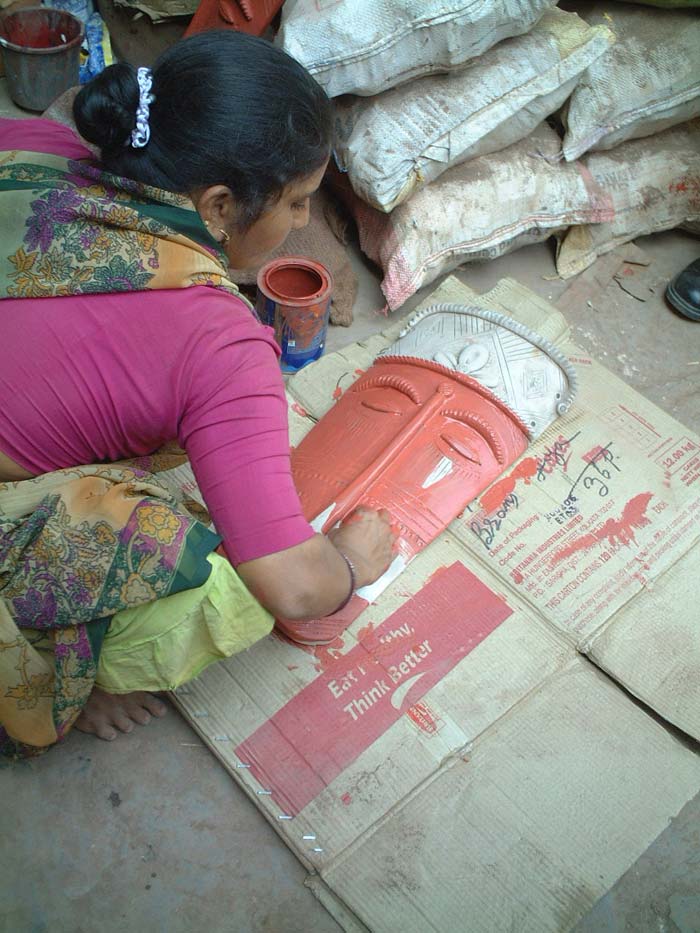
Smoke coming out of the ovens where the Kumbhars bake their pottery.
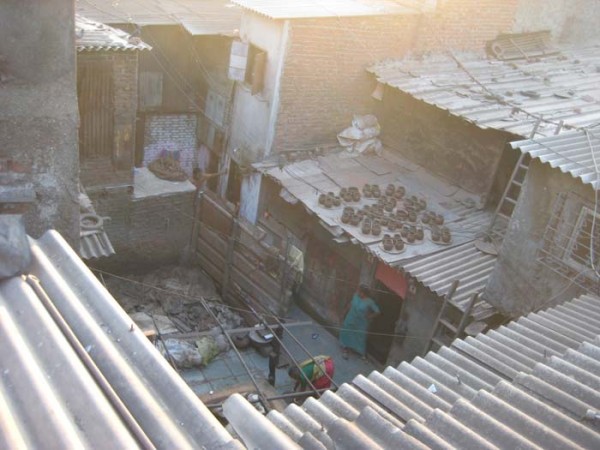
He finds it difficult to believe that the authorities cannot see a simple thing. That his neighbourhood is primarily an artisanal space around which the resident artisans have woven an intricate and interdependent structure of residential and work spaces that are so enmeshed, that it is impossible for one to be conceived off without the other even for a minute.
Tank, like other members of Kumbharwada in Dharavi, believes that for the city to do justice to its history of enterprise, it must rise to the occasion and recognize this simple fact. The best way of recognizing this is by letting this neighboruhood continue to evolve through its own inner logic. Not impose a development plan on it and learn to give importance to the voices of its residents and their choices.
Coming across someone like him is indeed an important reminder to all of us so invested in transforming the city. It is an important lesson for all urbanists, urban planners and urban historians. What the story of Kumbharwada represents is a vital moment in the history of cities that has the potential of making Mumbai a trendsetter.
A history, which acknowledges that homes and workspaces were decisively cut-off from each other only as recently as the industrial revolution and the impact of this incision was most strongly felt in the house of the artisan. Historically, if there was any space that used itself most creatively and productively it was the artisan’s workshop-cum-home that produced goods that circulated in the pre-industrial economy.
The gigantic scale of the modern city was unleashed through many forces – mainly energy-based revolutions – but its architectural character owes most to the atomic split that happened when the workshop-home of the artisan was splintered. Since then, the logic of separating residences from places of manufacture has shaped much of the way we think of cities.
However, cities like Mumbai are living examples of built-forms that do not reflect this neat divide. The artisanal home continues to exist in many different forms. Consider the fact that this form exists functionally, in some way or the other (as studio-homes, artists lofts and so many other examples) in the contemporary global economy.
All it needs is a little bit of imagination to transform neighbourhoods like Kumbharwada and use it to showcase Mumbai’s amazing spirit of enterprise. The pottery industry represents one of the few lucrative artisanal occupations that has survived mechanical competition thanks to the tastes of its consumers.
It would be nothing short of foolishness to over look this precious history.
Photo credits: All but last by airoots team. The last taken by KRVIA
Published in the Mumbai Mirror, December 31st 2008
Amar Farooqui’s slim but potent, ‘Opium City: The making of Early Victorian Bombay’ (Three Essays Collective, 2006) takes you on a journey of Mumbai darker than the city’s industrial waste.
Farooqui, makes absolutely no compromises. He leads us out of the sepia-tinted memories we fancy so much and forces us into the squalid eighteenth and nineteenth century streets of Bombay in a manner that would make most heritage conservationists squirm.
You get to see the city in pretty much the way we know it today – a city of crowds and pathetic facilities for those unlucky to live outside its privileged, inner circle. A city dominated by administrative uncertainty, yoked to the larger imperial project headquartered in Calcutta much in the manner that it is today to Delhi. A city energized by small business communities from across the region, but who are always kept subservient to its suspicious rulers. A city economically addicted to forbidden trade – opium – an addiction that shaped the rules of the trading game and one, which remains a shadowy presence in the city’s underbelly, where the lines between business and crime are still seen as blurred.
Such an account of the city’s past means that those who lived through the city’s effervescent post-independence optimism – the celebrated decades of the fifties and sixties – have to re-cast their nostalgia and see them as freak moments. As soon as the dust settled, the city reverted to its wicked old ways.
But then, Farooqui’s story is still half-told. Historians often get so carried away by the austere fact that lies in the archive that they forget there’s more.
And one is not talking about the spirit of the city at all. That has been done to death, by novelists and writers – and with good reason. One is talking about the fuel that keeps the city going – the act of exchanging goods and services.
We detect in Farooqui’s rendering a lot of prejudice about conducting business itself. And the familiar disdain that many misguided historians in India have towards this act. A disdain that is a mirror image of the equally pathetic attitude that the city’s economic elites show towards the traders that rule its streets – the feriwalas or the hawkers – treating them like criminals.
Such extreme attitudes yield two contrary but complementary stories; of the city’s heroic working class past that focuses exclusively on its industrial, trade union-lead history and the false hagiographies of its corporate heroes.
In reality, the complete story of Mumbai lies in its very humble origins as a trading city, which incidentally, Farooqui draws quite accurately. The problem is the way he tells his story.
He does not do adequate justice to these real characters – the petty traders, small shopkeepers and street-hawkers – who were crushed in the past by a colonial regime that treated them suspiciously. But they were all over the place, building the foundations of the city and making it what it remains – an economically successful and cosmopolitan city.
The tragedy is that even such well-researched historical accounts condemn these characters into insignificance because they do not fit into a larger story of working class history.
And that’s the reason the city keeps stumbling.
Instead of making the symbol of the feriwala or the street trader, its mascot, the city criminalizes them while the prejudiced scribe ignores them altogether.
No wonder the city’s thwarted identity spews out weird mythologies where the underworld refers to itself as a business company!
The immense ferment that Dharavi has seen in the last few years has settled a bit. A tiny bit maybe, but there has certainly been some calming. It is to do with the global financial crisis that translates into the expected cold-shouldering of the promised private investment in the Dharavi redevelopment plan.
According to many involved sources, there is hesitation on the part of several parties to say anything definite about where exactly the plans are headed now. Especially if they were linked to private investment and real-estate development rather than the masked rhetoric about slum redevelopment and rehabilitation.
However, those activist groups working in the field of housing who did not directly connect with the feverish rhetoric find themselves having some more breathing space. What they do eventually with this breather only time will tell.
According to a few unconventional urban planners, this is the best time to bring to notice the fact that a really effective transformation of a space like Dharavi is only possible from within. In other words, to rely on the resources that exist inside the community in terms of skills, willingness to mobilize resources and raising funds. However this has to be framed within the logic of incrementalism – the idea that slow, step-by-step growth and changes over time and stimulated by the needs of natural growth of families and communities is the best way ahead.
If we look carefully at those spaces within Dharavi where some level of incrementalism has occurred spontaneously, due to relative economic, we see the way economic mobility has spurred a natural improvement. Homes have been improved upon and built over. In some cases the communities have gotten together to build sewage and improve drainage systems on their own.
The residents of Dharavi have always aspired to better living standards, and demonstrated extraordinary resilience and creativity in the face of social exclusion and economic hardship. Many commentators, including The Economist, have been impressed with the dynamism and entrepreneurialism displayed by its residents. Studies show a very high degree of absorption of new technologies by the population. Every lane in Dharavi has a cell phone retailer, and cybercafes are flourishing.
If these internal energies are allowed to spill over into the space of self-development – or what are also called auto-built urban environments, then the government does not have to play a role beyond providing a support system.
From within the logic of incrementalism, Dharavi does not appear to be a complex, overcrowded, chaotic space but one that is teeming with resources. Of course the several decades of political and social indoctrination – in which patronage has been the norm has had its toll. Often it is difficult for the residents themselves to have faith in their own capabilities simply because the local leaders and political representatives brow-beat them into a passive role. Activists should have cut through the space of centralized leadership to create structures for organic participation. Processes that have worked, often by default or accident. Unfortunately, the language of activism that Mumbai and the country at large has become used to is an extension of state patronage. If the non-governmental organization also speaks a version of statism, then there is slim chance of a genuine break from old thought processes. In this scenario, it will be impossible to make ‘incrementalism’ part of a policy statement. That would involve the same level of synthetic intervention as wholesale manufacturing of consent.
Instead, the best way ahead would be to take advantage of a situation where the overheated markets are correcting themselves and also correct a bit of the overheated political rhetoric that we have also become attached to!
In the last week of November, all of us living in Mumbai went through a succession of mental states. Ranging from incredulity, rage, cynicism, disbelief, shock and nervousness, to fear, sadness, numbness, hate, and and the most disturbing of all, fascination. A morbid fascination for the ability of a handful of young guys to create mayhem in the city, shake Indian politics, and hypnotise the global media.
They checked in at the Taj next to the general manager and transformed their quarters into a five-star control room. After brutally killing scores of tourists they cool-headedly recharged their AK-47 and rampaged the city. They killed Mumbai’s top cops and hijacked police cars, twice. Till the end they defied India’s best commandos. For a moment it seemed that the country’s entire army could not stop them.
Before last week, a movie script based on this sequence of events would surely have been deemed far-fetched. The audacity of this attack is indeed incredible.
The accomplishment of extraordinarily audacious objectives has precedents throughout history. Not too long ago, the word audacity was being brandied in a completely different context and with a completely different meaning. In fact, at the other end of the spectrum altogether. A group of determined men and women succeeded in carrying their candidate all the way to the highest office, beating the most powerful political apparatuses in the US: The Hillary campaign and the Republicans. The Obama campaign provided magical inspiration to people all over the world and revived some hope for the world’s most powerful (and dangerous) democracy. Such a comparison is itself audacious, but there is a reason for making it.
If anything could be learnt from last week’s event, it is the lesson about the power of audacity. Audacity is precisely what Mumbai has been lacking, especially since the 1991 communal riots. Instead of defending its multicultural identity, forged by a history of trading and migration, it allowed goons turned politicians to rule and tear apart its unique brand of cosmopolitanism. Innocent scapegoats were killed and cowardly mobs were rewarded, setting in motion a cycle of violence that just took a new spin last week.
A response to last week’s events driven by fear and paranoia against our immediate or distant neighbours –which seems more than likely– will only feed into a further destructive spiral. If we don’t want to stand mute witnesses in the face of history, we will have to reclaim audacity for ourselves, and prove against all odds that yes-indeed all things are possible; including transforming our city’s mindset and reclaiming diversity and openness as Mumbai’s main strengths.
To do that we will have to rise above our prejudices against certain communities, neighbourhoods, slums, even ordinary people. These prejudices put us at threat more than anything else. Here is a concrete example: Of all the failures that paved the way for last week’s disaster, the biggest was that the police didn’t follow up on an alert given by members of Mumbai’s oldest communities, its fishermen. They were the first to report abnormal activity on their shore. Unfortunately they were not heard.
We are looking for funding for a project in Dharavi. We need your help! Please contact us if you can contribute or if you have any suggestions!!!
The Context:
Dharavi is usually described as the “largest slum†in Asia. Home to at least half a million people, it is one of the most diverse and culturally vibrant parts of Mumbai. About 95% of the residents of Dharavi belong to what are officially called dalits and ‘other backward castes’. This partly explains why the authorities have largely ignored their needs. Political parties and NGOs have been present in Dharavi for many years, providing support to many residents and speaking on their behalf. However, to this day, it is nearly impossible for individuals and grassroots groups of Dharavi to get heard. Mass media is generally sympathetic to the hardships endured by the residents, but again usually misrepresents Dharavi as an homogeneous community, when in fact it is composed of about 88 communities, each with their languages, practices and cultures.
One of the highest stresses faced by the residents of Dharavi today is uncertainty regarding their housing and workspaces. The Slum Rehabilitation Authority (SRA), which is the government agency in overseeing slum redevelopment efforts in Mumbai, has divided Dharavi into 5 sectors and requested proposals from real estate investors from all over the world for each of these sectors. This project, known as the Dharavi Redevelopment Project (DRP), requires developers to provide a 300 sqf flat to each family that can prove that it settled in Dharavi before the year 2000. In exchange for rehousing residents in new buildings, the builders get construction rights in Dharavi.
The DRP has been highly criticized by NGOs and independent experts, notably for leaving out of the plan hundreds of thousands of residents who cannot prove that they settled in Dharavi previous to 2000. Some experts have also pointed out that any plan that might increase the current population density of Dharavi was irresponsible, since the density levels are already unsustainable. In any case, the DRP is severly compromised by the current financial crisis, which has caused many of the bidders to withdraw or simply disappear.
Dharavi residents may be temporarily off the hook but that also means that Dharavi will also certainly fade away from the media and government’s limelight and go back to being what it always was, a shadow city. One of the reasons for the media frenzy that surrounded Dharavi is that it epitomizes the urban crisis that Mumbai, India and the world are facing as more and more people move to cities. Global economic recession will not stop rural immigrants from coming in mass to urban areas. In fact, as the crisis hits rural areas, it might well accelerate the influx and therefore the informal development of shelters on the city’s pavements, along the railways, and in the periphery.
The recent attacks in Mumbai will almost certainly translate into a renewed attention on security and a greater insularity of middle-class and upper class enclaves in a city where about 60% of the population is said to be living in slums. This deepening of the class divide will only isolate the poor majority further and exclude them from a process of development and globalization that has benefited many middle-class Indians.
The residents of Dharavi are not only aspiring to better living standards, they have also demonstrated extraordinary resilience and creativity in the face of social exclusion and economic hardship. Many commentators, including The Economist, have been impressed with the dynamism and entrepreneurialism displayed by Dharavites. Local industries, such as leather and embroidery, are even attracting the attention of shoppers and investors. Moreover, researchers, including Nokia’s R&D team and Microsoft Research India, who have performed market studies in Dharavi have noted the extremely high absorption of new technologies by the population. Every lane in Dharavi has a cell phone retailer, and cybercafes are flourishing.
The Urban Typhoon workshop, which took place in Dharavi in March 2008, and was supported by Asia Initiatives in Japan and PUKAR in Mumbai, clearly confirmed that residents are willing to be involved in the development process and have more than physical manpower to contribute. Foreign participants were utterly impressed with the positive attitude and great motivation displayed by local residents, as well as by their genuine willingness to be part of the solution.
The Concept:
DOT stands for Dharavi.organic Technology Centre. It combines several initiatives taking place in Dharavi, including the PUKAR Youth Fellowship, the Urban Typhoon Workshop, and the dharavi.org platform. These initiatives are described in the last section of the proposal.
DOT is a space of self-expression for all residents of Dharavi. It aims at helping those who are willing to voice their opinions, ideas, visions, and plans out to the rest of the city and the rest of the world.
Objectives:
The DOT center will provide a space, tools and training in English, Marathi and Hindi for all those who want to use dharavi.org and access other websites.
Dharavi.org already serves as a link between people interested in researching Dharavi and local residents. DOT will now allow residents to reach out to people, community groups and organizations from around the world who are dealing with the same set of issues.
The Urban Typhoon workshop sparked the interest of Dharavi residents from various parts of the neighbourhoods. DOT will provide an infrastructure that will allow the multiplication of such initiatives. DOT will help connect Dharavi with students and schools of architecture, engineering, planning, and economics as well as social workers and generally with people from all walks of life who want to spend some time to help local projects in Dharavi. It will constitute a physical connection point for the outside world into Dharavi.
DOT will not only allow Dharavi residents to access the Web free of charge, it will also help them to use it to fulfil their needs and aspirations. It will for instance support local business initiatives and the pursuit of educational goals.
In addition, DOT will provide vocational training in hardware repair and software development to young people in Dharavi. It will then connect trainees to potential employers.
The space itself will have versatile usage and will be usable for different functions, such as parties, youth, women’s groups and various workshops and classes.
Partners:
PUKAR (Partners for Urban Knowledge Action and Research) is a NPO (Not-for-profit-organization) in Mumbai. It is a Research Collective that has an ongoing three-year-old research project with 40 groups all over the Mumbai Metropolitan Region involving 300 youth from diverse socio-economic backgrounds, as barefoot researchers.
Dharavi.organic is a multimedia open source Wiki website dedicated to Dharavi, one of the largest informal settlements in the world located in the heart of Mumbai. This is an URBZ project.
Urban Typhoon is a participatory design and planning workshop organized by a global network of urban researchers and practitioners. The first Urban Typhoon workshop was held in Tokyo, 2006, the second in Mumbai, 2008 and the next one will take place in Istanbul, 2009.
Mumbai’s history reflects two distinct phases. One is the south-oriented story that starts with the development of the docks by the British in the early eighteenth century. The other is an older, northern-bound story that starts with the Portuguese conquest and domination of the regions around Vasai village in the sixteenth century. The essay argues that the point of intersection of these histories is one that can potentially explain the overwhelming presence of poor, infrastructure deprived habitats – often referred to as slums – that dominate the landscape of the city.
Worli-Koliwada, one of seven century old fishermen settlement in Mumbai
Mumbai’s slums occupy an unusually large scale – even when compared to other Indian metropolises, with similar economic and political constraints. The essay proposes that the scale and depth of the phenomenon requires a special inquiry into its history. The essay does this by focusing on the story of a small habitat – called Khotachiwadi – that encapsulates many of the issues being debated. Khotachiwadi eventually however, becomes a springboard to discuss other issues to do with the political economy of built-forms in the city – especially with regard to the dialectic of the slum and the village.
Khotachiwadi, Girgaum, South Mumbai
It also asserts that a critical examination of the category ‘slum’ – and its relationship with the ‘village’ – can challenge take-for-granted notions of urbanism and urban futures for labour-surplus countries like India that have old agrarian histories.
These notions usually render village-like habitats as being inappropriate for modern urban spaces. These spaces are viewed as having a certain kind of density that can only be absorbed by the high-rise form, which, in turn, is presented as antithetical to the village. While critiques of these notions have the potential of moving into radical ideas of the urban – especially in the realm beyond built-forms – this paper restricts its discussions to the physical dimension of urbanism.
When the Portuguese empire handed over islands in the southern end of the region to the East India Company they did not see this cluster of islands as valuable. They were more interested in the rich fertile lands of the north that supported their trading activities connecting Daman, Vasai, Goa and Calicut. These lands were dotted with villages that went all the way to Mahim and Bandra, perceived to be the southern borders of the Portuguese sphere of influence. The social structure of this space was dominated by a combination of feudal and mercantile practices subsidized by low-caste labour. Large parts of the population were converted to Christianity, a process that preserved the caste divisions by allowing for the emergence of upper caste land-lords and low-caste labour and artisanal groups.
When the East India Company took charge of the southern islands, they forcefully integrated Bandra and Mahim, which they saw as the northern borders of their territory. As the influence of the company increased through the development of the docks, many groups migrated from the Gujarat and Maharashtra regions all through the seventeenth and eighteenth centuries. The Parsee, Hindu and Muslim Gujarathi merchants, shop-keepers and businessmen moved in and around the Fort areas and brought in their urban traditions of built-forms from their city of origin – Surat – an architectural legacy that is still evident in some neighbourhoods of south Mumbai – especially Kalbadevi. On the other hand, the low-caste predominantly labour communities found themselves being absorbed by the villages that existed, in what was then perceived to be, the peripheral regions of the north. The lands were mostly owned by Christian landlords or occasionally by a member of the Pathare Prabhu community – an old courtly caste that linked its existence to a thirteenth century kingdom nearby.
All through the nineteenth century, poorer migrant groups would pay rents to landlords to set up hamlets that became their homes. Interestingly, richer rural communities, mostly upper caste Catholics, who happened to be educated and got skilled jobs in the docks also reproduced similar hamlets – referred to as wadis. These expressed themselves in newer villages like Khotachiwadi – a hamlet of cottages in Girgaum or a similar one in Matharpakadi at Mazagaon. They looked like the older upper-caste landed villages of Bandra, Mahim, Gorai and Vasai but had actually been built afresh in the nineteenth century.
On the other hand, swampy land around Mahim, particularly in a village called Dharavi (that was occupied primarily by Koli fisherfolk) became the site for the settling down of untouchable communities from different parts of the country. Those regions were seen to be unlivable and peripheral, from the vantage points of both – the fisher community that lived by the sea, as well as the city civic-authorities in the south.
Dharavi-Koliwada, a fishermen village that has for long been called a slum
As it turned out, as more low-caste groups arrived from the countryside, attracted by the mills and the docks, the southern city could provide only limited accommodation. Most of the surplus labour lived in the villages, outside the perceived city limits.
As the southern city kept expanding and as dependence on agriculture declined in importance, it became easier for landlords to make more money by renting or selling out land than through agriculture. However, when their lands got integrated into the city they had to give up their control either to the civic authorities or to slumlords. This process got even more complicated in the post-independence period with the development of a local electoral process and the growth of new neighbourhood leaders.
The landscape that thus formed by the middle of the twentieth century in the northern parts of Mumbai was really a cluster of villages that had become outsize settlements. Even today, the largest slums of Mumbai in that region -Â Dharavi and Jari-Mari – reflect this village like legacy with their land ownership patterns revealing this quite clearly.
However – villages do not simply become slums because of an awkward growth in population. It helps a certain political economy to view them as slums and this is the main argument being made in the essay. The attempt is to understand the deeper historical basis of slum formation in Mumbai and see it as much as a story of habitats and perceptions about habitats, as about the political economy of scarcity of infrastructure.
To explicate this point – we focus on a small village – called Khotachiwadi in Girgaum.
Khotachiwadi is a cluster of about twenty-eight small cottages and bungalows built in the late 19th and early 20th centuries in the heart of the city. Today it is referred to as an urban heritage precinct mainly because of its distinct architectural flourishes linked to an Indo-Portuguese past.
Right from the start, the homes represented a diverse set of architectural influences – Portuguese villas, Maharastrian coastal cottages, Goan homes and regular cottages and bungalows found in the region. In its hey-day – the early twentieth century – the village boasted of about eighty-eight such individually owned or leased homes.
Engendered architectural heritage in Khotachiwadi
During the course of interactions with the villagers, we came across frequent statements by elderly residents mentioning that the wadi used to be referred to as a slum in the early twentieth century. It was called as such by British surveyors who were developing a larger urban plan for the city. Intrigued by the fact that a village now celebrated for its architectural legacy was once referred to as a slum, we continued to explore this observation. In spite of frequent attempts though, we were unable to actually verify this through archival material. The records only mentioned the real name of the village, never the underlying assumed category. However, on inquiring with contemporary architects, urban planners and government officials, we found most of them agreeing with the residents. Their certainty was based on the awareness that many habitats even today tend to be loosely referred to as slums, though they are historically distinct villages. Some historical accounts of the city even referred to its native towns (immediately outside the Fort precinct), as slums. Referring to Khotachiwadi as such was, thus, quite understandable.
After all, even today, there exist village lands – called ‘gaothans’ – that are specifically recognized as distinct non-urban habitats, with separate development laws. They are treated by developers – and commonly perceived by neighbouring settlements – as slums.
According to urban historian Rahul Mehrotra, it was in the fifties that one saw the emergence of the simplistic binary – the slum and the multi-storied building dominating rhetoric of built-form in the city. It came to represent a discourse that over-wrote the diversity that existed in the earlier experience of Mumbai’s built-forms and transformed the perceptions of the future of the city through the aspiration of being a high-rise oriented city. This aspiration eventually started a process that aimed at erasing all ambiguous habitats, especially those that embodied the ethnic elements of built-forms found in the erstwhile “native city†– but more so those structures that seemed rural and therefore inappropriate . Thus till the heritage movement in the city really firmed itself up as some kind of a force to reckon with in the 1980’s – much of the old city (that was not protected by the old Rent Act) was destroyed on the grounds that it was part of a back-ward looking colonial experience .
House of famous fashion designer and Khotachiwadi life-long resident, James Ferreira
Places like Khotachiwadi were seen to be anachronistic, since they were villages. While most “native†spaces were distinctly urban buildings, this particular habitat’s resonances of being “rural†created further trouble for it. The colonial “native†city had quite comfortably absorbed the rural memories that its migrants had brought in. These memories had provided the quaint architectural flourishes of habitats like Khotachiwadi. However, in the long run these very flourishes and characteristics made these hamlets seem inconsistent with the ideals of a modern “urban†present – one, that wanted to distance it self as much as possible from any rural memory.