
Interview with Kazuyo Sejima & Ryue Nishizawa (SANAA)
October 5, 2008
By Matias Echanove For EGG Magazine [Taiwan], Tokyo August 8, 2007
Why did you come together as an office?
Nishizawa: Sanaa was established in 1995 in order to join forces to work on international and large competitions in Japan such as the Kamazawa Museum. We still each have our own offices on the side, concentrating mainly on smaller domestic projects.
Seijima: Sometimes clients want to work specifically with one of us, rather than Sanaa.
Do you each have your own style and specialties?
N: We have been working together for a long time so it is hard to distinguish our individual styles, they are related.
How many people work at Sanaa and in your respective offices?
N: About 30 people work at Sanaa from all over the world. 7 people at my office.
S: 5 to 6 people in my office.
You also have an office in New York?
N: That’s right, we have a couple of people working in New York, especially following the New Museum project, which is almost completed.
When will it open?
S: The public opening is scheduled in December!
Could you tell me about particular encounters or experiences that have influenced your practice?
S: Well, I started my architect’s career with Toyo Ito and I learned a lot from him. However it has been about 20 years since I left his office, so I don’t know how much of his influence is still present in my work. Maybe he would not recognize himself in what I do!
N: I have to say the classic Mies van der Rohe and Le Corbusier.
Is there a Sanaa “trademark”? What is it?
S: Our designs are simple without being strict.
N: We try to create architecture through program and atmosphere; this is a kind of style of ours.
Could you speak about your use of the color white?
N: Well there are a few reasons. We have been doing a lot of museums and museums need white walls. Same things with offices. A new office need white walls for a fresh start.
S: There is a generic quality to white that we like.
N: It gives a feeling of lightness.
S: White is a generic color, it makes places homogeneous and connects them. The use of the color white is strongly correlated to our planning of space. We want to bring the white feeling out. Our designs have no dead-ends, the same weightiness is present all over. White works as more than just a color, it is related to the design.
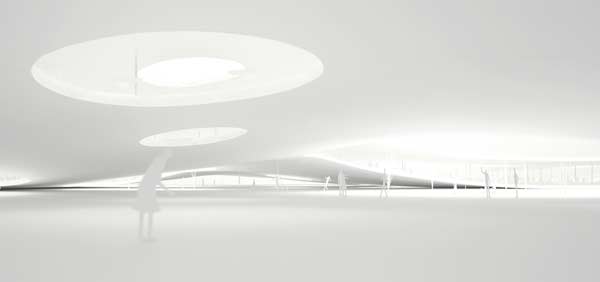
Design for a Learning Center at the Ecole Polytechnique Fédérale de Lausanne (EPFL).
Can you describe the relationship between floor, wall and roof and that of post-and-beams in the context of the Sanaa language?
S: Walls and floors are easy but roofs are difficult. The roof should not hide, it is not just a surface, it also has a clear function. Sometimes we try to make the distinction between a wall, floor and roof very clear, sometimes we try to make them all look as a continuous surface.
Could you talk about the relationship between interior and exterior in your work?
N: We always think about the continuity between inside and outside. The scope of the project is beyond the building. We are not just designing buildings but also a relationship to the city. The building is open to the outside.
How does the New Museum project in New York relate to the city?
N: New Museum was a difficult project. It is difficult for a museum to be so open to the outside. It needs walls to hang up the paintings. An enclosed space is necessary. One of the striking features of the New Museum is that it is right in the middle of the city. It is not in the outskirts like many museums. Also it doesn’t exhibit classical art, it is very contemporary. This is why they wanted to be in the middle of the city. So the question for us was how to open up the museum in this context.
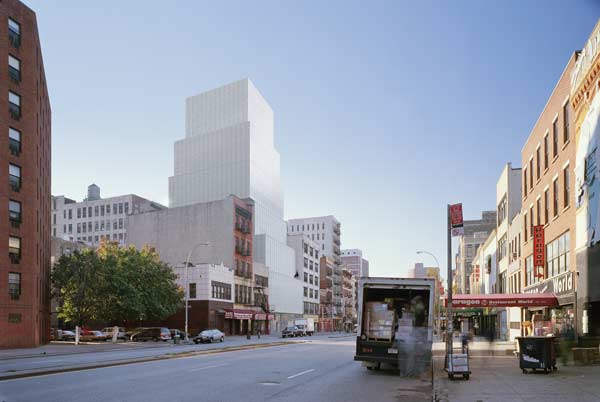
New Museum in New York City
So how did you manage?
N: We opened up the ground floor, people can get in and out for free, go to the cafe or the bookstore.
S: The design of the New Museum is based on the concept of shifting box, which allows us to create an open skyline. The building literally opens up to the sky. The shifting boxes create terraces allowing people to go in and out in the middle of the building.
N: As people go up the atmosphere changes. Each floor has a different relationship to the city and offers a different experience. The ground level is very messy, in direct contact with street life. From the top we can see the skyline of New York and the Chrysler building. Of course the clients wanted walls to exhibit art, but we wanted windows because the view is so interesting!
How much did the New Museum change from the competition project to the end product?
N: It is pretty much the same.
S: The shape of the building changed a bit because the program changed. Initially the office space was supposed to be on the ground floor. The office is a part of the museum; visitors can see the museum staff at work. In the end, the first floor is going to be gallery space and the office will be on the top floor. The first floor gallery is very visible, from the cafe and even from the street people can see the art.
Do you consider yourself 1) Asian architects, 2) Japanese architects and why?
N: We don’t consider ourselves to be Japanese architects. It just happened! We were born here, we had no choice!
S: I think that the starting point is different. Take for example the thickness of the walls. We are used to wood structures. European architects have a different idea of thickness of walls, which are usually made in concrete. The physical weightiness is different. Now, we cannot really speak for Asia as a whole, but maybewe can say that in Asia the relationship between the exterior and the interior is smooth. It is not as strongly divided as in the West, between the outside program and the inside program. The space is more continuous, created around the use and needs of daily life.
Some Western commentators have pointed that Japanese architecture has a specific conception of time. Buildings are not meant to last for more than 20 or 30 years, whereas in Europe architects don’t think about their work as temporary. How do you view your work in time?
N: Most of the Roman buildings are gone, except for a few bridges and the Pantheon which are still standing. In Japan some ancient temples remain thanks to maintenance. We expect our buildings to stand for a really long time, but I cannot say forever. Maybe a hundred years at the maximum. But the city has a longer life span. The city lives through many generations.
S: With many changes.
N: Yes, I feel nothing changes in European cities. The notion is that the city must preserve the same form forever. I go to Asian cities and I see everything changed since the last time. The population is growing. The life of the people is changing and the city is changing with it. In China and Tokyo I see many things happening, many changes. This is like moving with the life. This is a very different viewpoint. In Europe the idea is that cities must stay the same, in Asia cities must change. I cannot say which one is the good view.
In Tokyo things are changing fast indeed and some people criticize the way some changes are imposed, such as in the neighborhood of Shimokitazawa in Tokyo. There is a big plan for a large road cutting right through this historically and culturally important neighborhood. What about that type of change? Is it always a good thing? What about urban preservation in a city like Tokyo?
N: Change can be good or bad. What you mention often happens in Tokyo because the traffic is big and the government decides to make the streets larger. There is another type of change happening. In Shibuya you can see wooden houses with a new façade, which corresponds to a new program. For instance some people opened cafes in these old structures. Shibuya used to be kind of residential, then it became a commercial area and the facades of all the buildings changed. In France you don’t see this kind of change. The facades stay the same even if the program inside changes. In Asian cities you can change the landscape. If you convert a house into a ramen shop you can change the facade! So this is a positive aspect of the Asian cities approach to change. You can feel the real activity lead by the people. On the other hand there are many huge developments happening in Tokyo that are not nice, affecting old communities and residential areas and changing them into business & commercial centers.
Do think that Rem Koolhaas’ concept of the Generic City, which he used to describe the type of urbanism generated in rapidly developing Chinese cities can also be used to describe the urban development of Tokyo?
N: Developers are hired by companies to build very tall buildings. It is almost a natural phenomenon. If you go to the waterfront you can see these buildings mushrooming. This is not master planning in a Western way. The city is developing without a master plan, in a natural way.
S: Maybe that in Tokyo also there is no thought about the relationship between the building and the environment or the context. This is possibly another difference between Asian cities and Europe.
To conclude this interview I would like to ask you about Tokyo. Tokyo is the biggest city in the world and yet it has been described as a collection of small villages. What is your idea of Tokyo, thinking specifically about the notion of “scale” from very small to extremely big?
S: I use a very limited part of Tokyo, so in this sense Tokyo feels like a village. I cannot say I have an overall image of Tokyo. Physically I cannot tell what are the boundaries of Tokyo.
N: Tokyo appears to be very much disorganized but actually it is a city which works really well. There is no train delay. Every morning huge crowds are moved in a very orderly way from one point to the other. Very few crimes are committed in Tokyo. It is actually very orderly, even if the landscape looks disorderly. Some Westerners come to Tokyo and say this is chaos! Maybe it is true but people manage it very well.
S: It is a chaotic but also extremely dynamic place. Somehow it looks generic and not well organized but so many things happen in Tokyo. One bad aspect of Tokyo is that people cannot spend time without money, which is also related to the physical reality of the city. But since the economy was bad for so long, we gradually learned how to enjoy the city without much money!
Thank you very much for your time!