Weaving an Urban Fabric

March 28, 2014

Fabric4

Homegrown Settlements and New Metaphors for Urban Practitioners

Rebecca Houze in her essay ‘The Textile as Structural Framework: Gottfried Semper’s Bekleidungsprinzip and the case of Vienna 1900” (2006) analyses how significantly Europe’s rich traditions of textile design interwove itself into architectural practices.

Semper was one of the few architects who engaged with the dimension of architecture that was connected to weaving and the textile industry.  She explains: “The concept of cloth as a symbolic building material is contained in Semper’s enormous, unfinished compendium, ‘Style in the Technical and Tectonic Arts; or, Practical Aesthetics’ (2004 [1870-73]). The first and longest volume of this text is devoted to a detailed analysis of the textile arts. Architecture, according to Semper, originated in the primordial need to demarcate interior and exterior spaces with dividers–fencing made of branches, for example, or hanging tapestries of woven grasses. Some of the earliest built structures were temporary tents of real cloth stretched over scaffoldings, often festively decorated with garlands, ribbons, and other kinds of soft ornament that today we might characterize as “fiber art” (Semper 2004 [1870-3]; Wilson 1995: 42-8).

While the use of new materials was absorbed into modern construction practices, what characterized Europe’s dominance in the world of architecture and design was building on its rich traditions of textile related creativity.

Anybody familiar with Indian history will immediately be compelled to make comparisons. And recognize the wide gap that existed and exists between artisanal practices and the development of institutional knowledge linked to contemporary design related professions.

While the great architectural schools, and specialized institutions dedicated to design have paid academic attention to the enormous resource embodied in India’s artisanal traditions, especially textiles, a translation into practice has not always been as successful.

What is particularly relevant to us about Semper’s observation about architecture is that he sees textiles as integral to its evolution, along with the world of masonry, ironwork and carpentry.  European architectural practice seemed to have built on technological innovation of physical materials along with integrating design processes of textiles into it. They evolved masonry, ironwork and carpentry, making technological breakthroughs while also letting loose imaginations from the world of textile design to produce an aesthetic – either through restraint or elaboration – that continues to dominate architectural practice globally.

For many artisanal traditions (including textiles) outside the European experience the path of change was much more complicated. One reason could be in the structures that energized artisanal traditions in Europe – which were based on apprenticeship and a model of skill learning quite different from India. In India artisanal practices were enmeshed with the logic of caste and were responsible for a high level of productivity in terms of quality and scale – but were simultaneously anchored to values quite incompatible with modern impulses.

In contemporary times, to extract aesthetic and design skills while filtering away social bonds that sustain them, became enormously challenging to say the least.

Nevertheless, there were some attempts made in that direction. Government initiatives to preserve artisanal traditions were reasonably funded and their attempts to be integrated into contemporary economic exchanges were partially successful – but the difficulty in reconciling caste based modes of organization with them remained difficult.

How do you preserve traditional modes that are encoded into social structures for their talent and skill and yet demand radical changes in those structures for the sake of modern social objectives?

This contrarian challenge lies at the heart of many urban realities in India and confound visitors. Its poorest neighbourhoods inevitably have some of the most formidable talent and skill in fields as diverse as embroidery, leather work, intricate wood-carving, stone sculpting and others. It is not uncommon to see exquisite craftsmanship embedded in simple designs up for sale in grubby shops on polluted streets. Dharavi, Mumbai’s most well-known settlement that has the distinction of being referred to as a slum, is also considered to be the most productive space in the city. Traditional skills of ironwork, textiles and pottery constantly adapt, like these skills have always done, to contemporary economic needs. In Dharavi, its not just old leather work, that are sold in shops in India and abroad, but manual skills that have adapted to new needs of technologies connected to computers, mobile phones and automobiles also thrive. Not being able to deal with the social and economic knots into which these highly prized skills are tied, has made India pay a huge price, evident in its poor social and economic indicators and under-serviced urban neighbourhoods.

Another example of this state of affairs has been the inability to build on design traditions that were enmeshed in India’s textile related artisanal histories and weave them creatively into a contemporary sensibility of building and architecture. While Indian talent tied down directly to those traditions seem to have made some sort of mark in the field of fashion design, architectural practice in India does not seem to have  built as seriously on those traditions.

What it did manage to do is align itself more with traditional building practices as a source of ideas and creativity. There is a body of work based on older spatial and structural principles and a spirited defence of indigenous styled in response to  ‘western norms’.

The most recognized and renowned architectural practice in India today – is typically embodied in the hugely successful work of an architect like Bijoy Jain, who has developed a practice connected deeply to local artisans. He involves carpentry, iron smith and stone work into his studio that works like a collective crafts workshop. His strength has been recognising these processes and developing an elegant framework around them. His emerging aesthetic often reminds one of Japan, which constitutes a story of similar encounters with crafts and architectural practices.

However, Jain’s work is so authentically embedded in traditional arrangements that they echo some of the problems connected to the socio-economic knots we refer to above. Just as artisanship could not quite escape royal patronage in the past – in fact it thrived on it – India’s peculiar caste story traps Jain’s practice in much the same way. His dependence on rich clients does not allow genuine experimentations in aesthetic terms as well as to explore new markets.

It may well happen that in the coming years, more innovative young architects from India try to consciously evoke the Semper moment by building on design elements from textiles and interweave them into contemporary building materials and practices by combining them creatively with Jain’s processes.

One such Mumbai-based architect, already exploring these themes, and someone we work with closely, is Sameep Padora. Coming from a family historically involved with carpet weaving, originally from Kashmir, he builds on textures of textiles and combines them skilfully into structural principles using parametrics modeling, to come out with flexible and sound designs that move through all kinds of contexts. His works exist in luxurious shopping malls but also slide easily into Shivaji Nagar, Govandi, a re-settlement colony in north-west Mumbai, where he worked with us to experiment with light construction material to create a roof-top office. He exhibited artefacts that residents could use in their homes as well. What we find particularly striking about Padora’s approach is his ability to be adventurous with material, weave in the flexibility of light and heavy moments, derive an aesthetic from all kinds of sources including textiles and carpet weaving, and work with artisanal skills in the way we find most productive – well adapted to contemporary and even futuristic technological and economic needs.

Fabric1

We realise that building on tradition is never easy. Moments from the past can never be revoked or recreated – least of all through simply ideating change.

The European relationship to construction, artisanal histories and textiles produced an equation that still sustains its sense of supreme confidence in the world of design that no amount of mimicking will ever recreate for another set of practices from another history.

What may be more productive is to look firmly at the present – at the existing realities that confront us and – if we want to be inspired by Semper at all – translate his moment more delicately into the present.

What we would like to draw on from him is the observation that building traditions emerging from textile and its rich allied practices – like weaving – are as valid as the ‘hard’ world of stone, masonry, ironsmith and carpentry – as architectural practice itself.

Besides this – what we would also like to pay attention to is the other element of skill formation that our world today is networked into – information and knowledge – and see how these come together to produce a new language of architectural and urban practice.  We see specific processes of thought and practice as having becoming enmeshed to produce new ways of understanding architecture.

Thus a specific building as a starting point – its spatial logic, its dimensions and its aesthetic touch is created through negotiating several anxieties about the role of the mason, the architect and the engineer.  Similarly, when a neighbourhood in a city is the site of operation, the anxieties get enmeshed differently, with the architect and engineer working together and evoking the citizens in a specific way.

In the European tradition the architect, at some historical point, became the master of practices involved with building – in terms of an appointed role. Someone who worked with engineers, masons, carpenters, artists and provided his signature to the work produced. Typically his structure was usually commissioned by the Church, royalty or an aristocrat.

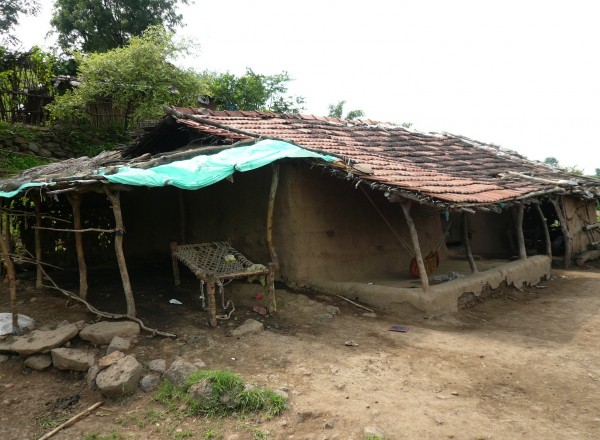
Yet, there remained a world of building outside his appointed role, a world that did not require his signature. This world – for a long time remained closer to Semper’s primitive building spaces in which the metaphors in use were closer to textiles than masonry. Homes made of reeds, cloth and the use of mud as flexible material dominated simpler societies, peasants, slaves and tribal communities. Where the arch builder – the master was not needed. It must be said though that some more technologically advanced societies like China and Japan also used woodwork and paper to produce very sophisticated building traditions that used weaving as a principle rather than masonry – to produce exquisite structures.

This space of weaving homes also produced a rich source of imagery to think about places. Textiles as metaphor related to construction and design is not something that must be reduced to materials and its direct uses whatsoever.  In fact that has been the biggest problem when contemporary societies try to work with the idea of traditional artisanship. Historians point out that all kinds of productive work has been in a constant state of change and transformation and to look at the past in terms of specific material use and skill sets as if they never adapted to markets and changing contexts would be myopic.

For us the richest interpretation we could possibly make of Semper’s observations is to think through new metaphors derived from architecture and textiles. And one very powerful metaphor is that of the Urban Fabric.  In an earlier piece in this blog – we spoke about the Aesthetic of Habitats while reflecting on the idea of aesthetics in urban spaces as a whole – navigating the world of architecture and design and trying to value the gaze that looks at neighbourhoods and cities.

Fabric3

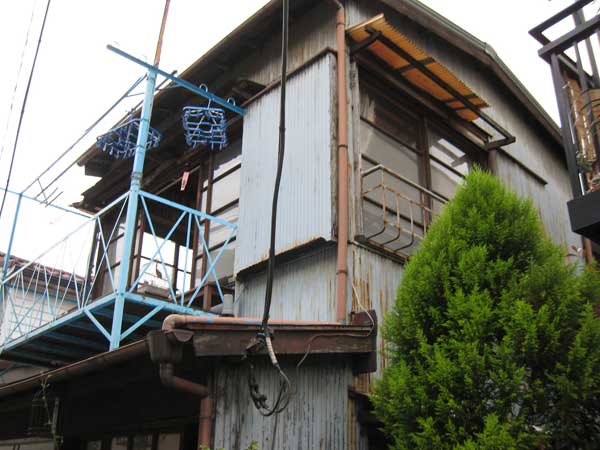
By re-visiting Semper we would like to argue that the patterns and elements of collective construction – as seen in the world of homegrown settlements is something that needs to be valued deeply – both as a practice and as an aesthetic. The idea of an urban fabric is a powerful one. It at once values the role of several weavers – home makers – tied to a logic of relations that produce patterns while being constructed. This represents a completely valid form of urban life that exists all around the world. Constantly improving favelas in Brazil, uncertain occupied spaces in Kenya, highly productive, skilled but marginal settlements in Mumbai, and incrementally grown neighbourhoods in Tokyo have started being recognized as having an aesthetic of their own.

Unfortunately, the reason most people see them as illegitimate spaces is not so much linked to their occupancy rights, poor quality, or misplaced and anachronistic exoticness (as in the case of Tokyo ) but as Ivan Illich would have reminded us – because they are produced in ways we consider illegitimate.

They are made through a collective intelligence, through processes that weave entire neighbourhoods with actors working in dedicated ways – without the master-builder providing a signature. Homes are woven into neighbourhoods through processes that produce their own patterns – which – through a historical gaze – have an aesthetic. But seen without imagination are considered to be without any whatsoever.

Our work in Mumbai’s homegrown settlements, provide us with new learning experiences everyday. And several more questions. What exactly is the role of an architect within such a densely and intricately woven fabric of networked homes? – is just one among them. We get some glimpses of answers in the small moves we make – project by project. A co-designed temple, a mosque, a tiny house – each of them a cacophony of intense dialogues and debates, but collectively being embraced into a landscape that seems to be emerging with its own pattern, its own style. We look forward to see what the future holds for us, as we take these small steps, we wonder what the pattern in the fabric will look like…

(These reflections were stimulated by discussions with Yehuda Safran who introduced us to Semper and Sarover Zaidi, who shared Rebecca Houze’s essay, during the Handstorm workshop organized in Shivaji Nagar Govandi – March 14-20th 2014. Photos by Tobias Baitsch)

Is India Already Urbanized?

December 13, 2012

A playful provocation; some serious questions

All indicators of urbanization in India point to a future that looks pretty stagnant, if you use conventional barometers. According to the latest census data, we see a  low proportion of officially urban to rural areas – still under 30 %. The growth of metropolitan centers is also slowing down.

Interestingly, all this is countered by a significant increase in non-farm economic activities in traditionally agrarian regions. These include manufacture, processing of agrarian products, construction and other services. There is also an increasing investment being made by rural-urban migrants from cities, back to their villages of origin. Significant rural-rural migration also hints at dynamism in erstwhile agrarian regions which are providing income through both farm and non-farm activities.

A family may have members spread out across the country fanning out into a range of different economic activities with roots in the ancestral village still active, and one leg firmly entrenched in the city. Different economic sectors can thus contribute to the income, or at the least, provide some social security to one family.

The presence of a pan Indian railway network that is cheap and relatively efficient allows for seasonal commutes, long distance migration as well the ability to keep  ties with rural areas intact, all of which contribute to a sense of belonging that is not classically rural or urban.

The slowing down of growth of metropolitan centers in the country, the most populous of which had emerged mainly during colonial times, is accompanied by a boom in small towns. These growing urban centers are more intricately connected to their rural hinterlands than the great presidency cities were. Which by the way, also owed much of their economic growth to agrarian fuel, either poppy, cotton or jute. For longer than one imagines, large parts of rural India were agro-industrial ventures, linked to urban markets, and not sites for home-based, sustainable agricultural activities.

To divide the country sharply into rural and urban sectors has been critiqued as vehemently by social scientists, many of whom tried to capture this fuzziness with awkward concepts such as rurban, or by presenting rural urban experiences on a continuum. However these observations were rarely used by policy makers, who preferred at first, to subscribe to a Gandhian fantasy of a rural idyll as the site of real India and then, with equal, one-sided alacrity, became anxious about urbanizing the country through seeing more people live in cities as soon as possible. The fact that a people depleted rural India is unthinkable anytime in the near future, thanks to a 800 million strong presence does not seem to daunt such eager urbanists.  A fallacious comparison with totally different historical experiences from North America, a selective reading of European history and a pointless competitiveness with China allows this fantasy to have currency in spite of all indicators pointing elsewhere.

Historically, to classify agrarian practices as purely rural – as if this sector was not tied down to taxation policies or revenue needs of urban centers – is a fallacy. The growing of grains was directly connected to accumulation of centralized, storable wealth.  At the same time, to ignore that much of pre-industrial manufacture actually happened in villages is also subscribing to simplistic and rigid notions of what is rural or urban.

Even in contemporary times, social scientists are trying to sensitize census data collectors to interpret peoples self proclaimed professions in more nuanced ways. A farmer is not always just a farmer (if she ever was one) – but also someone who could be a taxi driver, a construction worker or an artisan and maybe even all of these. In fact the evolutionary framework that cast social growth into tribal, rural and urban-industrial has been one of the weakest theoretical constructs in terms of empirical substantiation, even though a hugely influential one. It tended to fix people into singular roles ignoring the intricate and complex economic systems that existed in the smallest of societies.  Even a hunter-gatherer did some horticulture, construction, fishing and artisanal work.

The development of a modern industrial, job oriented ethic reduced individuals to cash oriented capitalist wage earners even though urban environments provided as much variety and possibility to absorb multiple skills from a single worker or a group of workers. Modern urban work ideals were connected to certain promises linked to a special arrangement of labour, technology, resources and skills. This was based on imagining an endless supply of resources and continuous economic growth. In reality growth hardly happened in this way.  Workers were always relying on multiple sources of income, dealing with economic cycles, depression and uncertainty.

Progressive politics put all hopes into the promise of a stable job oriented economy and rarely looked at other forms of state-sponsored economic systems for individuals and families. Rural worlds were firmly seen as static and incapable of being integrated into a modern worldview. Insurance systems, social security, pensions were all tied down to the negotiations that workers had to make with private job providers or the state, in the city. Creative solutions that gave them more agency and control over resources, both traditional and new, was rarely the path chosen by pro-worker political actors.

Yet in countries like India, urban industrial workers always managed to create support systems that were wired to their villages of origin, no matter how economically and socially marginal their location there. Sometimes this may have been acts of desperation, but often it was also linked to a real desire to remain connected. For most of the country, the railway network acted as the biggest factor making this dual affiliation a reality. However, historian Raj Chandavarkar points out that  in the case of Mumbais famed textile industrial workers, (at one point of time, half of whom came from just one coastal district in Maharashtra, Ratnagiri,) the lack of railways was substituted by sea travel.  Workers commuted seasonally,  across 400 kilometers of coastal waters. The citys iconic mill workers relied a lot on agricultural income from back home to supplement their earnings in expensive Mumbai. Almost as much as they used their ethnic connections to their villages to assert their own urban identities in a cosmopolitan city. Industrial strikes became real bargains only because the workers could prolong their defiance, thanks to support from their village.

Indias supposedly most modern city,  Mumbai, grew around several fishing villages, which themselves spawned large settlements in which rural urban migrants settled into homes and started commercial activities which allowed for a complementary set of work that supplemented the dominant job-providing sector. The state, at one time shaped by welfare ideals, was forced to protect land use by poor migrants. Even if it did not do much else but grant temporary, negotiable rights of occupancy, this act allowed for migrant groups to develop systems of sustainability with very little resources. They too could not rely on stable job generating  abilities of the city beyond a point.

Today, instead of finding ways to improve these neighbourhoods, provide them with better infrastructure, support their emerging economic activities, the state agencies and the private sector have entered into battles over land and proprietorship in the most reductive of ways.

The expansion of a neo-liberal economic mindset encourages the specter of speculation to hang over every urban space in the country. It eventually develops into an ideology of the city that never gives any space to economically dynamic neighbourhoods which need little else but special protection from market forces as far as land occupation goes.. People are willing to pay rents to the government for occupying and using land for socio-economic development, but this is rarely acceptable to authorities. Instead urban policy itself  speculates over every square inch of land and is eager to generate more urban space to emerge in the city (and elsewhere) and make even more money out of speculation. Subsequently, a city like Mumbai ends up having 500,000 vacant flats in the city where prices remain sky-high, for very mediocre properties.

Contrast this with the generations of residents in the so-called informal city – commonly referred to as slums and whom we refer to as homegrown neighbourhoods. They increase and enhance the quality of life of their neighbourhoods through incremental investment in its built form, by raising capital from using space as intensively as possible. Many of these residents also invest back in their villages – in improving ancestral homes, or by starting new businesses there.

The latest census report points out to increased rural expenditure in the country thanks to urban migrants sending money home on a regular basis. These are often from the same homegrown neighbourhoods of cities like Mumbai, who are now being increasingly attacked  as speculative value of urban space becomes more unbearable and the city more unlivable for those with modest resources.

Thankfully the rate of population and economic growth of cities like Mumbai is declining. Instead, small towns are developing more dynamic growth patterns all over the country. What is important to note is that these small towns are more smoothly entrenched into their rural hinterland than large metros. People often commute from villages to cities on an everyday basis for jobs and education. Sometimes rich farmers buy second homes in towns. Families expand their affiliations across rural and urban areas with more ease thanks to better transport facilities. Well-connected and networked areas make it easier for people not to migrate, but instead, navigate distances more strategically for commercial and personal reasons.

In India, the administrative unit of the district in many parts operates like an urban system. With a network of towns and villages criss-crossing, using transport facilities that are private and public. To classify such spaces as exclusively urban or rural does not make sense.  Economic interactions are enmeshed and educational needs are cross-wired across massive distances, as well as in closer proximity.

If there is any need to persist in defining these areas as exclusively rural or urban – it is only because we are still stuck with a very limited notion of a city. One which remains informed by speculative practices and  visualizes cities as dense and consolidated spaces.

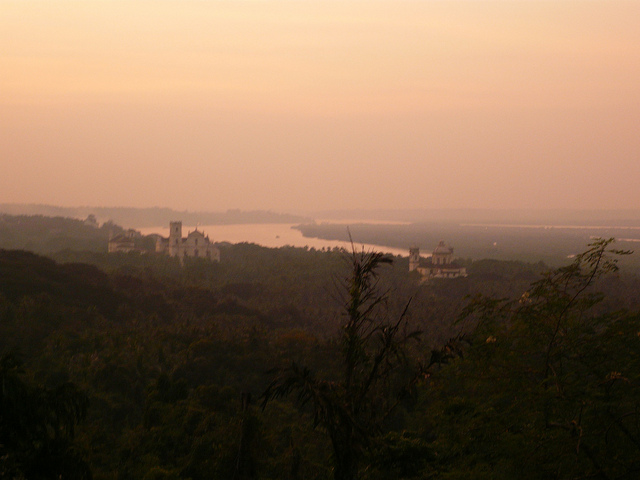
In reality the experience of urbanization is extremely unpredictable. Officially the state of Goa is India’s most urbanized state, even though a large proportion of its residents live in villages, (just under 50 %) . The remaining 50 odd % of urban Goa includes large villages and networks of  habitats of a great variety.  Thanks to a slightly different historical trajectory, Goa manages to have a landscape that is mixed use in terms of agrarian, mining, tourist and manufacture, has a large forested land cover and is also urbanized in a social sense.  Conversely – if you follow an ethnic history of Mumbai – the metropolis has more than 150 official urban villages that are part of the city s East Indian history (Maharashtrian Catholics connected to the city’s Portuguese past) in which more than half a million people still live. Thus more people live in villages in Mumbai than in Goa.

This play of statistics is only being evoked to open up our way of looking at Indias urban future in a more realistic way. On one hand we have the depressed figure of an under 30% urbanized economy. On the other hand you have the vision of a highly dynamic agrarian sector that is emerging as a manufacturing hub, and a service economy, with a relatively skilled and multi-talented workforce.

As a cautionary note we must acknowledge that rural India is also being exploited commercially by global agricultural practices and an aggressive mining sector. However it is they who will benefit from an evacuated rural landscape more than anyone else. This is what happened in many so called developed countries that looked at urbanization purely as dense consolidated urban centers and ignored the possibilities that rural lives could provide to a modern economy. Evacuated and empty rural areas made it easier to create hyper commercialized agro-industrial territories, depleted of human presence.

In India thankfully we are far from that picture. India still is heavily populated in its rural and tribal areas. However the nature of these  areas is changing.

Can this change be harnessed more creatively? If urbanization is such an important part of a modernizing economy can we not define urbanization a bit differently?

Can we say that India’s teeming populations are organized in urban systems that connect agricultural and other activities and spaces? That the future of this kind of an economy is as much connected to a peopled farm sector as it is of non-farm activities in both rural and urban areas? Just as formal and informal settlements and economies hide a more complex reality does Indias rural area also hide such a complexity? One that we are burying under a very simplistic dichotomy?

As Anthony Leeds suggests very provocatively, pre-industrial kingdoms were not urban centers ruling vast territories of rural villages. The villages were producing for a tax regime, for centralized urban centers and food was revenue and wealth in the form of taxes. Villages were part of urban systems. There is no such thing as the distinctively rural – as opposed to the urban -  in his world view. Kingdoms were urban systems. Just because people lived in villages did not mean their lives were not being governed by  urban power centers. For him it is urban systems all the way. But this argument cannot be used to justify a narrow world view of urbanization or a dense urban future for all. It actually calls for a more integrated understanding of economies and habitats.

Maybe if India – in an ironic twist of statistical reality calls itself 100 % urban – and defines itself as a network of urban systems, it will dignify its vast rural populations in a more creative way – it will be able to harness its natural resources more inclusively and also look at the future of urban India in a less anxious way – where the image of rural hordes attacking its urban frontiers will give way to a more generous relationship to space. Instead of visualizing the future of rural India either as gorged out mines, battlefields, or dystopic cash crop landscapes, it can be still seen as peopled with habitats, organized around healthy public transport systems, a combination of agrarian and other kinds of economic activities and greater local control over natural resources.  For those concerned that a peopled rural landscape cannot be environmentally friendly, one only has to look at states like Kerala, which for all  local cynicism, is a living example of rural-urban density and a mixed use, tree lined inhabited landscape – like Goa, another kind of an urban system. In contrast, all the commercially exploited landscapes of colonial rural British India (thanks to cotton, jute or opium and aggressive mining in tribal belts)  remain tied down to exaggerated rural-urban categories.

To look at India as a network of urban systems, having a wide variety of landscapes and uses of land, of deeper connections between natural resources and people who use them – would need an over haul of conceptual frameworks. It would mean a fresh look at administration, at infrastructure, at revenue generation and use of natural resources. It would mean a more creative way at looking at the countrys human capital and potential – and a firm break from an outdated way of looking at work and livelihoods. But it may still be economically and ecologically less expensive than going down an imagined one way route of hyper-urbanization on one hand and empty, depleted hinterlands on the other.

Recognizing the User-Generated City

June 17, 2012

bhandup
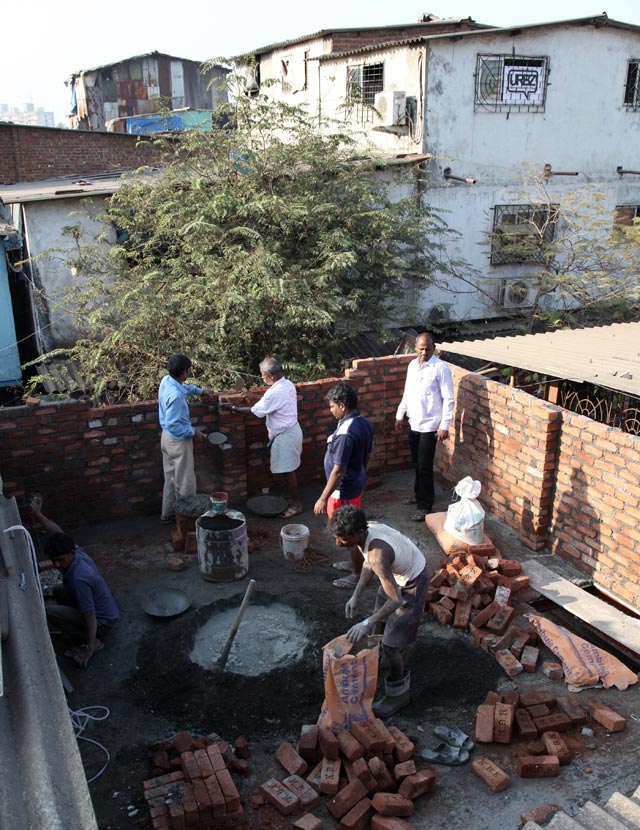
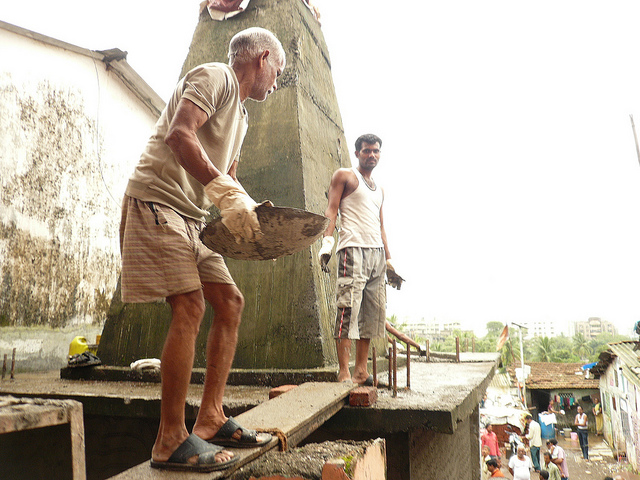
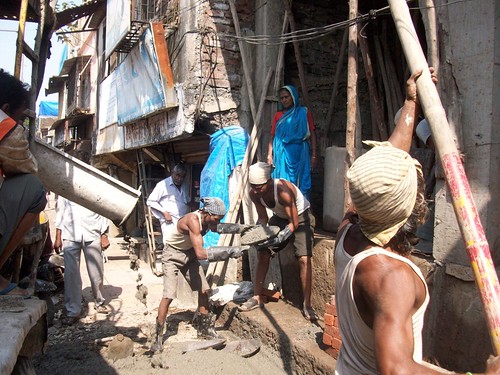
Construction in Utkarsh Nagar, a predominantly Kokan neighbourhood in Mumbai.

Presentation at the World Bank in New Delhi on Monday June 18th, 2012.

This presentation seeks to offer alternatives to apocalyptic visions of over-crowded cities, rural wastelands and endless slumscapes, which may well become self-fulfilling prophecies. Our practice and engagement with neighbourhoods in Mumbai and its hinterland has lead us to question taken-for-granted categories such as the slum and city. We will make a case for policy recognitions of existing practices and urban patterns, and for moving towards a more realistic and pragmatic approach to urban development in India.

One of the forgotten memories of Mumbai is that of the nearly 190 villages that compose its historical fabric. Lost somewhere in between the ‘slum’ and the ‘high-rise’, villages may be out of the city’s mental map, but they are still very much present in its culture and urban dynamics. The vernacular urbanism of Mumbai is as much a reflection of the city’s history as of its post-industrial makeup. The “tool-house” combining living and working functions is at the heart of the spatial, social and economic organization of Mumbai’s “homegrown” neighbourhoods.

These neighbourhoods, where more than 70% of Mumbai’s population are said to be living, are incrementally developed and improved by an army of contractors, masons, plumbers, electricians, painters and material providers, who typically live in the same neighbourhoods where they work. This makes for a vibrant local construction industry responsible for the production of hundreds of thousands of affordable houses all over the city. This process is however not recognized by the authorities, which either look the other way or actively repress it.

Our engagement with residents and constructors living and working in neighbourhoods notified as slums comes both in the form of collaborative projects and discursive output. Our practice and writing steams from the conviction that the involvement of local actors is the only way that the government’s affordable housing targets can be met. Between 1997 and 2002, the government and the builders built 500 000 houses in urban India, when in the same time, the people built 8.5 million units in so-called “slums”.

There is another the way the village continues to haunt Mumbai, and nearly all other cities in India. Migrant communities rarely disconnect from their native points of origin. Deep ties to the land, hearth and family create loops of interconnectedness that sustain the life of residents on both sides of their habitat spectrum. People draw from either side for self-reliant insurance and security. Even when people dig deep roots in the city, they often relive their village life in its architecture and cultural life.

Urbanization in India is not the one-way street that one normally associates with the phenomenon. The communities that keep the connections most going are often the service, working class communities who occupy the kind of spaces often referred to as slums, gaothans, urban villages. Not only are the connections between big cities and villages forged by migrant communities an important characteristic of urban life in India, but almost all small towns and villages are networked and connected to each other through different forms of mobility.

Rather than see the vast regions of the country as a rural hinterland punctuated by towns and cities, our research shows us how most districts function as urban systems in which people from villages and towns travel to and fro all the time, function as markets and circulate objects, finance and people. One of the important consequences of looking at networks of towns and villages as a valid urban form is an acceptance of a diversity of habitats, that includes villages and towns, and in some cases forests and other landscapes within one fold.

Recognizing the existence of urban systems spanning over large regions can help us think of alternative models of urban development and help promote more sustainable habitats across the sub-continent. It may also help us revise our approach to the big metropolises and the large-scale presence of so-called slums. By turning around the idea of villages and their connections to cities, we may be able to address issues of affordable housing in a more creative and effective way.

Our presentation will touch upon both these themes. We believe that a policy which recognises the ability of homegrown cities to contribute to better and inclusive cities is vital for urban policy. It will help evolve more realistic infrastructure policies that adapt to the needs of the maximum populations that reside in cities.

1. Sticky feet on rails

kokanrail
Ratnagiri Station on the Kokan Coast.

Because of the price of real-estate in Indian metros people living in neighbourhoods notified as slums often have no option but to move out to better places. As a result, residents with “sticky feet” often reinvest their earnings in their house. When reinvestment in their city homes is made difficult by hostile policies, they prefer to invest in their native places. India’s well-developed railway network means that urban migrants can keep good connections with their native town. Even over several generations, the link between the village of origin and the city is maintained. These flows benefit the village economically, since it captures a large share of the savings of the urban migrants. Whenever dwellers feel that investing in their urban dwellings is safe enough, they often prefer to do so, since the return on investment is higher. The desire to grow roots in the city, as well as keep deep connections with the village is often facilitated by the family structure where members divide their loyalty. This contributes to the incremental improvement of their neighbourhood as well as allows for the benefits of support structures from back home, to remain active. This dynamic relationship across city and village/town is something that needs to qualify the misplaced faith that authorities in India now have in one-way urbanization trends.

2. Homegrown Homes

Contractor-Dharavi-select_1
Construction site in Dharavi, opposite the URBZ/Urbanology office (photo taken by Ben Parry).

Investment in homes happens when there is some sense of security. Local builders make hundreds of thousands of affordable homes all over the city, improving, reconstructing or building afresh. They are socially networked in neighbourhoods where they live and work. Their success rests on the reputation they establish over time in the localities where they operate. Their physical and cultural proximity to their client means that a relationship of trust replaces contractual arrangements. They understand local politics and regulations very well since their work entirely depends on it. They often have evolved working relations with local bureaucrats and corporators. Flexible and adaptable in their approach, they are typically open to collaborations with outside agents who can enhance their profile locally. They are private actors of development that institutions, organizations and corporations can partner with.

3. Tool-house


The structure that dominates these home-grown neighbourhoods is the Tool-house. They combine living and economic functions, where the houses themselves are often used as income generating spaces. Along with living spaces for families or workers, a “tool-house” combines retailing, manufacturing or servicing functions. Such post-industrial habitats define the typology of many neighbourhoods. They are also central to their economic development. Even in cases where people predominantly work outside the neighbourhood, the house is often an economic unit for supplementary incomes in some way or the other. Inter-linked clusters of such homes make up distinct settlements, shaped by different factors – community, caste or just history

4. Connected neighbourhoods

mobilitymapdharavi2
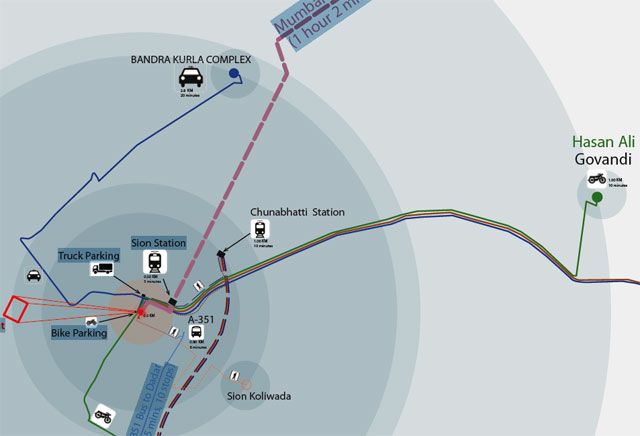
Study in process on mobility patterns in Dharavi.

Far from being self-sufficient and autonomous “cities in the city”, unplanned neighbourhoods are extremely connected to the rest of the city. Many of their residents often work in shops and offices outside.  Some send their children to private schools in other neighbourhoods. Those who live and work in the neighbourhood (for instance in a tool-house) have suppliers and clients from all over the metropolitan region, from elsewhere in the country or from abroad. These connections are vital to the neighbourhood as much as to the city, which benefits from the proximity of production centres and service workers.

5. Public streets

dharavistreet
Street in Dharavi (photo by Lasse Bak Mejlvang).

The lack of formally defined “public spaces” such as squares and playgrounds in many unplanned settlements is made up for by the use of streets as multipurpose spaces. The narrow streets, typical of unplanned settlements, makes them hard to access for cars. The result is that most unplanned settlements are largely pedestrian. Streets are relatively free to be used for public purposes such as temporary markets, socializing, playgrounds for children (whose parents can keep an eye on them from their homes), and ritual functions (prayers and festivals). Recognizing these aspects as valid, will help evolve sensible plans for transportation and public spaces.

6. Walk2Work

MGRd
MG Road in Dharavi.

More than half the population of Mumbai walks to work. If we add the human and animal powered vehicles (bicycles, carts)– which are very common in many localities, we have a spontaneous constituency already practicing sustainable transport practices. These practices are well connected to existing mass transportation systems like trains and buses. What the city needs is less car-centric development and instead an increased attention to the interconnections between sustainable modes of transportation. Many cities today are trying hard to create the walk to work kind of environment, which is both prevalent and threatened in Mumbai and other Indian cities today.

7. Incremental development of habitat

dharavishelter
Incremental improvement at the Dharavi Shelter.

Unplanned neighbourhoods systematically improve overtime, unless they are prevented from doing so by local authorities (through demolition drives or overly restrictive control on construction). Incremental development encompasses urban, economic and social aspects of the neighbourhood. This is particularly so when the house also serves as income generators (tool-house), since reinvestment in the house translates into higher productivity. Incremental development may be driven by individual house occupants but favourably affects the neighbourhood as a whole. Collectively, incrementally improving homes add value to the entire neighbourhood and to the city. Through incremental development, neighbourhoods become upwardly mobile.

8. Incremental development of infrastructure

publictoilets
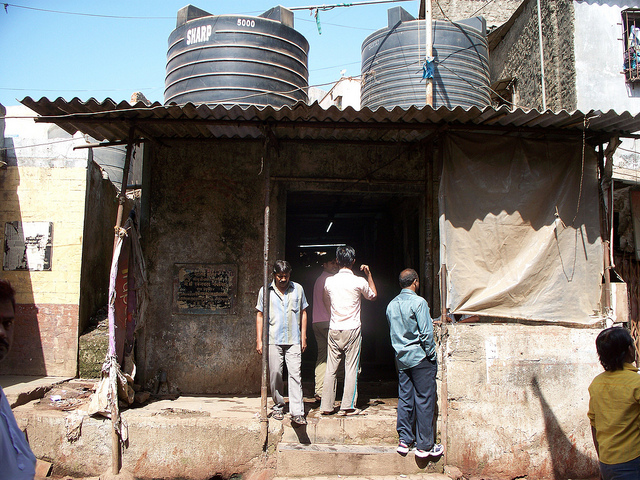
Community toilet in Dharavi.

Infrastructure improves over time thanks to internal and external mobilization of resources by community leaders and through the participation of inhabitants. Electoral politics, strengthen the links between residents and civic authorities. The more politically stable a neighbourhood is, the better its civic infrastructure will be. In Mumbai, through a combination of local intervention by private contractors, civic involvement and public interventions, the large majority of unplanned settlements have access to water and basic sewage and roads. Coordination between different actors does happen, but it would benefit from being institutionalized.

9. Community economics

baiganwadimosque
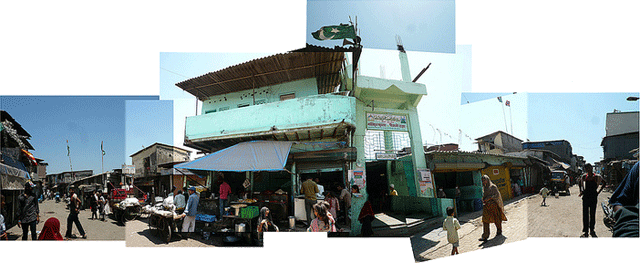
Mosque in Baiganwadi, Deonar, Govandi.

Caste, ethnicity and religion play an important role in the provision of employment opportunities. Neighbourhood boundaries are often defined along ethnic lines, and the same logic structures the neighbourhoods internally. Clusters of specialized activities relying on economic cooperation produce economies of scale. Agents connect these clusters to spaces of trade. Economic interdependency and trade networks consolidate neighbourhoods and create bridges between different communities, promoting social peace. Within neighbourhoods, community ties help raise capital and resources for individuals and families and help provide social security to tide over bad times.

10. Institutional roots

saibabatemple
Construction of Sai Baba temple in Bhandup.

Public institutions and non-governmental organizations have deep roots in neighbourhoods notified as slums. Residents and activists spend much time lobbying political representatives for schools, hospitals, temples, public baths, gyms, resident associations and youth clubs. These institutions enrich the life of the neighbourhood and also become important actors in mobilizing communities and external resources for ongoing development projects, in particular infrastructure development. They are also a strong assertion of mobility aspirations.

11. Political right to use land vs. than legal right to sell it

dharavi
Tool-houses in Dharavi (photo by Sytse de Maat).

Occupancy right is a political rather than a legal right. Elected representatives often seem to act against the interests of municipal authorities, and recognize the political right of inhabitants to remain on government or vacant land. This is what has kept many neighbourhoods going for so long in Mumbai – but in a half-hearted and conflicting way since residents are not legally owners of the land. The bureaucracy and the middle-class usually perceive unplanned neighbourhoods as encroachments, regardless of their history. The wisdom of the day is to turn occupants of neighbourhoods notified as slums into property owners. In the speculative context of India today, land titles will quickly swap hands and be used to develop new property for another kind of constituency. In Mumbai, the supply of new housing has been not responding to demand of house buyers/tenants as much as that of real estate investors (whether they are large funds or middle-class investors). Recognizing the right of using land over that of selling it would go a long way into protecting neighbourhoods in formation from speculative redevelopment.

12. Informal construction tax

demolitiondharavi
Destruction of illegal floor by BMC in Dharavi.

Far from being remote and disconnected from the process of development described above, the municipal authorities are actively involved with local actors. Rigid regulations and the lack of accountability for institutions such as the BMC in Mumbai have provided many opportunities for the imposition of “special taxes”. The reconstruction or extension of houses in neighbourhoods notified as slums typically happens through un-receipted administrative procedures in which the Municipal authorities validate the moves made by inhabitants and local agents. Sometimes, this system adds up to 40% to the cost of construction and forces builders to work at extreme speed. Non-adapted regulations, low wages for municipal workers and corruption are all to blame. Yet, this informal system could inspire a new model of public financing through taxation of local construction that could be extended to other parts of the city.

13. Interdependence of communities & diversity of habitats

southmumbai
Diversity of habitat in Kemps corner, South Mumbai.

The idea that an entire neighbourhood must be homogenous in terms of class goes against the way in which urban India operates. Middle-class and upper middle-class homes often prefer to have service-oriented people living around them or in their vicinity. The current restructuring of Indian metros that is pushing low income residents to the suburbs is particularly unsustainable in view of the existing strains on public transportation. While mixed income neighbourhoods are still the norm in older city centres, new housing developments in the suburbs are leaving no space for the working class to stay. Due to the loss of a mixed income crowd in central neighbourhoods, India may loose one of its most democratic urban dimensions.

14.  Slums as urban villages

worlikoliwada
Worli Koliwada in Mumbai. Often mistaken as a slum. In fact one of the most interesting urban village in the city.

In Mumbai, like in several Indian cities, many old urban villages have become the nuclei around which unplanned neighbourhoods have sprawled. Villages have a different typology (low-rise, high-density), land use (mixed use) and value structure for historical reasons. This has produced cheaper tenancy and sub-tenancy systems in various pockets of the city. About 189 goathans in Mumbai have evolved into larger settlements, which are often mistaken to be slums. The Chawl system and the Rent Control Act have also played a major role in allowing certain (non-native) groups to stay in central locations over generations. This historical and cultural fabric, which predates British colonization needs to be recognized and validated.

15. Urban systems

goaurbannature
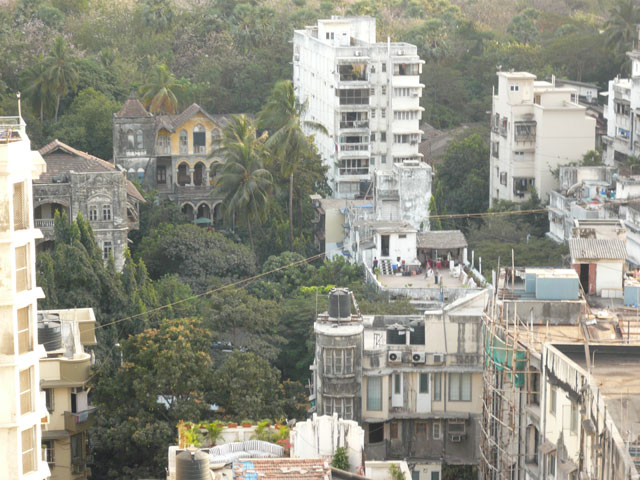
North Goa: Below the trees a dense urban system.

Gandhian inspired rural development strategies, which focused on the self-sustainability of villages and the post-liberalization urban centric policies that believe that city are the engines of economic growth – are ignoring much more complex historical patterns of communication between towns and villages that promoted cultural and economic exchanges. To date many Indian regions are organized in a network of towns and villages that form an integrated economic and cultural system. This is clearly visible in Goa, a state composed of hundreds of villages and small town with a capital city of 100, 000 residents. Far from being an impoverished economy Goa provides some of the highest standard of living to its residents, many of who work in urban sectors while living in villages. This pattern is repeated in several parts of India, in the form of districts. However, these units are rarely treated or administered as urban systems, even though they are networked spaces with people and goods moving within them all the time, interspersed with a variety of economies and habitats, ranging from forests, villages, fields, industries and cities. These urban systems are loosing out from the current focus on “cities” because they get ruptured and divided by rural/urban specific schemes and policies, which do not factor these deep ongoing connections.

The Sao Paulo Urban Revolution

March 20, 2012

One City, Many Forms

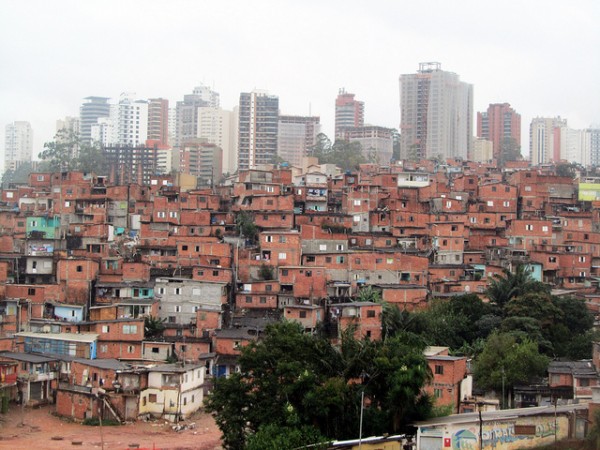
For a city as high on modern architecture as Sao Paulo, its newly found generosity of spirit towards its contrasting favela-studded landscape is a precious thing. The administration seems to be more accepting of the city’s diverse urban texture than ever before. It is now loosening policies to allow existing favelas to upgrade themselves and become well-integrated parts of the city. 

Sao Paulo has experimented with years of diverse approaches to ‘tackle’ these neighbourhoods. These have included encouraging migrants to go ‘back home’ or relocating them in social housing projects.

Today, of its officially estimated three million favela residents, the administration focuses on relocating only those who live in high risk zones. Local actors continue building and improving their houses, while the prefecture retrofits water systems and other civic infrastructure. 

Such a shift may be strategic, shrewd or contingent on electoral cycles. However, in a world with little patience for alternative forms of urban settlement – where everyone is in a hurry to redevelop according to the global standards of the day – such a reprieve is itself revolutionary. Especially when it is combined with the strengthening of local governance and emergent economic practices such as local currencies.

These moves signal a new found faith in the capability of the favelas to reinvent themselves into confident middle-class neighbourhoods. From once signifying a ‘slum’ the word seems to represent a new and assertive urban order that today dominates the globe, showing its civic potential in cities like Sao Paulo and Mumbai. One which – if allowed to – can absorb new infrastructure in a flexible manner, help open up rigid planning rules, energize architectural imagination, encourage healthy economic practices and eventually transform the neighboourhoods into prosperous areas with a high quality of life and a strong sense of identity.

The biggest hurdle Sao Paulo’s nascent ‘urban revolution’ could eventually face may be from an unexpected quarter. We may well discover that mainstream urban practitioners, builders and theorists provide the strongest resistance! After all, what can one make out of the unexpected landscapes? The emergent, messy aesthetic takes some time to enter into our realm of the normative. However, instead of opening up design and architectural theory, and adapting to the change, planners and architects may realize that their traditional moneymaking models of development are threatened by local construction practices. Their response could be about pure, competitive survival. They may insist on broadening the notion of ‘risky’ neighbourhoods to eventually become so wide that the favelas may eventually transform into morose, straight-jacketed social housing projects anyway!

However, this does not have to be so. Favelas have the means and need to engage many kinds of urban practitioners. Working together with local builders and residents on a multitude of smaller projects is likely to be more fulfilling to young architects than helping developers maximize their returns on large real estate projects. And it may well be more remunerative as well in the long run. Architects are most exposed to the booms and burst of a real estate industry, which is more than ever riding on roller coasting financial markets. On the face of it, the construction market in the favela, with its relative autonomy from the debt economy, its thrust for improvement and its openness to new ideas seems like an increasingly sensible field of practice for a new generation of urban practitioners.

Construction professionals living and working in favelas earn much more than one would assume. They are willing to share their resources with practitioners and suppliers able to add value to their work. The fact that most of them value quality over low cost is not as counter-intuitive as it seems, given their extreme reliance on good reputation and recommendation from previous clients. The close-knitted social fabric of the favela acts as an efficient insurance against malpractice. Bad masons quickly run out of business. Personal relationships and trust, lower transaction costs in the construction industry are alive in the favelas.

Because trust is won over the years, the best way for an architect coming from outside to start working in the favelas is to offer her services to local builders who already have a good client base. For this to happen, architects have to accept a reversal of their traditional hierarchical status, which places them above contractors. Instead of being a maestro in charge of the project and commanding a team of executioners, the architect has to learn how to be a contributor working alongside the masons and the client.  The reward may well be worth it. And the day the real estate bubble bursts in BRICS markets, this paradigm shift may well become a necessity for most practitioners. 

Whether we want it or not, the urban order of tomorrow will consists of many contrasting landscapes. Uniform high-rise cities are dangerous and unrealistic fantasies. Instead of trying to stretch and tear our imaginations to force urban landscapes to fit into such visions is it not better to use that same ability to visualize new kinds of cities?

It would be truly revolutionary to see technologically advanced, high-quality, Tokyo-style low-rise high-density urbanscapes merge with Sao Paolo’s modernist skyline. Why can’t it be as natural to walk into colorful streets throbbing with music, small retail shops and stores as it would be to drive through broad avenues and shopping malls? Instead of seeing this encounter as necessarily antagonistic or schizophrenic, it would work better to see it as the sign of the times. Ours may not become a planet of slums after all, as much as a repository of the most diverse habitats possible!

Urbane Villages, Wild City

March 13, 2012

1. Gaothans of Mumbai

bom_map_Details_1
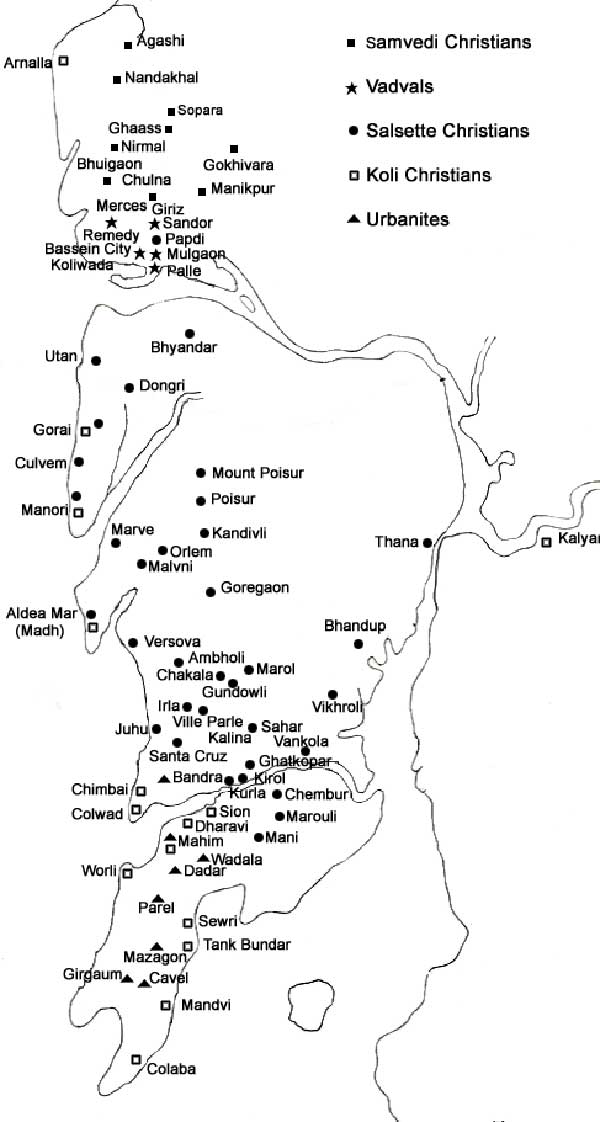
Location of East-Indian villages in Mumbai: source: http://www.east-indians.com

There are 189 East Indian Villages in Mumbai with a total population of 1 million people. In a sense as many if not more people in Mumbai live in villages than in the state of Goa. In a strange twist of narratives, there are some official documents which presents Goa as a highly urbanized state, with as many people living in urbanized areas (large modern villages and towns) as there who live in its official 350 villages. We evoke both these stories simultaneously because they have the potential of supporting each other. In Mumbai, the East Indian Villages, like their Goan counterparts are very well organized at the community level and are battling with local politicians, builders and the vast urban jungle that has grown around them in what they perceive as a wild and uncontrolled way. However as anybody can see, Mumbai seems to be a hopeless case. And many would say that in Goa too it is a difficult battle.

2. Villages and diversity of habitats

The village story of Mumbai is the tip of a long standing argument we make about incremental growth of cities that takes along with it a great diversity of habitats that the city has produced including villages, chawls and low-cost affordable housing structures often called slums. Our engagement with these habitats, ranging from the heritage story of Khotachiwadi to the Koliwadas of Dharavi have made apparent the deep connections between the form of villages and the so-called informal settlements for which the former acts as a template. Mumbai never was a city of slums and skyscrapers but one in which a great variety of built forms accommodated people working at different layers of the its powerful economy. Old villages provided land for affordable housing on a large scale and their templates were reproduced in the thousands of habitats that emerged all over the city.

3. Slums, villages and urbanization

The overwhelming presence of these habitats, often referred to as ‘slums’ is connected to a confusion about urban forms and can be seen from the example when British authorities in the late 19th century referred to Khotachiwadi as a slum and today, this village is enshrined as a heritage hamlet. This example reveals the deep wedge in Mumbai’s history between its two distinct phases. One is the south-oriented story that starts with the development of the docks by the British in the seventeenth century. The other is an older, northern-bound story that starts with the Portuguese conquest and domination of the regions around Vasai village in the fifteenth and sixteenth centuries. As the influence of the British East India company company increased through the development of the docks, many groups migrated from the Gujarat and Maharashtra regions all through the seventeenth and eighteenth centuries. Working class communities found themselves being absorbed by the villages that existed, in what was then perceived to be, the peripheral regions of the north. These lands were mostly owned mostly by Catholic landlords. All through the early twentieth century, poorer migrant groups would pay rents to landlords to set up hamlets that became their homes. Interestingly, richer rural communities, mostly upper caste Catholics, who happened to be educated and got skilled jobs in the docks also reproduced similar hamlets – referred to as wadis.

4. Mumbai in Goa

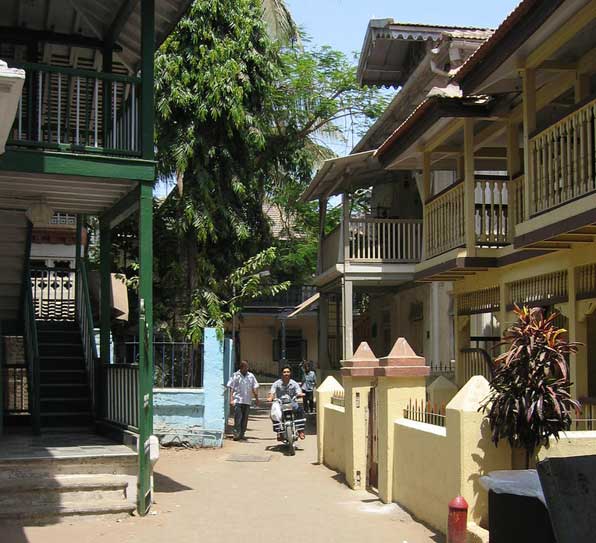
These expressed themselves in newer villages like Khotachiwadi – a hamlet of cottages in Girgaum or a similar one in Matharpakadi at Mazagaon. Today these habitats are living and dying simultaneously. Khotachiwadi is a cluster of about twenty-eight small cottages and bungalows built in the late 19th and early 20th centuries in the heart of the city. Today it is referred to as an urban heritage precinct mainly because of its distinct architectural flourishes linked to an Indo-Portuguese past. Right from the start, the homes represented a diverse set of architectural influences – Portuguese villas, Maharastrian coastal cottages, Goan homes and regular cottages and bungalows found in the region. In its hey-day – the early twentieth century – the village boasted of about eighty-eight such individually owned or leased homes. Today, it is surrounded by urban forms that literally look down upon the hamlet and see it no better than one more ‘slum’ in the neighbourhood.

The Khotachiwadi story is essentially a starting point for us to examine a whole range of locally built neighbourhoods all over Mumbai. An overwhelming 60 % of the population of the city lives in these spaces and has continued to mutate from the village like form, which was often from where they grew. These neighbourhoods keep the city’s economy going, subsidise costs of living for most of its workers, and once invested with civic amenities are perfectly desirable places. They have enhanced the value of urban land through intensive use and need to be protected from the predatory speculative impulse which has transformed the city at large into a real-estate roulette game. They combine, in true village fashion, spaces of working and living, and have made the tool-house a very contemporary, post-industrial component of urban living. By focusing on this form as a valid one, working closely with contractors who build them, by attempting to invest in the technology of building such spaces, we hope to develop an alternative discourse of urban living, especially for the so-called ‘sluym-dwellers’.

To do this we look towards Goa because this is one place in the world which has produced a unique template for habitats thanks mostly to its ability of validating the village as a modern form. It is because the village in Goa continues to be dynamic that the villages of Mumbai don’t appear to be anachronistic. By bringing together the stories of villages in Mumbai and Goa we feel that it is possible to focus once again on the ability of modern habitats to escape from a limited notion of what urban living has to be. We evoke Anthony Leeds understanding of the urban system, with villages and towns networked with each other to best epitomise Goa’s unique land use patterns – under threat of course. Goa’s urban system, as long as it continues to validate its villages, can be a viable alternative urban form to the large metropolitan thrust that otherwise we are moving towards and which only produce self-made problems around housing as we in Mumbai today.

All this brings us back to the not-so-accidental fact of the Portuguese connections between Mumbai and Goa. The observation that different colonial moments worked differently at different points and today can become resourceful tools  for the future is a thematic that returns to haunt us again and again. What was it about the Portuguese past that allowed village forms to live, become sick, die and regenerate themselves over different points of history? Is it a coincidence that the villages of Mumbai provide a strong counterpoint to the narratives of slums and are connected to its Portuguese past? Is it a coincidence that the favelas of Sao Paolo are also reinventing themselves today and demanding a more nuanced reading of their urban form? Or that the villages of Goa are fighting tooth and nail for their future in a more intense way than many other parts of the country? Can we learn something from the incremental growth of cities the way we understand them and also extrapolate on the use of history and the past in the same way? Not by blanket totalizing narratives of oppression and overthrow but of a more resourceful utilizing of those experiences in a way that builds from wherever someone left something behind?

The Future of the Unplanned City

December 1, 2011

Presentation at the Politecnico de Torino, December 1st, 2011

1.    Vulnerable Urban Age

kharbuilding
Building in construction, Khar West, Mumbai. Photo by Priyanka @ urbz

We live in a vulnerable urban age – where many ambitions of the twentieth century seem to be coming apart. According to David Harvey, the connections between the financial crisis and urban “development” are very real. He connects it to the financial mismanagement of the real estate market, and also projects it on a larger story of urban politics. Today – bursting of real estate bubbles in Dubai, decaying infrastructure in the US, social unrest in London, are all part of the same story. We take as our starting point this vulnerability of the urban world that we accept as the normative.

2.    Post-Planning World

postoccupancy-moscow
Add-on to Micro-Rayon Housing Projects, Moscow. Photo by Francisca Insulza, Merve Yucel and Evgeniya Nedosekina (Strelka).

One very important political goal that was expressed in urban civic terms in the twentieth century imagination was reducing inequality and providing a decent standard of living for as many sections of society as possible. Social housing projects in Europe and America were one manifestation of this social concern – but its highest point of achievement was in the Soviet Union. Today 70% of the population in the capital city of Moscow live in mass housing projects. However, In contemporary Moscow too we see how such projects have been overgrown by the post-planned city where structures and homes have been extended and personalized.

3.    The Natural City

dharavi
House in Dharavi, Mumbai. Photo by anonymous KRVIA student.

The emerging economies of today – especially Brazil, India and Africa – are responding to the same impulses and imperatives as the post-planned city in Russia, US or Europe. The form that dominates much of the new urbanscape is what is often misrepresented as slums or the informal city. We refer to this as the natural city. The natural city is a urban cyborg, in a constant process of simultaneous decay and regeneration. It is neither pure nor perfect. Often polluted, corrupted and toxic itself, it is simply a manifestation of certain irrepressible processes of urban growth. It flourishes anywhere planning fails. This failure is itself an expression of the fact that the natural city was denied a legitimate expression. This dominant urban form that Mike Davis evokes as engulfing the planet in the 21st century is our point of inspiration and departure.

4.    Local Expression

artamis
Artamis. Former campus of the industrial services of the city of Geneva, it was squatted for many years and had become a nodal point of the city’s cultural life until occupants were evacuated. Photo by airoots.

We see it as energized by what anthropologist Arjun Appadurai refers to as the production of locality – a process that is determined by collective agency and will and which makes people participate wholly in the production of their environments. It is a process which is often negated or even actively repressed by the state, which in the twentieth century even in non-socialist countries, was epitomised by the desire for total urban planning and control. The frustrated impulse to produce locality manifests itself in all kinds of ways: urban counter-cultures in developed societies, underground markets, parallel economies and of course habitats that emerge in the shadow of the planned environments.

5.    Vernacular Absorption

The natural city absorbs all materials and ideologies, becoming a vernacular expression in every locality – feeding off the negentrophic tendency of systems that internally mitigate their imbalances and dysfunctionalities. Much like the hunter-gatherer societies that live outside the boundaries of controlled civilizations and create wealth and culture on their own terms, the natural city creates its own systems of transactions. It is at once deeply connected to the powerful state-level and global forces that try to control it, but also, to some extent, able to mitigate their local reach. Where they are forced to express themselves in large numbers as so-called informal settlements they are constantly threatened by the state-crafted ideology of planning which itself has actually lost steam in many parts of the world. An ideology that does not pay adequate attention to the special form of the natural city based on creative spatial arrangement of space, time, functions and relationships.

6.    City Users – City Makers


Construction site in Shivaji Nagar, Deonar, Mumbai. Photo by urbz team.

Out of the agents that energise and produce the natural city, the post industrial artisan, the local contractor and the hardware dealer, are key characters. The local contractor is at once businessman, community player and a possible political figure. He knows the nuts and bolts of his constantly forming environment like no one else. We see him as part of the larger story of urban based class struggle that David Harvey talks about. According to Harvey, the city is no more the site where the factory exists but is – in lieu of the factory – itself the agency of production and also the product itself. It consists of the alienated worker in the planned discourse and the relatively less alienated figure – a bit like a post-industrial artisan – the contractor, his team of workers and network of collaborators. (We are aware this is a huge departure of the narrative presented but feel that this trajectory of thought is worth following as well.)

7.    Freedom of Expression, Imagination and Action

shimojins
March against the redevelopment of Shimokitazawa, an unplanned locality in the centre of Tokyo. Photo by Save the Shimokitazawa.

Eventually the Natural City – as a universal expression with its vernacular- local ammunition is a creative moment. It is sad that in the world of urban futures the practice of making cities has not allowed – in fact has actively suppressed – the ability and desire of people to allow themselves a form that is economically and culturally liberating even though at present tends to be civically deprived in many manifestations.

The Persistent Shadow of Faded Grandeur

October 2, 2011

OldGoa
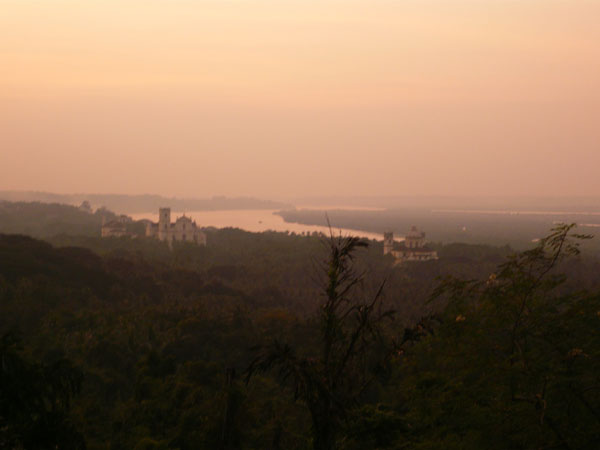
Old Goa

Any engagement with Goa and Mumbai inevitably stumbles across its Portuguese history. In Goa its in your face and omniscient, in Mumbai its hidden and unexpected. Either way this past reinvents itself and sustains its influence in the places it once touched, embraced and dominated. In its persistence lies a tale that is worth hearing.

One of the most striking aspects of post-colonial societies that have had relations with Portugal, is that their habitats and architecture have continued to be an inspiring part of contemporary building practices. Not as monumental backdrops, but as practical models and templates of distinctive and desirable ways of living. A lot of this is reflected in the human scale of old villages and urban precincts, walking friendly neighbourhoods and the enmeshing of cultural and economic histories with building practices.

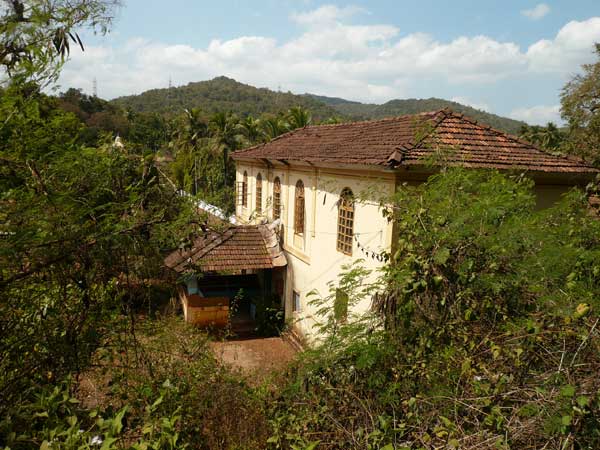
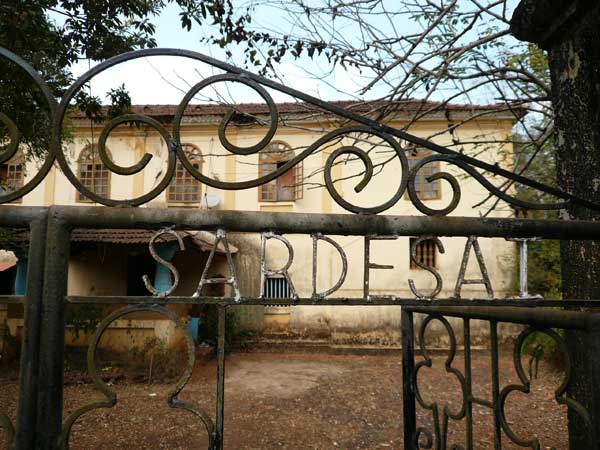
SardesaiHouseSavoiVeremGoa2

SardesaiHouseSavoiVeremGoa
The family House of the Sardesai, a upper caste Hindu family, in the village of Savoi Verem, North Goa.

Historically, all of the following factors contributed to the dynamic presence of the colonial imprint in these spaces; the older time-period at which Portugal touched lives, mostly the fifteenth and sixteenth centuries, the way in which traditional, European style building and architectural practices fused with local traditions and carried on being practiced and the contrasting templates of their habitats when compared to non-Portuguese neighbouring regions, which made them distinctive.

For example, in predominantly British colonial Mumbai, where Victorian architecture dominates imperial memory, the older Portuguese inflected neighbourhoods stand proud as counter-points, becoming the most treasured and desirable neighbourhoods in this hyper dense megalopolis. The trendiness of Bandra is directly connected to the East-Indian (old Portuguese converted local Christians) villages that miraculously survive modern day aggressive urban practices. Under threat, but bravely putting up a fight is Khotachiwadi, that Portuguese – Coastal – Konkan architectural fusion, comprising of several homes and bungalows belonging to the East-Indian community.

Gorai-Mumbai
The East Indian village of Gorai, North Mumbai

These Portuguese inflected neighbourhoods open up a new vocabulary of evaluating contemporary urban practices, that built upon traditional European and local artisanal practices and allowed for a very innovative way of dealing with contemporary challenges. At best, when Mumbai’s villages evolved through a conscious understanding of this legacy, they produced beautiful, livable and modern neighbourhoods. When these practices were not recognized or validated, they became perceived as slums.

The dynamism of the favelas of Brazilian cities, the streets of Macau, the villages of Mumbai, the diffused urbanism of Goa, the cosmopolitan legacy of Maputo in Mozambique and parts of Angola, all of these together make for a story that has much to teach the world about architectural and urban practice today. A practice that is facing many challenges – from the pressure of dealing with rising populations, questions of sustainability, and financial manipulation and mismanagement of architectural practices.

Khotachwadi
Khotachiwadi, South Mumbai

The Institute of Urbanology, located in Aldona, Goa is engaged in exploring the relationship of this history to contemporary urban practice. If this story stimulates  your imagination, do get in touch…

Mandu, Mahua and Magic

August 29, 2011

mandu

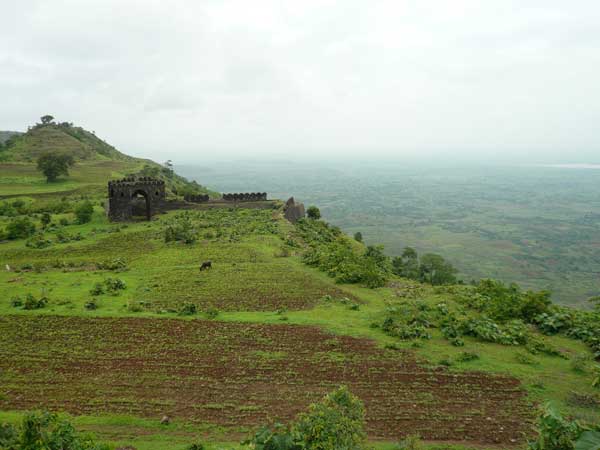
At most times the urbanologist and the anthropologist are one and the same. For us walking the streets of old neighbourhoods in ancient or futuristic cities and the forgotten paths of history in far away places happen together. An assignment to Indore in central India, for the Aranya project saw us make a detour to mythic Mandu (Madhya Pradesh). Basically ruins of an old kingdom, the splendour of the place was accentuated by the lush monsoon greenery which gives the region that fantastic hue of green. It is deceptive, since it does not indicate the dryness it is also capable of declining into, just a few months later.

Mandu of course, on a weekend was overrun by tourists. This pushed us to look beyond and we had our customary airoots adventure that took us on a journey into the primeveal past of most cities. A journey through time that connects forests, collective memory and cities into one holistic moment. In four hours of driving time we could span habitats that nestled next to each other but lived in different centuries.

The Mahua Tree
The Mahua Tree

Mahua, that magical tree which epitomizes the core of the colonial-tribal encounter yielded the most delicious intoxicant we had ever tasted. A nutritious drink made from the flower of the Mahua tree – also known by that name – came to us in a leaf cup. The making of the drink was banned by the colonial authorities in the late 19th century because it made the independent minded Bhil communities  that lived in the region even less dependent on a monetary labour economy that the authorities were intent on pulling them into. They licensed the making of distilled liquor only so that the communities could be addicted to it and had to pay and thus work for cash. Devious.

The colonial legacy lives on. Mahua making is not banned, but it is trapped in a moralistic, anti-drinking rhetoric that is the very opposite of the spirit of the tribal communities that love it. So it goes a bit underground.

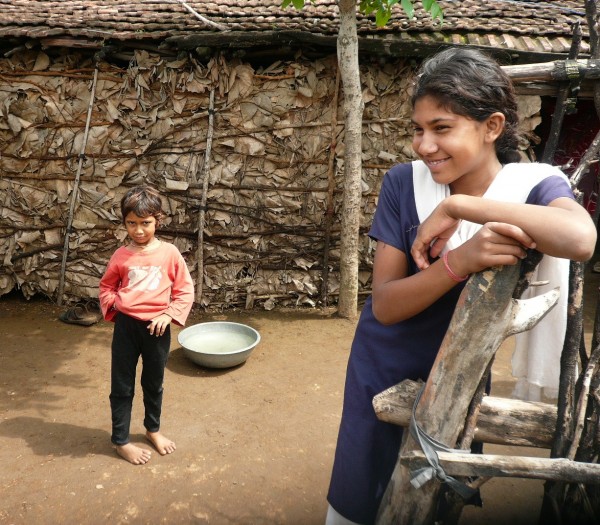
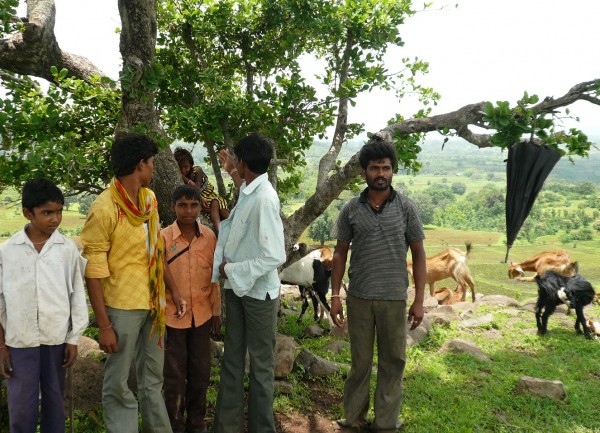
We are sometimes blamed for being idealists. We spoke to the Bhil girls and boys, shepharding goats on the hills, and told them that our belief that there is something valuable here is often called delusional. They laughed. They told us they are really quite happy to be here on the hills, as long as their connections to the forests are not tampered with. No one likes going to the city and being pulled into doing physical work for the construction industry, something they have to do for survival, especially during the summers.Their presence in the forests around is discouraged by the authorities on the grounds that they will denude them.

The forest policies in India remain anti-people and to our minds are at the heart of a faulty policy that creates forest-less cities and people-less forests.

Generous Hosts
Generous Hosts

Bhil Pride
Bhil Pride

This experience will definitely inform our next paper that we are working – on to be presented at the EPFL in Lausanne, Switzerland, in November 2011 about the connections between the jungle that is Dharavi and the jungle that is the Borivili forest sanctuary in the metropolitan limits of Mumbai.

Our collective ancestral homeOur collective ancestral home


Cheap Stories, Expensive Subjects

June 1, 2011

Structures like these emerge over time. Their flexibility and adaptability is invaluable.

Structures like these emerge over time. Their flexibility and adaptability is invaluable.

The following text appeared as an op-ed on June 1, 2011, on page A27 of the New York Times with the headline: Hands Off Our Houses.

Last summer, a business professor and a marketing consultant wrote on The Harvard Business Review’s Web site about their idea for a $300 house. According to the writers, and the many people who have enthusiastically responded since, such a house could improve the lives of millions of urban poor around the world. And with a $424 billion market for cheap homes that is largely untapped, it could also make significant profits.

The writers created a competition, asking students, architects and businesses to compete to design the best prototype for a $300 house (their original sketch was of a one-room prefabricated shed, equipped with solar panels, water filters and a tablet computer). The winner will be announced this month. But one expert has been left out of the competition, even though her input would have saved much time and effort for those involved in conceiving the house: the person who is supposed to live in it.

We work in Dharavi, a neighborhood in Mumbai that has become a one-stop shop for anyone interested in “slums” (that catchall term for areas lived in by the urban poor). We recently showed around a group of Dartmouth students involved in the project who are hoping to get a better grasp of their market. They had imagined a ready-made constituency of slum-dwellers eager to buy a cheap house that would necessarily be better than the shacks they’d built themselves. But the students found that the reality here is far more complex than their business plan suggested.

To start with, space is scarce. There is almost no room for new construction or ready-made houses. Most residents are renters, paying $20 to $100 a month for small apartments.

Those who own houses have far more equity in them than $300 — a typical home is worth at least $3,000. Many families have owned their houses for two or three generations, upgrading them as their incomes increase. With additions, these homes become what we call “tool houses,” acting as workshops, manufacturing units, warehouses and shops. They facilitate trade and production, and allow homeowners to improve their living standards over time.

None of this would be possible with a $300 house, which would have to be as standardized as possible to keep costs low. No number of add-ons would be able to match the flexibility of need-based construction.

In addition, construction is an important industry in neighborhoods like Dharavi. Much of the economy consists of hardware shops, carpenters, plumbers, concrete makers, masons, even real-estate agents. Importing pre-fabricated homes would put many people out of business, undercutting the very population the $300 house is intended to help.

Worst of all, companies involved in producing the house may end up supporting the clearance and demolition of well-established neighborhoods to make room for it. The resulting resettlement colonies, which are multiplying at the edges of cities like Delhi and Bangalore, may at first glance look like ideal markets for the new houses, but the dislocation destroys businesses and communities.

The $300 house could potentially be a success story, if it was understood as a straightforward business proposal instead of a social solution. Places like refugee camps, where many people need shelter for short periods, could use such cheap, well-built units. A market for them could perhaps be created in rural-urban fringes that are less built up.

The $300 house responds to our misconceptions more than to real needs. Of course problems do exist in urban India. Many people live without toilets or running water. Hot and unhealthy asbestos-cement sheets cover millions of roofs. Makeshift homes often flood during monsoons. But replacing individual, incrementally built houses with a ready-made solution would do more harm than good.

A better approach would be to help residents build better, safer homes for themselves. The New Delhi-based Micro Homes Solutions, for example, provides architectural and engineering assistance to homeowners in low-income neighborhoods.

The $300 house will fail as a social initiative because the dynamic needs, interests and aspirations of the millions of people who live in places like Dharavi have been overlooked. This kind of mistake is all too common in the trendy field of social entrepreneurship. While businessmen and professors applaud the $300 house, the urban poor are silent, busy building a future for themselves.

Spectacular Speculation and Mumbai’s Unplanned Future

May 7, 2011

SurrealEstatesofDharavi

Presentation @ MAD Salon in Mumbai on Saturday, May 7th, 2011. Hosted by Susmita Monhanty and Sid Das.

1. Tower of Babel

babel-brugel

This biblical story conveys many human anxieties and fears. Its monumental architecture encompasses a tale of tyranny – the domination of man over man in an attempt to bring together diverse histories under singular control, of streamlining otherness and reducing all fantasies into one. What is striking to the modern mind is the sheer scale of its ambition, of reaching out to the skies before crumbling under its own weight of over-extension and then fearing the ensuing confusion that comes with multiplicity and pluralism. The ambitions embodied in the myth seem to recur in human history – complete with the repetitive and cyclical fall.

2. Skyscraper Index

The-skyscraper-index_full_600

A little statistical table that circulates in the media now and then has an unsettling effect on many who encounter it. It shows correlations between ambitious building projects – specifically those that strive to the greatest heights ever – and the mysterious occurrence of economic depressions and the bursting of speculative bubbles that seem to unfailingly follow them. The table is seen to be unscientific but like the power of all great myths – has managed to plant little seeds of doubts and beliefs in the collective consciousness of those involved in realizing such ambitions. Are these grand projects crystallizations of arrogance and power till the sky literally falls on their heads? Often they become like the ruins of the tower of Babel, unfinished or surrounded by the rubble of economic despair.

3. World One

worldone

Mumbai’s very own Babel arises from its already pretty ruinous landscape with the same old tired ambition. The World One tower aims to be the highest residential tower in the world and rather like the grand but ill-fated biblical structure, wants to enclose as much as possible within its generous boundaries. It posits to be self-contained, encompassing as many needs as possible within it. It plans to tower over the rest of the city in arrogance and ambition. It turns away from the economic reality of thousands of luxury flats lying unused or unsold in its neighbourhoods and seems to be paving the way for a bubble to burst that, paradoxically people seem to be anticipating.

4. Barad Dur

Barad-dur

The prevalence of biblical images and tales in medieval literature, of medievalism being one of the most challenging coming-of-age of moments of modern consciousness and the continued prevalence of medieval imagery and tales in modern fantasies and imaginations is explained by scholar Umberto Eco. He points out how an episodic and evolutionary presentation of history does not really mirror the diverse, complex and unpredictable way in which human lives and cultures actually unfold in space and time. Medieval concerns continue to exist deep in the human consciousness and experience. Popular culture is replete with imagery and fantasy from medieval times because modern life is punctuated by medieval moments, not withstanding the self-image we have of being modern thanks to technological changes and the scientific spirit. The Dark Tower of Sauron from the Lord of the Rings haunts us in movies, games and art, reliving old nightmares and shaping dreams and fantasies.

5. Dark Urban Age

rickyburdettslumhighrise

As episodic history and transformative epic moments continue to influence our understanding of life, one powerful myth that has become prevalent is that we are now all firmly entrenched in the great Urban Age. However, it would be more accurate to say that we are in a rather Dark Urban Age. Prophets predict apocalyptic visions about this era with images of dark shadowy habitats replacing the erstwhile fears of the forest that castles and protected urban habitats had in the past. Every new architectural or urban fantasy that gets realized repeats such imagery, presenting itself as a fort surrounded by architectural wilderness full of danger and chaos. If it is not such negative imagery about their surroundings then it is about taming the wilderness and transforming it into acceptable notions of urban life – most of it still shaped by ambitions of the Babel Tower.

6. Out of the Castle

forets

Today, when a young, well-meaning architect steps out of the castle, she is alert and on the lookout for dangers of the wilderness which she has to bravely tackle and eventually tame. The wilderness is epitomized by the category slum, encompassing all that is avoidable, dangerous and worthy of erasure. Like the proverbial adventurer of ancient tales she encounters false monsters and elusive spirits. The slum emerges as a highly unstable category, slipping through fingers the moment she thinks she has found one. In Mumbai particularly, the spectacular spectre of speculation has produced the most naive narrative on slums, where it is used in the grossest of way at one level and full of nuances at another. In Dharavi, each neighbourhood looks the other way when asked where the legendary and largest slum in Asia is supposed to be. It is always on the next street. Eventually when she finds it – it appears as a chimera, a construct and helps her realize that the dangerous forest around her is nothing like what she had been told it was.

7. Final Fantasy

The scary forest was a fantasy in the mind of castle dwellers in a way that played upon all kinds of anxieties and fears. Kings and aristocrats saw them as spaces out of control, unlike the domesticated peasants and taxed agrarian lands that were caught in their web. From the vantage of the subaltern hero, the forest was Sherwoodian, full of Robin Hoodian impulses, a social space and a world of creative freedom and economic independence. Resisting control was its biggest aim. An urbanological understanding of forests reveals a sharp questioning of what is wild, tame, and natural. Urbanology questions what is urban, rural and tribal, what is a slum and what is heroic resistance to monumental ambition. The final fantasy for an urban explorer is questioning the romantic fallacy of Babylonian ambition and revealing falsely frightening wilderness to be something else altogether – a liveable fantasy of human, creative and ecological possibilities

« Previous PageNext Page »