
Haiti Viewed from Asia
January 17, 2010
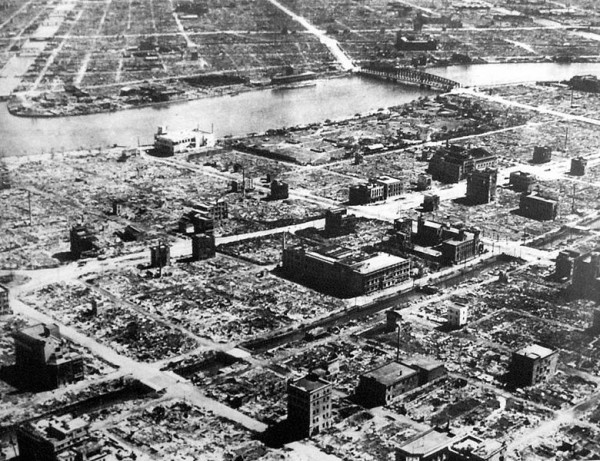
Tokyo in 1945 after being flattened by USA Air Force firebombs.
The standard approach to residential redevelopment projects is to take ground zero as a starting point — even if it means creating it. This often translates into shifting people from substandard but incrementally developing environments into apartment blocks that cut them off from their social networks and livelihoods. These projects often become housing-centric and blind to the relationship between neighborhoods and economic development. They end up benefiting the construction industry much more than the population they are supposed to serve.
Haiti’s shattered urban landscapes were about communities, street life, resourcefulness, aspirations and dynamic local exchanges. As we have seen in the Dharavi area of Mumbai (the setting of “Slumdog Millionaireâ€), poverty often generates creative responses and initiatives. Local actors tend to produce piecemeal development that directly supports neighborhood-level activity.
As we consider how to rebuild Port-au-Prince, we can find an alternative to the usual top-down redevelopment model in postwar Tokyo. The Japanese government didn’t have the money to rebuild housing and so focused instead on roads, sewage and rail transportation. It also encouraged lenders to give families money to build homes. A decentralized and highly participatory urban redevelopment process produced areas of low-rise, high-density structures built with local skills and material. This not only strengthened communities but also stimulated the local economies. Tokyo today has a landscape that is futuristic and yet retains many traditional Asian urban features including street markets, small-scale businesses and family enterprises. The incremental redevelopment of Tokyo was thus intricately connected to the rise of its middle class.
If aid in Haiti aims specifically at regenerating local economies, if it promotes existing skills and collective initiatives, if it consults with grassroots groups and residents directly, it may well bring about a real transformation.
This is not so much of a comment but an observation and somewhat a question. You have mentioned a few characteristics of Tokyo which I think a few other Asian cities could share and hence are not unique.
I just returned from Tokyo this morning, my first and a long awaited trip. My impression for Tokyo as one of the most populous urban regions in the world was more about density than anything else. I had read, seen pictures and heard about the rush in Tokyo, people pushers in Subways and crowded lanes.
Surprisingly, I failed to experience this density and the City seemed to be extremely calm and quiet. That does not mean it was slow or lacked energy. It seemed to be running on a number of super-efficient systems where both man and machine were performing to perfection. I never saw roads packed with cars, or trains where people couldnt board or human jams at intersections. Business/ entertainment districts such as Shinjuku or Roppongi were nowhere close to an experience in New York, Mumbai, Manila, Hong Kong or Jakarta during the office rush hours.
Many are intrigued by my unique observations about Tokyo. I wonder what would you have to say?
Comment by prasoon — January 21, 2010 @ 7:35 pm
Thanks so much for your response. Actually many would agree with you. If you compare figures of population – Tokyo is the most populated city in the world. However, the reason why it deals differently with density is in fact encoded in its historical evolution. When we look at land-use and spatial – demographic density as resources that can be managed from above – the gaze of the state/planner – we lose sight of the many ways in which people actually live and organize space.
You can have crowded buses between Panjim and Vasco (in the Indian state of Goa with 1.6 million people) and have smooth jostling free journeys in a city of 14 million.
The thing with Tokyo was that it allowed existing spatial uses (building on small agricultual plots, using old village organizational principles, presence of shrines in neighbourhoods) to evolve and modernize through a creative, more plastic and adaptive use of civic amenities. It used the winding tracks of the railways to create a system of transport that changed the way we think of circularity and linearity in urban spaces.
This could well be one of the many reasons why the city may appear calm and relaxed. There are less jams for sure. It could be GPS or it could be the way the messy road networks allow for more route discoveries and navigation then the simplistic, 90 degree, grided road patterns of Manhattan – simply designed for jams!
And yes of course – districts designated to be business and entertainment ones produce a different kind of experience then those that emerge from a more diffused notion of it – tempered by totally different philosophies of what makes for entertainment. Dense neighbourhoods, tiny bars and winding roads open up the imagination very differently than the designated enclaves of pleasure and entertainment on 42nd street – which many find jaded.
Cities are subjective entities. We all will perceive them differently. However – its vital to see how much diversity there is in the way uses of space express themselves in cities around the world. And they are of course meant to produce different experiences. Why should cities be experienced in the same way? Why not look at the special qualities?
Tokyo indeed share many qualities of other Asian cities. The problem is many Asian cities also experienced colonialism and denied their own logic. Tokyo, through the fate of history – escaped certain categories – native town v/s white town for one! What emerged were both similarities and differences with the larger Asian fabric for sure.
Lets continue with the discussion!
Comment by Airoots — January 25, 2010 @ 7:40 am