
Media Media on the Wall
February 5, 2009

The Jevon Hall on Dharavi Main road usually resounds with Bollywood music playing during marriages and festivals. But last week Bollywood arrived on Dharavi’s door steps. Music composer Bappi Lahiri, the disco king of the eighties walked up the flight of stairs to sing with a bunch of children from Ganesh Vidya Mandir and Ambedkar schools located in Dharavi.
Bappi Lahiri aka Bappi Da came for a press conference about the new album he is producing with children of Dharavi and DJ Paul Devro of the label Mad Decent (Philadelphia). We had invited Paul Devro, a veteran of the Urban Typhoon Workshop, for a week to map the music and sounds of Dharavi. When Paul expressed his unconditional love for the music of Bappi Da, we immediately tried to connect them. It worked and they got along so well that they decided to produce an album together with children from Dharavi, which Bappi Da called “Slum Stars†as a response to the title of the movie “Slumdog Millionaire.â€
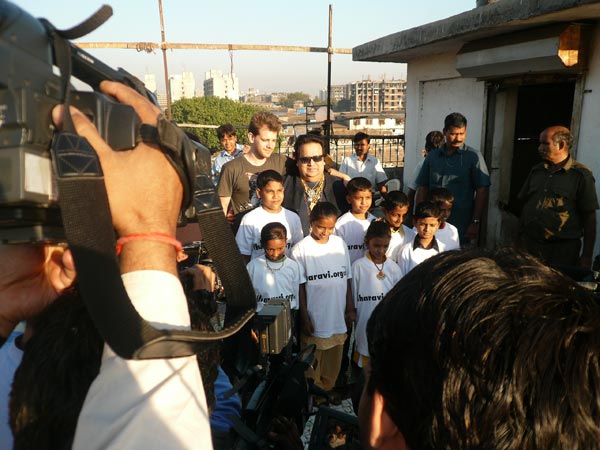
Bollywood star producer Bappi Lahiri with DJ Paul Devro and young Dharavi singers at a press conference in Dharavi.

Bappi Da recorded some songs with the children in his studio. The media had come that day to check out what his public relations officer had sent out to them. Many admitted they had stepped into Dharavi for the very first time. While Bappi Da, Paul Devro and the children got good attention – there were a host of community leaders and residents who had also come for the event but were given the royal ignore. Except for a couple of press reporters – who did interview a few – for the most part Dharavi remained in the media’s shadow this evening.
Fortunately, a local hip hop crew, the South Dandy Squad who Paul Devro had recorded and who had helped us find a space for the party in Dharavi managed to get some attention from the media.
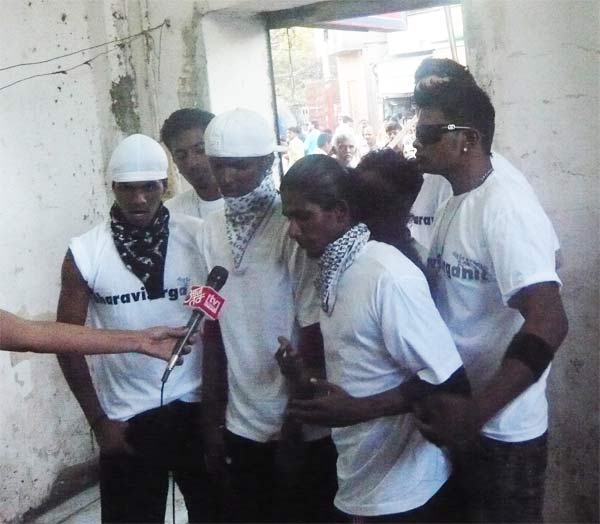
South Dandy Squad performing a capella for a local TV network.
Yet – the media bias was clear. Just a couple of weeks earlier we, along with architect Wahid Seraj and students of Srishti School, Bangalore, helped organize an architectural studio. This was to help the faculty and graduate students of the Urban Design Program at Columbia University and the JJ School of Architecture do a project in Dharavi. The studio responded to the need of three Municipal Chawls in Dharavi to evolve plans for their self development.

Omkar Municipal Housing Society (proposed) in Kokiwada, Dharavi.
The issues were complex, but the students and the community did a terrific job in responding to the nuances. They provided alternative scenarios, using different rules and regulations. They connected with the community, who in turn gave them all the cooperation that was needed. It is rare that architects, planners and community members get a chance to collaborate like this. However, when an event was organized to present the work to the community and the public at large, we invited the media. Unfortunately, since there was no celebrity, no big speeches and consequently, very little reportage. The sole journalist who came did not publish the report as promised. It was published later – truncated within another story.
One of the persons who was disappointed, but not surprised was Mr. Ramesh Mishra, a lawyer born and brought up in one of the several Bombay Municipal Corporation (BMC) chawls in Dharavi, Koliwada. It was he who had invited us to help evolve plans for his chawls that subsequently lead to the studio. He was working on a case in the Human Right Commisson. It involved the right to self-development for the residents of his and a neighbouring chawl.
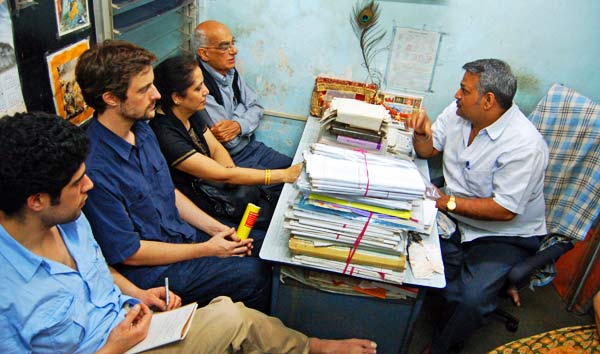
Ramesh Mishra (right) with members of the Urban Typhoon team, including architects Geeta Mehta and Kamu Iyer in the back.
The built-form of the ‘chawl’ evolved in colonial Bombay as a working class tenement modified on army barracks with one room per family, a common toilet and usually a long common corridor. They can be single or multi-storied structures and reportedly a good part of Dharavi comprises of chawls. Their existence testifies to some official involvement in their construction. In fact most of the tenants in the chawls in Dharavi built by the BMC (The Brihan Mumbai Municipal Corporation) pay controlled rent to the administration.

Municipal Chawl in Dharavi
The case by Ramesh Mishra demands that chawls such as his be exempt from the Dharavi redevelopment Plan which would reduce the size of individual homes considerably. His insistence that the BMC chawls be recognized as a distinct historical component of the neighbourhood is important at several levels. It questions the deliberate homogenization of the neighbourhood as one slum. It aligns with similar resistances by residents of Koliwada (in fact Mr. Mishra is on fairly strong ground when he says that his chawl actually comes within the purview of the Gaothan law – a special protection for urban villages).
All these concerns went into the studio but almost nothing was reported. Many residents of Dharavi have been cynical about the way the media reports or does not report stories about their neighbourhood, this is why we created www.dharavi.org which lets anyone publish their research, ideas and opinion in any language.
This is our tip to the mass media: If you want a good story speak to Mr Mishra, the South Dandy Crew and the thousand other people who have unique stories and knowledge about Dharavi. If that happens it will be a paradigm shift in the way the media understands cities and neighborhoods.
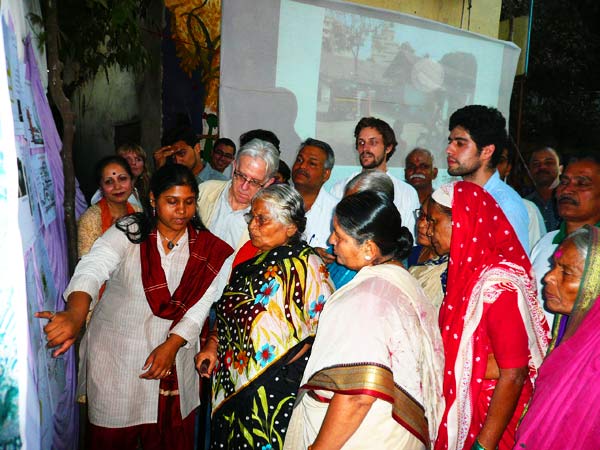
JJ School of the Arts and Columbia University students presenting their work to chawls residents. Bellow is one out of three Powerpoint presentations shown by the students to the residents. This was done after only a week of work on site. The students are now working on a more professional plan that Municipal Chawls hope to present to the authorities in June.
In addition to the airoots team, Melissa Nahory and Sytse de Maat contributed photos to this post.
