
Incremental Development I: Preserving Street Layout
January 6, 2009
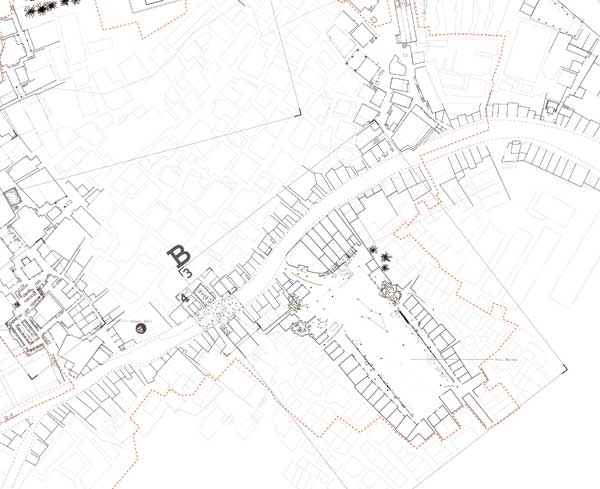
 Koliwada Map: This map of Koliwada was based on collection and synthesis of historical documents and maps, studies and surveys from SPARC, KRVIA and SRA, satellite views, and on-site photographic surveys. All maps and sketches in this text produced by Wahid Seraj for the Urban Typhoon Workshop in Dharavi-Koliwada, March 2008.
The first mistake of virtually all slum redevelopment schemes, no matter how well intentioned, is to start from scratch instead of using existing structures and patterns as a starting point. Planners often use structural and demographic surveys as raw data, but these only provide snapshots of the state of things at a given point in time. They do not capture the dynamic interactions between people, structures and streets, which are vital for sustainable planning and development.
The end result of most redevelopment projects is a series of grids in every direction, up, down and sideways, that erases all the existing formations imprinted on the territory. The constant movement of people within urban spaces and across neighbourhoods, as well as fresh migrations – factors that every city has to reckon with – find no legitimate expression. Nor does the versatile use of space, a trademark of slum life.
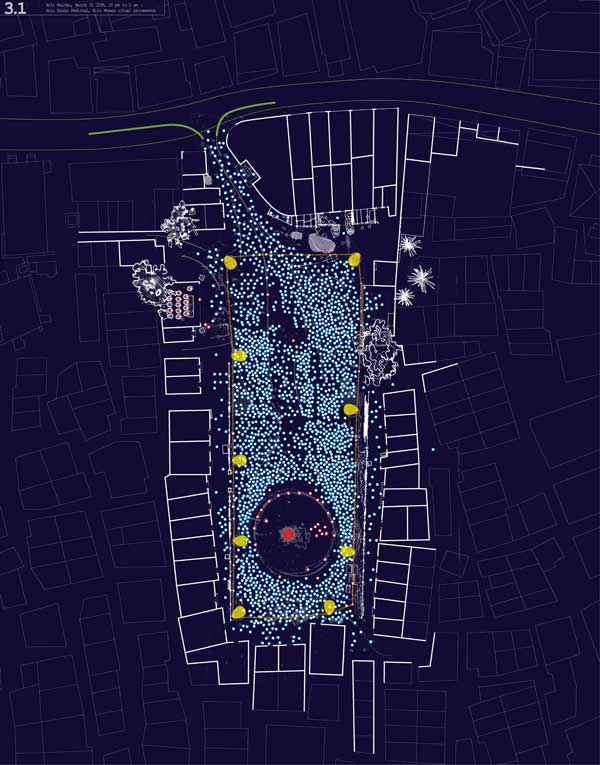
The Holi Maidan is Koliwada’s main open public space. At the time of the annual Holi Festival, a Hindu celebration, more than 10,000 people gather in and around the central space, including Dharavi Main Road. The drawing records the movement of crowds and ritual processions around the central fire during Holi.
A tabula rasa approach to slum redevelopment only results in the formation of new slums in the periphery. Those who cannot be absorbed in the new housing or afford maintenance move out and new slums emerge.
Most redevelopment projects, until very recently, translated the issue of slums redevelopment only in terms of housing needs. Such an approach buries over organic connections between local livelihood systems and residential requirements.The livelihood issue becomes secondary and at most, reduced to questions of employment. As research on the informal economy began to throw new light on the way cities function, especially in the context of slums, the understanding of these spaces became more informed. It became clearer that the new global economy relied a lot more on locally produced goods and services that are dependent on cheap labour, and that these activities are organically connected to the forms of habitats in which they exist.

The Tool-House: Live-Work Typology of a Kumbarwada Potter Family House:This drawing reflects the necessity to understand the particular urban life-styles of traditional communities. Many of Dharavi’s residents live and work at the same site, a reality completely dismissed by the ongoing Dharavi Redevelopment Plan. One must understand that shelter issues are inextricably tied to residents’ means of livelihood.
However, it is one thing to understand the organization of slums in terms of its economic role and another to incorporate this understanding into urban planning. At best, what emerges are token gestures to livelihood issues, – either in the form of building a local market or providing space for economic activities within new homes.
What happens if we work from the other side of this spectrum. If we take as the starting point the existing resources at hand? What we get is a rich legacy of user-generated space patterns that are organically connected to the way people live and earn livelihoods. These patterns are based on the principles of incremental development. In other words, they have evolved over time, over generations and through the absorption of new migration inflows, constant movement within and between neighbourhoods and through continuous class mobility.
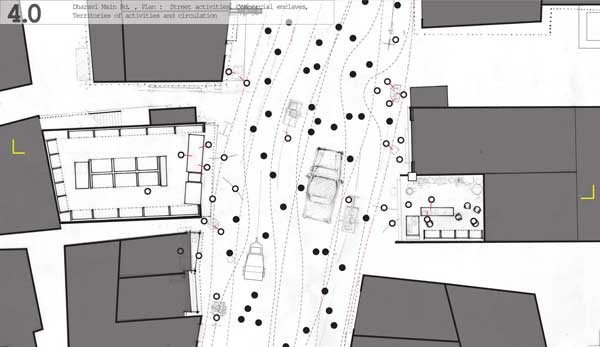
Fragment of Dharavi Main Road: Mapping of Street Activities and Territories, Public and Commercial: Dharavi Main Road is 25 ft.-wide road running through Koliwada and across Dharavi. In the section that crosses Koliwada alone, one finds almost one hundred non-residential sites, such as churches, temples, shops, restaurants and small-scale industrial workshops. Reflecting Dharavi’s high-density street-scape, the road also accommodates heavy and continuous pedestrian traffic, cars, motorcycles and mobile street vendors.
It is our contention that these patterns of incremental development are embodied within the streetscapes of such localities. It is in the street that the genetic code of a habitat gets imprinted. They emerge as walking paths connecting markets, homes and nodes of transport hubs. As they evolve, accommodating cars and other forms of local transport, street bazaars, spaces for youngsters to hang-out, for children to play, for neighbours to exchange news and gossip, for people to shop and set-up shop, they follow the needs of the residents very directly. The signature of a neighbourhood is often a streetscape.
Ideally, slum redevelopment schemes should build upon the incremental logic that most slum histories embody. And a pragmatic way to do so would be by recognizing the street layout that has evolved within such habitats.
In the case of Mumbai, we clearly see two dominant patterns of slum formations with their distinctive streetscapes. (Actually there are three patterns, the third, post-modern version is linked to the redevelopment projects outlined above and is the most nasty and dangerous one!).
The first one is best exemplified by the presence of fishermen’s villages in the city. They were villages that at some point got absorbed in the sprawling megacity to be eventually assimilated as slums. Self-standing houses, some of them more than 100 years old, within these habitats, are a clear marker of that history. The second type is the slum that emerged gradually as immigrant workers settled into temporary camps wherever they could and consolidated them over time.
As A. Jockin, founder of the National Slum Dwellers Federation poetically puts in an interview; first the man comes to work from the countryside, then his wife joins him. Because she needs privacy she puts her sari on strings and that becomes their home. This gets multiplied a million times.
Urbanology – Part 1 – India from The Travelling Twins on Vimeo.
In incrementally developed neighborhoud the connection to the village is very direct, since migrant workers and their families bring with them skills and crafts from their hometowns. They are soon joined by fellow villagers who reinforce the reproduction of traditional patterns.
Villages, whether they are in Asia or in Europe have strikingly similar features. The most important one, and the most easily overlooked, is high-density levels of populations and structures. We generally assume that because they are typically surrounded with open fields, villages have a low density and that high density is usually found only in cities. In fact, in most French, Italian, or Indian villages houses are so narrowly built to each other, that cars cannot get through, making rural settlements mostly pedestrian.
Getting a little deeper in the study of the structure of villages, one can observe an interesting hierarchy of streets, with broader roads serving smaller roads all the way down to the entrance of the hut. Anyone who has ever walked in a slum has observed the same type of network, leading the visitor from a large road with rickshaws and cars to smaller roads shared by pedestrians and vehicles bringing goods in and out, to smaller roads penetrating inside specific nagars. Even within the nagars some streets are busy with people going from one point to the other, which themselves open to smaller lanes taking the visitor to clusters of houses.
These communal lanes are often used by the residents of the huts alongside it as space for social interaction and production, and are clearly not public in the sense of the larger roads. They will make the visitor walking along these lanes almost feel uninvited, nearly as uncomfortable as if he was walking into someone’s private property.
The street layout is initially shaped by social and economic relationships, and then influences them in return. The interconnectedness between spatial and social structures should be fully acknowledged by any architect and planner engaged in slum redevelopment. While it is true that these structures are often communal and unequal, changing the spatial structure alone will never suffice to change social structure. It must be understood once and for all that relocating every family in 225 sqft or 300 sqft flat in high rise structures will not make everybody equal or suddenly propel them into middle-classdom! Unless one pretends to tackle social and economic issues alongside spatial issues, architects and planners should not pretend that they will be able to address issues of equality in a given settlement. When we think about these issues we have to remember one of Thomas Jefferson’s most enlightened quotes: “There is nothing more unequal than the equal treatment of unequal people.†The same goes for the serpentine, complex and uneven streets that can be found in villages and slums!
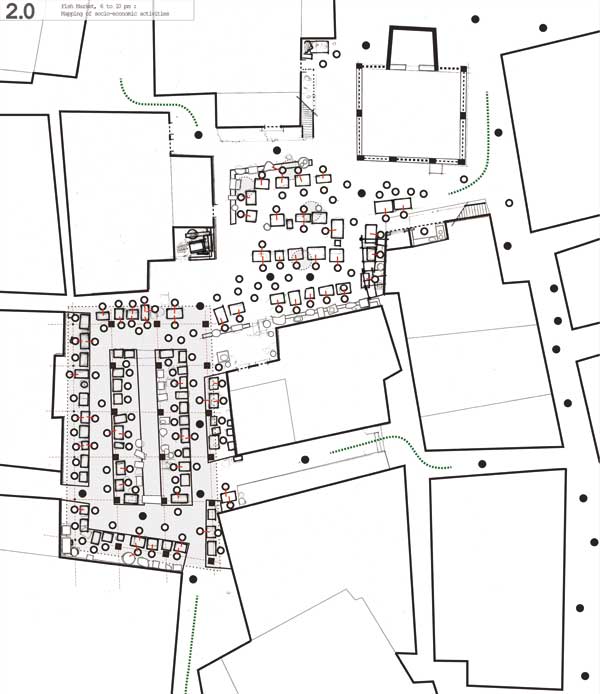 Koliwada’s Fish Market: Mapping of Socio-Economic Activities of the Market in Relationship to the Morphology of Space: The Fish Market is the witness of Koliwada’s roots as a traditional fishing village. The fish market has existed at its current location for the last 70 to 100 years.
The fact is that habitats constantly change and evolve, as families start to grow with new members being added, as new businesses come into the neighbourhood and as new families migrate. Add to this, the need for infrastructural expansion, including sewage, water supply and road networks means that the ongoing transformation of habitats is an everyday reality. Most habitats, harness the resources for making these changes from within. The necessary skills are brought to surface and used to the best of their abilities.
As change unfolds, the street patterns remains a point of continuity from the past and the anchor for the future. Once they are seen as the starting points, then the transformations become more productive. Many cities around the world have evolved in this way. And most are bookmarked in public memory by their streetscapes. Indeed, it is precisely these organic patterns that give so much charm to European old towns. There is a reason why despite being invaded by hordes of tourists the ancient quarters of cities such as Barcelona, Basel, Lyon, and Florence keep their local character and charisma intact. What is important to note is that this happened despite the fact that many buildings have been torn down and rebuilt or floors have been added up to 7 or 10 stories high. All the transformations happened over a period of time by responding to specific user needs and without altering the streetscapes too much.
The same holds true for Tokyo, which more than any other city has kept its village-like fabric and street patterns while completely transforming itself. In fact, the success story of Tokyo –which transformed itself from being a gigantic pile of debris produced by US fire bombs during the Pacific war to being the largest, most advanced and urbane city on earth – is the story of incremental urban and economic development.
We deliberately focused here on the importance of preserving the organic street layout of slums to preserve identity and continuity in social and economic arrangements. There are many others reasons that we will elaborate in future essays. These include: visual coherence, functional efficiency, respect of local autonomy, sustainability and quality of life.
It should finally also be clearly stated that the preservation of existing street layouts should be a means to maintain and improve existing quality of life. It is not an ideology that should blindly followed. It should always be considered on a case-to-case basis and in consultation with residents, since in some instance the benefits of modifying the layout of some streets can in fact be greater than the advantage linked to its preservation.
Published in The Indian Architect & Builder, December 2008
Streets come in many different shapes and sizes. You have rightly touched upon many aspects of street life in Dharavi and its significance in redevelopment efforts. The most fascinating aspect of streets in Dharavi, and for that matter any slum is their use as an extension of home or workplace. In their basic function of catering to human movement, they very often cater to absolute minimal human anthropometrics both in width and height. In fact, the buildings can come so close together that it is hard to look up and see the sky. The only time I have walked around in Dharavi was at night time, so I am not sure how they perform during the day. Streets in their many utilitarian functions also provide for light and ventilation which gets largely compromised in Dharavi. This is a reflection of human spatial needs that often overcome the environmental quality needs. This is however not limited to slums but is true for most urban conditions in India.
Another interesting aspect about Dharavi’s streets are the intersections that form ‘chowks’ which are public in character, serve directional purposes, act as relief areas and add an element of pleasant surprise. These are important identifiers and form neighbourhood addresses that (as described in the article) are focal points for community events and gatherings.
A very well written article indeed. I like the comparisons with Tokyo and Europe.
I look forward other essays in future.
Comment by prasoon — January 9, 2009 @ 8:21 am
Hi There,
Can I ask how you made the maps and how did you illustrate the movement patter by dots? Did you put the dots one by one manually or did you use any software. TNX
Comment by Omid Rismanchian — February 5, 2010 @ 6:19 pm
dear. sir
iam doing in M.tech in urbon regional palning i have a project work in 4th semister. please sugeest some topics. how to improvig towns.
Comment by Deepak.p.v — September 24, 2010 @ 2:44 pm