
The Metabolic City
October 24, 2008
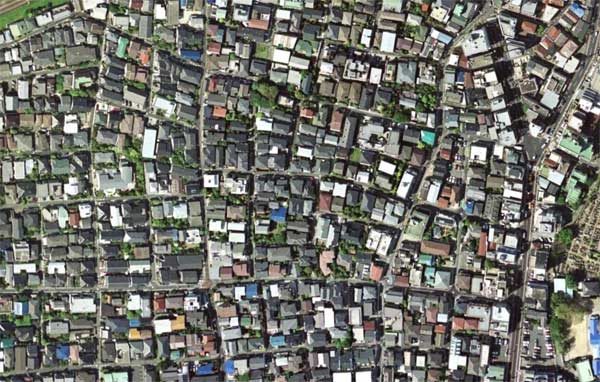
Satellite image of North Shimokitazawa, Tokyo
According to Kisho Kurokawa – a proponent of the metabolist architectural movement – “Western Culture…based on modernism, cannot be discussed without reference to its… [reliance on] dualism and binominal opposition … Dualism is the fundamental base of rationalism of the modern West. Spirit and form, freedom and necessity, good and evil, reaction and reform, art and science, intellect and emotion, humanity and nature, tradition and technology, capitalism and socialism, the individual and the whole…†(1998).
To this list of oppositions we can add city and village, modern and primitive, formal and informal, order and mess or “noiseâ€, as Kurokawa calls it in reference to Edgar Morin’s theory of noise. According to Kurokawa, in Japan, order includes noise. This is why Japanese cities are so tolerant to those forms of urbanism that Western notions of planning and urban order would call “irrationalâ€, “messy†or even “slummyâ€.
A city, says Kurokawa, “is also composed of complex and multilayered relations between an organized structure and the multivalent, heterogeneous elements that can be called noise. The city is always changing dynamically as it continually incorporates new elements. The open structure, or receptivity, is a special feature of the Japanese city and one it shares with other Asian cities.â€
Japanese cities have largely evolved as unplanned habitats in a gradual, incremental manner, which blurred many of the dichotomies at the root of Western conceptions of urban planning, including those between urban and rural. Greater Tokyo was developed over the small patches of farm land surrounding the ancient capital of Edo. This “pattern gives continuity with the past, [it is a] kind of patchwork [that] is the main urban replacement of an agricultural … landscape†(Shelton 1999).


Mixed-used, unplanned and crowded streets in Shimokitazawa, Tokyo.
Observers of Tokyo have for long admired its fluidity, its capacity to constantly reinvent itself and its ability of multiplying, juxtaposing, and overlaying functions. The history of Tokyo’s urban development in the past century is mainly one of incremental and spontaneous development of the parts assembling to form a whole. Modernizers have for long attempted to “rationalize†Tokyo, but were ultimately unable to cope with the extremely rapid demographic and urban expansion.
What made this process quite distinctive (from other Asian urban histories) is that official policies did not dismiss the city’s organic evolution. The mixed-use habitats, the village like social foundations of the urban neighbourhoods and the low-rise high density landscape emerged as a default urban model. A model that was not seen as an ideal one by planners, but which also was not considered illegitimate. In fact the government engineered projects related to sewage, water supply, electricity and roads to reach every corner of these neighbourhoods through private agencies. These agencies had to negotiate labyrinthine inner roads and unexpected twists and turns, an inevitable feature of such habitats, but eventually succeeded with ingenious and innovative use of technological inputs.
The “metabolist†approach theorized by Kisho Kurokawa describes the city as a living organism, an evolving system that is being produced from the bottom up, rather than from the top down. Each part of the city has its functions and sense of locality, and it integrates the whole in its own terms. We believe that there is much to be learned from the Tokyo “default†model, especially at a time when emergent cities throughout the world – facing unprecedented rates of urbanization – are battling with the idea of “modern urban formâ€. Broadening their conception of what a city can be would be the single biggest step central planners, bureaucrats, and policy-makers could make in the direction of improving the life of slum dwellers in developing cities, since it would allow for more sensible planning interventions.


From a local commercial lane to a tiny community pathway. A fractal pattern that repeats itself all over Tokyo. Photos taken in Ikebukuro, seconds away from 4 lanes roads and high rise buildings.
[...] today in Tokyo, a developed city through all definitions, we see street markets, low-rise high density structures, [...]
Pingback by URBZ@ TEDx Mumbai: The Presentation | URBZ — April 7, 2010 @ 5:37 pm